



Abstract
This study investigated the effects of perceived maternal and paternal acceptance, and parental power and prestige on university students’ psychological adjustment. The sample consisted of 315 students (17% males) ages 18 through 49 years (M = 23.35) from the United Kingdom. Measures used were the adult versions of Parental Acceptance–Rejection Questionnaire for mothers and fathers, the adult version of the Parental Power–Prestige Questionnaire, and the adult version of the Personality Assessment Questionnaire. Results showed significant positive correlations between perceived parental acceptance and students’ psychological adjustment, and between perceived maternal acceptance and power and prestige. Significant negative correlations were found between perceived paternal acceptance and power and prestige, and between perceived parental prestige and psychological adjustment as well as between a composite measure of power–prestige and students’ psychological adjustment. Results of hierarchical regression analyses showed that both perceived maternal and paternal acceptance made significant and unique contributions to students’ (both men’s and women’s) psychological adjustment. In addition, a composite measure of power–prestige significantly moderated the relationship between perceived maternal (but not paternal) acceptance and students’ psychological adjustment.
Introduction from the Editors
In order to avoid unnecessary redundancy across the data-oriented articles in this Special Issue, common issues relevant to all articles are discussed in Rohner’s Introduction (Rohner, 2014). These issues include an introduction to the International Father Acceptance-Rejection Project, of which this article is a part. Common issues also include description of measures used by authors, as well as data analytic procedures employed by all authors. Only information specific to this study is included here.
Method
Participants
Three hundred fifteen 18- through 49-year-old students (M = 23.35, SD = 7.01) were recruited from three universities in the United Kingdom. The majority of students (17% males) came from intact families. Ninety-two percent were born in the United Kingdom, 90% were of European descent, 95% spoke English as their primary language at home, 37% were Christian, and 53% were not religious.
Measures
Parental Power–Prestige Questionnaire, adult version (3PQ)
Alpha coefficients in this study were .83 for power, .92 for prestige, and .92 for a composite measure of power–prestige (Rohner, 2011). The data were deemed appropriate for principal components analysis (PCA) due to a participant-to-item ratio greater than 10:1 (Nunnally, 1978), a large number of intercorrelations of .30 and above between items, a Kaiser–Meyer–Oklin value of .93 which exceeded the recommended value of .60 (Kaiser, 1974), and a significant result for Bartlett’s test of sphericity (Bartlett, 1954). PCA (with Varimax rotation) extracted one component with an eigenvalue of 6.01, which explained 60.09% of the variance, and had loadings ranging from .63 to .88. The correlation between the power and prestige subscales (r = .77, p < .001) was above .75, the level recommended as a prerequisite for combining related subscales into a composite scale (Kline, 1998). Therefore, the composite power–prestige scale was used in all subsequent analyses.
Parental Acceptance–Rejection Questionnaire, short form (adult PARQ: Father and mother versions)
Alpha coefficients in this study were .97 for both maternal and paternal acceptance (Rohner, 2005).
Personality Assessment Questionnaire (adult PAQ)
In this study, coefficient alpha for the total PAQ score was .96 (Rohner & Khaleque, 2005). Hereafter, total PAQ scores are referred to as psychological adjustment.
Education level
A 4-point scale was used to code level of education, corresponding to the credit levels used in higher education in the United Kingdom: 1 to 3 = levels 4 to 6 (undergraduates); 4 = level 7 (postgraduate).
Gender Inequality Scale (GIS)
The index of gender inequality was calculated from a sample of 102 respondents (34.3% men; M age = 46.04; SD = 9.43, ranging in age from 27 through 66 years; Rohner, 2012). The sample consisted of participants who were academic staff at two universities where the student data were collected. The mean GIS score was 10.54 (SD = 3.24). Sex differences in the Gender Inequality Scale were statistically significant with females scoring higher than males (t = 3.93, p < .001), suggesting that—although these participants rated the United Kingdom to be egalitarian overall—females perceived more gender inequality than did males. Coefficient alpha for the GIS in the United Kingdom was .87.
Procedure
Ethical approval for the study was obtained from the University of Chester. An online version of the questionnaire packet was created, and links to it were distributed via the Virtual Learning Environment and/or email distribution lists at each university.
Results
Table 1 shows descriptive statistics for parental acceptance, power–prestige, and psychological adjustment. Because there were no significant gender differences in any of the major variables in this study, all analyses pooled men and women into a global sample. These U.K. students generally perceived their mothers and fathers to be accepting, with mothers perceived to be more accepting than fathers. Furthermore, self-reported psychological adjustment showed that the students generally rated themselves as being fairly well adjusted. Table 1 also shows the mean power–prestige score of 25.76, suggesting that the students tended to perceive their parents as being approximately equal in power and prestige.
Descriptives and Gender Differences in Measures of Perceived Maternal and Paternal Acceptance, University Students’ Psychological Adjustment, Interpersonal Power–Prestige, and Gender Inequality.
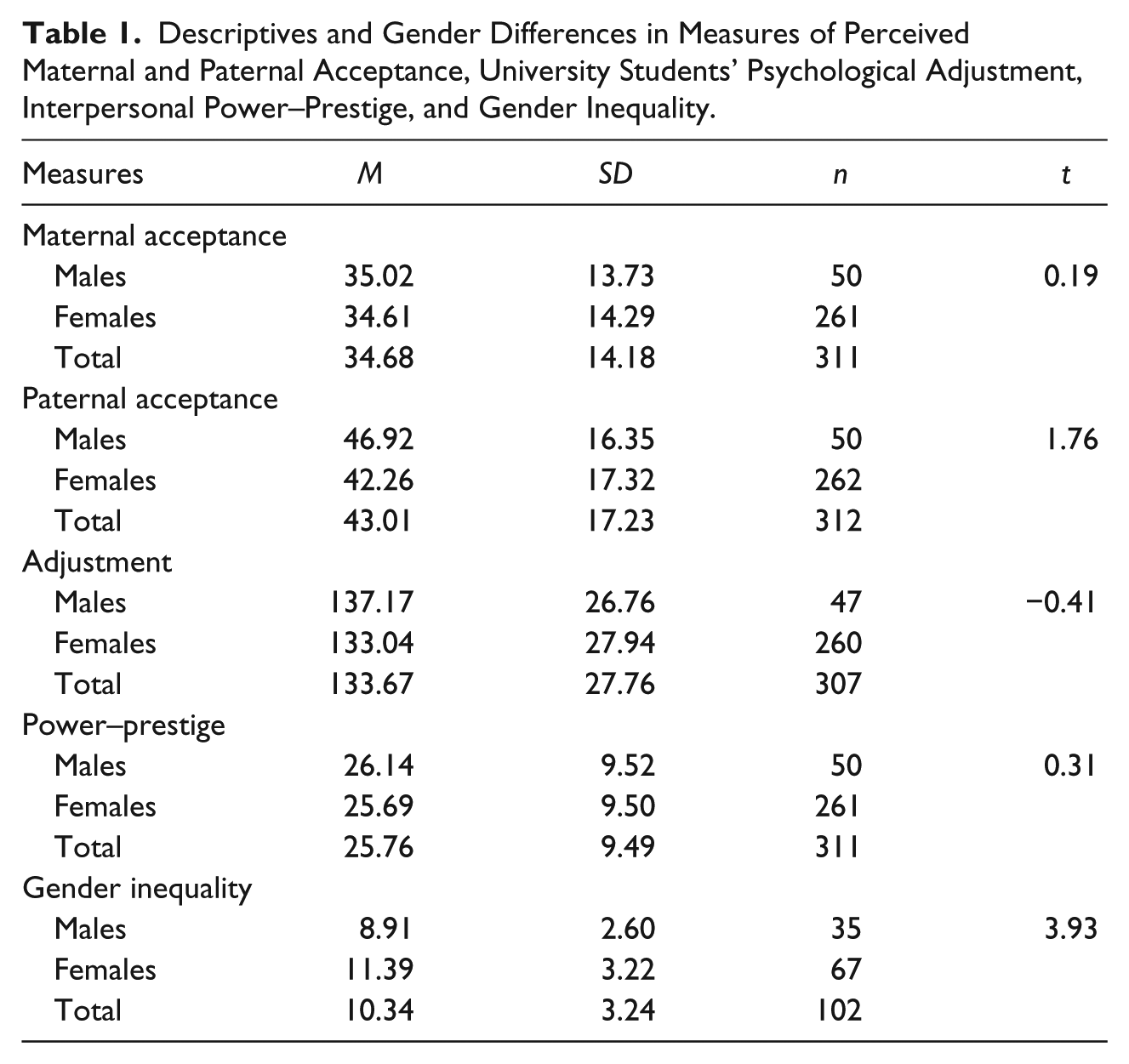
Table 2 displays intercorrelations between perceived parental acceptance, power–prestige, and students’ psychological adjustment. As predicted, there were strong relationships between maternal and paternal acceptance and students’ adjustment. Table 2 also shows significant negative correlations between paternal acceptance and power–prestige, but significant positive correlations between maternal acceptance and power–prestige. These correlations indicate that parents who were perceived to be accepting were also more likely to be perceived as holding power–prestige within the family. Finally, the table shows that power–prestige was negatively correlated with students’ psychological adjustment. This correlation suggests that the more powerful and prestigious fathers were perceived to be relative to mothers, the better was the students’ adjustment.
Correlations Between Maternal and Paternal Acceptance, Interpersonal Power and Prestige, and University Students’ Psychological Adjustment (N = 315).

p ≤ .01.
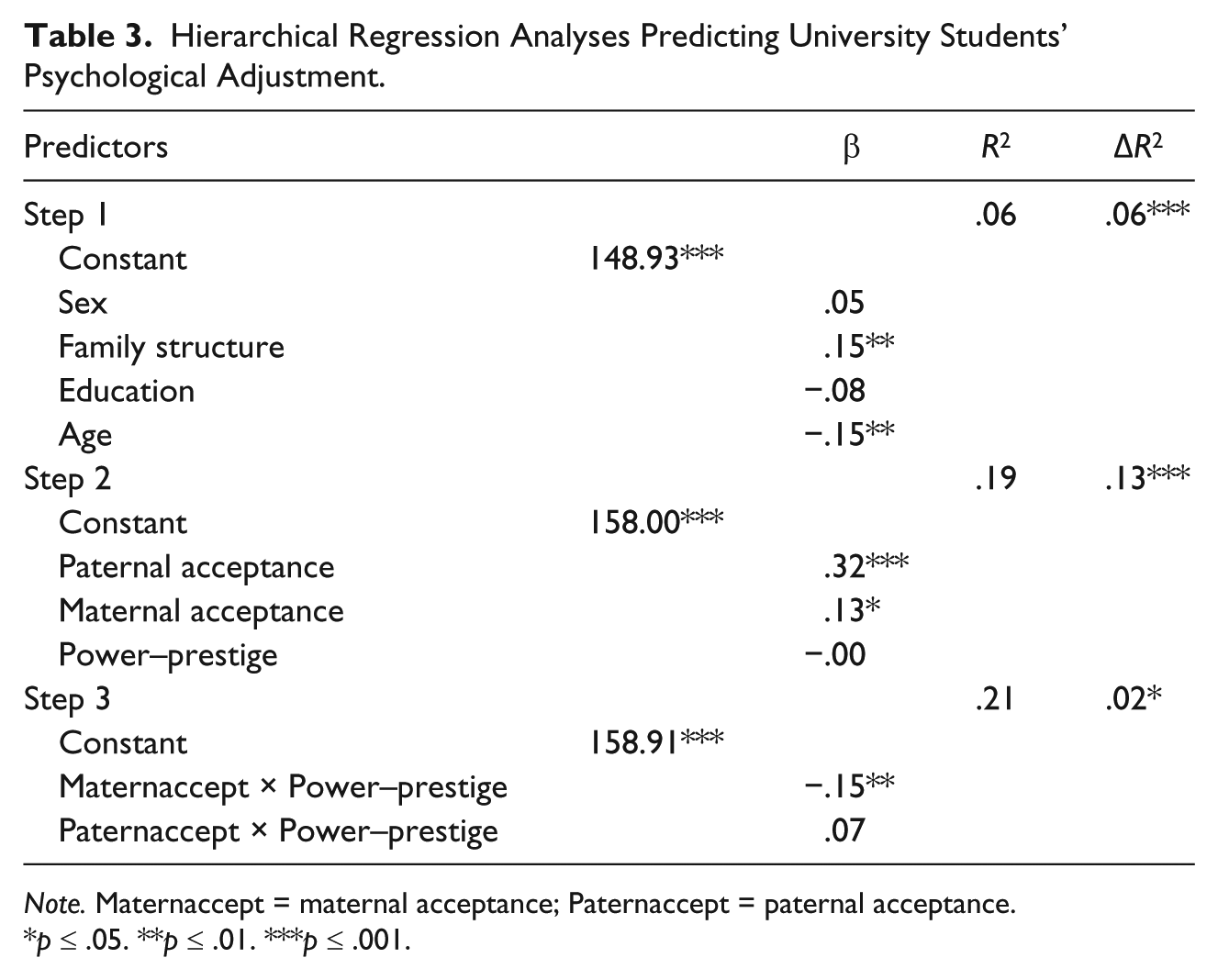
Following the correlational analyses, hierarchical multiple regression was used to test whether power–prestige moderated relationships between paternal acceptance and adjustment, and between maternal acceptance and adjustment (Cohen & Cohen, 1983). Psychological adjustment was the dependent variable. Table 3 shows that age, gender, level of education, and family structure (intact = 0 and other family structures = 1) were entered as control variables in Step 1; paternal and maternal acceptance and power–prestige were entered as the main predictors in Step 2; and, the two-way interaction terms, which were products of the main predictors (Paternal acceptance × Power–prestige, Maternal acceptance × Power–prestige), were entered in Step 3. To minimize multicollinearity between the main predictors and the interaction terms, the main predictors (Step 2) were standardized as z scores, and the interaction terms were computed using these standardized variables (Step 3; Aiken & West, 1991). The following results are based on these standardized variables and their products.
Hierarchical Regression Analyses Predicting University Students’ Psychological Adjustment.
Note. Maternaccept = maternal acceptance; Paternaccept = paternal acceptance.
p ≤ .05. **p ≤ .01. ***p ≤ .001.
Table 3 shows that the effect of adding the control variables in Step 1was significant, and accounted for 6% of the variance in students’ adjustment. Age and family structure contributed significantly and uniquely to the model, accounting for 2.8% and 2.7% of the variance, respectively. The effect of adding the main predictors in Step 2 was also significant, and accounted for a further 13% of the variance. Paternal and maternal acceptance both made significant and unique contributions, which accounted for 11.30% and 4.40% of the variance in students’ psychological adjustment, respectively. These results indicated that paternal acceptance was a stronger predictor of adjustment than maternal acceptance. In Step 3, adding the interaction terms made a small but statistically significant contribution of 2% to the variance in adjustment, with Maternal acceptance × Power–prestige making a significant and unique contribution, accounting for 1.5% of the variance in adjustment. Because the R2 change (ΔR2) in Step 3 was significant, and because the interaction term Maternal acceptance × Power–prestige significantly predicted psychological adjustment, we conclude that power–prestige moderated the relationship between maternal acceptance and adjustment. However, power–prestige did not moderate the relationship between paternal acceptance and adjustment.
To understand more clearly what this interaction meant, we followed recommendations by Aiken and West (1991). We plotted the interaction between power–prestige and maternal acceptance in relation to psychological adjustment. We also tested the statistical significance of simple slopes to probe the interaction. Initially, we tested the association between perceived maternal acceptance and students’ psychological adjustment at +1 SD power–prestige, mean power–prestige and −1 SD power–prestige, However, under the −1 SD power–prestige condition (confidence interval [CI] = [0.50, 1.20])—where mothers were perceived to hold more power–prestige in the family than fathers, and the +1 SD power–prestige condition (CI = [0.16, 0.67])—where fathers were perceived to have more power–prestige than mothers (CI = [0.16, 0.67]), the significant results did not confirm the interaction. All CIs were at p < .05. Because the interaction was not confirmed at these levels of power–prestige, we examined simple slopes at −2 SD power–prestige and +2 SD power–prestige (see Figure 1). We found −2 SD power–prestige was outside the range of the data, but under the mean power–prestige condition—where there was a relatively equal sharing of power–prestige between mothers and fathers—Beta was .63 (p < .001), and under the +2 SD power–prestige condition—where fathers were perceived to hold the most power–prestige—Beta was .20 (p = .29). Thus, perceived maternal acceptance had a significant effect on students’ psychological adjustment when mothers were perceived to have the most power–prestige and when it was shared equally between mothers and fathers. However, when fathers were perceived to hold the most power–prestige relative to mothers, the effect of maternal acceptance on students’ adjustment was not significant.

Maternal acceptance predicting students’ adjustment at three levels of parental power–prestige.
Discussion
This study focused on U.K. university students’ retrospective reports of perceived parental acceptance and parental power–prestige during childhood. Results suggest that the students remember their mothers and fathers to have been accepting, with mothers being more accepting than fathers. In addition, students also remember their mothers and fathers to have been approximately equal in the power and prestige they held within the family. These findings support those of a previous study of U.K. students (Lloyd, Moore, & Rohner, 2011). Beyond this, self-reports of psychological adjustment suggest that the students are fairly well adjusted.
As predicted, paternal and maternal acceptance are positively correlated with adjustment. This conclusion is supported by the results of hierarchical multiple regression, which identified both maternal and paternal acceptance as independent predictors of adjustment—with paternal acceptance being the stronger of the two predictors. These findings provide further support for parental acceptance–rejection theory’s (PARTheory’s) central postulates concerning relationships between parental acceptance and offspring adjustment (Khaleque & Rohner, 2002; Rohner & Khaleque, 2010).
The primary objective of this study was to test the hypothesis that parental power–prestige moderates the contributions of maternal and paternal acceptance to students’ adjustment. Hierarchical multiple regression showed that the interaction between parental power–prestige and maternal acceptance has a significant effect on student adjustment, but the effect of the interaction between power–prestige and paternal acceptance on adjustment is not significant. The U.K. study therefore provides only partial support for the hypothesis.
By probing the significant interaction between power–prestige and maternal acceptance, we found that the effects of maternal acceptance on adjustment are significant at three levels of power–prestige: −1 SD, mean, and +1 SD. However, at +2 SD power–prestige, the effects of maternal acceptance on students’ adjustment are not significant. Analysis of simple slopes therefore shows that the effects of maternal acceptance on adjustment intensifies the more power and prestige mothers are perceived to have relative to fathers. Alternatively, one could say that the effects of maternal acceptance on student adjustment weaken as the proportion of power–prestige held by fathers increases, until there is no significant effect when fathers are perceived to hold the power–prestige. These findings support Carrasco and Rohner’s (2012) conclusions from Spain where maternal acceptance made the greatest contribution to offspring adjustment in families where mothers held the most power–prestige, but paternal acceptance made a greater contribution to adjustment than maternal acceptance in families where fathers held the most power–prestige.
Several limitations of this study should be noted. The limitations of using retrospective measures, and reliance on self-reports (i.e., the issue of shared method variance) have been addressed elsewhere (Rohner & Khaleque, 2010). Another limitation concerns the bipolar nature of the scale used to measure parental power–prestige. This scale anchors mothers at the lower end of possible scores and fathers at the higher end. Mid-range scores signify shared power–prestige between mothers and fathers. Although this conceptualization of parental power and prestige has brevity—and even though the 3PQ has excellent internal consistency-reliability and construct validity—the measure does have the disadvantage of sometimes making interpretations problematic about the independent influence of maternal versus paternal power and prestige.
In conclusion, the major finding of this study is the fact that the effects of remembered maternal acceptance on students’ current adjustment intensifies insofar as mothers are perceived by students to have a greater proportion of power–prestige within the family than fathers, but maternal acceptance has no significant effect on students’ adjustment when fathers are perceived to hold the power–prestige. These findings have implications for social policy in that they suggest complex interrelationships between parental influences, and they support current thinking about involving both parents in children’s lives (Centre for Social Justice, 2011). Future research should consider power–prestige as a moderator of parental acceptance–rejection and other outcomes such as depression. Future research should also identify factors associated with gaining power and prestige within the family.
Footnotes
Declaration of Conflicting Interests
The author(s) declared no potential conflicts of interest with respect to the research, authorship, and/or publication of this article.
Funding
The author(s) received no financial support for the research, authorship, and/or publication of this article.