



Abstract
This article explored relationships between perceived maternal and paternal acceptance, parental power and prestige, and young adults’ psychological adjustment in Poland. The sample consisted of 200 college students (38% men) ages 20 through 22 (M = 21.10). The measures used were the child versions of the Parental Acceptance–Rejection Questionnaire for mothers and fathers, the youth version of the Parental Power–Prestige Questionnaire, and the adult version of the Personality Assessment Questionnaire. Results showed that maternal and paternal acceptance were significantly and positively correlated with offspring’s psychological adjustment. Furthermore, fathers’ high power and prestige were positively correlated with women’s psychological adjustment, whereas mothers’ high power was positively correlated with men’s adjustment. However, hierarchical regression analyses showed that only paternal (but not maternal) acceptance was a unique predictor of women’s psychological adjustment as well as of men’s adjustment. The regression analysis also suggests that the less power–prestige fathers had relative to mothers (beyond the point where both parents were perceived to be approximately equal in power and prestige), the better was men’s adjustment. No significant moderating effects were found.
Keywords
Introduction from the Editors
In order to avoid unnecessary redundancy across the data-oriented articles in this Special Issue, common issues relevant to all articles are discussed in Rohner’s Introduction (Rohner, 2014). These issues include an introduction to the International Father Acceptance-Rejection Project, of which this article is a part. Common issues also include description of measures used by authors, as well as data analytic procedures employed by all authors. Only information specific to this study is included here.
Method
Participants
Data were collected in Poland from 200 university students ages 20 through 22 years (M = 21.10, SD = 0.81) living in Bialystok, a city located in the northeast part of the country with a population of 294,399 people. Thirty-eight percent of the respondents were men. All were of Polish nationality, and 90% were Roman Catholic. Most participants were unemployed, and had never been married. Only those who grew up in intact nuclear families (or larger family units)—with their mother and father in residence—were included in the study.
Measures
All participants responded to Polish translations of four self-report questionnaires, along with the demographic form. Each of these is described next.
Personal Information Form (PIF)
The PIF (Rohner, 2005) was used to elicit information about respondents’ age, sex, ethnicity, religious beliefs, level of education, occupational status, and marital status.
The Parental Power–Prestige Questionnaire (3PQ)
The two subscales of interpersonal power and prestige showed good reliability, with Cronbach’s alphas of .84 for interpersonal power and .90 for prestige. When analyzed using principal components analysis with Varimax rotation, the two subscales formed two clear factors with factor loadings ranging from .80 to .60 on the power factor and from .87 to .64 on the prestige factor (with no cross-factor loadings). Because the correlation between the power and the prestige scores was significant and high for the total sample (r = .77, p < .001), a summed interpersonal power–prestige variable was created. This correlation met the criterion of r ≥ .75 suggested by Kline (1998) for combining two highly correlated variables into a single composite variable. The total score also showed good reliability, with Cronbach’s alpha of .94.
Parental Acceptance–Rejection Questionnaire (Child PARQ: father version and mother version, short forms)
The overall measure was reliable, with Cronbach’s alphas of .93 for the mother PARQ (Rohner, 2005) and .95 for the father PARQ.
Personality Assessment Questionnaire (Adult PAQ)
The overall measure was reliable, with Cronbach’s alpha of .93 (Rohner & Khaleque, 2005).
Gender Inequality Scale (GIS)
The gender inequality index (Rohner, 2012) was calculated using data gathered from 71 adult Poles of diverse occupational status (36 women and 35 men, Mage = 35.45, SD = 10.18). The scale showed good reliability with Cronbach’s alpha of .83. The mean for the scale was 12.58 (SD = 3.68), indicating moderate gender inequality in Poland. Sex differences in the gender inequality index were not significant, t(69) = .78, p = .44, Cohen’s d = 0.19.
Procedure
A standardized data-collection procedure was used. This included describing the research project to students, assuring them of anonymity and confidentiality, and receiving signed informed consent. Students then completed the questionnaire packet during class time.
Results
As can be seen in Table 1, students tended to perceive their mothers and fathers to be quite loving/accepting. However, women perceived both parents to be significantly more accepting than did men. Similarly, both men and women tended to self-report fair psychological adjustment, though women self-reported somewhat better adjustment than did men. Finally, both men and women tended to see their parents as having approximately equal prestige, but women saw their mothers as having significantly more interpersonal power than did men—who saw both parents to be approximately equal in this respect. Because of these gender differences, all further analyses were conducted separately by sex.
Descriptive Statistics and Gender Differences in Measures of Perceived Maternal and Paternal Acceptance, Young Adults’ Psychological Adjustment, Interpersonal Power and Prestige, and Gender Inequality.

p < .05. **p < .01.
Table 2 shows that maternal and paternal acceptance were significantly correlated with both men’s and women’s psychological adjustment. In addition, both parental power and prestige were negatively correlated with women’s adjustment. But interpersonal power was positively correlated with men’s adjustment. These correlations reveal that the more powerful and prestigious women perceived their fathers to be relative to mothers, the better was women’s psychological adjustment. However, the more powerful men perceived their mothers to be relative to their fathers, the better was their adjustment. Finally, power and prestige correlated negatively with both men’s and women’s perceptions of paternal acceptance, but did not correlate with maternal acceptance. These results indicate that the more powerful and prestigious fathers were perceived to be relative to mothers, the more accepting both sons and daughters perceived fathers to be.
Correlations Between Maternal and Paternal Acceptance, Interpersonal Power and Prestige, and Young Adults’ Psychological Adjustment.
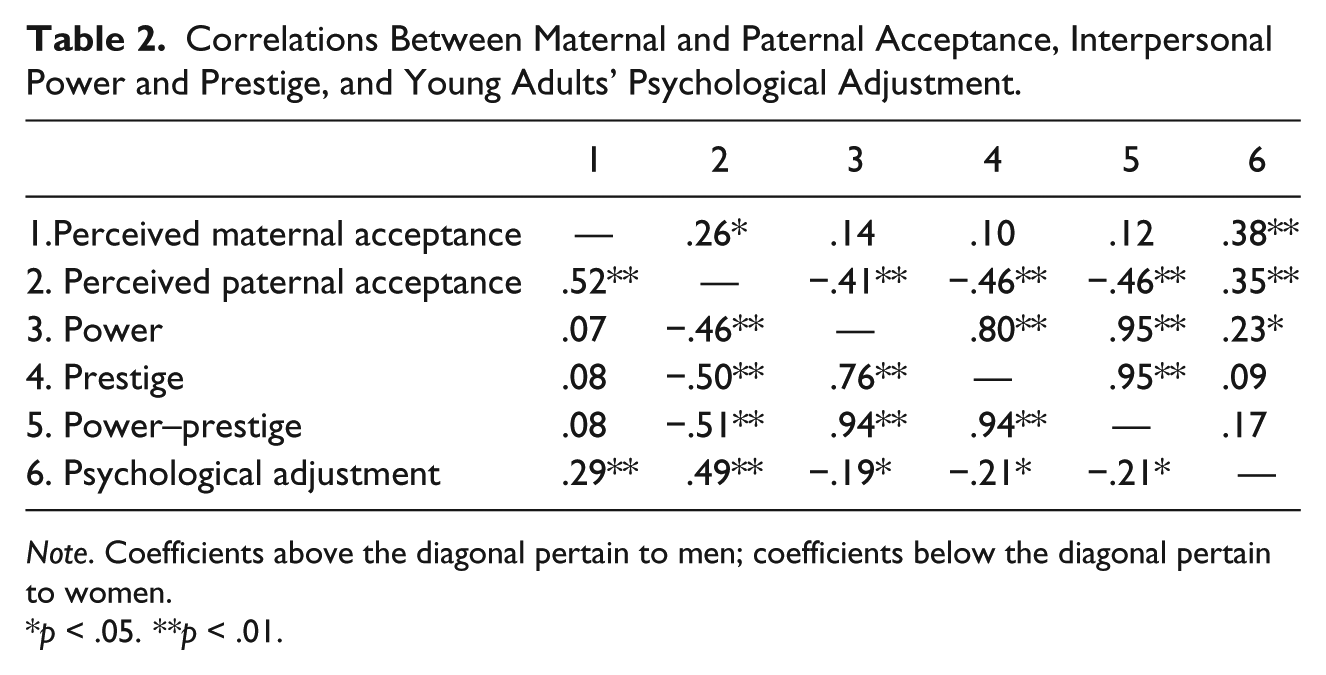
Note. Coefficients above the diagonal pertain to men; coefficients below the diagonal pertain to women.
p < .05. **p < .01.
To test whether parental power–prestige moderated the relation between perceived maternal or paternal acceptance and students’ psychological adjustment, a hierarchical multiple regression analysis was carried out separately for men and women. Maternal and paternal acceptance were entered in Step 1. So too was the composite variable of power–prestige. Major interaction terms were included in Step 2. Results of analyses are shown in Table 3. This table shows that perceived paternal (but not maternal) acceptance uniquely predicted significant portions of the variance in the psychological adjustment of both men and women. In addition, the composite power–prestige variable also uniquely predicted a significant portion of the variance in men’s (but not women’s) adjustment. The positive beta seems to reveal that the less power–prestige fathers had relative to mothers the better was men’s adjustment. Power–prestige was not a significant moderator of the relation between perceived parental acceptance and psychological adjustment for either men or women. Finally, perceived paternal acceptance and power–prestige explained a total of 30% of variance in men’s adjustment and 24% of the variance in women’s adjustment.
Hierarchical Regression Analyses Predicting Young Adults’ Psychological Adjustment.

Note. Maternaccept = maternal acceptance; Paternaccept = paternal acceptance; PP = power–prestige.
p < .05. **p < .01.
Discussion
Results of this study show that young men and women in Poland tend to perceive their mothers and fathers to be accepting. Furthermore, men and women report fair psychological adjustment. Results of the correlational analyses reveal that both maternal acceptance and paternal acceptance are positively related to young adults’ (both men’s and women’s) psychological adjustment. This result is consistent with the outcome of a great many studies conducted all over the world. These studies reveal that parental acceptance is universally associated with offspring’s positive adaptation and functioning (Rohner, Khaleque, & Cournoyer, 2012). The present study also indicates that women assess their mothers as having somewhat more interpersonal power–prestige than fathers. But men perceive their mothers and fathers to be approximately equal in power–prestige.
Women’s perception of maternal power and prestige in the family is consistent with Boski’s (2006) view that Polish culture can be described by Humanism, a value dimension referring, among others, to the high status of women and femininity in Poland. Throughout the 19th and the beginning of the 20th century, Polish men were killed or imprisoned in large numbers, whereas women were left to raise children and sustain families. This led to the emergence of a model of Matka Polka (the Polish Mother), a woman who was strong, selfless, and played a central role in the family (Wejnert & Djumabaeva, 2004). This image of the Polish woman, however, is not entirely consistent with the fact that the GIS used here shows that both young men and women today tend to see a slight leaning toward gender inequality disfavoring women.
Moreover, the image is contradicted somewhat by the fact that regression analyses here reveal that only perceived paternal acceptance (not maternal acceptance) is a unique predictor of young men’s and women’s psychological adjustment. This result is consistent, however, with results of other studies that have shown that perceived paternal acceptance is often a better predictor of offspring’s psychological functioning than is maternal acceptance (Flouri & Buchanan, 2003; Gecas & Schwalbe, 1986; Khaleque & Rohner, 2011; Rohner & Veneziano, 2001). Furthermore, the regression analyses here reveal that high paternal power–prestige makes an independent and positive contribution to men’s psychological adjustment, but it does not predict women’s adjustment. Interpersonal power–prestige is not a significant moderator, though, of the relationship between parental (either maternal or paternal) acceptance and the psychological adjustment of either men or women in Poland.
These results should be interpreted in the context of the Polish parenting model, which is mother-centered. That is, even though Polish fathers have become somewhat more involved in childrearing than was once true, mothers still perform most of the household and childcare duties. The higher engagement of Polish mothers than fathers in childrearing may lead to the situation where mothers’ love, care, and engagement are taken for granted by their children, and thereby become relatively unnoticed, whereas fathers’ love, care, and engagement are perceived as something more special. Thus, offspring may be motivated to pay more attention to their fathers’ love-related behaviors than to their mothers’.
There are several potential threats to the validity of the findings of this study. For example, the sample was not representative of all young adults in Poland in that only university students from intact families were investigated. Moreover, the correlational design does not allow us to draw conclusion about the direction of influence between parental behaviors and student outcomes. Finally, participants’ self-reports on all measured indicators may have strengthened relationships among the variables.
Despite these limitations, the study shows that the gender of the parent needs to be taken into consideration in research on the relationship between parental acceptance/love and offspring’s psychological adaptation and functioning. In Poland, as in many other countries, offspring’s perceptions of their fathers’ love tend to be more important for offspring’s psychological adjustment than mothers’ love. This conclusion underlines the need for further investigation of the potential psychological and cultural factors that might account for the greater importance of fathers’ love than mothers’ love in cultures like Poland, which are characterized by high status of mothers and femininity in the family.
Footnotes
Declaration of Conflicting Interests
The authors declared no potential conflicts of interest with respect to the research, authorship, and/or publication of this article.
Funding
The authors received no financial support for the research, authorship, and/or publication of this article.