



Abstract
Compared to European Americans, East Asians are more reluctant to seek social support when dealing with stressful events. The purpose of this study is to test three possible explanations of these cultural differences. In addition to examining both harmony seeking and rejection avoidance (two facets of interdependence reflecting relationship concerns) as possible explanations, we propose a novel explanation, namely that sense of contribution (i.e., the degree to which one contributes to other people’s well-being) may be an important mediator for explaining cultural differences in support seeking. A survey was conducted on adults living in Japan and the U.S. Results revealed that Japanese less often rely on social support, and sense of contribution significantly mediates the association between culture and support seeking. In contrast, the mediating role of both harmony seeking and rejection avoidance was not supported. The results indicate that cultural differences in support seeking may be more adequately accounted for by sense of contribution than relationship concerns.
It has been frequently highlighted that attitudes toward seeking help and support from other people differ between cultures. Previous studies show that East Asians and Asian Americans are more reluctant to seek social support compared to European Americans (Kim et al., 2006; Taylor et al., 2004). However, the literature is yet inconclusive pertaining to the reasons behind these cultural differences. The purpose of this study is to clarify why people from Asian cultures hesitate to seek social support, by revisiting the concept of relationship concerns, and putting forward a novel explanation based on sense of contribution.
First, we aim to clarify the role of two facets of interdependence, harmony seeking and rejection avoidance, in explaining Japan—U.S. cultural differences in social support seeking. In previous research (Taylor et al., 2004), harmony seeking and rejection avoidance have been investigated together as forms of “relationship concerns,” but we propose that they should be distinguished from one another, and their explanatory power should be tested separately. Our prediction is that rejection avoidance, but not harmony seeking, will significantly mediate cultural differences in social support seeking. This way, we aim to show that the reason behind Japanese’ reluctance to seek support is not the desire to maintain harmonious relationships with others, but the fear of being negatively evaluated.
Second, we propose a novel explanatory mechanism of cultural differences in social support seeking: sense of contribution. We define sense of contribution as the subjective feeling of contributing to other people’s well-being, and expect it to be a stronger mediator of cultural differences in support seeking than rejection avoidance, as sense of contribution is more closely related to a person’s ability to repay for received favors, which is a major concern in cultures where exchange norms are prevalent (including both Japan and the U.S.). While extending previous research focusing on aspects of interdependence, this study is one of the first to put to the test a novel explanation based on sense of contribution. Unlike aspects of interdependent self-construal such as harmony seeking and rejection avoidance, which are strongly embedded in one’s culture and difficult to intervene upon, sense of contribution may be more easily targeted in interventions, and therefore, increased. This way, we aim to offer a hint on how to encourage people from Eastern cultures to seek social support when encountering difficulties.
Cultural Differences in Social Support Seeking
Previous research has shown that East Asians and Asian Americans are more reluctant to seek social support than Euro-Americans (Kim et al., 2006; Taylor et al., 2004). This cultural difference has been found both in regard to seeking support from close others (e.g., siblings, friends, and neighbors) as well as seeking help from professionals (e.g., clinical psychologists and counselors; Mojaverian et al., 2013). Furthermore, East Asians and Asian Americans have more negative perceptions of support seeking, considering social support seeking as a less effective or appropriate method of coping with stress (Kim et al., 2006; Miller et al., 2017; Mortenson et al., 2009; Wang et al., 2010). East Asians also anticipate feeling more shame and guilt as a result of seeking support (Ishii et al., 2017), and benefit less from receiving explicit support from others (Taylor et al., 2007). Overall, the results of previous studies converge in supporting the idea that East Asians and Asian Americans are less inclined to seek social support compared to European Americans.
In this study, comparing Japan and the United States, we aim to replicate previous research showing that support-seeking tendencies differ between these two cultures. In line with the research reviewed above, we expect Japanese to seek social support less than U.S. participants, thus leading to the following hypothesis.
Hypothesis 1. There are significant cultural differences between Japan and the United States in social support use, the latter relying on social support as a stress-coping method more than the former.
Possible Explanations of Cultural Differences in Social Support Seeking
In the next three sections we discuss the theoretical underpinnings for Hypotheses 2 and 3. The first section reviews previous theorizing and research on interdependence and relationship concerns, the second discusses harmony seeking and rejection avoidance, two facets of interdependence, and the third section introduces our concept of sense of contribution.
Interdependence and relationship concerns
Some studies investigating cultural differences in social support seeking have focused on the role of relationship concerns, a comprehensive construct referring to harmony seeking and fear of negative evaluation (Kim et al., 2006; Taylor et al., 2004). Relationship concerns could explain the observed cultural differences in social support seeking, because they inhibit social support seeking, and are stronger in interdependent cultures, such as Japan and China.
Cultures differ in the norms and expectations regarding how individuals should relate to one another, the goals they pursue, as well as the way their self is structured (Markus, 2016; Markus & Kitayama, 1991). Markus and Kitayama (1991) proposed the theoretical framework of self-construal to explain cultural differences in cognition, emotion and behavior. They make the distinction between the independent self-construal, more prevalent in Western cultures, and the interdependent self-construal, which characterizes Eastern cultures. According to their theory, people from East Asian cultures, in which the dominant view of the self is interdependence, are connected and bound to others, place more importance on pursuing group versus personal goals, and are more concerned about disrupting social harmony or losing face, compared to people from independent cultures, such as the United States (Markus & Kitayama, 1991). In cultures where the interdependent view of the self is prevalent (i.e., Japan), expressing one’s problems to others may disrupt social harmony, increasing the risk of being negatively evaluated by other members of the group. This tendency makes people from interdependent cultures more sensitive to relationship concerns than those from independent cultures (i.e., the United States), leading to more reluctance in seeking support (Kim et al., 2006; Taylor et al., 2004).
In an effort to bring empirical evidence supporting the theoretical prediction that relationship concerns explain cultural differences in social support, Taylor and her colleagues (Taylor et al., 2004) conducted focus-groups with Asian Americans and European Americans, exploring the reasons for the lesser use of social support seeking as a coping method among individuals with Asian cultural backgrounds. Five explanations were generated by participants: desire to maintain group harmony, avoiding making the problem worse by telling others, fear of criticism, desire to save face, and the belief that people should be self-reliant. In subsequent studies, researchers directly measured these relationship concerns, and presented evidence suggesting that they mediate the association between culture and social support use (Kim et al., 2006; Taylor et al., 2004). Altogether, these studies empirically support the prediction that relationship concerns, as a comprehensive construct including harmony seeking, as well as fear of criticism and loss of face, are higher in interdependent cultures and could explain interdependent individuals’ reluctance to seek social support from others.
Although previous studies looked at relationship concerns comprehensively, including both concerns with harmony maintenance and fear of criticism under the same conceptual umbrella, subsequent research investigating reasons for cultural differences in social support seeking highlighted the need for a more nuanced perspective. One study focused on the mediating role of the interdependent self-construal. Because high relationship concerns are representative of interpersonal relationships in interdependent cultures (Markus & Kitayama, 1991), researchers investigated whether the interdependent self-construal could be a significant mediator of the association between culture and social support seeking (Mortenson et al., 2009). As people from interdependent cultures value harmony, group goals, and accommodation (facets of the interdependent self-construal), they might be concerned about disrupting harmony by asking for support (relationship concerns), therefore seeing social support seeking as a less appropriate method to cope with stress. Researchers measured interdependence through items measuring relationship harmony and priority of group goals, but results failed to support the mediating role of the interdependent self-construal, as self-construal was not related to support seeking in one study, and to culture in a second one (Mortenson et al., 2009). These results cast doubt on the conclusion that cultural differences in social support seeking could be due to cultural differences in interdependent characteristics such as priority of harmony.
A subsequent study (Wang et al., 2010) suggests the need to distinguish between different types of relationship harmony: emotional harmony (self-restraint of emotional expression with the purpose of not burdening others), and social harmony (regulation of behavior and accommodation). Their results suggested that emotional harmony, but not social harmony, mediated cultural differences in social support seeking. Together, these studies highlight the importance of a clearer definition of relationship concerns and interdependence, as well as a finer distinction between their different facets.
Two facets of interdependence: Harmony seeking and rejection avoidance
In previous studies investigating the role of relationship concerns (Kim et al., 2006; Taylor et al., 2004), we can see a mix of altruistic explanations (desire not to burden others, i.e., relationship harmony), and self-defensive explanations (desire not to lose face or be criticized, i.e., rejection avoidance). However, cultural psychologists argue for the need to distinguish between two facets of interdependence: harmony seeking and rejection avoidance.
First, the assumption that relationship harmony is the core of interdependence, and stands behind important cultural differences in the behavior and motivation of Western and East Asian people has been challenged by researchers. Reviewing several studies which showed that there are actually few differences in the importance placed on relationship harmony by Westerners compared to East Asians (e.g., Levine et al., 2003), Hashimoto and Yamagishi (2013, 2016) draw attention to the fact that equating interdependence with harmony seeking may be inadequate. They propose that aside from harmony seeking, rejection avoidance is an important, yet frequently overlooked, 1 aspect of interdependence, which may be more strongly influenced by culture than harmony seeking. Accordingly, they constructed a scale that taps both harmony seeking and rejection avoidance, as two different facets of interdependence, and showed that although there are significant cultural differences between United States participants and Japanese in rejection avoidance (the latter having higher scores), participants from the two cultures do not differ in harmony seeking (Hashimoto & Yamagishi, 2013). In fact, their later investigation showed that participants from the United States are actually higher on harmony seeking than Japanese (Hashimoto & Yamagishi, 2016).
The authors explained these surprising cultural differences (higher harmony seeking in the U.S.) by bringing into discussion the importance of relationship maintenance in cultures in which social relationships are more fluid (Hashimoto & Yamagishi, 2016). In high mobility cultures, such as the United States, forming new relationships is relatively easy (as is dissolving old relationships), so people must put more effort into maintaining their relationships (therefore the high harmony seeking tendency). In contrast, in low mobility cultures such as Japan, relationships are more stable, so people put less effort into relationship maintenance; in contrast, forming new relationships is difficult, so avoiding social exclusion becomes critical (therefore the high rejection avoidance tendency). Previous studies have shown that self-disclosure is higher in mobile cultures such as the United States, because Americans strategically use self-disclosure to form and maintain relationships, and lower in low-mobility cultures such as Japan, because Japanese are concerned with not gaining a negative reputation by disclosing personal information, and thus being rejected by others (Schug et al., 2010). Social support is also a form of self-disclosure that can be strategically used in different ways by people of different cultures. These results challenge the claim that Asians prioritize the maintenance of relationship harmony more than European Americans, casting doubt on the validity of harmony seeking as the explanatory factor of cultural differences in social support use. In contrast, rejection avoidance may be a better predictor of the negative attitudes toward social support seeking in Asian cultures. However, previous studies have either failed to distinguish between harmony seeking and rejection avoidance, including both under the umbrella of “relationship concerns” (Ishii et al., 2017; Kim et al., 2006; Taylor et al., 2004), or have failed to include rejection avoidance alongside harmony seeking as a possible mediating factor of cultural differences in support seeking (Wang et al., 2010).
Guided by the duality of interdependence framework discussed above (Hashimoto & Yamagishi, 2013, 2016), in this study we distinguish between harmony seeking and rejection avoidance as two possible explanatory mechanisms of the cultural differences in social support use, and investigate their mediating effects simultaneously. By doing so, we aim to clarify whether the reason why people from Asian cultures are more reluctant to seek social support lies in their desire to maintain harmonious relationships with others (harmony seeking), or in their fear of being criticized and rejected by others (rejection avoidance). Based on the literature reviewed so far (Hashimoto & Yamagishi, 2016), we expect rejection avoidance to be higher among Japanese than Americans, and to significantly mediate the association between culture and social support use. More specifically, we expect Japanese to use social support less than people from the United States because they are more concerned with being negatively evaluated by others (high rejection avoidance), and rejection avoidance inhibits support seeking. As for the role of harmony seeking, in line with previous research suggesting that Japanese are not higher on harmony seeking than United States participants (Hashimoto & Yamagishi, 2013, 2016), we expect it not to have a significant mediating effect. This leads to our second hypothesis:
Hypothesis 2. The cultural differences in social support use are significantly mediated by cultural differences in rejection avoidance, but not by differences in harmony seeking. More specifically, Japanese will seek social support less because they are higher in rejection avoidance, and rejection avoidance inhibits support seeking.
Sense of contribution
Previous studies have focused mainly on facets of interdependence such as harmony seeking and fear of criticism when explaining cultural differences in social support seeking. However, other explanations should also be considered. In this study, we put forward a novel explanation of the higher reluctance to seek social support in East Asian cultures: sense of contribution.
Sense of contribution, the subjective feeling of being a useful contributor to others’ well-being, is positively associated with help-seeking (Hashimoto, 2015). A person whose sense of contribution is low may be reluctant to seek others’ support due to the fear of being unable to repay the debt thus created. In contrast, a person whose sense of contribution is high may feel more comfortable seeking support, as they have already been helpful to others and are confident that they can return the favor.
The explanatory potential of sense of contribution has been suggested by several studies that highlight the importance of exchange and mutuality in social support. Miller and her colleagues (Miller et al., 2017) make a distinction between communal norms and exchange norms, and propose that cultures differ in whether communal or exchange norms guide interpersonal behavior. Communal norms dictate that people should help others when such a need arises, regardless of previous benefits exchanged, while exchange norms dictate that helping must be given and returned in kind. Previous studies have shown that both Japanese and Americans rely on exchange norms when it comes to giving and receiving social support (Miller et al., 2017). People who rely on exchange norms tend to worry about the costs incurred to others when asking for support, as well as their own ability to repay the debt in time. Although both Americans and Japanese acknowledge the importance of short-term reciprocation of benefits, their approach to exchange is different, Japanese being concerned with compensating for the costs incurred by the donor, and Americans being concerned with conveying appreciation through gratitude expression. The results of this research hint to the view that both Japanese and Americans may be concerned about repaying for received benefits, although in different ways.
Another study emphasizing the importance of exchange investigated the role of mutuality in social support. Social support was more beneficial among East Asian Americans when it was construed as mutual (Wang & Lau, 2015). More specifically, Asian American participants experienced less psychological and physiological stress in a stressful experimental task when they were asked to write a letter seeking support from a person they have helped in the past (mutual support), compared to a person they have been helped by in the past (non-mutual support). This study suggests that, especially for participants from East Asian cultures, repeatedly being the receiver of someone else’s support is not beneficial (also see Furuhashi & Igarashi, 2020), because it may enhance a feeling of debt toward the donor. In contrast, having helped the other person in the past may give rise to a high sense of contribution, thus making the use of social support easier, and its consequences, more beneficial.
In this study, we propose that sense of contribution may explain cultural differences in support seeking. We define sense of contribution as the subjective feeling of having a positive impact on others, as inferred from others’ evaluations. Unlike self-regard and self-esteem, which are primarily self-focused, sense of contribution is other-focused, reflecting individuals’ self-evaluation of how much other people benefit from their presence and support. We argue that the key factor shaping self-support seeking tendencies is not the actual contribution made by the individual, but individuals’ subjective sense of being a contributor to other people’s well-being.
Past research has shown that sense of contribution promotes help-seeking, especially under a strong norm of reciprocity (Hashimoto, 2015). In other words, people who are concerned about exchange norms and feel they do not contribute to others’ well-being may be less inclined to seek social support. In both the U.S. and in Japan, people rely on exchange norms (Miller et al., 2017). When exchange norms are salient, one’s previous contribution to others becomes important in the decision of whether to ask for social support or not. More concretely, people with a high sense of contribution may be more inclined to seek social support, thus giving others a chance to return the favor. In contrast, people who think their contribution to others is insufficient may hesitate to ask for social support, in order not to increase their debt. The relationship between sense of contribution and support seeking can only be understood when taking into consideration whether exchange norms are prevalent, as in Japan and the U.S. Sense of contribution may not be important in cultures such as India where communal norms dictate interpersonal behavior and help is given based on necessity, without taking into consideration previous contributions.
For sense of contribution to be a valid mediator of cultural differences in social support seeking, we should find significant cultural differences in sense of contribution between Japanese and Americans. One reason why sense of contribution could be lower in Japan compared to the U.S. is self-derogation. Cultural differences in self-enhancement versus self-effacement have been documented in numerous previous studies (for a meta-analysis, see Heine & Hamamura, 2007), their results suggesting that European Americans tend to self-enhance, while East Asians tend to self-derogate. Self-effacing Japanese may tend to think they do not have a positive impact on others (low sense of contribution), and this could lead to their reluctance in seeking social support. However, some research suggests that Japanese self-effacement is just the default form of self-presentation, which may disappear when accurate self-evaluation is needed (Suzuki & Yamagishi, 2004). Japanese may not actually consider themselves to be less helpful or useful to others, although they may present themselves as such. Accordingly, self-effacement may not be enough to explain Japanese people’s lower sense of contribution and their avoidance of social support seeking as a coping strategy.
Another reason that might explain why Japanese could have a lower sense of contribution than Americans is the fact that, in Japan, providing help to others directly is less frequent, so Japanese may have fewer opportunities to confirm their positive impact on others. First, as shown in the studies reviewed above, Japanese are concerned about the costs incurred to the donor when asking for help, as well as returning the favor through compensation (Miller et al., 2017). Furthermore, Japanese are strongly inclined to experience indebtedness when being helped (Hitokoto, 2016). This is one reason why East Asians are more likely to refuse a small gift (Shen et al., 2011). Knowing the existence of this strong reciprocity norm, donors themselves may hesitate to offer help to others in order not to increase receivers’ feeling of indebtedness. Previous studies also show that Japanese do not positively evaluate offered help that is not needed (Morling et al., 2015). Unsure of whether others really need their help (possibly caused by Japanese people’s tendency to avoid directly asking for help), people may seldom actively offer help to others, fearing that they may be negatively evaluated for offering unnecessary, yet burdening, help. This tendency can also be discussed by referring to studies investigating implicit versus explicit support. While explicit support refers to providing actual help with a concrete problem, implicit support refers to spending time with others without discussing or disclosing specific problems. Previous research has shown that Asians and Asian Americans benefit more from implicit support than explicit support (Taylor et al., 2007), and they prefer to seek implicit support because of the relationship concerns involved in asking for explicit support (Ishii et al., 2017). While people from Asian cultures may hesitate to give explicit support, offering implicit support (providing company to close others) could be very common. Such implicit support may not be perceived by donors as a “contribution,” thus may count toward their sense of contribution less than explicit support offering. Taking these cultural factors into account, we may expect Japanese to have a lower sense of contribution than Americans, which could explain their hesitance in asking for support. This leads to our third prediction.
Hypothesis 3. Sense of contribution significantly mediates the association between culture and social support seeking. More specifically, Japanese will rely less on social support because they have a lower sense of contribution, and sense of contribution promotes support seeking. 2
Because our aim is to investigate sense of contribution alongside harmony seeking and rejection avoidance as mediators of cultural differences in social support use, the relationship between the proposed mediators also needs to be discussed. Considering the association between sense of contribution and rejection avoidance, we could expect them to be negatively related. As discussed above, people who fear being negatively evaluated by others may hesitate to help (contribute to) others, and, thus, experience low sense of contribution. However, the opposite relationship can also be assumed. People who fear being rejected by others may put more effort into being helpful and having a positive impact on others, therefore their sense of contribution may be high. As for the association between harmony seeking and sense of contribution, a positive relationship could be expected. Individuals who want to maintain harmonious relationships with others may try to be helpful, therefore, their sense of contribution may be high. However, as formulating directional hypotheses is difficult, this study will investigate the associations between sense of contribution and interdependence facets in an exploratory fashion.
Method
Participants
An Internet-based survey was conducted on Japanese and American adults in November 2017, with recruitment outsourced to an Internet research company based in Japan (Cross Marketing Inc.). In both countries, approximately 100 participants were recruited for each of five age groups (20s, 30s, 40s, 50s, and over 60s), and gender ratio was balanced. The online questionnaire was completed by 1,064 adults (522 in Japan and 542 in the U.S.). Regarding the ethnicity of the participants, in the Japanese sample, most participants (98%) identified themselves as Japanese, while in the U.S. sample, 430 were European-Americans, 45 were African-Americans, 31 were Hispanic, 11 were East Asian, 8 were Native Americans, and 17 reported other ethnicities.
To address the problem of satisficing (careless responding), a small number of directed questions (e.g., “Please select answer number 4 for this item”) were included, and participants who selected an incorrect answer for these questions were excluded automatically. In addition, the following two criteria were also adopted to exclude participants with inadequate responses. First, 39 participants who took too much time to answer the survey (a limit of 60 minutes was set, following the standard employed by Miura and Kobayashi, 2015) were excluded. As a second criterion, participants showing a self-contradictory answering pattern were excluded. We used two items with opposing meanings from the Sense of Contribution scale (item 1: “I think that people around me want my company” and item 8: “I think that my presence or absence does not matter to people around me”). The items of this questionnaire are answered on a 5-point Likert-type scale (1 = strongly disagree, 5 = strongly agree). The scores for item number 1 were subtracted from reverse scores for item number 8, and participants for whom the result was 3 or more were identified as satisficing participants, and were excluded. This resulted in the exclusion of 15 Japanese participants and 71 American participants. Therefore, the responses of 939 participants (241 Japanese males, 240 Japanese females, 224 American males, and 234 American females) were included in the final analysis (Mage = 46.2, SD = 14.9).
Measures
Harmony seeking and rejection avoidance
To measure harmony seeking and rejection avoidance, the self-construal scale proposed by Hashimoto and his colleagues was used (Hashimoto & Yamagishi, 2013, 2016). This questionnaire has two subscales measuring interdependence: rejection avoidance (interdependence based on an adaptationist approach: e.g., “I find myself being concerned about what others think of me”), and harmony seeking (interdependence based on a cultural psychological perspective: e.g., “I try to respect the feelings of others”). Each subscale includes five items, and participants responded on a 7-point scale (1 = strongly disagree, 7 = strongly agree). U.S. participants responded to the English version of the scale, while Japanese participants responded to the Japanese version. Both the English and Japanese versions of this questionnaire have been validated in previous research (Hashimoto & Yamagishi, 2016).
The questionnaire also includes items measuring independence, but because independence is not a focus of this research (and due to the fact that the factor structure for the independence scales did not replicate in our sample), we employed only the interdependence scale in the following analysis. The two-factor structure of the interdependence scale (rejection avoidance and harmony seeking) was investigated through confirmatory factor analysis, and the multigroup configural model showed adequate goodness-of-fit (CFI = 0.944, TLI = 0.926, RMSEA = 0.079). This result suggests that the two-factor structure fits well in both cultures. The two subscales had sufficient internal consistency (rejection avoidance: total α = .83; Japan α = .87; U.S. α = .80; harmony seeking: total α = .88; Japan α = .81; U.S. α = .82), so mean scores for each subscale were computed.
Sense of contribution
The Sense of Contribution Scale (Hashimoto, 2015) measures the degree to which one feels that they contribute to other people’s well-being. This scale consists of 10 items (e.g., “I think that I have a positive impact on people around me”), with responses given on a 5-point Likert scale (1 = strongly disagree, 5 = strongly agree). Internal consistency coefficients were sufficient (total α = .93, Japan α = .95, U.S. α = .89), so the mean of the 10 items was calculated and used in the analysis as the sense of contribution score. Because this scale was originally developed in Japanese, a team consisting of three bilingual social psychologists translated the scale into English through the process of back-translation (for English items of this questionnaire, see Appendix A). Japanese participants responded to the original scale (in Japanese), while U.S. participants responded to the English translation of the scale.
Support seeking
Four items from the use of emotional and instrumental support subscales of the Brief COPE inventory (Carver, 1997; Hashimoto et al., 2007) were adopted as an index of support seeking. Among the four items, two measure instrumental support (e.g., “I get help and advice from other people”), while the other two measure emotional support (e.g., “I get emotional support from others”). This scale has been widely used as measure of social support seeking (e.g., Kim et al., 2006; Taylor et al., 2004). Participants were asked to answer the questionnaire by indicating how they usually respond to difficult or stressful events in their lives (“We are interested in how people respond when they confront difficult or stressful events in their lives. There are lots of ways to try to deal with stress. This questionnaire asks you to indicate what you generally do and feel when you experience stressful events. Obviously, different events bring out somewhat different responses, but think about what you usually do when you are under a lot of stress.”). Each item was rated on a 4-point Likert scale (1 = not at all, 4 = a lot). The scale had sufficient internal consistency (total α = .84; Japan α = .81; U.S. α = .85), so the mean score for all four items was computed. Japanese participants responded to the Japanese version of the questionnaire, which has been validated in previous research (Hashimoto et al., 2007).
Data Analysis
Data was analyzed using R version 4.0.4. First, we investigated the cultural differences in support seeking and the proposed mediators (harmony seeking, rejection avoidance, and sense of contribution). Then, we tested the mediating path from culture to social support seeking using the sem function from R package lavaan (Rosseel, 2012), which allows the estimation of direct and indirect effects for structural equation modeling.
Results
Cultural Differences and Correlations between Study Variables
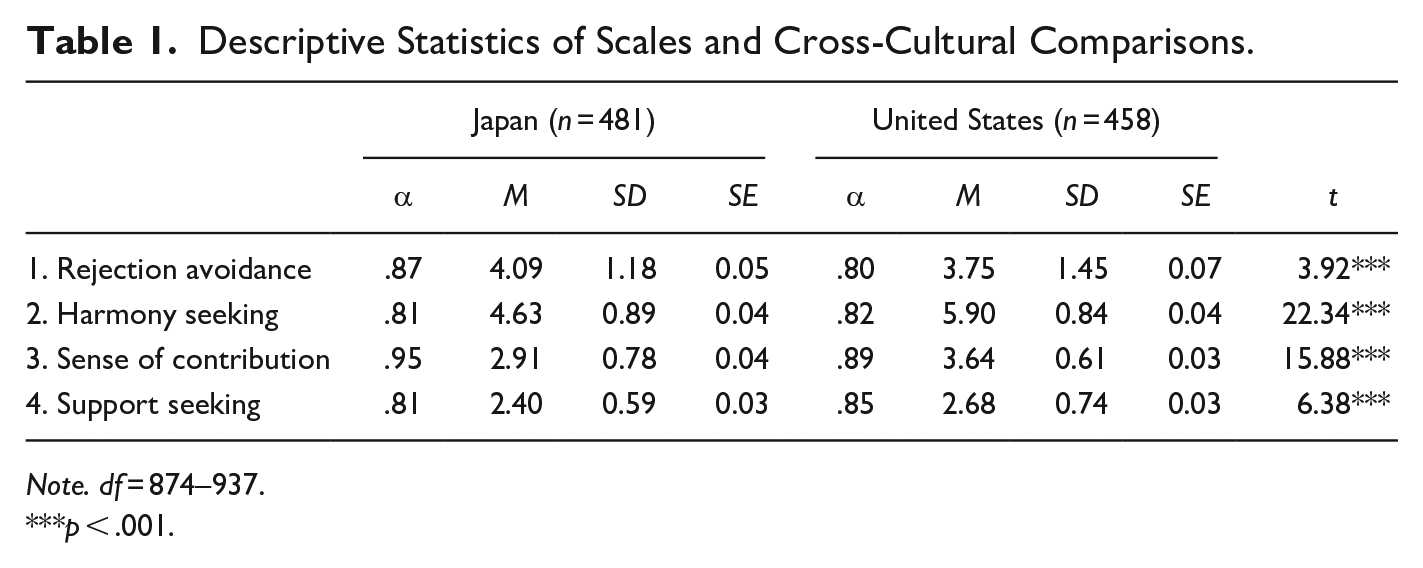
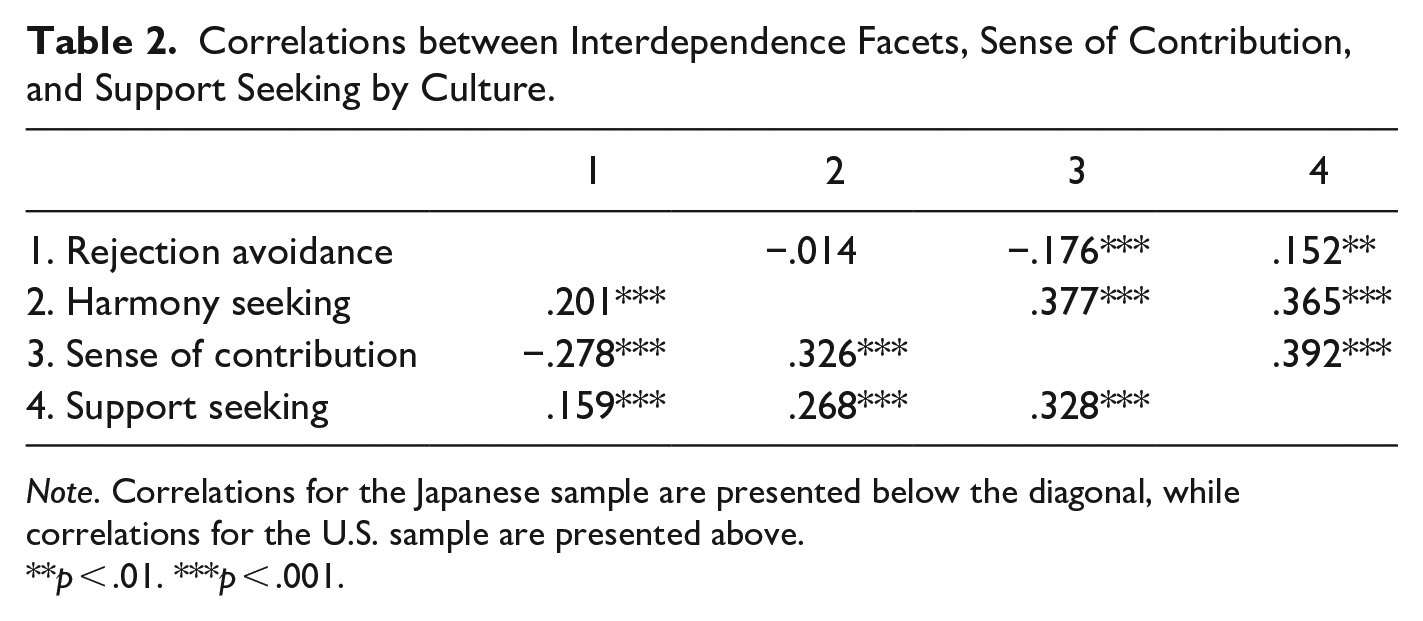
Cross-cultural differences in the main study variables are presented in Table 1, while bivariate correlations between variables are presented in Table 2. To test Hypothesis 1, which assumed that U.S. participants rely more on social support than Japanese, we investigated cross-cultural differences in social support seeking. Results showed that, as predicted, support seeking was higher in the U.S., compared to Japan.
Descriptive Statistics of Scales and Cross-Cultural Comparisons.
Note. df = 874–937.
p < .001.
Correlations between Interdependence Facets, Sense of Contribution, and Support Seeking by Culture.
Note. Correlations for the Japanese sample are presented below the diagonal, while correlations for the U.S. sample are presented above.
p < .01. ***p < .001.
The Mediating Role of Rejection Avoidance
To test Hypothesis 2, which assumed that rejection avoidance, but not harmony seeking, mediates cultural differences in support seeking, we investigated cross-cultural differences in the two facets of interdependence, as well as the association between interdependence and support seeking. Recall, we expected Japanese to be higher in rejection avoidance than the U.S. participants, but not to differ from them on harmony seeking. Furthermore, we expected the two facets of interdependence to inhibit social support seeking.
As expected, our results showed that rejection avoidance was significantly higher, while harmony seeking was lower in Japan, compared to the U.S (see Table 1). However, contrary to our predictions, harmony seeking and rejection avoidance were positively associated with support seeking in both cultures (see Table 2). These results suggest that the cultural differences concerning support seeking cannot be explained by differences in harmony seeking or rejection avoidance.
The Mediating Role of Sense of Contribution
Before testing Hypothesis 3, which assumed that sense of contribution mediates cultural differences in social support seeking, we investigated whether sense of contribution is higher in the U.S. compared to Japan, and whether it is positively associated with social support seeking. Results showed that, indeed, U.S. participants had higher sense of contribution than the Japanese (see Table 1), and sense of contribution was positively associated with social support seeking in both cultures (see Table 2). We thus proceeded to testing the mediating effect of sense of contribution. A simple mediation analysis (maximum likelihood estimation) based on 1,000 bootstrap samples revealed that the indirect effect of culture on support seeking through sense of contribution was positive (indirect effect = 0.240, SE = 0.029, 95% CI = [0.185, 0.298]). Culture did not influence support seeking independent of its effect on sense of contribution (β = .029, 95% CI = [−0.036, 0.093]; see Figure 1).

Indirect effect of culture on support seeking through sense of contribution.
Additional Analyses Exploring the Role of Rejection Avoidance
As predicted, Japanese were higher on rejection avoidance, suggesting that rejection avoidance may be a possible mediator for the cultural difference in support seeking. However, contrary to hypotheses, rejection avoidance was positively (though weakly) associated with support seeking. As rejection avoidance was also negatively associated with sense of contribution, we tested a serial mediation model assuming that culture affects rejection avoidance, which in turn influences sense of contribution, finally leading to support seeking. The results of the mediation analysis (maximum likelihood) with 1,000 bootstrap samples revealed an indirect effect of culture through rejection avoidance and sense of contribution (total indirect effect = 0.015, SE = 0.001, 95% CI = [0.006, 0.027]). In this model, rejection avoidance had a negative indirect effect on support seeking through sense of contribution (indirect effect = −0.045, SE = 0.008, 95% CI = [−0.062, −0.029]), although the direct effect was positive (see Figure 2).
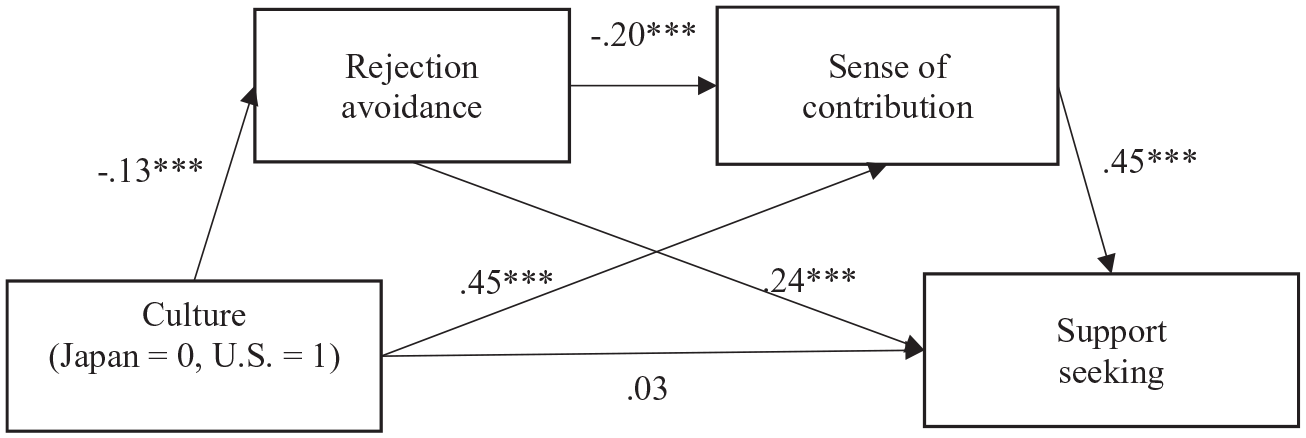
Serial mediation testing the indirect effect of culture on support seeking through rejection avoidance and sense of contribution.
Discussion
This study examined the comparative validity of three explanations of cultural differences in social support: harmony seeking, rejection avoidance, and sense of contribution. The premise of this research was that people living in Japan are more reluctant to seek support than those in the U.S. (Hypothesis 1). Our results supported this hypothesis, replicating previous research (Taylor et al., 2004).
The second hypothesis proposed that rejection avoidance, and not harmony seeking, stands behind these cultural differences. Indeed, results showed that Japanese do not seek harmony more than Americans (in fact, they are lower on harmony seeking than U.S. participants, as in Hashimoto & Yamagishi, 2016). This result casts doubts on the validity of relationship harmony as explanatory mechanism of cross-cultural differences in help-seeking (e.g., Taylor et al., 2004; Wang et al., 2010). Relationship harmony maintenance motivation could be higher in high relational mobility cultures such as the United States, where actively maintaining relationships requires more effort than in low mobility cultures such as Japan (Schug et al., 2010). Furthermore, harmony seeking did not inhibit (as previous research assumes), but promoted social support seeking. This unexpected finding could be related to the operationalization and measurement of relationship harmony. Previous studies have mostly focused on disruption of relationship harmony (e.g., “It is better to hold one’s emotions inside than to burden others by expressing them”; Wang et al., 2010), while the harmony seeking scale in our study focused on pursuit of harmony (e.g., “I value maintaining harmony with others”). Concerns about disrupting harmony could be more closely associated with hesitance to seek social support. In contrast, active pursuit of harmony may promote social support seeking, because self-disclosure of personal problems could deepen existing relationships. Taking these into consideration, future research should disentangle the effects of harmony disruption concerns (preventive orientation) from those of harmony seeking (promotive orientation).
However, although we predicted that rejection avoidance provides a more valid explanation of cultural differences in social support use, the second hypothesis was not supported. Japanese were higher in rejection avoidance than their U.S. counterparts, but rejection avoidance was not negatively related to social support seeking, suggesting that the association between rejection avoidance and social support might be more complex than initially expected. Especially in Japan, where a clear delimitation between soto (outgroup, distant others) and uchi (ingroup, close others) exists (Bachnik, 1992), the relationship between self and support providers could define support seeking tendencies. In this research, the instructions did not specify who the support provider is, so participants may have thought about both close and distant relationships. In order to avoid being rejected by distant others (soto), Japanese may turn to close others (uchi) for support. Another possibility is that people who fear being negatively evaluated by others may actually ask others what they should do to avoid rejection. Closeness of relationship and type of problems for which support is sought could shape social support interactions (see also the Limitations section), leading to the unexpected positive relationship between rejection avoidance and support seeking in our study.
Nevertheless, the main purpose of this study was to propose a novel explanation of cross-cultural differences in social support seeking: sense of contribution (Hashimoto, 2015). Hypothesis 3 predicted that sense of contribution mediates cultural differences in social support seeking, and results supported this hypothesis. In a culture where direct support offering is common, such as the U.S., people may have more opportunities to help others spontaneously, thus maintaining a high sense of contribution. Furthermore, people with a high sense of contribution may feel more comfortable seeking social support, by invoking the norm of reciprocity (it’s others’ turn to return the debt they owe me). Understanding cross-cultural differences in social support seeking necessitates adding social support offering to the equation. In cultures where exchange norms are prevalent, practitioners need to analyze individuals’ help seeking and offering experience, and encourage both.
Finally, to explore the relationship between our proposed mediators, we tested a model in which culture predicts social support through rejection avoidance and sense of contribution. Rejection avoidance negatively predicted sense of contribution, suggesting that a person who fears rejection may avoid engaging in behaviors that could be misinterpreted by others (i.e., offering unnecessary help), so they might not have many opportunities to verify and enhance their sense of contribution. The total indirect effect of culture on social support through rejection avoidance and sense of contribution was significant, suggesting that Japanese seek support less because they have lower sense of contribution, which is triggered by their higher rejection sensitivity. In other words, this model revealed that rejection sensitivity may be a distal predictor, while sense of contribution may be a proximal predictor of support seeking.
Limitations and Future Directions
This study has several limitations. To start with, this is the first study to utilize the English version of the Sense of Contribution scale. Further examination of the concurrent validity of the instrument, as well as the cultural equivalence of the concept, is necessary. Studies investigating whether cultural differences in sense of contribution are not driven by differences in self-esteem or response bias are necessary in order to bring further empirical support for the construct validity of the scale.
Second, this study focused on general daily relationships, without distinguishing between relationship types (e.g., siblings, friends, and neighbors) and/or closeness with support providers. The strength of the norm of reciprocity may differ depending on the relationship between donor and receiver. Miller et al. (2017), who examined the association between exchange and communal norms, relationship concerns, and support seeking in Japan, India, and the U.S., found that Japanese and Indians rely on communal norms among siblings more frequently than do Americans, whereas Japanese and Americans rely on exchange norms among friends more frequently than do Indians. In Japan, relying on exchange norms among friends enhanced negative outlooks on social support seeking via relationship concerns (Miller et al., 2017). Another study showed that East Asians are more likely to refuse help and gifts from unfamiliar persons, in order to prevent indebtedness (Shen et al., 2011). Therefore, the relationship between help-seeker and donor is an important factor that needs to be taken into account when discussing reciprocity norms, because relationship type may affect the association between sense of contribution and support seeking. Furthermore, future research should focus not only on the relationship between donor and receiver, but also on the context in which people ask for support. Depending on culture, social support seeking may be more common or acceptable in some situations than others, so support seeking tendencies could be influenced by the context or problem for which social support is being sought.
Third, it may also be important to consider types of support and assistance. In line with previous research, in this study, the tendency to use explicit support was adopted as a support-seeking index. However, previous studies show that indirect, unsolicited support may be culturally favorable in East Asian countries (Mojaverian & Kim, 2013; Taylor et al., 2007). Therefore, future studies should also address cultural differences in indirect support seeking, as well as their causes.
Finally, as a methodological issue, this research is a correlational study based on a self-report, one-shot survey. To clarify the causal relationships between our variables, longitudinal research and experimental designs are needed. Of particular importance are intervention studies targeting sense of contribution. Empirical evidence showing that social support seeking among East-Asians may be increased by promoting individuals’ sense of contribution could validate the results of this study further.
Conclusions and Implications for Practice
Research so far have advanced several explanations regarding cultural differences in support seeking (i.e., relationship concerns) that are based on given cultural characteristics (Taylor et al., 2004; Wang et al., 2010). However, such fatalistic explanations are disadvantageous in terms of clinical and practical availability, because it is difficult to change given cultural tendencies. Characteristics of interdependence such as harmony seeking and rejection avoidance are acquired through socialization and are, thus, deeply rooted in one’s culture. Changing these characteristics in order to facilitate social support may be extremely difficult. In contrast, sense of contribution can be intervened upon, and enhanced. Clinical and community interventions could target individuals’ sense of contribution and, by providing opportunities to enhance it, an environment in which both help-offering and help-seeking are easier, could be promoted. Such interventions should take into consideration each person’s cultural background. Knowing that Japanese may hesitate to offer help to others directly, facilitators could arrange opportunities to increase individuals’ sense of contribution through more indirect means, such as environmental work, or anonymous donations. This way, people’s reluctance to rely on others in times of need may wane, while help offering may increase, contributing to the sustainment of healthy communities.
Footnotes
Appendix A
Declaration of Conflicting Interests
The author(s) declared no potential conflicts of interest with respect to the research, authorship, and/or publication of this article.
Funding
The author(s) disclosed receipt of the following financial support for the research, authorship, and/or publication of this article: This research was supported by Japan Society for the Promotion of Science Grants-in-Aid for Scientific Research 15K04026 and 19K03190 to Takeshi Hashimoto.