



Abstract
Innovation constitutes a key factor for the economy and the competitiveness of societies. Using the Hofstede model of national culture, previous studies investigated the influence of different cultural dimensions on national-level innovation. These studies provided for mixed evidence regarding the influence and weight of each cultural dimension in innovation. By considering possible explanations for these inconsistent results, the present study (N = 106 countries) showed that only two cultural dimensions seem to be consistently associated with innovation. Cultures that view change as necessary (long-term oriented) and are more accepting of norm violations (displaying low uncertainty avoidance) tend to promote innovation. These results shed new light on the way cultural tightness and social regulation processes can affect innovative behaviors.
Keywords
Innovation refers to the implementation (e.g., application, commercialization) of creative ideas or productions (Chaubey et al., 2019), that is solutions that are both novel and efficient, useful, valuable (Runco & Jaeger, 2012). It is now undisputed that innovation constitutes a key factor driving both economic progress and competitiveness of national economies and societies as a whole (Dutta et al., 2016; Florida, 2002). Consequently, researchers have paid increasing attention to the factors that could favor or hinder innovation at the national level. Among these factors, culture was found to be crucial (e.g., Rinne et al., 2012; S. Shane, 1993). Drawing upon the Hofstede model of national culture (Hofstede, 1980, 1984, 2001; Hofstede et al., 2010), researchers have started to investigate the influence of different cultural dimensions on national-level innovation. While studies so far corroborated the role of culture in shaping creativity and innovation, they also provided for mixed evidence regarding the influence and weight of each Hofstede cultural dimension in innovation outputs (see Andrijauskienė & Dumčiuvienė, 2017). By considering alternative explanations for these inconsistent results, the present contribution aims to further investigate the associations between Hofstede cultural dimensions and innovation.
The Hofstede Model of National Culture
Culture can be defined as a body of information (e.g., beliefs, rules, values) shared within a population of individuals, and (nongenetically) transmitted across generations (Kashima, 2010). A widely used theoretical framework for describing cultures at the national level is the Hofstede model of national culture (Hofstede et al., 2010). This model distinguishes six cultural dimensions: Power Distance (the social acceptability of unequal distribution of power within society), Individualism (the preference for loose rather than tight social structures and the tendency to be more concerned about oneself and loved ones than about other members of the society), Masculinity (preference for competition, pride, heroism, assertiveness and material rewards over cooperation and consensus), Uncertainty Avoidance (the degree of individual discomfort with uncertain and ambiguous situations), Long-Term Orientation (low scores reflect societies that prefer to maintain traditions and are suspicious toward change, whereas high scores describe societies in which adaptation and change are seen as necessary), and Indulgence (the tendency to allow vs. restrict individuals’ pursuit of hedonist goals; see Hofstede, 2011). This model was chosen for comparability purposes, because of its prior use in studies exploring the impact of culture on innovation.
Cultural Dimensions and National-Level Innovation
Various studies investigated the influence of Hofstede’s cultural dimensions on creativity and innovation at the national level. If these studies agree on the fact that “culture matters” (S. Shane, 1993, p.59), they provide contrasting results regarding the exact associations between each of these dimensions and innovation (see Andrijauskienė & Dumčiuvienė, 2017). For example, Prim, Filho, Zamur, and Di Serio’s (2017) results suggested that individualism and long-term orientation are positively linked to innovation, while Andrijauskienė and Dumčiuvienė (2017) did not find these effects. While Kaasa and Vadi (2010; see also Kaasa, 2017; S. Shane, 1993) observed a negative relationship between uncertainty avoidance and innovation, this was not the case for Rinne et al. (2012). Kaasa and Vadi (2010) also found a negative correlation between masculinity and innovation, but no significant association was observed between these variables by Andrijauskienė and Dumčiuvienė (2017) or S. Shane (1993). These are only few of the many inconsistencies observed in the literature (see Andrijauskienė & Dumčiuvienė, 2017).
Different explanations can be proposed as to why these inconsistencies are observed. First, they could occur because studies in the literature often include a small number of countries, sometimes due to logistical difficulties for data collection (e.g., 18 in Prim et al., 2017; 27 in Andrijauskienė & Dumčiuvienė, 2017; see S. F. Anderson, Kelley, & Maxwell., 2017 for an overview of the consequences of small samples for replicability). Second, studies display considerable variations in terms of geographical location, some studies drawing upon samples across the world while others focus on specific areas (e.g., European Union and neighboring countries; see Andrijauskienė & Dumčiuvienė, 2017; Kaasa, 2017; Kaasa & Vadi, 2010). This can pose generalizability issues from one study to the other (Muthukrishna et al., 2020). Third, they differ in the number of cultural dimensions included in their analyses, from only two (S. A. Shane, 1992) to all six dimensions (e.g., Prim et al., 2017), which renders comparability complicated. Fourth, studies differ in the number and nature of the control variables included in their analyses, with some studies including no control variable at all (e.g., Prim et al., 2017). Yet, variables such as population count or socioeconomic characteristics can constitute important confounds as they relate to both innovation outputs (e.g., King, 2004; S. Shane, 1993) and cultural dimensions (e.g., Bianchi, 2016). Fifth, there is substantial heterogeneity in the operationalization of innovation-related measures used across studies. For instance, Andrijauskienė and Dumčiuvienė (2017) used the European Innovation Scoreboard as a measure of innovation in European countries. Studies conducting worldwide investigations often use the Global Innovation Index, its sub-dimensions (e.g., Rinne et al., 2012), and/or partial indicators from these sub-dimensions (Prim et al., 2017; see method section for more information about these variables). Therefore, it is possible that inconsistent results arise due to stimulus sampling-related issues (Wells & Windschitl, 1999).
The Present Study
In light of all the above-mentioned sources of variability, the present study aimed to obtain a clearer view of the association between cultural dimensions and national-level innovation. To do so, we adopted the most methodologically rigorous solutions to each of the problems we described. First and foremost, we included a total of 106 countries (the maximum number of countries allowing to find data concerning Hofstede cultural dimensions and innovation-related variables) from various cultural areas around the world. For the analyses, we took into account all six Hofstede’s cultural dimensions, as well as theoretically relevant control variables. More precisely we included the population count, the Human Development Index (HDI) and the Gross Domestic Product (GDP) for each country as potential confounds. Indeed, population count related variables tend to be linked to both innovation (e.g., population growth; Weinberger et al., 2017) and economic development (e.g., fertility; Buckles et al., 2021). For their part, variables linked to societies’ economy and development—as HDI and GDP—have been found to be associated with both innovation (e.g., King, 2004; S. Shane, 1993) and some cultural values. Especially, individualism tends to be enhanced in affluent contexts (e.g., periods of economic growth) and tempered in deprivation contexts. Indeed, deprivation enhances individual uncertainty (e.g., recessions provoke uncertainty about jobs, financial security and future; Bloom, 2009), which leads to decreased individualism (Bianchi, 2016). In line with this observation, research consistently highlighted positive correlations between GDP and individualism (Hofstede, 1980, 2001; Inglehart & Baker, 2000; Inglehart & Oyserman, 2004). Conceptual overlap exists between HDI, GDP, and the relative nature of the GII (already adjusted on some or similar variables). However, there are important empirical distinctions between all these indicators. For instance, HDI includes life expectancy (as an indicator of a long and healthy life), hence characteristics linked with a country’s environmental harshness which breeds tightness, and directly relates to innovation (Gelfand et al., 2006). In addition, HDI is based on per capita GNI which differs from GDP in that it measures only the national wealth (takes away the share of wealth generated by foreign residents in the country for instance). Note that the GII makes use of some indices adjusted per GDP for sub-index calculation. However, mathematically speaking, this is not equivalent to complete adjustment to GDP, especially since not all such indices are measured as proportions of GDP. Given that our goal was to adopt the most methodologically rigorous approach, we decided to stay maximal and conservatively control for related albeit distinct dimensions of a country’s economy and development.
Finally, we gathered five different—although related—innovation indexes from the Global Innovation Index framework (the Global Innovation Index itself and its sub-dimensions; e.g., Prim et al., 2017; Rinne et al., 2012).
Despite previously described inconsistencies in the literature, we believed that the theoretical predictions formulated by Andrijauskienė and Dumčiuvienė (2017) would stand when methodological issues are solved (even partially). Thus, first, previous works showed that low power distance cultures, emphasizing individuals’ autonomy in decision making, promotes innovation and invention (Kaasa & Vadi, 2010; see also ; Gallego-Álvarez & Pucheta-Martínez, 2021). Second, individualistic cultures offer individuals greater freedom to explore and express opinions, and thus favor the production of new ideas (Andrijauskienė & Dumčiuvienė, 2017). Moreover, individuals living in such societies have more reasons to expect rewards for their ideas (Herbig & Dunphy, 1998). Previous research—albeit inconsistent—generally showed positive associations between individualism and innovation (e.g., Chen et al., 2017; Efrat, 2014; Rinne et al., 2012). Third, low masculinity cultures (i.e., feminine cultures) favor supportive and non-conflictive environments (sharing of information, collaboration, greater error-tolerance) that help individuals cope with the uncertainty inherent to new ideas (Khan & Cox, 2017; Madjar et al., 2002). Fourth, several contributions support the idea according to which cultures displaying strong uncertainty avoidance tend to be more resistant to change and innovations since rules and norms tend to be carefully followed in order to reduce uncertainty (Hussler, 2004; Kaasa, 2017; Kaasa & Vadi, 2010; S. Shane, 1993; Waarts & Van Everdingen, 2005). Conversely, cultures displaying low uncertainty avoidance accept new technology more easily (Syed & Malik, 2014). Fifth, long-term–oriented cultures display higher innovative capacities (Herbig & Dunphy, 1998; see also Gallego-Álvarez & Pucheta-Martínez, 2021), and this dimension reflects an important feature of innovative countries (Khan & Cox, 2017). On the contrary, short-term orientation is associated with respect for traditions and suspicion toward change. A positive association between long term orientation and innovation has even been previously observed (e.g., Prim et al., 2017). This effect seems to be consistent with previous findings according to which individuals in cultures displaying low cultural tightness (loose cultural norms and moderate penalties for violations of these norms; Gelfand et al., 2011; Jackson et al., 2020) tend to be more innovative (e.g., Harrington & Gelfand, 2014; Mu et al., 2015). Sixth, previous studies tend to show that indulgent societies promote innovation as a way to satisfy individuals’ needs related to hedonism and to improve life (Khan & Cox, 2017; Syed & Malik, 2014).
Hence, in line with Andrijauskienė and Dumčiuvienė’s (2017) review, and the associations the most consistently observed in the literature (see a description of the 16 cited studies in supplementary material), our hypotheses are as follows: H1: Power distance would be negatively associated with scores on our five measures of innovation. H2: Individualism would be positively associated with scores on our five measures of innovation. H3: Masculinity would be negatively associated with scores on our five measures of innovation. H4: Uncertainty avoidance would be negatively associated with scores on our five measures of innovation. H5: Long-term orientation would be positively associated with scores on our five measures of innovation. H6: Indulgence would be positively associated with scores on our five measures of innovation.
Method
We included only the countries for which we had the necessary data for each variable (Hofstede values and innovation). Analyses were therefore conducted on 106 countries. Scores related to the six cultural values for each country (i.e., power distance, individualism, masculinity, uncertainty avoidance, long term orientation, indulgence) were retrieved from https://www.hofstede-insights.com.
Innovation was assessed using five different but related indexes previously used in the literature (e.g., Prim et al., 2017; Rinne et al., 2012). First, the “Global Innovation Index” 2020 (GII; see Dutta et al., 2014) aims to assess innovation in countries. The GII score proposes an inclusive perspective on innovation, defined as “improvements made to outcomes in the form of either new goods or services or any combination of these” (2020 Global Innovation Index), a definition originally derived from the Oslo Manual developed by the OECD (OECD). The GII score is a composite score of two correlated sub-dimensions: the “Innovation Input Sub-Index” (information about the national economy that supports innovative activities such as innovative institutions and market sophistication), and the “Innovation Output Sub-Index” (information about the innovative activities of countries). Since this last dimension is intrinsically linked to the production of innovations, we also included its two sub-dimensions: “Knowledge and technology outputs” (e.g., patent applications, scientific publications) and “Creative outputs” (intangible assets, e.g., movies, Wikipedia contributions).
A complete presentation of these indices is available here: 2020 Global Innovation Index. In addition, we included the 2019 population count (2019 Population), the 2019 HDI (2019 Human Development Index Ranking) and the 2019 GDP (2019 Gross Domestic Product
Results
Summary of regression analysis for the five measures of innovation (step 1).

Note. GII = Global Innovation Index, Innov. Input = Innovation Input Sub-Index, Innov. Output = Innovation Input Sub-Index, Knowledge = Knowledge and technology outputs, Creativity = Creative outputs. *p < .05, **p < .01, ***p < .001. All variance inflation factors were inferior to 3, indicating an absence of multicollinearity.
Summary of regression analysis for the five measures of innovation (step 2).
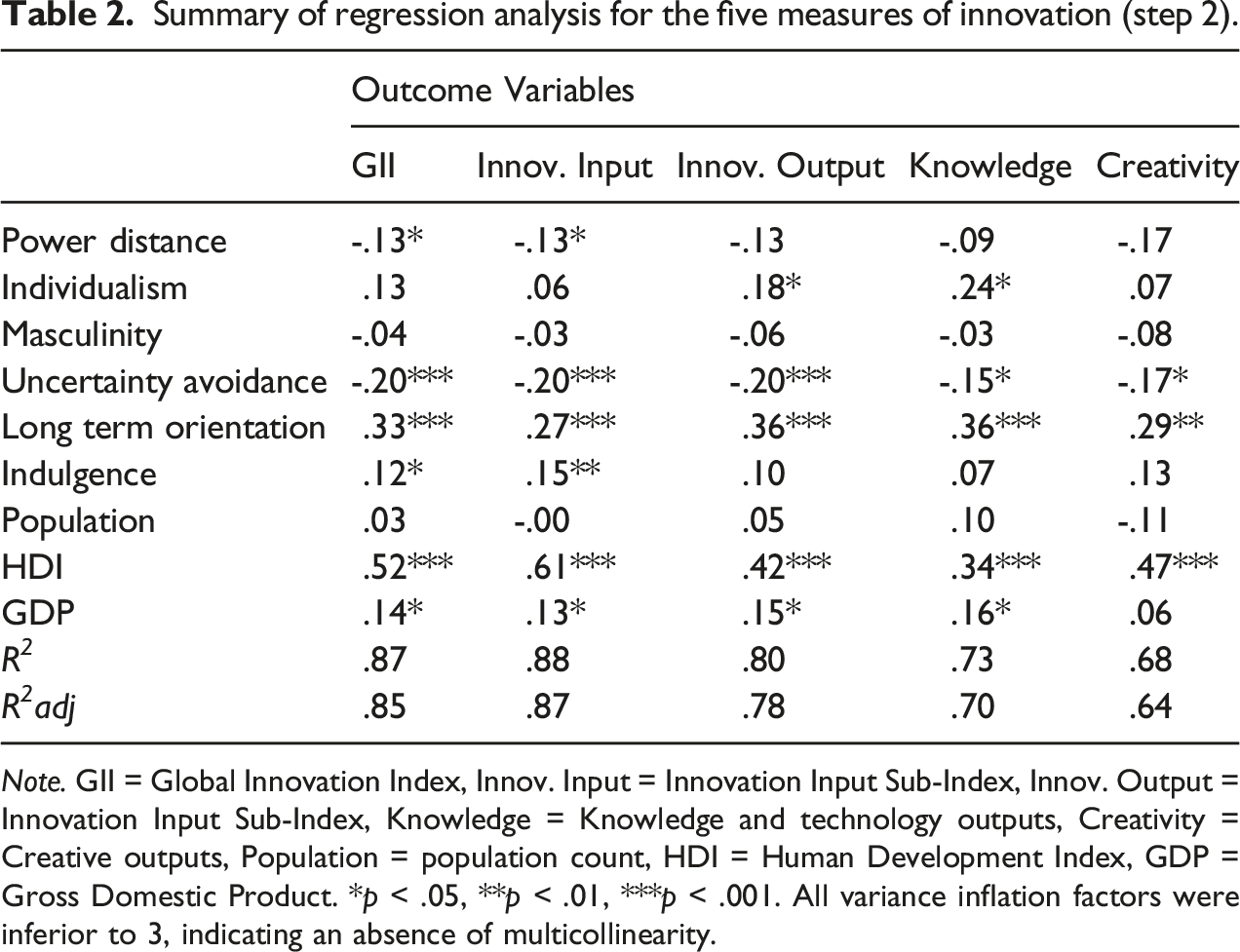
Note. GII = Global Innovation Index, Innov. Input = Innovation Input Sub-Index, Innov. Output = Innovation Input Sub-Index, Knowledge = Knowledge and technology outputs, Creativity = Creative outputs, Population = population count, HDI = Human Development Index, GDP = Gross Domestic Product. *p < .05, **p < .01, ***p < .001. All variance inflation factors were inferior to 3, indicating an absence of multicollinearity.
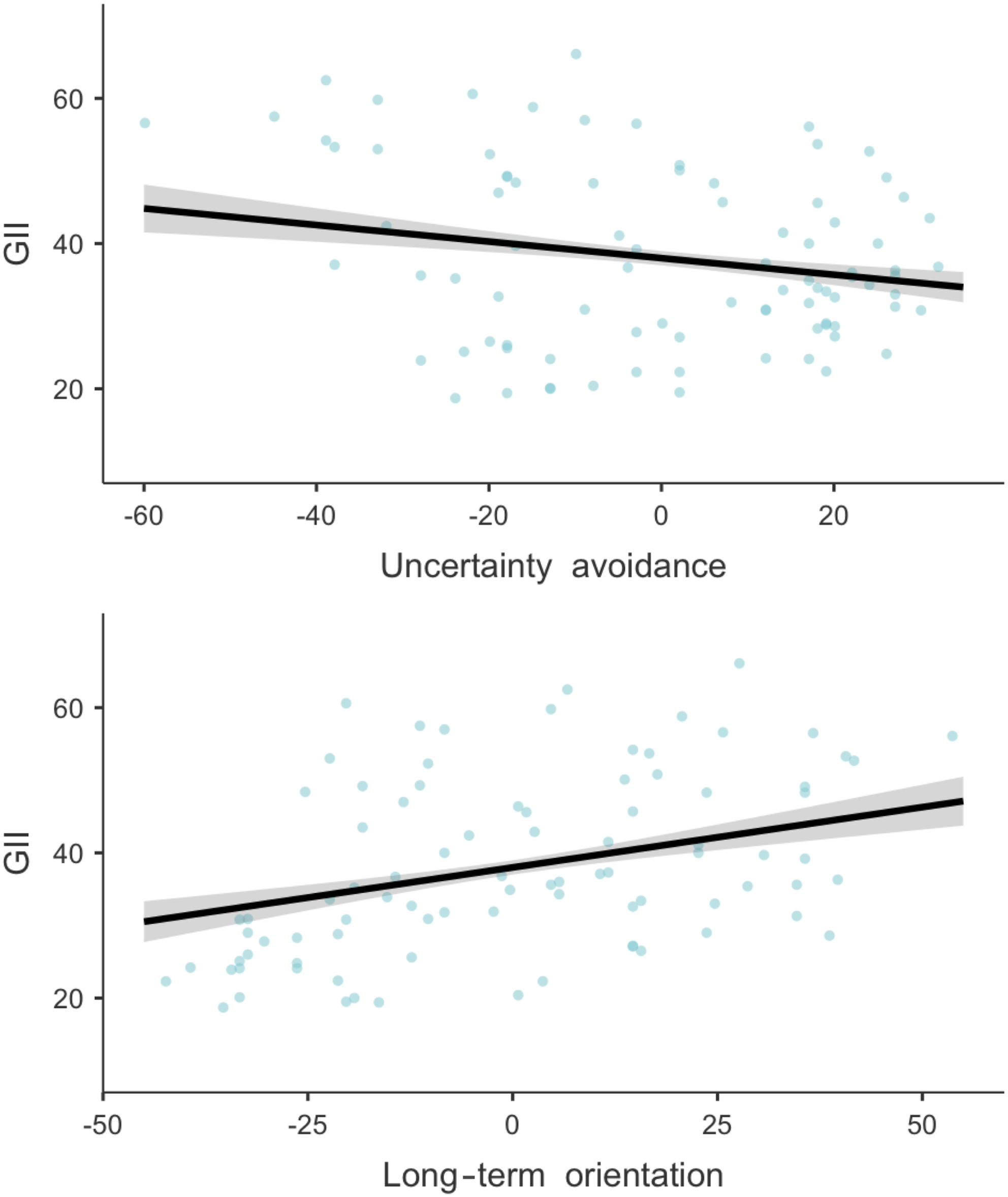
Scatterplots of the relationship between uncertainty avoidance (above), long-term orientation (below) and global innovation index scores (adjusted for population, HDI and GDP; N = 106). Note. GII = Global Innovation Index scores. Data points represent countries and gray areas 95% CI for slope estimates.
Discussion
With the inclusion of 106 countries from all over the world, analyses including all six Hofstede’s cultural dimensions, relevant control variables and five different innovation scores, the present study indicates that only two cultural dimensions seem to be consistently associated with national-level innovation. First, as predicted, we observed a negative association between uncertainty avoidance and innovation (H4). In cultures displaying strong uncertainty avoidance, rules tend to be carefully followed in order to reduce uncertainty. These cultures may thus limit opportunities for change and provide fewer incentives to the expression of new ideas (Kaasa & Vadi, 2010; Waarts & Van Everdingen, 2005). On the contrary, in cultures displaying low uncertainty avoidance, norms and rules violation is more socially acceptable, while conflicts or ambiguous situations are considered natural and interesting (Kaasa & Vadi, 2010). Yet, innovation is inherently associated with change and, consequently, with uncertainty. In line with this, we observed consistent positive associations between long term orientation and measures of innovation (H5). The more cultures view adaptation and change as beneficial and necessary, the more they tend to be innovative. On the contrary, cultures that prefer to maintain traditions and view change with suspicion would tend to be less innovative.
These results are in line with the definition of innovation itself, that is the implementation of ideas that promote change, are novel and rule-breaking (e.g., Amabile, 2018; Bonetto et al., 2021; Csikszentmihalyi, 2014). Societies that tend to be “change-friendly”—that view change as necessary (long-term oriented) and are more accepting of violations of norms (low uncertainty avoidance)—promote more the introduction of new ideas and their implementation (i.e., innovation). This interpretation is consistent with previous works showing that individuals in cultures displaying low cultural tightness (loose cultural norms and moderate penalties for violations of these norms; Gelfand et al., 2011; Jackson et al., 2020) tend to be more creative and innovative (e.g., Harrington & Gelfand, 2014; Mu et al., 2015). It is also consistent with the idea according to which social regulations of creative behaviors (precursors of innovation; N. Anderson et al., 2014; Chaubey et al., 2019) can discourage the generation and implementation of new ideas because of the risks associated with breaking social norms (e.g., ostracism of individuals promoting change; Bonetto et al., 2021) and the apprehension of these risks (see Bonetto et al., 2020).
No association was observed between masculinity and innovation (H3), and we observed mixed results concerning power distance (H1), individualism (H2), and indulgence (H6). Indeed, power distance, individualism and indulgence showed expected significant associations with only a few measures of innovation. In other words, regarding these dimensions, we observed variations from one measure of innovation to another. This variability therefore prevents us from concluding these dimensions are associated with innovation. Moreover, the inclusion of control variables significantly impacted these links (step 1 vs. step 2 of the step-by-step regression analysis conducted). For instance, previous studies found positive associations between individualism and innovation (e.g., Prim et al., 2017). This association was observed with all five innovation measures when no control variable was included in the analysis (step 1, Table 1). However, as previously outlined, variables linked to societies’ economy and development have been found to be associated with both innovation (e.g., King, 2004; S. Shane, 1993; and in the present results, see Table 2) and individualism (e.g., Bianchi, 2016). Especially, individualism tends to be enhanced in affluent contexts (e.g., periods of economic growth) and tempered in deprivation contexts. Indeed, deprivation enhances individual uncertainty (e.g., recessions provoke uncertainty about jobs, financial security and future; Bloom, 2009), which leads to decreased individualism (Bianchi, 2016). In line with this observation, research consistently highlighted positive correlations between GDP and individualism (Hofstede, 1980, 2001; Inglehart & Baker, 2000; Inglehart & Oyserman, 2004). Once this potential confound was included in the analysis (step 2, Table 2), the association between individualism and innovation became observable only for two out of five innovation measures. Thus, when adjusted on specific aspects of economic performance (national, international) and national ecology (e.g., life expectancy), we were able to disentangle the positive effect of uncertainty avoidance (or tolerance, necessary to foster and create new ideas; e.g., Chirumbolo et al., 2004) from that of individualism. This is theoretically interesting because cultural values, just like social attitudes, typically come in bundles (see for instance recent developments on the Sino-American WEIRDness continuum; Muthukrishna et al., 2020). Individualism fosters and thus correlates with a host of relevant cultural features that may impact innovation, including tightness and uncertainty avoidance just to name a few. This may explain the discrepant results in the literature, depending on which covariates are included or not. This result therefore challenges the role of individualism in national-level innovation.
Our study remains constrained by certain boundaries which could be improved in future research. First, in spite of the fact that it includes a much larger number of countries than typically observed in previous studies, it will be necessary to extend this investigation to a larger number of countries in order to obtain more accurate parameter estimates. Still, this kind of investigation remains constrained by the total number of countries available for analyses (only 193 countries are recognized members of the UN). Also, although Hofstede’s dataset used here has the advantage of covering all six of Hofstede’s cultural dimensions and comprises a large number of countries around the world, it contains some important limitations. In particular, data from different countries were collected at different points in time. Nonetheless, this limitation should be tempered by the fact that national cultures tend not to vary or evolve rapidly (Kaasa, 2017).
Another limitation of the Hofstede model relates to some of its dimensions. Although masculinity and uncertainty avoidance dimensions are still frequently used in studies soliciting Hofstede’s cultural dimensions in various fields of research (Damen et al., 2019, 2020; de Mooij & Beniflah, 2017; Sabri et al., 2020), previous contributions have raised doubts about the usability of these dimensions (weak internal consistencies, replicability issues; Minkov, 2018; Minkov & Kaasa, 2020). However, excluding masculinity and uncertainty avoidance dimensions from our analyses did not reveal any new consistent associations between cultural dimensions and our five innovation-related measures (no previously unobserved associations emerged; see supplementary materials). Relatedly, our study only used the Hofstede model of national culture, and did not include Schwartz, 1990’s values or cultural tightness as predictors of national-level innovation. This was done for lack of sufficient country scores for each of these cultural values models, which would have resulted in a much lower sample size for our analyses.
A final point pertains to the mixed results we observed regarding power distance, individualism and indulgence. Importantly, the present study does not provide information on the reasons for these inconsistencies. In particular, these could be due to measurement issues, the associations observed with innovation measures could be artifactual. These inconsistencies could also stem from differences in the nature of innovation measures: different cultural values could have a different impact on qualitatively different measures of innovation, particularly through the distinction between the inputs and outputs of innovation. However, previous studies have shown that innovation inputs and outputs are strongly interrelated (Kaasa, 2017) and are similarly influenced by some cultural dimensions (e.g., Rinne et al., 2012 with power distance and individualism). Moreover, some inconsistent patterns were more likely the product of control and confound issues (e.g. individualism) rather than linked with the nature of our outcomes. Future studies will be needed clearly address these questions.
Within the boundaries of the above-mentioned limitations, we believe the present study offers a clearer picture of Hofstede cultural dimensions’ associations with national-level innovation. Overall, cultures that view change as necessary (long-term oriented) and display greater tolerance for norm violations (low uncertainty avoidance) seem to promote innovation.
Footnotes
Declaration of Conflicting Interests
The author(s) declared no potential conflicts of interest with respect to the research, authorship, and/or publication of this article.
Funding
The author(s) received no financial support for the research, authorship, and/or publication of this article.
Author’s Note
All authors were involved in all parts of the research.
