



Abstract
Introduction
In Australia there is an overwhelming need to provide effective treatment to patients presenting to the Emergency Department (ED) in mental health crisis. We adapted Improving Access to Psychological Therapies service model (IAPT) from the National Health Service (NHS) method for the large scale delivery of psychological therapies throughout the United Kingdom to an Australian ED setting. This telephone-based low intensity therapy was provided to people presenting in crisis to the EDs with combinations of anxiety, depression, substance use, and suicidal thinking.
Methods
This uncontrolled study utilised session-by-session, before-and-after measures of anxiety and depression via Patient Health Questionnaire (PHQ-9) and Generalised Anxiety Disorder-7 (GAD-7).
Results
Of 347 eligible post-crisis ED referred patients, 291 (83.9%) engaged with the IAPT team. Most patients (65%) had attended the ED previously on an average of 3.9 (SD = 6.0) occasions. Two hundred and forty one patients received an average of 4.1 (SD = 2.3) contacts of low-intensity psychological therapies including 1.2 (SD = 1.7) community outreach visits between 20th Oct 2011 and 31st Dec 2012. Treated patients reported clinically significant improvements in anxiety, depression and suicidal ideation. Uncontrolled effect sizes were moderate for anxiety (0.6) and depression (0.6).
Discussion
The Australian ED IAPT program demonstrated that the UK IAPT program could be adapted for emergency mental health patients and be associated with similar clinical benefits as the original program.
Funding
The Flinders Medical Centre IAPT program received Emergency Department project funding from the Australian Commonwealth Government through the Council of Australian Governments (COAG) and the South Australian Government initiative, Every Patient Every Service (EPES).
Introduction
Emergency departments (EDs) remain a gateway for people who need urgent psychiatric care, despite significant initiatives to reduce overall ED demand.1,2 Currently, psychiatric presentations represent around 5% of the total ED attendances.3–6 The raw numbers are substantial. Across Australia, mental health presentations accounted for 240,000 ED occasions-of-service during 2011--12. Over two-thirds were related to high-prevalence disorders such as anxiety, depression and substance use. 3
In 2011--12, most patients (62.3%) with mental health presentations were discharged from EDs without planned follow-up by a public mental health service or a clinical psychologist. 3 Even when follow-up plans are made, it is notoriously difficult to engage people in routine office-based care after ED crisis presentations.7,8 To address these issues, we need flexible treatment models that can deliver evidence-based treatment on a large scale in timely, accessible and cost-effective ways.
One of the most promising models is the National Health Service (NHS) stepped care model for Improving Access to Psychological Therapies (IAPT UK).9–14 IAPT has provided low intensity interventions to over 1 million people in British primary care settings since 2010 with 680,000 completing evidence-based treatment approved by the National Institute for Health and Care Excellence and achieving “recovery rates consistently in excess of 45%”. 14 Participants in the original IAPT primary care program had an average of 4.9 sessions (Clark et al., 2009). The IAPT UK model utilises telephone-based low intensity therapy, mainly delivered by telephone, which overcomes many of the social, physical and economic barriers that limit access to office-based mental healthcare (e.g. Good practice guidance on using self-help materials within IAPT UK services, 2010).
The Australian ED IAPT model has tailored many of the philosophies of the UK model to the target ED population; swift response, brief evidence-based interventions based on cognitive behaviour therapy (CBT) principles stepped-care, signposting to community services, structured weekly supervision of therapists 15 and collaborative practice. The Australian ED IAPT builds on UK model through targeting a very specific intake point (ED) and integrating psychosocial outreach support through its Non-Government Organisation (NGO) partner, MIND Australia with evidence-based psychological therapies (http://www.mindaustralia.org.au/need-help/mind-services-in-south-australia.html). Through rapid engagement with consumers whilst they are in crisis and during the post-ED discharge period, therapists work with consumers using telephone-based delivery 16 and supported by guided self-help workbooks17,18 to stabilize and improve mental health symptomatology, problem solve stressful events or situations that precipitated their ED visit and connect them with appropriate social supports.
In extending IAPT to the ED, the intake criteria were broadened substantially to include people presenting with substance use and suicidal risk, which are exclusion criteria in the British primary care model. Previously, one study has shown that IAPT decreased healthcare utilisation within primary care settings in Britain including reducing referrals to local hospital EDs. 19 Whilst specific evidence for the value of the IAPT model in ED is limited, there is mounting evidence from both qualitative and quantitative studies that ED-based psychosocial follow-up interventions can yield positive impacts on suicide behaviours,20–25 client distress and service satisfaction,26–30 problematic drug and alcohol use,31,32 ED utilization 33 and feelings of loneliness 34 even when they involve relatively simple (e.g., postcards) contact interventions. Potential mechanisms of action include a sense of connectedness as well as facilitating contact with appropriate health services. 29
This is the first report of the clinical outcomes of an IAPT program in Australia and the first international demonstration site for IAPT integrated within an ED setting. (See Bastiampillai et al. 35 for a more detailed description of the Australian ED IAPT model and implementation details).
Methods
Participants
Participants were people presenting to a local hospital ED with anxiety or depressive symptoms, aged 18 years or older, had been assessed and informed by the Emergency Department Mental Health Team or Medical Team that they are suitable to be discharged home, and were not currently case-managed either in the public or the private sectors. Any presentations outside this criterion were therefore excluded including people with psychotic disorders.
Data collection
The Australian ED IAPT program recorded outcome measures and managed supervision via a web-based software program Patient Case Management Information System (PC-MIS. http://www.york.ac.uk/healthsciences/pc-mis/) with anxiety and depression measures and risk assessment obtained at each session to track symptoms. Approval was obtained from SA Health Human Research Ethics Committee (Protocol ID: 334.12) to analyse the de-identified data sets.
Intervention modifications and protocol
Key additions to the UK IAPT model telephone-based model were initial face-to-face sessions in the ED, community outreach visits and the expansion of inclusion criteria to include patients with substance use and/or suicidal ideation.
Staff qualifications varied from the UK IAPT who do not require prior qualifications and receive structured on-the-job training where the Australian ED IAPT staff required post-graduate professional qualifications at certificate, diploma or masters level. In addition, they were trained to manage suicide risk. The Australian ED IAPT sessions focused on guided self-help for anxiety and depression, and problem-solving skills especially for social situations similar to those that that precipitated ED attendances.
After assessment by the ED team, the Australian ED IAPT therapist introduced themselves to eligible patients in the ED and the patient was then usually seen the following day at Flinders Medical Centre for an assessment session. Within a collaborative patient-driven framework, the services of a Non-Government Organisation, MIND Australia, were offered to provide the option of outreach visits. These outreach sessions were designed to provide immediate practical assistance to patients regarding a range of psychosocial adversities. Subsequently the Australian ED IAPT sessions were mainly delivered by telephone using the standard IAPT procedures developed in the NHS.
If a patient became acutely suicidal at any point in the treatment, the regional mental health triage was notified with subsequent assessment by the integrated community team.
Measures and analysis
The primary outcome measures were the Patient Health Questionnaire (PHQ-9) 36 ; the Generalised Anxiety Disorder scale (GAD-7) measure 37 ; Work and Social Adjustment Scale (WSAS) 38 and the IAPT assessment of risk and phobias. 11 Measures were collected on a session-by-session basis, as per the UK IAPT model, to ensure high quality pre-post data.
Patients needed at least 2 IAPT sessions to be considered ‘treated by IAPT’. Questionnaire scores at the intake session and the final treatment session were compared to assess clinical outcomes. The last available session data was used to derive the post-treatment score. In order to assess if the outcomes attained at the end of the treatment were sustained over time, a follow-up interview was administered to all participants of the programmed 4 weeks after they had their last treatment session. The service staff did the follow-up which included collecting data for GAD-7, PHQ-9 and WSAS over the telephone as part of routine practice.
Recovery rate was defined as the percentage of patients who scored above the clinical cut-off for the PHQ-9 (10 or more) and/or the GAD-7 (8 or more) at intake, and scored below the clinical cut-off for both PHQ-9 and GAD-7 at end of treatment. 11
Paired t- tests were used to compare pre-treatment and post-treatment scores and repeated measure anova were used to assess impact of duration of presenting problem on differences between pre and post treatment scores. Post-treatment scores were subtracted from the initial assessment scores and divided by pooled standard deviation to derive treatment effect sizes. Suicide risk reduction was derived from the percentage of patients who had a ‘suicidal ideation’ at initial assessment, defined as a score of 3 on PHQ-9 item 9, and who scored below 3 at end of treatment.
Results
Patient characteristics
Between October 2011 and December 2012, the ED team referred 438 patients to the Australian ED IAPT program (Figure 1). Two hundred and forty one patients received the minimum IAPT low-intensity treatment of at least 2 sessions (treatment group), over a duration varying from 2 to 8 weeks.
Flow of participants into the intervention group.
Among the intake group, the majority (59%, N = 172) were female. The median age was 37 years (SD = 15): 23% (N = 68) were aged between 18-24 years, 40% (N = 112) between 25--44 years, 31% (N = 86) between 45--64 years and 5% (N = 15) over 65 years. Around half (49%, N = 141) had not completed secondary school. A minority (35%, N = 103) were in a current relationship and 31% (N = 190) had dependent children. Twenty six percent (N = 75) lived in a sole occupancy dwelling.
IAPT patients presented to the ED with a range of anxiety and depressive diagnoses: specifically 43.0% (N = 125) were diagnosed with mixed anxiety and depression; 8.9% (N = 26) had panic disorder; 8.2% (N = 24) had a pure depressive episode; 7.6% (N = 22) had a mental disorder secondary to alcohol abuse; 5.2% (N = 15) had post-traumatic stress; and 5.2% (N = 15) had recurrent depression. Around half of the patients (51%, N = 149) had alcohol or other drug co-morbidities. At intake, most patients (94.5%, N = 275) scored above the clinical cut-off scores for the PHQ-9 or GAD-7 (over 10 on PHQ-9 or over 8 on GAD-711) and 21.5% (N = 45) reported suicidal ideation “nearly every day”.
Most patients (61.5%, N = 179) had experienced the presenting problem for over 2 years; 11.7% (N = 34) for 6 months to 2 years; and 27% (N = 78) for less than 6 months. Most patients (55%, N = 160) had received a prior mental health service and most (61%, N = 161) were taking psychotropic medications.
The majority of the intake group (65%) had attended the ED previously with a mean of 3.9 (SD = 6.0) prior ED presentations per patient with most presentations being relatively recent (M = 9.7 months (SD = 11.4)).
Clinical outcomes
On average, the treatment group received 4.1 (SD = 2.3) IAPT sessions including the initial face-to-face assessment. The average number of NGO outreach sessions was 1.2 (SD = 1.7) per patient.
Clinical outcomes for depression and anxiety comparing pre and post IAPT scores at end of treatment.
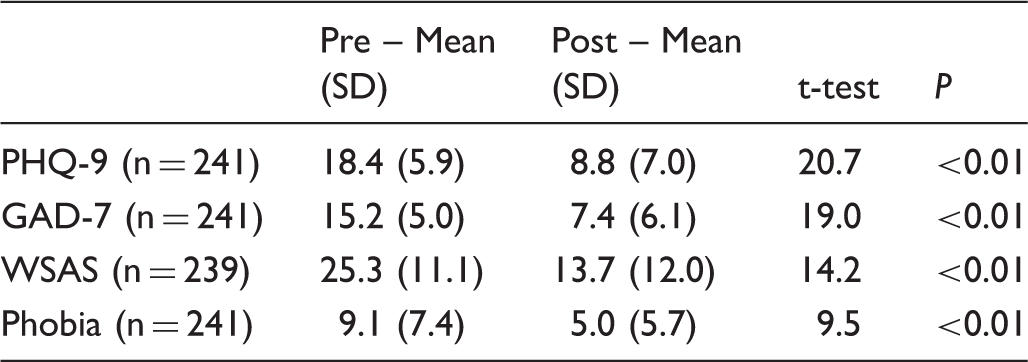
Suicidal ideation was measured by item 9 of the PHQ-9. At intake, 21.8% (N = 45) of the patients reported suicidal ideation ‘nearly every day’. After treatment, most of these patients (80%) experienced reductions in the frequency of suicidal ideation. For the treatment group (N = 241), a paired t-test indicated a highly significant improvement on item 9, PHQ-9, t(265) = 0.55, p < 0.01; with a large effect size (eta squared = 0.5). One patient completed suicide within 48 hours of the initial ED assessment representing 0.3% mortality over 12-months. This patient was assessed by an IAPT therapist in ED and followed up with a further face to face interview (accompanied by risk assessment) within 24 hours. Collaborative plans were then made and agreed upon with a further follow-up arranged for 3 days’ time.
We carried out further analysis of outcomes to see if the changes in PHQ-9 and GAD-7 as well as recovery rates varied as a function of the duration of the patients’ presenting problem (defined as the period of time patients had suffered from symptoms). A one-way between groups analysis of variance was conducted to explore the impact of duration of presenting problem on change in GAD-7 and PHQ-9 scores. The duration of presenting problem was divided into 3 groups; <6 months, 6 months – 2 years and over 2 years. There was a statistically significant difference in GAD-7 scores changes (p = 0.03) between the 3 groups but the effect size was small (eta squared = 0.03). The mean change for participants who had presenting problem between 6 months – 2 years, 6.0 (SD = 5.7) was significantly lower than the mean change observed in participants who had presenting problem for less than 6 months, 9.4 (SD = 6.3) according to Post-hoc comparison using Tukey HSD test.
Outcomes at follow-up
All 241 eligible participants who had completed at least 2 sessions and finished treatment were followed up. 64 participants (27%) responded and provided the data.
Clinical outcomes for depression and anxiety comparing pre and post IAPT scores at follow-up.
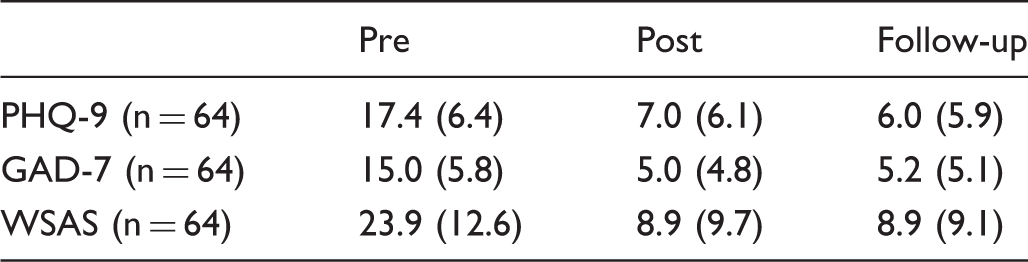
Anova analysis showed patients showed a significant improvement in PHQ-9, GAD-7 and WSAS at follow-up compared to initial assessment (p < 0.01). There was a modest but not significant drop in PHQ-9 score of 1.0, between post treatment and follow-up, 1 month later (p = 0.1). With GAD 7 and WSAS there was a small but not significant increase in scores between post and follow-up, 1 month later.
Discussion
The current study is the first outcome study of the Australian ED IAPT for emergency mental health referrals. Before treatment, most patients had experienced chronic mental health difficulties and were prescribed psychotropic medications. The UK IAPT inclusion criteria were extended for the study and the treatment group included many patients with substance use (51%) and suicidal risk (22% reported suicidal ideation ‘nearly every day’). These problems have been excluded in previous trials of IAPT, which have taken place in British primary care settings. Despite the inclusion of a higher-risk group referred after ED crisis presentations, the Australian ED IAPT was still associated with clinically significant improvements in anxiety, depression and suicidal ideation with large treatment effects. At the end of treatment, the recovery rate was around 59%, which is similar to the rate found in the British primary care demonstration trials (Richards and Borglin 9 ) but higher than the overall NHS average for IAPT of 45%. It is also important to note that symptomatic improvement (PHQ and GAD) was accompanied by significant changes in functional outcomes for work and social adjustment (WSAS). This functional improvement could reflect the resolution of psychosocial crises and reduce the risk of further illness relapse.
Most patients had previous crisis presentations to the ED, often on repeated occasions in the preceding months. These crisis presentations contributed to the demand in an ED facing mental health access block. This is a common occurrence around Australia with high-prevalence disorders such as anxiety, depression and substance use accounting for the majority of ED mental health occasions-of-service. In the current study, IAPT was designed to change patterns of service use by providing patients with empirically supported treatment that could be delivered in timely and flexible ways.
Overall, the Australian ED IAPT was associated with decreased suicidal ideation as measured by the PHQ-9 depression questionnaire. The PHQ-9 suicidal ideation item is strongly predictive of suicide attempts and completed suicide among outpatients 39 especially among those with the highest frequency of ideation. However, while suicide risk decreased for the overall group.
The limitations of the study are typical of those found in clinical interventions. Firstly, the study did not include a control group. ‘No treatment’ controls are not possible for studies including suicidal patients. Hence, it is difficult to investigate true spontaneous remission rates among ED crisis patients. It is however important to note that ‘treatment-as-usual’ can be accompanied by substantially reduced distress over the first month after an ED presentation as the patient’s immediate crisis resolves 40 (Brown et al, 2005). Future studies could compare IAPT with ‘treatment-as-usual’.
In addition, outcomes were assessed using self-report questionnaires collected by the treating therapists as part of session-by-session monitoring. This limited the pre and post comparisons to the length of treatment cycle and longer-term follow-up is required to establish medium term clinical outcomes over a 6--12 month period. Clinicians collecting questionnaires may have introduced bias into patient reporting. While this is a standard feature of IAPT, it would be desirable to have independent assessors in future studies.
Finally, a substantial proportion of the treated group showed only partial improvement.
In conclusion, the IAPT program was useful for addressing a recognised gap in patient care after ED crisis presentations. IAPT provided a useful template for evidence-based service delivery and was associated with clinically significant improvement for most patients. These findings are relevant for the increasing number of patients who present to Australian EDs seeking help for anxiety, depression, suicidal risk and co-morbid substance abuse. Further large-scale controlled studies are required to replicate the efficacy of IAPT for ED mental health patients.
Footnotes
Declaration of conflicting interests
The authors declared no potential conflicts of interest with respect to the research, authorship, and/or publication of this article.
Funding
The authors disclosed receipt of the following financial support for the research, authorship, and/or publication of this article: The Flinders Medical Centre IAPT program received Emergency Department project funding from the Australian Commonwealth Government through the Council of Australian Governments (COAG) and the South Australian Government initiative, Every Patient Every Service (EPES).