



Abstract
On January 1, 2024, a major earthquake struck Japan's Noto Peninsula. From 2021 to 2023, we conducted a baseline survey. Four months after the disaster, we conducted a follow-up survey to investigate the relationship between house damage and forgetfulness in older adults without dementia. A total of 923 individuals were included. Among the respondents, 32.2% and 33.8% reported as suffered major house damages and increased forgetfulness, respectively. Multivariate analysis revealed major house damage was significantly associated with self-reported forgetfulness, which are partly mediated through sleep disturbance and sedentary behavior in the cognitively unimpaired and mild cognitive impairment groups, respectively.
Keywords
Introduction
On January 1, 2024, a major earthquake struck Japan's Noto Peninsula. 1 A particular concern for older adults is the cognitive decline resulting from environmental changes caused by disasters. 2 Individuals experiencing large-scale disasters often have to shift to evacuation shelters or change their living environment due to house property damage, resulting in sleep disturbance, decreased physical activity and social contact. These are known to be risk factors for cognitive decline in older people. 3 The short-term effect of property damage was reported that older adults who have to stay at an evacuation shelter showed significantly cognitive decline approximately within six months of a disaster. 4
Numerous studies have examined the effects of large-scale disasters on the health of older people, reporting that older survivors are at a higher risk of deteriorated cardiometabolic profiles, 5 functional disability, 6 depressive symptoms, 7 and cognitive decline2,8 two to five years following the occurrence of a disaster. However, relatively few studies have examined the short-term effects of disasters on their cognitive function within a year. Older adults with cognitive decline do not necessarily worsen, but can potentially improve their cognition over time if they have appropriate lifestyles such as regular physical activities. 9 Therefore, we would like to clarify which disaster-related experiences are associated with cognitive decline in a short period and consider what kind of support can help prevent post-disaster cognitive decline and provide support as soon as possible after a disaster occurs.
It was reported that 12.3% of community-dwelling individuals aged 65 and over have dementia and 15.5% had mild cognitive impairment (MCI) in Japan. 10 Compared with individuals who are cognitively unimpaired (CU), individuals with MCI are thought to be more susceptible to the effects of large-scale disasters on their cognitive function. 11
The Nakajima study is an ongoing population-based longitudinal cohort study that investigates cognitive decline in older Japanese individuals. The study was conducted in Nakajima, Nanao City, a part of Noto Peninsula, Japan, and its design has been described previously.12-14 From September 2021 to November 2023, one month prior to the 2024 Noto Peninsula earthquake, a total of 2060 residents aged 65 years or older participated in the screening examination for dementia. Approximately four months after the disaster struck, we reconnected with the participants to examine the relationship between house property damage and cognition through a questionnaire survey.
In this study, we prospectively examined the relationship between disaster-related experiences and post-disaster memory complaints, using data procured on community-dwelling older adults, including cognitive function immediately before the disaster struck.
Methods
Study population
The Noto Peninsula earthquake had a magnitude of 7.6, killing 358 residents, injuring 1211 residents, damaging 84,005 homes, and causing 34,173 evacuations. Furthermore, Nanao City endured significant damage from the earthquake, resulting in 14 deaths (9 of which were disaster-related) and 15,713 damaged homes. The Nakajima study was conducted in an area within Nanao City located ∼90 km south of the epicenter of the Noto Peninsula earthquake (Figure 1A).

Figure 1A. Map of Noto peninsula, Japan. Figure 1B. Flow chart of individuals enrolled in the study.
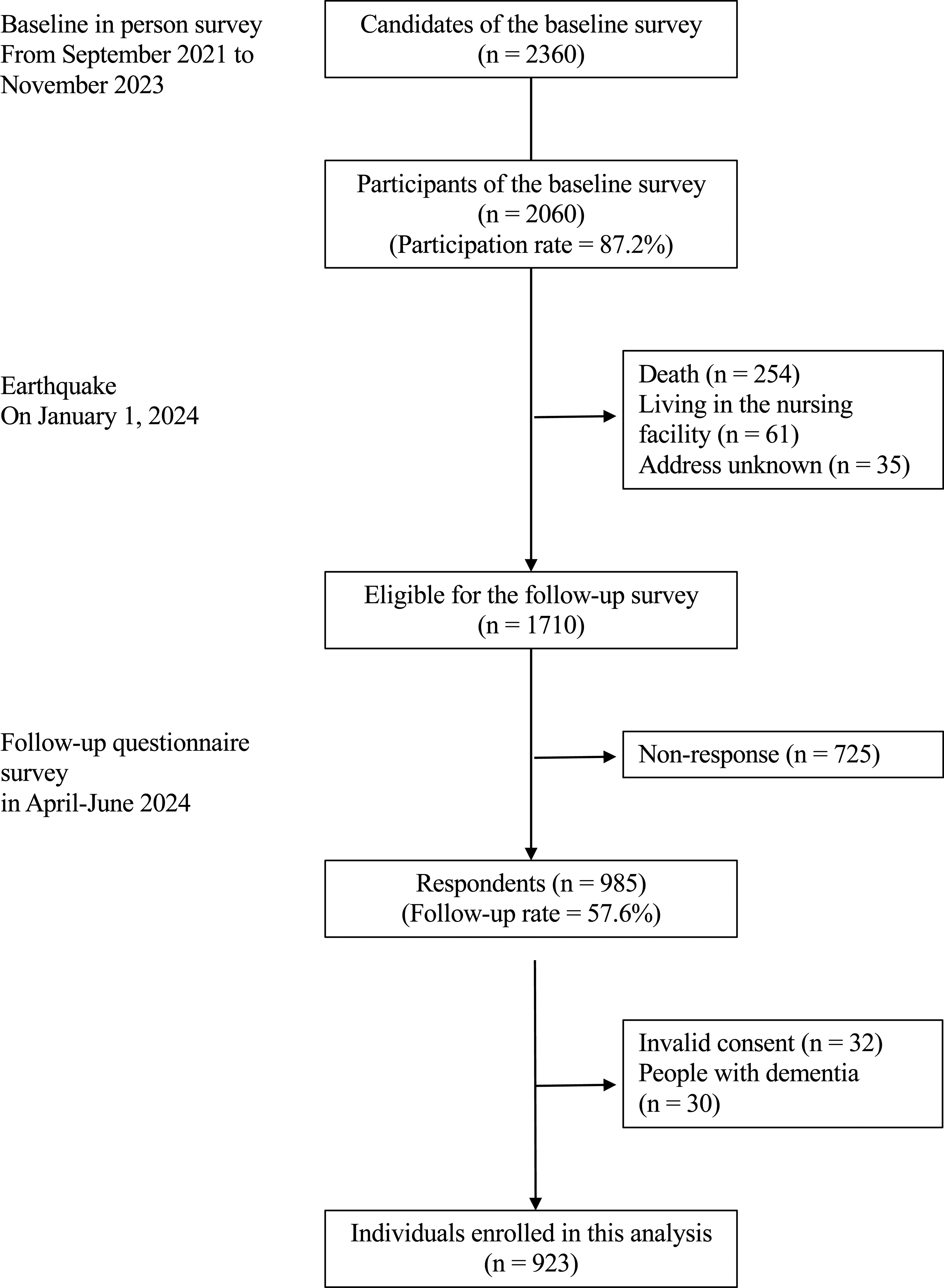
In the baseline survey, 2360 older adults were considered potential candidates who were residing in Nakajima, Nanao-city in April 2021, aged ≥65 years. A total of 2060 older adults participated in the baseline survey (participation rate = 87.2%) (Figure 1B). In the baseline survey, to diagnose MCI or dementia, the standardized method was used, which described elsewhere. 15 In short, the 1st survey was conducted by trained doctors, nurses, and clinical psychologists using the Mini-Mental State Examination, 16 and the presence of MCI or dementia was determined by expert neurologists in the 2nd survey. MCI and dementia were confirmed using the clinical criteria defined by Petersen et al. 17 and the Third Diagnostic and Statistical Manual of Mental Disorders, Revised Edition (DSM-III-R). 18 We conducted the follow-up survey after the disaster (starting April 2024). Subsequently, the questionnaires were mailed to community-dwelling older adults (n = 1710) who had participated in the baseline survey, excluding 254 who died before the earthquake struck, 61 who were residing in nursing facilities, and 35 whose addresses were unknown (Figure 1B). Participants completed the signed self-administered questionnaires and returned them by mail.
Standard protocol approvals and participant consent
This study was conducted in accordance with the guidelines of the Declaration of Helsinki and all procedures were approved by the Medical Ethics Review Board of Kanazawa University (Approval Number 2186 and 114484). We obtained written informed consent from all participants during the baseline survey. Returning the questionnaire by mail in the follow-up survey was considered as consent.
Assessment of house property damage
Housing damage was assessed in accordance with objectively established criteria for the purpose of compensation for victims. Damages were classified into five levels: (i) no damage, (ii) partial damage, (iii) partially destroyed, (iv) destroyed on a large scale, and (v) totally destroyed. The analyses were conducted by classifying (i) no damage and (ii) partial damage into the “minor house damage” group, and (iii) partially destroyed, (iv) destroyed on a large scale, and (v) totally destroyed into the “major house damage” group.
Outcome variables
Subjective memory complaints (SMC) in older adults have been identified as a risk factor for dementia. 19 Participants were asked a single, original question through a self-administered questionnaire: “Do you consider yourself to have become more forgetful since the 2024 Noto Peninsula earthquake?” They were then asked to choose from four options: strongly agree, agree, disagree, strongly disagree. The analyses were conducted by classifying “strongly agree” and “agree” as perceived forgetfulness.
Other risk factor measurements
In the baseline and follow-up surveys, each participant completed a self-administered questionnaire containing questions on sociodemographic data (age, sex, and educational level), medical history (diabetes mellitus and hypertension), drug information, and smoking and drinking habits. We additionally examined a set of variables as potential mediators of the relationship between property damage and subjective memory complaints. These included sleep disturbance, sedentary behavior, and social contact.
Statistical analysis
Demographics variables were evaluated using the t-test and chi-squared test for continuous and categorical variables, respectively. Generalized linear models (binominal distribution and logistic regression model) were used to analyze the independent effects of house property damage and self-reported forgetfulness. The model 1 were adjusted for variables such as age, sex, educational level, hypertension, diabetes mellitus, and dyslipidemia. The model 2 were adjusted for smoking and drinking habits in addition to the model 1.
Furthermore, mediation analyses were conducted to calculate the proportion of the relationship between house property damage and self-reported forgetfulness attributable to the mediating effects of sleep disturbance, sedentary behavior, changes in social contact, smoking habits, or drinking habits. The SPSS procedure PROCESS was used for the mediation analyses. Our hypothesized conceptual model is illustrated in Supplemently Figure 1. The SPSS software (version 26; SPSS Inc., Chicago, IL, USA) was used to perform all statistical analyses.
Results
Characteristics of participants
Of the 1710 eligible participants from the baseline survey, 985 responded (follow-up rate: 57.6%). After excluding 32 responses due to invalid consent, our analytic sample comprised 953 participants (Figure 1B). Among these 953 individuals, 854 were diagnosed as CU in the baseline survey (89.6%), 69 were diagnosed with MCI (7.3%), and 30 were diagnosed with dementia (3.1%). Due to the relatively small number of individuals with dementia (n = 30), the subsequent analyses focused on individuals who were CU and had MCI.
The demographics and characteristics were presented from the baseline and follow-up surveys according to cognition (Table 1A). The follow-up survey was conducted approximately 1.5 years after the baseline survey. The mean values of age were significantly higher and education levels were significantly lower in the MCI group compared with the CU group (Table 1A). Among the respondents, 32.2% reported partially destroyed, destroyed on large scale, or destroyed homes in the diaster, 46.6% used evacuation shelters, 39.0% reported sleep disorders, and approximately one-third of the subjects reported increased sedentary behavior and self-reported forgetfulness following the disaster (Table 1A). There were no significant differences in the prevalence of hypertension, diabetes mellitus, dyslipidemia, or current smoking and drinking habits between the baseline and follow-up surveys in either the CU or MCI group. Furthermore, when comparing characteristics between the CU and MCI groups in the follow-up survey, the prevalence of dyslipidemia was significantly lower in the MCI group. Moreover, the MCI group displayed significantly increased sedentary behavior and self-reported forgetfulness compared with the CU group (Table 1A).
Demographics and characteristics in the baseline and follow-up surveys according to cognition.
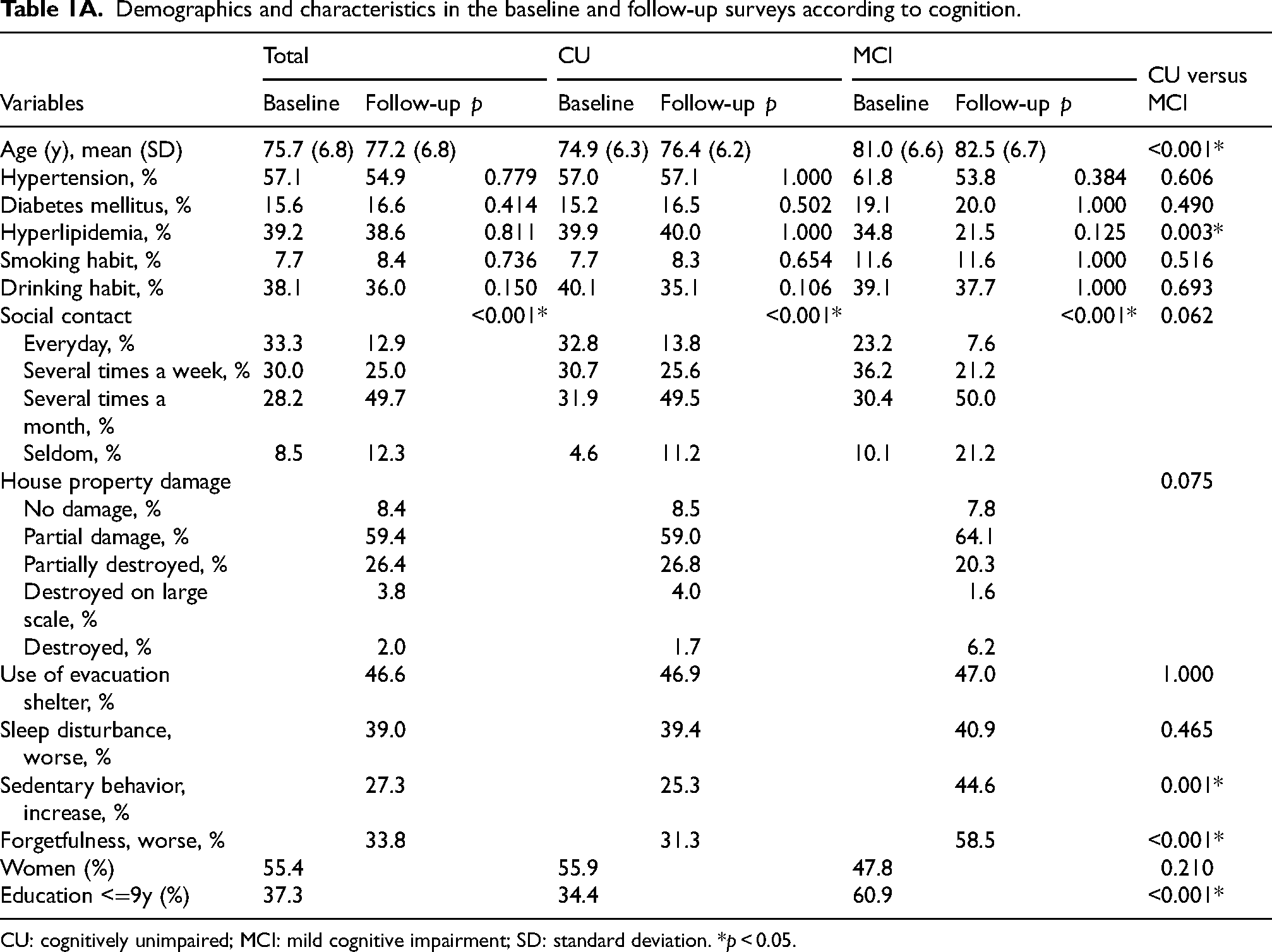
CU: cognitively unimpaired; MCI: mild cognitive impairment; SD: standard deviation. *p < 0.05.
Table 1B presents data on sleep disturbance, sedentary behavior, changes in social contact, and self-reported forgetfulnesss in the follow-up study according to cognition and house property damage. There were no differences in age, sex, years of education, smoking habits, or drinking habits between the minor and major house damage groups. The prevalence of the use of evacuation shelters was significantly higher in the major house damage group compared with the minor house damage group. Moreover, the major house damage group exhibited significantly increased sleep disturbances, sedentary behavior, and self-reported forgetfulness compared with the minor house damage group (Table 1B). We also analyzed that sleep disturbance, sedentary behavior, changes in social contact, and self-reported forgetfulness according to cognition and use of evacuation shelter. The prevalence of women were significantly higher in the evacuation shelther user group compared with the non-user group. The prevalence of the major house damage was significantly higher in the evacuation shelther user group compared with the non-user group. Moreover, the evacuation shelther user group exhibited significantly increased sleep disturbances, sedentary behavior, and self-reported forgetfulness compared with the non-user group (Supplemental Table 1). Additionally, we analyzed the demographics and comorbidities which are associated with cognitive decline according to self-reported forgetfulness. The age, the prevalence of diabetes mellitus, and hyperlipidemia were significantly higher, and the education period were significantly lower in people who asserted forgetfulness than people who did not (Supplemental Table 2).
Demographics and health variables according to cognition and house property damage.
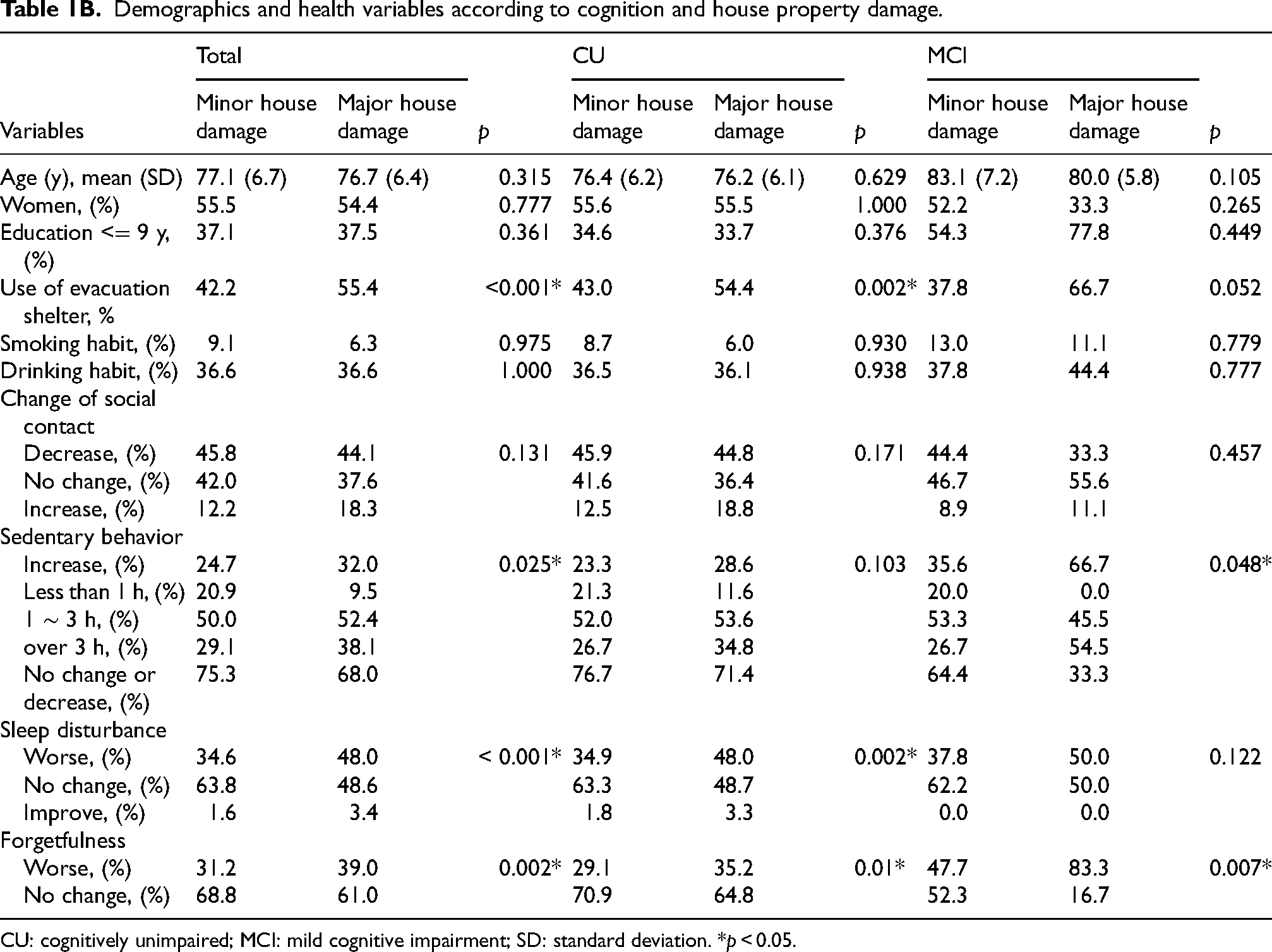
CU: cognitively unimpaired; MCI: mild cognitive impairment; SD: standard deviation. *p < 0.05.
Next, we conducted a multivariate analysis to consider the possibility that house property damage may have influenced self-reported forgetfulness in older adults. As indicated in Table 2A, major house damage was significantly associated with self-reported forgetfulness in the CU and MCI groups. Regarding the use of evacuation shelter, we did not find the significant association between use of evacuation shelter and self-reported forgetfulness in either in the CU nor MCI groups (Supplemental Table 3).
Relationship between house property damage and self-reported forgetfulness.

CU: cognitively unimpaired; MCI: mild cognitive impairment. Values are presented as β (95% confidence interval).
Model 1 was adjusted for age, sex, educational level, hypertension, diabetes mellitus, and dyslipidemia.
Model 2 was adjusted for age, sex, educational level, hypertension, diabetes mellitus, dyslipidemia, smoking habits, and drinking habits.
Finally, we performed a mediation analysis to assess the extent to which sleep disturbance, sedentary behavior, social contact, and smoking or drinking habits mediated the association between house property damage levels and self-reported forgetfulness (Table 2B). Overall, house property damage levels had a significant indirect effect on self-reported forgetfulness through sleep disturbance and sedentary behavior. In the CU group, this effect was mediated through sleep disturbance, whereas in the MCI group, it was mediated through sedentary behavior.
Mediation analysis of the impact of sleep disturbance, sedentary behavior, and changes in social contact due to house property damage and self-reported forgetfulness.

CU: cognitively unimpaired; MCI: mild cognitive impairment. *p < 0.05.
Discussion
Our study revealed the significant association between major house damage and self-reported forgetfulness in community-dwelling older adults who were diagnosed as CU or with MCI based on their cognitive function immediately before the disaster. It is well known that individuals with MCI find it challenging to adapt to environmental changes such as house property damages, relocation, and displacement associated with large-scale disasters.2,6,20 However, we were able to demonstrate for the first time that the impact of environmental changes on self-reported forgetfulness caused by a disaster is stronger in individuals with MCI than in those who are CU. In addition, we demonstrated that the relationships between greater housing damage and self-reported forgetfulness were mediated partly through sleep disturbances in the CU group and sedentary behavior in the MCI group, which could be a potential mechanism underlying the link between housing damage and cognitive function or dementia. Living in temporary housing, 8 relocation 20 as well as house property damage 2 were all reported as long-term risk factors for large-scale disaster-related cognitive decline in older adults. Our findings showed that house property damage might be short-term risk of cognitive decline for older adults especially with MCI. Additionally, we showed that better sleep and less sedentary time might prevent cognitive decline when large-scale disaster occurred.
SMC, or subjective cognitive decline (SCD), is a risk factor for dementia. 19 Individuals with SCD generally possess normal cognitive abilities; however, they report experiencing subjective cognitive decline. 21 Our study demonstrated that house property damage was associated with SCD, partly mediated through sleep disturbances. Growing evidence suggests that sleep disturbances are a risk factor for cognitive decline. 22 Sleep disturbance is a psychological symptom that is exacerbated by natural disasters and house property damage, and it is also possible that chronic sleep disturbance can worsen mental health disorders. 23 Moreover, Alzheimer's disease is one of the leading causes of dementia, and the deposition of amyloid-β protein in the brain is the earliest pathological indicator of this disease. It was reported that sleep duration and poor sleep quality are significantly associated with cortical amyloid burden in older adults,24,25 suggesting that amyloid deposition is caused by disrupted sleep–wake mechanisms. Therefore, it is important to identify and treat individuals with sleep disorders after a disaster to maintain their cognitive and mental health.
In the MCI group, house property damage was associated with self-reported forgetfulness, partly mediated through sedentary behavior. Additionally, more time spent indulging in sedentary behavior is a risk factor for dementia. 26 It is possible that environmental changes such as house property damage due to a disaster reduces the time spent being physically active and increases the time spent indulging in sedentary behavior.
This study has several limitations. First, we were unable to administer assessments, such as the Mini-Mental State Examination, to measure cognitive impairments during the follow-up survey since it was conducted by mail. Second, we could not assess the medication use which may be related to subjective cognitive decline. Third, SMC assessmten was measured by one simple question. There were some studies which also measure SMC by one simple question such as “Do you feel like your memory has become worse?”27–30 and some of them revealed SMC reporters are at a higher risk of furture dementia 27 or MCI. 29 Forth, selection bias may exist due to the 57.6% response rate to the follow-up survey. However, this response rate is comparable to that of similar surveys involving community-dwelling older adults. 2
In conclusion, experiences of housing damage were significantly associated with self-reported forgetfulness in the MCI and CU group, and these associations were partly mediated through sleep disturbances and sedentary behavior in the CU and MCI groups, respectively.
Supplemental Material
sj-docx-1-alz-10.1177_13872877251335005 - Supplemental material for Housing damage and forgetfulness following the 2024 Noto Peninsula earthquake, Japan
Supplemental material, sj-docx-1-alz-10.1177_13872877251335005 for Housing damage and forgetfulness following the 2024 Noto Peninsula earthquake, Japan by Moeko Noguchi-Shinohara, Taro Ozaki, Yuta Usui, Syutaro Shibata, Ayano Shima, Junji Komatsu and Kenjiro Ono in Journal of Alzheimer's Disease
Footnotes
Acknowledgments
We wish to thank all residents of Nakajima town for their participation in this study.

Ethical considerations
This study was conducted in accordance with the guidelines of the Declaration of Helsinki and all procedures were approved by the Medical Ethics Review Board of Kanazawa University (Approval Number 2186 and 114484).
Consent to participate
We obtained written informed consent from all participants during the baseline survey. Returning the questionnaire by mail in the follow-up survey was considered as consent.
Consent for publication
Not applicable.
Author contributions
Moeko Noguchi-Shinohara (Conceptualization; Formal analysis; Investigation; Writing – original draft); Taro Ozaki (Investigation; Writing – original draft); Yuta Usui (Investigation); Syutaro Shibata (Investigation); Ayano Shima (Investigation); Junji Komatsu (Investigation); Kenjiro Ono (Conceptualization; Project administration; Supervision; Writing – review & editing).
Funding
The author(s) disclosed receipt of the following financial support for the research, authorship, and/or publication of this article: This study was supported by the Japan Agency for Medical Research and Development (JP23dk0207053). The sponsor had no role in the design and conduct of the study; collection, management, analysis, and interpretation of the data; or preparation, review, or approval of the manuscript.
Declaration of conflicting interests
The authors declared no potential conflicts of interest with respect to the research, authorship, and/or publication of this article.
Data availability
The data supporting the findings of this study are available on request from the corresponding author. The data are not publicly available due to privacy or ethical restrictions.
Supplemental material
Supplemental material for this article is available online.
References
Supplementary Material
Please find the following supplemental material available below.
For Open Access articles published under a Creative Commons License, all supplemental material carries the same license as the article it is associated with.
For non-Open Access articles published, all supplemental material carries a non-exclusive license, and permission requests for re-use of supplemental material or any part of supplemental material shall be sent directly to the copyright owner as specified in the copyright notice associated with the article.
