



Abstract
The development studies community needs to work towards building cumulative knowledge that lies between all-encompassing universal truths that leads to a ‘one solution fits all’ approach, on the one hand, and empirically rich atheoretical context-specific details, on the other. Drawing on the comparative capitalism research, which operates at the ‘middle-range’, the article demonstrates the usefulness of comparative (historical) institutional analysis as a way of deriving middle-range insights on capitalism and development, and in particular, the highly contested practice of embedding foreign institutions in local contexts (often referred to as ‘institutional transplantation’) that prevails in development policy. It illustrates how middle-range theory building in this area can advance development research in a way that better informs policy and practice.
Keywords
I Introduction: Towards middle-range theory building in development research
There is no shortage of theories in development studies. There are a number of ‘grand’ theories in the cognate areas of sociology, political science and economics that have long informed development research and policy. These include modernization theory, neoclassical (and neoliberal) theory, Marxist theories such as dependency and world-systems theories, Keynesian (and state interventionist) theories, and more recently new institutional theory, especially the rational choice variant. What unites these grand theories is their proclivity to view development as a universal and linear progression towards economic growth and prosperity (or the so-called ‘project of modernity’), which perpetuates the notion of ‘one solution fits all’ (Guillen, 2001: 12). The critics of grand theorizing have stressed the need to demonstrate sensitivity towards context specificity, which in turn has led to the abundance of fine-grained in-depth empirical case studies that are, by and large, atheoretical. While providing rich detail that often gets overlooked when relying on grand theories, the notion that ‘every case is different’ has done little to generate useful knowledge with potential to advance policy and practice, without substantive engagement with theory (Rueschemeyer, 2009).
The knowledge void that exists at the ‘middle-range’ – a middle ground between ‘the all-inclusive systemic efforts to develop a unified theory’ and ‘the minor but necessary working hypotheses that evolve in abundance during day to day research’ (Merton, 1968: 39) is not unique to development studies. In fact, the very term ‘middle-range’ was first used by sociologist Robert Merton as an alternative to Talcott Parson’s grand (abstract) theorizing that defined the terms of sociological research in the post-World War II period (Boudon, 1991; Reuschemeyer, 2009). In development studies, however, the need to fill this gap is particularly critical and immediate as the very nature of the discipline demands that its researchers not simply seek to understand the world around them for the sake of advancing knowledge, but also to serve the policy actors who seek to better it.
The consequences of our inability to generate useful knowledge at the middle-range are most obvious in the study of modern capitalism and development. The ‘rediscovery’ of institutions in the form of ‘new’ (as opposed to ‘old’) institutional theory has not led to greater sensitivity to distinct national contexts as one might have expected. Rather, it has led to the framing of ‘best practices’ in terms of Anglo-American institutions, the applicability of which is presumed to transcend national contexts. The serious dangers associated with the policy and practice of embedding foreign institutions in local contexts (hereinafter, ‘institutional transplantation’) has been well highlighted by its critics, many of whom point to the need to be sensitive to local conditions (see the special issue on institutional transplantation edited by Dunning and Pop-Eleches, 2004). The failure of international financial organizations to transplant Anglo-American ‘liberal’ capitalism to Russia is an obvious and oft-cited example. Yet, despite the dangers, the practice of institutional transplantation continues because it is seen as the only strategy currently available to the international development community. This is because even if the actual merits and context appropriateness of ‘liberal’ institutions in ‘non-liberal’ contexts are questionable, without sufficient theorization of how certain contexts influence the processes and outcomes of institutional change at the middle-range, transplanting institutions is believed to be a superior option to simply ‘muddling through’ (Evans, 2004).
Hence, the article is devoted to thinking about how best to promote middle-range theory building, focusing on the problem of institutional transplantation in the context of modern capitalist development. To this end, the article begins with an examination of the comparative institutional analysis (CIA) as an analytic tool that enables researchers to operate at the middle-range. It then explores how comparative capitalism research employs CIA to derive insights on the processes and outcomes of institutional diffusion. Drawing on these insights, the article goes on to illustrate – through the CIA of Germany and Japan in the post-World War II period – the importance of the agency of local actors, as embedded in a socio-political context at a given historical time, when studying institutional transplantation. The article argues that the systematic investigation into the politics that underpin pre-existing institutional arrangements can generate cumulative knowledge at the middle-range with the potential to inform policy and practice.
II Comparative institutional analysis and middle-range theory building
CIA is an analytic approach that conjoins comparative methods with new institutional theory. It is championed by comparative capitalism literature as a ‘hook’ to link grand theories with local contexts (Morgan et al., 2010). New institutional theory is a vast literature comprised of many different schools of thought within. Table 1 provides a summary of the three key variants in new institutional theory in the interest of space (for a concise account of the difference between the ‘new’ and ‘old’ institutional theory, see Djelic, 2010). In reality, the distinction between rational choice, historical and sociological/organizational approaches is not as stark as portrayed in Table 1. In fact, in recent years, there has been some convergence between rational choice and historical institutionalisms as they seek to overcome their own limitations.
Nonetheless, variations do exist, and they have important implications for research. For instance, there are notable differences in the use of ‘path dependency’ – a key concept that new institutional theorists invoke as the causal explanation for change (or more accurately, lack of change). As explained by Djelic and Quack (2007), rational choice and some segments of sociological institutionalisms endorse a ‘strong’ version of path dependency, relying on rationalist epistemology and formal methodology. It views the outcome as related stochastically to the initial conditions, and the contingent historical events that set into motion institutional patterns with deterministic properties. In contrast, historical institutionalism, inspired by comparative historical sociology (for example, Moore, 1969; Skocpol, 1979, 1984), endorses a ‘weaker’ version of path dependency. It does not make strong claims about the historical sequence and contingency of these variables, but views the past as constitutive, but not determinative, of the present. Historical institutionalism relies on a weaker version to open up the analytical space required to examine agency, not as that which is context-free, but as that which is embedded in a given socio-political context at certain points in history (Thelen, 1999). However, unlike the way historians treat history, historical institutionalism places emphasis on generating theoretical propositions, even in this essentially interpretive exercise (Djelic, 2008; Sewell, 1996).
In comparison to rational choice institutionalism, the historical variant may appear less ‘neat’ in its analysis, and have less theoretical bite in terms of predictive power. However, it is the latter that has greater potential to capture the complexities of empirical reality. This is because of its treatment of history allows context-specificity to be taken seriously. At the same time, what enables historical institutionalism to go beyond its empirical context to generate propositions with some degree of generalizability (even if they are narrowly circumscribed) is the comparative method, which is the second component of CIA. A lengthy elaboration on comparative method is beyond the scope of this article (for a more detailed, first-rate discussion on the comparative method, refer to Tilly (1989)). To briefly elaborate its relation to theory building, for comparison to play its role as a theoretic lever at the middle-range, it requires a combination of (a) delimited substantive focus through clear ‘scope conditions’ that serve to constrain the universal applicability of the derived propositions (Harris, 1997; MacIntyre, 1978); and (b) systematic conceptualization of comparisons, which allows the space, within the specified scope conditions, for ‘variation-finding’ exercise so as to establish a principle of variation in the character or intensity of a phenomenon by examining systematic differences among instances (Tilly, 1989: 82). The variation finding exercise is where the complexities of comparisons lie as it demands, on the one hand, sensitivity to the problems associated with ‘conceptual-stretching’ (Collier and Mahon, 1993), and on the other, the ability to recognize ‘functional equivalents’ so that ‘apples’ (which may be disguised and dismissed as ‘oranges’ by an untrained eye) are taken seriously and compared with other ‘apples’ (Locke and Thelen, 1995).
Three variants of new institutionalism
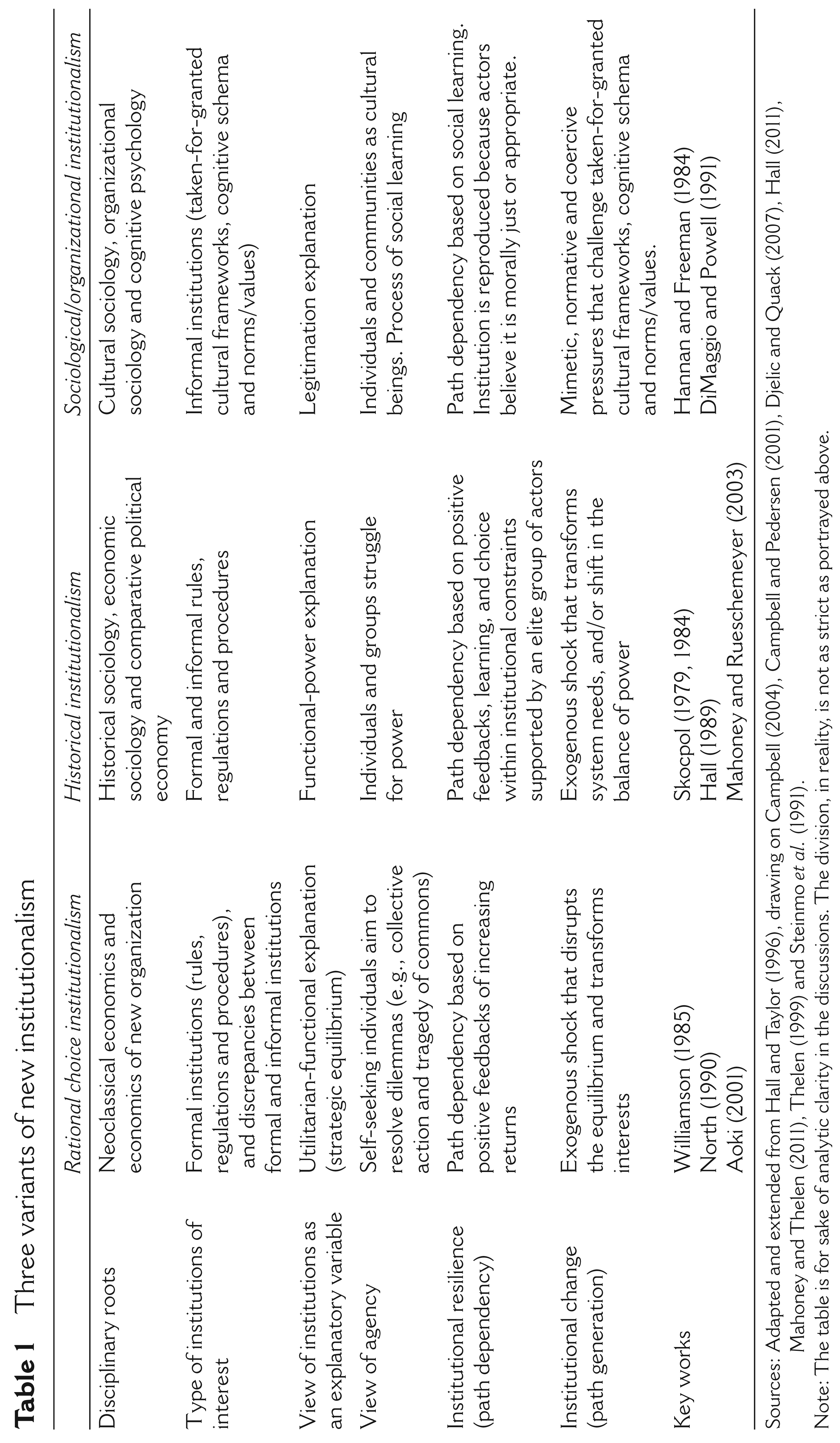
Sources: Adapted and extended from Hall and Taylor (1996), drawing on Campbell (2004), Campbell and Pedersen (2001), Djelic and Quack (2007), Hall (2011), Mahoney and Thelen (2011), Thelen (1999) and Steinmo et al. (1991).
Note: The table is for sake of analytic clarity in the discussions. The division, in reality, is not as strict as portrayed above.
III Comparative capitalism as a theory of the middle-range
The comparative capitalism literature has long championed the use of CIA to enhance of our knowledge of modern capitalism at the middle-range (see Morgan et al., 2010). Comparative capitalism is a vast literature, but as a body of work, it shares common worldview that there is not a single, but multiple ways of organizing modern capitalisms (for an example of earlier work in this tradition, see Dore (1973), and for representative works that have emerged in the last decade or so, see Amable (2003), Hall and Soskice (2001), Hancké et al. (2007), Streeck and Yamamura (2001) and Walter and Zhang (2012)). The central tenet of the literature is that economic growth and progress entails ‘a process by which countries and [their leading] firms seek to find a unique place in the global economy that allows them to build on their pre-existing economic, social, and political advantages’ (Guillen, 2001: 12). As outlined in Table 2, the focus on theorizing the varied ways in which countries coordinate their political economies is what distinguishes this set of literature from the grand theories that have shaped much of the development research and policy.
To operate at the middle-range, the comparative capitalism research delimits its substantive focus through scope conditions; namely, modern (industrial) capitalist societies with state capacity to uphold formal institutional arrangements in the key areas of the system, such as those that govern the behaviour of capital (namely, the financial system) and labour (namely, the industrial relations system, the labour market, and the skills and education system). National systems of corporate governance have received significant attention by the researchers in the field as a sphere in which the institutional arrangements governing capital and labour intersect at the firm level, and with time co-evolve to attain ‘institutional complementarity’; that is, a process of mutual reinforcement (positive feedback) between institutions (or sets of institutions) that accords its leading firms competitive advantage in certain activities (Jackson, 2001; Jackson and Moerke, 2005). While the literature focuses on national experiences for the reason that nation-states are the main ‘containers of institutions’ (Morgan, 2005), to ensure that it does not remain trapped in a particular national setting, the literature relies on systematic conceptualization of comparisons by using ‘models’ of capitalism (as ‘ideal-types’ in the Weberian sense of conceptual devices built on stylized account of empirical reality) (Weber, 1949). Models made up of cross-national, and even cross-regional comparisons are techniques employed to avoid the pitfalls of being confined to a specific country or regional settings, and to facilitate middle-range theory building.
While there is no agreement on how many models of capitalism exist (Crouch, 2005a), the literature distinguishes broadly between ‘liberal’ and ‘non-liberal’ models (Streeck and Yamamura, 2001: 5–6). The ‘liberal’ model is often used as the default (or baseline) for comparison, and refers to a capitalist system coordinated predominantly by the market mechanism. In this model of capitalism, the financial system consists of a well-developed stock market system and arm’s length relations between financial and non-financial capital, which incentivizes financial capital to lend for the short term and behave ‘impatiently’ for returns on profit. Meanwhile, industrial relations are individualized and contract based, encouraging labour market flexibility. When the two institutional arrangements co-evolve and attain complementarity at the firm level, its corporate governance system, which gives primacy to shareholders’ interests above those of other stakeholders (that is, ‘shareholder value’), creates the temporal conditions in which managers can experiment with shorter term and more flexible investment strategies. Hence, firms in the liberal model, enjoy a comparative institutional advantage in radical innovation industries, as they are able to raise capital quickly and are encouraged to adapt rapidly to shifting market conditions and opportunities. Anglo-Saxon countries, such as the United States and the United Kingdom, where neoliberalism has flourished, are considered to be the exemplars of this model (Amable, 2003; Hall and Soskice, 2001).
Key theories of capitalism and development
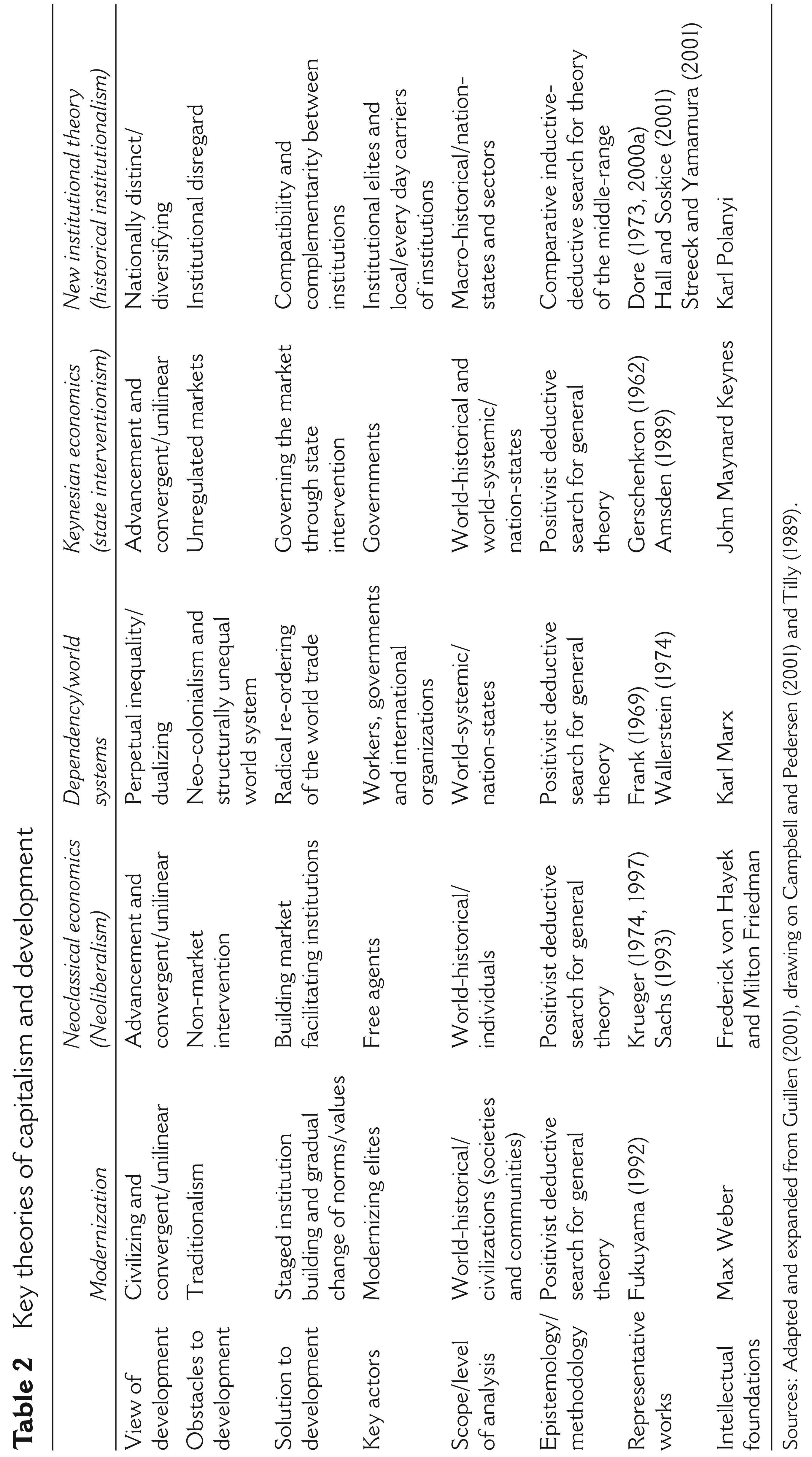
Sources: Adapted and expanded from Guillen (2001), drawing on Campbell and Pedersen (2001) and Tilly (1989).
The ‘non-liberal’ model refers to alternatives to the liberal model, and relies on non-market mechanisms for coordination. Those seeking to further refine the non-liberal model, through variation-finding exercises, have identified the varying institutional logics at work within the non-liberal category; namely, non-market coordination based on neo-corporatism (as exemplified by Germany and Japan), and those based on the state (as exemplified by France and South Korea) (Kang, 2010; Lee and Yoo, 2007; Schmidt, 2003). In the neo-corporatist model, the financial system consists of a relational banking system, which incentivizes banks to lend for a longer term, and behave ‘patiently’, even offering financial advice, choosing to express ‘voice’ and ‘loyalty’, rather than to disinvest and ‘exit’ (Hirschman, 1970). Meanwhile, industrial relations, which are coordinated through employers’ associations and unions, encourage stability in the labour market, inducing a strong commitment to the firm on the part of workers. When brought together at the firm level, its corporate governance system, which balances the varied and often conflicting stakeholders’ interests (that is, ‘stakeholder value’), provides the temporal conditions within which managers can experiment with long-term investment strategies. Hence, firms in neo-corporatist model enjoy a comparative institutional advantage in incremental industries that require heavy sunk costs and continuous, ongoing investment. Germany and Japan are oft-cited examples of this model (Aoki and Dore, 1994; Dore, 2000a; Streeck and Yamamura, 2001).
In the state-led model, faced with different initial conditions – most notably, the absence of strong peak-level associations – the state substitutes, and in so doing creates institutional logic that is functionally equivalent to those found in neo-corporatist model. To explain, the state engineers the kinds of ‘patient capital’ and labour commitment found in the neo-corporatist model by tightly controlling the financial system and industrial relations. However, there is a consequence to by-passing capital and labour; its corporate governance system is designed not to balance the stakeholders’ interests, but rather to promote the state’s development agenda (that is, ‘public value’) (Kang, 2010). Hence, firms in state-led model enjoy long-term conditions that enable them to catch-up without the need to manage stakeholder pressures. France and South Korea, especially during the height of their respective development eras (prior to mid- and late 1980s) are considered to fit this model (Kang, 2010; Lee and Yoo, 2007; Schmidt, 2003), although China in the post-1990s period also approximates this model. Table 3 provides an overview of the institutional arrangements in three models of capitalism.
The key debate for the comparative capitalism literature has been on the diffusion of ‘liberal’ (Anglo-American) institutions as best practices with the ascendance of neoliberalism, and its implications for non-liberal models of capitalism. Those arguing for continued divergence have relied on the concept of institutional complementarity, portraying it as a strong mechanism of path dependency (Hall and Gingerich, 2009; Hall and Soskice, 2001). The argument here is that once the value of complementarity between institutional arrangements governing capital and labour is recognized and accepted by the relevant actors, these actors will seek to protect the existing institutional arrangements (or the ‘institutional logic’), creating a lock-in effect. In more concrete terms, and at a firm level, despite the pressures to promote shareholder value by Anglo-American investors in the financial markets, managers operating in non-liberal (neo-corporatist) contexts will seek to maintain the existing institutional arrangements that support stakeholder value as this is what supports their comparative advantage in incremental innovation industries (Goyer, 2006). Confronted with conflicting empirical evidences of managers in some countries preferring to dismantle the existing institutional arrangements, and thereby facilitating substantive changes (for example, Campbell and Pedersen (2009) on Denmark, Streeck (2009) on Germany), and not in others (for example, Buchanan et al. (2012) on Japan), the comparative capitalism literature has redirected its efforts in understanding institutional complementarity; from testing the varying degrees of tightness in complementarity (Crouch, 2005b, 2010; Schneider and Paunescu, 2012) in national systems to inquiring on the different kinds of politics that underpin this complementarity (Kang, 2010).
Key institutional arrangements of three models of capitalism
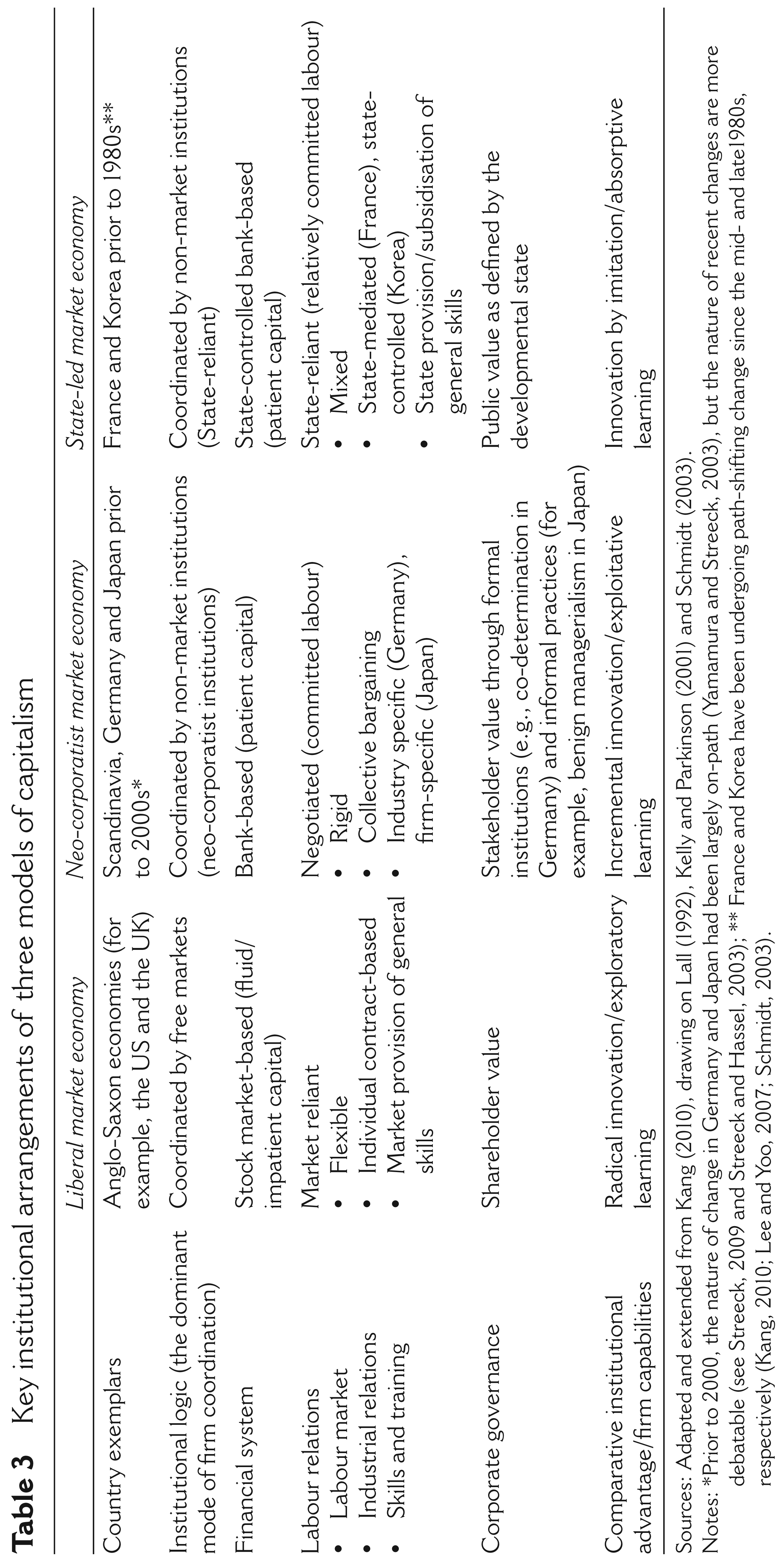
Notes: *Prior to 2000, the nature of change in Germany and Japan had been largely on-path (Yamamura and Streeck, 2003), but the nature of recent changes are more debatable (see Streeck, 2009 and Streeck and Hassel, 2003); ** France and Korea have been undergoing path-shifting change since the mid- and late1980s, respectively (Kang, 2010; Lee and Yoo, 2007; Schmidt, 2003).
In ‘capturing the political’ (Hickey, 2009), historical institutionalists have argued for the need to study ‘diffusion as encounter with embeddedness’ (Djelic, 2008: 548). Understanding this encounter – or the point in which foreign institutions reach the local context – requires taking seriously the agency of local actors as embedded in a socio-political context at a given historical time. Here, local actors are not only the co-opted political (policy) elites in charge of translating, implementing and enforcing these institutions, but also the elites who are the ‘carriers of institutions’ responsible for embedding these institutions into everyday routine. This is where more theoretically informed empirical evidence needs to emerge for discussions on institutional transplantation to advance. Hence, we turn to Germany and Japan in the early post-World War II period to examine how, despite the liberalizing pressures, the agency of local actors enabled capitalist development towards neo-corporatism.
IV Comparative (historical) institutional analysis of institutional transplantation
1 The shared macro-histories of non-liberalism in Germany and Japan
In the shadows of world-historical and world-system analyses these macro[-]historical structures, processes, and comparisons start to look puny indeed. Nevertheless, they are the attainable ‘big structures, large processes, and huge comparisons’ I had in mind. Their systematic study within specific world systems – but not necessarily throughout an entire world system – constitutes the historically grounded treatment of structures and processes I advocate as our surest path to knowledge.
Despite their geographical distance, West Germany (hereinafter, Germany) and Japan share similar ‘macro-histories’ that can shape the processes and outcomes of institutional transplantation. The institutional landscapes in Germany and Japan looked similarly non-liberal (state-led) prior to World War II. Imperial Germany (1871–1918) had been cultivating state interventionist methods against a backdrop of unsuccessful experiments with liberal economic policies in the mid-nineteenth century that led to doubts about the self-regulating mechanisms of the market (Lehmbruch, 2001). There have been explicit attempts at cross-national transfer of institutions as Meiji Japan (1868–1912) looked to Imperial Germany as a source of social and political inspiration (Westney, 1987). As the need for rapid industrial catch-up and war mobilization became prominent concerns, this tie between the two countries further strengthened in the lead-up to World War II.
In the post-World War II period, both Germany and Japan were subjected to large-scale reforms of a liberal tenor by the American occupying forces. This is not to suggest that the United States was (or is) ‘liberal’ in the strict ideal-typical sense of the phrase (on the disparity between ideology and discourse, on one hand, and the actual policies and practices, on the other, see Block (2008) and Chang (2002)). But there were clearly varying institutional logics at work. Taking corporate governance an example, in the United States, anti-trust regulation was introduced as a corrective measure against market failures (that is, monopolies), and was aimed at deterring the ‘collusive’ behaviour of firms such as cartels and business groups so as to ensure free competition. In Germany and Japan, business groups and cartels were not considered to be market failures, but rational and progressive developments that moderated excessive (and wasteful) competition which inevitably occurs in unregulated market settings (Djelic and Quack, 2007). This difference in view was not lost on the Americans, and there were concerted efforts to transplant liberal institutions in the two countries by the Americans, as the fast-approaching Cold War required that they had like-mined allies in the two regions. In reference to the introduction of anti-trust legislation in Germany, a popular American press at the time commented that ‘[e]ven in a modified form, it would mean a major victory, perhaps the greatest victory even won in Europe for the principles of dynamic American-style capitalism’ (Fortune Magazine, 1954, cited in Djelic, 1997: 170). Yet, with the benefit of hindsight we know that Germany and Japan continued on the non-liberal path, developing neo-corporatist model of capitalism that is competitive in its own right. The question of importance for this article is how and why.
2 Two potential explanations for continued divergence
Two explanations for continued divergence can be found in the extant literature. The first focuses on the role of the hegemonic discourse. The argument here is that while a number of different (and even contradictory) ideologies and discourses that compete for hegemony can be entertained in various points in history, once hegemony is achieved, as it had in Germany and Japan prior to World War II, any further evolution takes place in a ‘weakly’ path-dependent fashion (Blyth, 1997; Hall, 1989). This is because the discourse that has achieved hegemonic status supports the formation of institutions that fit its logic, thereby further ensuring that, when crises arise, the scope of policy options is limited to those that are ‘cognitively conceivable, normatively legitimate and instrumentally feasible’ inside the dominant discourse (Streeck and Yamamura, 2001: 9). However, World War II was not just any crisis, but sufficiently disruptive to constitute a ‘critical juncture’ where the dominant ideology and discourse are challenged, enabling sufficient space for path-shifting change to occur. This is especially true if we take into consideration the strong coercive pressures exerted by the occupying forces to adopt liberal institutions.
A more plausible explanation – and one that is related to the above – focuses on the degree of freedom enjoyed by the local political (policy) elites. The argument is that, despite the strong coercive pressures, there was in fact a large degree of freedom for local policy elites to translate, interpret and enforce the reforms on the ground, allowing room for path-dependent choices and outcomes (Djelic and Quack, 2007; Mahoney and Thelen, 2011). This argument appears to fare better when we examine Japan, but less so under closer scrutiny. Historical evidence suggests that in Japan, the Americans collaborated with the local policy elite who had been part of the war economy (Gao, 1994; Lanciaux, 1996), and maintained the existing government structures (Johnson, 1982; Pemple, 1987). However, in Germany, local policy elites who were sympathetic to the American liberal ideology were co-opted, and placed in key locations in the government, ensuring that a strong cross-national transfer mechanism is in place (Djelic, 1997). For instance, where anti-trust laws are concerned, the Americans monitored closely the German agencies responsible for drafting of these laws, at times forcing revisions in the policy proposals, and even exerting pressures when reforms seemed to stall (Djelic, 1997).
Even if the claim that there was a varying degree of transfer mechanism at work is accepted, an unexplained fact that remains is that Japan adopted more of the liberal reforms than Germany. For example, the financial system in Japan, while ultimately relational and bank-based like Germany, also had a relatively more developed stock market (Jackson, 2001). Similarly, labour relations in Japan, although essentially inclusive, were not based on the formal rights of the workers as in the case of Germany, but on the informal practice of benign managerialism (Jackson, 2001). In seeking to better understand what enabled Germany and Japan to stay on the non-liberal paths, and with time evolved from state-led to neo-corporatist model of capitalism, we turn to the notion of diffusion as encounter with embeddedness.
3 The explanatory power of diffusion as encounter with embeddedness
This entails taking into consideration the agency of every day actors – local capital and labour – as embedded in a socio-political context at a given historical time. While the relationship between capital and labour in this period is often shown to be highly tension-ridden in Germany and Japan, the immediate post-war period was an interesting time for both actors, as the need to keep the state out of industrial relations was an important lesson learned from the war (Lehmbruch, 2001: 78). The shift away from state intervention, however, did not translate to the adoption of market as the dominant mode of coordination.
In Germany, local capital opposed the liberalizing reforms through aggressive anti-American campaigns and active political lobbying (Djelic, 1997). However, deemed to be the culprits of the war, the power of local capital had been purposely weakened in the immediate post-war period, and despite their resistance, they were not in a position to block these reforms. What swung the pendulum in favour of the local capital is the cross-class coalition that emerged between the capital and labour. A good example of cross-class coalition between capital and labour is the shifting positions on ‘co-determination’; a complex set of legal and social institutions which first emerged in the nineteenth century that aimed to give more voice to the workers by enabling their participation (along with the banks’) in company decision-making, through councils and representation in the supervisory boards of large firms. Prior to the war, both capital and labour had opposed co-determination (Höpner, 2005). Local capital viewed co-determination as an impingement on managerial prerogatives, while labour viewed it to be a compensatory measure for lack of rights in the political sphere (Jackson, 2001; Jackson and Moerke, 2005). However, in the post-war period, both labour and capital came to accept co-determination as a way of keeping the state (and by extension the Americans) at bay. With time, local capital came to accept co-determination as they learned to use it as a strategy of reducing industrial conflict and improving workers’ commitment, and labour as a means of projecting their power onto the shop floor, making it the cornerstone of the German capitalism (Thelen, 1991).
Cross-class coalition between local capital and labour found in Germany also emerged in Japan, but the terms of the social compromise were dictated largely by the local capital in the case of Japan, which goes some way in explaining the different nature of neo-corporatism between the two countries. Japanese labour movement in the immediate post-war period was much more radical and militant than their German counterparts who belonged largely to Christian and Social Democratic traditions (Crouch, 1993). This made industrial relations highly political and conflictive in Japan (Deyo, 1989; Lanciaux, 1996), inviting strong and concerted state involvement. With the help of the Americans and the support of local capital, radical unionism was eventually stamped out (Garon, 1990; Kume, 1998). When moderate unions were the only form of labour remained, the state gradually withdrew, and cross-class coalition emerged, but the nature social compromise is what came to be famously described as ‘corporatism without labour’ (Pemple and Tsunekawa, 1979). The labour was granted certain political rights such as the right to be consulted in national policy making through participation in deliberative councils (Johnson, 1982), and to bargain collectively through the annual wage bargaining (known as the shunto) (Kume, 1998). However, at the firm level, Japanese labour never enjoyed the legal and formal structures of co-determination, but had to settle for the informal practice of benign managerialism (Dore, 2000a; Jacoby, 2004).
4 Middle-range insights on institutional transplantation
The experiences of Germany and Japan show that despite the attempt by the American occupying authorities to transplant liberal institutions, they continued on the non-liberal paths, and with time evolved from state-led to neo-corporatist model. There are limits to explaining their trajectories of capitalist development through the non-liberal hegemonic discourse that existed prior to World War II, and the path-dependent choices of the local policy elites. CIA of Germany and Japan in the immediate post-war period above suggest that local context – namely, the power and interests of the local capital and labour and the nature of cross-class coalition that emerged – heavily influenced the outcomes.
These findings are not definitive statements on the local (initial) conditions that enable neo-corporatist model to emerge. Rather they are propositions to be further refined and tested through cumulative knowledge building at the middle-range. A way forward, for instance, would be to take the variation-finding exercise further by investigating if, and to what extent, the power and interests of the local capital and labour influenced the development of another model of capitalism. For example, what would CIA of France and South Korea, as exemplars of the state-led model, reveal? We can postulate that the interplay of power and interests between the local capital and labour differed from their neighbours, Germany and Japan. Indeed, the relative backwardness of the French and Korean economy prior to the World War II, and therefore, the weakness of local capital and labour in their early stages of modern capitalist development meant the state had to take on the role of the dominant actor (Lee and Yoo, 2007; Schmidt, 2003). This is likely to have undermined the scope for the kind of cross-class coalition and social compromise found in Germany and Japan to emerge, as evidenced by the particularly high levels of continued tension and conflict in industrial relations in France and Korea compared to their respective neighbours even in the periods of high growth (Hancké, 2002; Kang, 2010). In fact, it has been argued that the very absence of cross-class coalition and social compromise lie at the heart of their radical and path-shifting change to a liberal model of capitalism since the 1980s (Dore, 2000b; Kang, 2010; Kang and Moon, 2012).
V Conclusion
The article argued for the need to work towards building a cumulative knowledge at the ‘middle-range’ as a way of deriving useful knowledge that sits between all-encompassing universal truths that leads to ‘one solution fits all’ approach, on the one hand, and empirically rich atheoretical context-specific details, on the other. The article introduced CIA as a hook that can enable grand theories, such as the new institutional theory, to operate in a historically and contextually grounded way at the middle-range. Drawing on the comparative capitalism approach, which is analytically strong at the middle-range, the article illustrated how the interplay of power and interests between the local capital and labour enabled neo-corporatist model to emerge in Germany and Japan, amidst the attempts by the Americans to transplant liberal institutions.
While the post-war experiences of a handful of cases in Western Europe and East Asia cannot (and should not) provide a detailed micro-historical template for managing institutional transplantation, their institutional experiences are not irrelevant. They have the potential to better inform policy and practice if the insights derived contribute to cumulative knowledge building at the middle-range. For now, the findings suggests that even at critical junctures, institutional change does not occur on a clean slate, and political dynamics that underpin the institutional arrangements have bearing on the processes and outcomes of institutional transplantation. The implication of this finding for policy and practice is that indirect strategies that are able to shift the power and interests of the local capital and labour on the ground will have more profound impact in shaping the national trajectories of capitalist development, even if this is more difficult to do in practice, than direct intervention through transplanting what is thought to be ‘right’ institutions through coercion and tight policy transfer mechanisms.