




Abstract
The current research explores the role of power in moral decision-making. Some work suggests that power increases utilitarianism; other work suggests power increases deontological judgments. Conversely, we propose that power can both increase and decrease both deontological and utilitarian decisions by building on two recent insights in moral psychology. First, we utilize the moral orientation scale to assess four thinking styles that jointly predict moral dilemma decisions. Second, we employ process dissociation to assess deontological and utilitarian judgments as orthogonal rather than opposite constructs. We conducted two preregistered confirmatory studies that replicated exploratory findings. In Study 1, power increased three moral thinking styles: integration, deliberation, and rule orientation. In Study 2, these decision-making styles simultaneously mediated the effects of power on utilitarian and deontological responses in opposing ways, leading to null effects overall. These results reconcile previous findings and demonstrate the complex yet systematic effects power has on moral decision-making.
Sometimes people face decisions where causing harm maximizes overall outcomes, such as whether to torture a terrorist to find out the location of a hidden bomb that would kill many people. The philosophy of deontology forbids such actions because causing harm violates moral rules (Kant, 1785/1959). In contrast, the philosophy of utilitarianism accepts such actions because they maximize overall outcomes (Mill, 1861/1998). A great deal of research has examined the psychological mechanisms behind dilemma judgments (Greene, 2014), but such work has revealed some perplexing conundrums. For example, a review of the scientific literature suggests that power, defined as the ability to control the resources of oneself and others (Galinsky, Gruenfeld, & Magee, 2003; Keltner, Gruenfeld, & Anderson, 2003; Magee & Galinsky, 2008), increases both utilitarian and deontological decision-making.
On the one hand, Lammers and Stapel (2009) demonstrated that feelings of power increase the tendency to make deontological (rule-based) decisions at the expense of utilitarian (outcome-based) decisions. On the other hand, Lucas and Galinsky (2015) theorized that power increases utilitarian decisions at the expense of deontological ones. Although Lucas and Galinsky did not provide an empirical test of their predictions, Côté and colleagues found that elevated social class, which is associated with power, predicted increased utilitarian moral judgments (Côté, Piff, & Willer, 2013). Likewise, other markers associated with power—such as testosterone—also increase utilitarian judgments (Carney & Mason, 2010). Such inconsistencies are troubling given that powerful people often make moral decisions that affect many others. Therefore, it is important to clarify how power shapes moral thinking.
The current manuscript aims to resolve these inconsistencies regarding the effects of power on moral dilemma decisions. We propose that power can both increase and decrease both deontological and utilitarian moral decisions. This proposition builds on two recent insights in moral psychology. First, although a dual process model of moral decision-making remains popular (Greene, 2014), there is growing recognition that processes beyond affective reactions to harm and cognitive evaluations of outcomes play a role in driving moral judgment, including the application of heuristic moral rules (Sunstein, 2005). We employ the moral orientation scale (MOS; Conway, Velasquez, Reynolds, Forstmann, & Love, 2017) to assess four different moral thinking styles that jointly predict moral dilemma decisions (which we describe in detail below). Second, whereas past work typically treats deontological and utilitarian judgments as diametric opposites, methods such as process dissociation can assess them as orthogonal and independent constructs (Conway & Gawronski, 2013).
Using these two new insights, two preregistered confirmatory studies, based on initial exploratory findings, demonstrate that power simultaneously increases multiple different moral thinking styles. The activation of multiple moral thinking styles produces competing influences on dilemma judgments that result in opposing effects that cancel each other out. This insight resolves theoretical confusion by clarifying how power simultaneously increases and decreases both utilitarian and deontological responses. We first explain the two new insights that we use in this article: the moral orientations scale and process dissociation.
Moral Orientations
Moral dilemmas involve multiple levels of conceptualization. On a psychological level, various different underlying psychological processes may contribute toward influencing moral decision-making. The dual process model (Greene, 2014) suggests that there are two key psychological processes involved: On the one hand, affective reactions to harm, which motivate harm avoidance (consistent with deontology), and on the other hand, cognitive evaluations of outcomes, which entail harm acceptance to maximize outcomes (consistent with utilitarianism). Although there is a great deal of support for this model (e.g., Bartels, 2008; Cushman, Young, & Hauser, 2006; Greene, 2007, 2008; Greene, Morelli, Lowenberg, Nystrom, & Cohen, 2008; Greene, Nystrom, Engell, Darley, & Cohen, 2004; Koenigs et al., 2007; Moore, Clark, & Kane, 2008), other candidate processes not captured by the dual process model have also been identified, such as heuristic application of moral rules (Nichols & Mallon, 2006; Sunstein, 2005).
One problem with existing approaches is that they are top-down; they distinguish between processes based on theoretical distinctions in moral philosophy. A disadvantage of this approach is that the psychological processes behind moral decisions may not match these theoretical assumptions. To address this difficulty, the MOS was created to integrate theory with a data-driven approach (Conway et al., 2017, see Online Supplemental Material [OSM]). The MOS is derived from an initial set of 71 face-valid items theorized to reflect relevant aspects of moral thinking based in part on the Survey of Ethical Theoretic Aptitudes (Brady, 1990). Through scale development analyses, four clusters emerged via principle factor analysis with oblimin rotation and parallel analysis (Glorfeld, 1995): the integration, deliberation, rule, and sentiment moral orientations.
To establish support for the MOS, Conway, Velasquez, Reynolds, Forstmann, and Love (2017) examined confirmatory factor structure, as well as convergent, discriminant, and predictive validity in six studies and confirmed that these four clusters reflect four distinct approaches to morality. These orientations correlate mildly to moderately with one another, suggesting that although each pertains to morality, they reflect relatively independent constructs. They predict different patterns of individual difference variables, dilemma judgments using both conventional analyses and process dissociation, reactions to moral violations, and prosocial behavior (Conway et al., 2017). Furthermore, the MOS distinguishes between different reasons for outrage to others’ moral judgments (Wissink, Lammers, & Conway, 2017), violations of ethical scientific practice (Burghardt & Conway, 2017), and reactions to social rejection (Friesdorf, Hess, & Conway, 2017). We briefly explain each of the four orientations and our predictions for how power relates to each.
Integration Orientation
Past research suggests that both cognitive and affective processes contribute to people’s dilemma decisions (Greene, 2008; Greene et al., 2008). Integration orientation reflects a tendency to integrate affective reactions with cognitive deliberation, a hallmark of mature moral thinking (Frimer & Walker, 2009). People who score high on integration orientation think deeply about relevant arguments, experience emotional concern for all potential victims, and flexibly consider all response options. Although the items primarily describe affective experiences (e.g., “It upsets me when people do something unethical” and “I tend to get upset when I see someone cheating”), integration orientation nonetheless predicts both affective variables (such as empathic concern) and cognitive variables (such as need for cognition), as well as endorsement of both principled and outcome-focused decision-making and charitable behavior. Most importantly, integration orientation positively predicts both the deontology and utilitarian parameters, although the former relationship is stronger than the latter. Because of this relatively stronger link with deontology, it produces a modest deontological pattern of responding on relative dilemma judgments (Conway et al., 2017).
We predicted that power will increase integration orientation because power is associated with more flexible processing of information, which allows people to abstractly integrate different sources of information while avoiding getting bogged down in detail (Guinote, 2007a, 2010b; Smith, Jostmann, Galinsky, & van Dijk, 2008; Smith & Trope, 2006). Powerful people also tend to search for more information if the presented information does not lead to a consistent conclusion (Chen, Ybarra, & Kiefer, 2004). This first prediction can help to integrate the literature, given that integration orientation is associated with both increased utilitarian and increased deontological inclinations (Conway et al., 2017). Therefore, the effect of power on integration orientation could translate into both increased deontological and utilitarian response inclinations on dilemmas, thus resolving apparently inconsistent predictions by Lammers and colleagues (2009) and by Lucas and Galinsky (2015).
Deliberation Orientation
Although some people tend to integrate emotion with cognition, others rely primarily on cognitive processing alone. Deliberation orientation includes items such as “When people disagree over ethical matters, I strive for workable compromises” and “When thinking of ethical problems, I try to develop practical, workable alternatives.” People high in deliberation orientation focus on pragmatic resolutions and remain suspicious of the impact of emotion on decision-making. Accordingly, deliberation orientation predicts cognitive variables such as need for cognition, but not affective variables such as empathic concern or moral identity, and it leads to a preference for outcome-focused decision-making. More importantly, deliberation orientation positively predicts the utilitarian parameter and negatively predicts the deontology parameter, leading to a strong utilitarian pattern on relative dilemma judgments. This pattern suggests that such people value rationally maximizing outcomes and are skeptical of decisions rooted in emotion (Conway et al., 2017).
Power may increase deliberation orientation due to two reasons: because powerful people are better at regulating negative emotions and they are better at deliberating. First, powerful people are better in overcoming their first negative emotional reactions toward utilitarian trade-offs. They experience greater social distance from other people (Lammers, Galinsky, Gordijn, & Otten, 2012; Magee & Smith, 2013) and find it easier to ignore others’ emotions (Gruenfeld, Inesi, Magee, & Galinsky, 2008; Gwinn, Judd, & Park, 2013; Lammers & Stapel, 2011; van Kleef et al., 2008). Therefore, their first emotional reaction to a moral dilemma might be less strong and easier to overcome. Furthermore, the powerful focus more effectively on goals and avoid distractions (Guinote, 2007b, 2017; Smith et al., 2008). Therefore, they might also be better at overcoming their first reaction. Second, powerful people process information more thoroughly if this is necessary. For example, power increases abstract (Smith & Trope, 2006) and systematic thinking when it is necessary for the task (Scholl & Sassenberg, 2014, 2015). This favors decisions rooted in pragmatic deliberation over emotional reactions (Agerström & Björklund, 2013; Lammers, 2012). This second prediction, that power increases deliberation orientation, can explain why power increases utilitarian decisions (Lucas & Galinsky, 2015).
Rule Orientation
Together, integration and deliberation orientations roughly align with the dual process model of moral judgments (Greene, 2014), but this model overlooks the possibility that some dilemma decisions also reflect the tendency to apply moral rules in a heuristic manner, while avoiding deliberation (Nichols & Mallon, 2006; Sunstein, 2005). This tendency is captured in rule orientation. Rule orientation includes items such as “When faced with an ethical dilemma people should focus on rules” and “A person’s actions should be described in terms of being right or wrong.” People who endorse rule orientation focus on detecting and uncritically applying the relevant moral rule (e.g., do no harm), thereby rejecting even the consideration of potentially breaking such rules. People high in rule orientation score low on cognitive measures such as need for cognition, but score high on measures of cognitive rigidity, such as need for cognitive closure (Roets & Van Hiel, 2011) and dogmatism (Troldahl & Powell, 1965). Rule orientation does not predict affective variables such as empathic concern but does predict a preference for principled decision-making. Most importantly, rule orientation negatively predicts the utilitarian parameter and fails to predict the deontological parameter, leading to a relatively “deontological” pattern of responding on relative dilemmas driven primarily by rejection of outcome maximization.
Power may increase rule orientation because power is associated with heuristic processing of information (Dépret & Fiske, 1999; Fiske, 1993; Fiske & Dépret, 1996; S. A. Goodwin, Gubin, Fiske, & Yzerbyt, 2000; Guinote & Phillips, 2010). Due to the greater sense of security and safety associated with power, powerful people tend to automatically follow cognitively available cues (Brinol, Petty, Valle, Rucker, & Becerra, 2007; DeMarree et al., 2012; Guinote, 2010a; Guinote, Willis, & Martellotta, 2010; Lammers & Burgmer, 2017; Slabu & Guinote, 2010; Weick & Guinote, 2008). Therefore, powerful people are likely to follow cognitively available rules, when following these rules is sufficient for reaching their goals. However, we note that if automatic and heuristic processing is not enough for goal attainment, powerful people process information even more thoroughly than powerless people (Chen et al., 2004; Overbeck & Park, 2001; Scholl & Sassenberg, 2014, 2015; Smith et al., 2008). If power increases rule orientation, then this can explain why earlier research found that power increases focus on following deontological moral rules (Lammers et al., 2009). However, the increased focus on rules may result from rejection of rule-breaking utilitarian decision-making rather than increased desire to avoid causing harm per se.
Sentiment Orientation
A fourth and final factor relevant for moral decision-making is the degree to which people rely uncritically on gut feelings at the expense of deliberation. It corresponds to older notions of sentimentality, a dispositional tendency to respond affectively, rather than cognitively, to stimuli (French, 1947). Sentiment orientation includes items such as “In matters of morality, heart is more important than your head” and “I tend to follow my heart rather than my head when faced with an ethical dilemma.” Sentiment orientation predicts affective variables such as empathic concern, while negatively predicting cognitive variables such as need for cognition, but it fails to predict a preference for either principled or outcome-focused decision-making. Like rule orientation, sentiment orientation also negatively predicts the utilitarian parameter and fails to predict the deontology parameter. Unlike rule orientation, sentiment orientation does not predict need for cognitive closure. Instead, sentiment orientation is strongly predicted by low education (Conway et al., 2017). Hence, where rule orientation reflects a motivated desire to avoid thinking about utilitarian trade-offs, sentiment orientation rather reflects an unmotivated failure to engage in deep reflection.
It is less clear how power affects sentiment orientation. On the one hand, power has been associated with more automatic processing, thus increasing the effect of feelings on judgment (Guinote, 2010b; Keltner et al., 2003). On the other hand, power can help people to regulate their feelings more effectively (Gruenfeld et al., 2008; Guinote, 2007b; van Kleef et al., 2008). Therefore, we make no clear predictions for the role of sentiment orientation in the relation between power and morality.
Process Dissociation of Moral Dilemmas
Having established that there are four different moral thinking styles that jointly predict moral dilemma decision, we turn next to the second recent insight on moral decision-making. Work using process dissociation models has established the orthogonal and independent nature of utilitarianism and deontology (Conway & Gawronski, 2013).
Moral dilemmas were originally developed by philosophers to contrast two different ethical positions (Foot, 1967). Because utilitarian philosophy requires producing the greatest possible well-being, harm that maximizes outcomes is acceptable (Mill, 1861/1998). In contrast, deontological philosophy requires treating each individual with fundamental dignity, making this unacceptable (Kant, 1785/1959). For example, imagine that you were hiding with townsfolk from murderous soldiers when a baby starts to cry—the soldiers will be alerted to your presence unless you smother the baby. Smothering violates deontology but follows utilitarianism; refusing to smother follows deontology but violates utilitarianism. Researchers typically assess the proportion of such judgments that are willing to cause harm in such dilemmas, producing a single measure of relative endorsement of utilitarianism versus deontology (following Greene, Sommerville, Nystrom, Darley, & Cohen, 2001).
Assessing dilemmas along a single continuum assumes that the more people wish to avoid causing harm, the less they wish to maximize outcomes and vice versa. Hence, a tendency to select the deontological option and an equally strong tendency to select the utilitarian option effectively produce a null effect when these response tendencies are measured as opposites. However, this need not be the case: Conway and Gawronski (2013) adapted Jacoby’s (1991) process dissociation procedure to moral dilemma judgments and developed a battery that allows estimating both parameters independently. These parameters are typically uncorrelated, despite both correlating strongly with relative judgments (a pattern now confirmed meta-analytically; Friesdorf, Conway, & Gawronski, 2015). Hence, the opposite predictions on the relation between power and morality can be tested using process dissociation but not traditional relative measures.
Overview of Studies
We predict that power simultaneously increases integration orientation, deliberation orientation, and rule orientation. In turn, integration orientation increases both deontological and utilitarian response tendencies, deliberation orientation increases utilitarian responses, and rule orientation reduces utilitarian responses. In other words, because we expect power to increase three different moral orientations that simultaneously produce opposite effects on both the utilitarian and deontological parameters, we predict that power may simultaneously increase and decrease both utilitarian and deontological response tendencies—thus producing null effects. This core insight can explain the seemingly opposing hypotheses reported in literature.
We conducted two preregistered, confirmatory studies to test these predictions. Study 1 tests how power affects the four moral orientations of the MOS. Study 2 examines the effect of power on deontological and utilitarian responses (using process dissociation), mediated by the MOS (using multiple mediation). Both confirmatory studies replicate exploratory pilot studies that obtained similar results (reported in the OSM). Across these studies, we report how we determined our sample size, all data exclusions, all manipulations, and all measures in the study (Simmons, Nelson, & Simonsohn, 2012). All participants were recruited via Amazon’s Mechanical Turk (MTurk; minimum approval rate 90%, repeated participation barred). All data and analyses are available online at https://osf.io/pz4re.
Study 1: Power and Moral Orientations
Study 1 examined our preregistered hypothesis (see https://aspredicted.org/nx4tr.pdf) that power increases the integration, deliberation, and rule moral orientations. This study follows a nonpreregistered pilot test (N = 360) employing the same experimental design and materials, which obtained near-identical results (see OSM).
Method
Participants and Design
We recruited 360 MTurkers (194 female, 166 male, M age = 36) for US $0.50, and randomly assigned them to either a high-power or low-power condition. Based on pilot data, we used GPower to set sample size to detect d = 0.30 with 80% power (Faul, Erdfelder, Lang, & Buchner, 2007), rounded up to account for unequal distribution to conditions. We did not exclude any participants.
Power Manipulation
Participants completed the Dubois, Rucker, and Galinsky (2010) imagined hierarchical role manipulation of power. Participants imagined holding a high-power manager or low-power employee role in a company and wrote what that would be like. See OSM for exact instructions.
MOS
Next, participants completed the 28-item MOS (Conway et al., 2017, see OSM), adapted to fit the power manipulation. The items started with either “as a manager” or “as an employee,” and small changes were made so that the items fit the context. Participants indicated agreement with the 7 items comprising each subscale on scales between strongly disagree (1) and strongly agree (7). Items appeared in a randomized order. Internal reliabilities were acceptable to good, .73 < Cronbach’s α’s < .89. As in previous studies, the scales were moderately correlated between r = .190 and r = .585 (see OSM for all correlations). Furthermore, a factor analyses showed that the items loaded on the expected four subscales of the MOS (see OSM).
Manipulation Check
Participants answered how powerful, in control, influential, and responsible they felt in their roles, on scales ranging between not at all (1) and very much (7), which we combined to one index (Cronbach’s α = .95).
Results
We present means and standard deviations for all measures in Table 1.
Means and Standard Deviations for the Manipulation Check and Moral Orientations Subscales in the High- and Low-Power Condition in Study 1.

Manipulation Check
Participants reported feeling more powerful in the high-power than low-power condition, t(358) = 21.56, p < .001, d = 2.27, 95% CI d [2.00, 2.54].
Moral Orientations
As expected, compared to low-power participants, participants in the high-power condition scored higher on the integration, t(336.74) = 5.76, p < .001, d = 0.61, 95% CI d [0.40, 0.82]; deliberation, t(332.94) = 6.60, p < .001, d = 0.70, 95% CI d [0.49, 0.91]; and rule orientations, t(358) = 3.20, p = .001, d = 0.34, 95% CI d [0.13, 0.55] but did not differ on sentiment orientation, t(358) = 0.05, p = .961.
Discussion
These results suggest that power simultaneously increases different moral thinking styles related to dilemma decision-making. Power increased integration orientation (the tendency to flexibly integrate cognition with emotion), increased deliberation orientation (a pragmatic rational focus on outcomes), and increased rule orientation (a focus on the importance of following rules). Given that integration, deliberation, and rule orientations produce opposite effects on moral dilemma decision-making (Conway et al., 2017), these findings provide initial evidence for our idea that power simultaneously produces opposing effects on moral judgments.
Study 2: Power and Moral Decisions
In Study 2, we measured power, assessed the MOS, and measured utilitarian and deontological moral inclinations via process dissociation (Conway & Gawronski, 2013). We tests our preregistered prediction (see https://aspredicted.org/pp82j.pdf) that integration, deliberation, and rule orientations would each mediate the relation between power and dilemma decisions in directions consistent with past work (Conway et al., 2017). This study replicates an identical, nonpreregistered pilot test (N = 302) using identical materials, which found near-identical results (see OSM).
Method
Participants and Design
We recruited 606 MTurkers (326 female, 287 male, M age = 36), who participated for a compensation of $0.70. We doubled sample size compared to the pilot test. Following the recommendations of Conway and Gawronski (2013), we excluded one participant who always accepted harm on incongruent and never on congruent dilemmas because calculating that parameter involves an impossible division by zero. We also excluded 70 participants who reported they were currently unemployed because our power measure referred specifically to power relationships at work. Analyses retaining these participants look similar (see OSM). Descriptively, most participants (56%) were in a nonmanagement position, with 20% in lower, 17% in middle, and 8% in top management.
Power
We employed an adapted version of the generalized sense of power scale (Anderson & Galinsky, 2006), by using the same items, but adding the stem In my relationships with others at my job…. For example, 1 item ended the stem:…I can get others to do what I want on scales from 1 (strongly disagree) to 7 (strongly agree). We averaged these items (Cronbach’s α = .91).
Mediator: Moral Orientations
Next, participants completed the MOS (Conway et al., 2017, see OSM). Cronbach’s α ranged from .76 to .88. Again, the scales were moderately correlated, between r = .093 and r = .358 (see OSM for all correlations).
Moral Dilemma Response Inclinations
Finally, participants completed the randomized 20-item Conway and Gawronski (2013) moral dilemma battery. This battery presents 10 incongruent dilemmas where causing harm maximizes outcomes, similar to classic high-conflict dilemmas widely employed in the field (e.g., Greene et al., 2001). Such dilemmas are incongruent because responses consistent with utilitarianism (accept harm) are incongruent with responses consistent with deontology (reject harm). Additionally, this battery includes 10 congruent dilemmas, worded identically to their corresponding incongruent versions, except that the outcome of causing harm is diminished such that causing harm no longer maximizes outcomes. In such cases, responses consistent with utilitarianism are congruent with responses consistent with deontology: Rejecting harm upholds both principles, whereas causing harm violates both. Participants responded to all dilemmas by indicating either yes, this action is appropriate, or no, this action is not appropriate. Following Conway and Gawronski (2013), we plugged in participants’ responses into a processing tree and used six equations to algebraically compute estimates of the utilitarian and deontology parameters.
Results
Moral Orientations
We conceptually replicated the results of Study 1; power was positively associated with integration, r = .087, SE = .043, p = .045, 95% CI r [0.002, 0.171], deliberation, r = .163, SE = .042, p < .001, 95% CI r [0.079, 0.244], and rule orientations, r = .094, SE = .043, p = .030, 95% CI r [0.009, 0.177], but not sentiment orientation, r = .037, SE = .043, p = .388, 95% CI r [−0.048, 0.121].
Utilitarian Parameter
We used the Process macro (Version 2.15, Hayes, 2013) for SPSS (Version 23) to conduct a simultaneous mediation (Model 4) using 10,000 bootstrapped samples. This model examined whether each of the four moral orientations simultaneously mediated the statistical effect of power on the utilitarian parameter (see Figure 1). Consistent with the idea that power is associated with opposite effects that largely cancel each other out, we found no direct relation between power and the utilitarian parameter, b = −0.041, SE = .035, p = .236, 95% CI b [−0.109, 0.027]. However, consistent with predictions, we found indirect effects on the utilitarian parameter: Specifically, consistent with Lucas and Galinsky (2015), power was associated with an increased utilitarian parameter because it was related to increases in the integration, b = 0.017, SE = .010, 95% CI b [0.001, 0.041], and deliberation orientations, b = 0.014, SE = .007, 95% CI b [0.003, 0.031]. However, in line with Lammers et al. (2009), power was also associated with a decreased utilitarian parameter because it was related to increases in rule orientation, b = −0.015, SE = .009, 95% CI b [−0.037, −0.001]. There was no indirect effect of power on the utilitarian parameter through sentiment orientation, b = −0.005, SE = .008, 95% CI b [−0.024, 0.008].
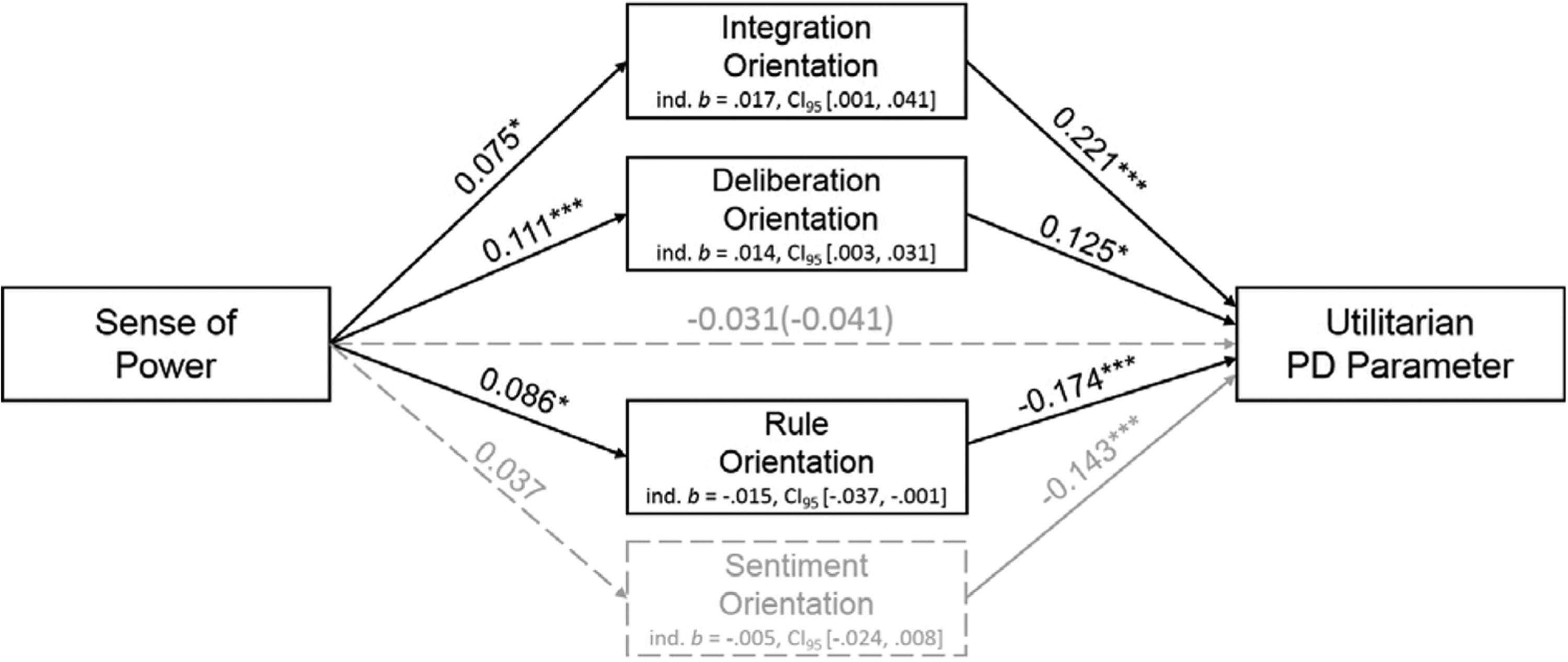
Mediation model for utilitarian process dissociation parameter in Study 2. Sense of power is associated with increased utilitarian response inclinations through the integration and deliberation orientations but with decreased utilitarian response inclinations through rule orientation. There was no indirect statistical effect through sentiment orientation. Bold lines indicate significant effects and dotted lines indicate nonsignificant effects. Significant indirect effects in black, nonsignificant in gray.
Deontology Parameter
We conducted the same analysis for the deontology parameter (see Figure 2). Again, consistent with predictions, there was no significant direct relation between power on the deontological parameter, b = 0.062, SE = .034, p = .071, 95% CI b [−0.005, 0.130]. However, consistent with predictions, we found indirect effects on the deontological parameter: Consistent with Lammers et al. (2009), power was associated with an increased deontological parameter because it was related to increases in integration orientation, b = 0.025, SE = .014, 95% CI b [0.0001, 0.053]. However, in line with Lucas and Galinsky (2015), power was simultaneously associated with a decreased deontology parameter because it was related to increases in deliberation orientation, b = −0.025, SE = .010, 95% CI b [−0.049, −0.009]. The indirect effect of power through rule orientation approached but did not reach, significance, b = −0.006, SE = .005, 95% CI b [−0.020, 0.0002]. There was no indirect effect through sentiment orientation, b = 0.001, SE = .002, 95% CI b [−0.087, 0.003].
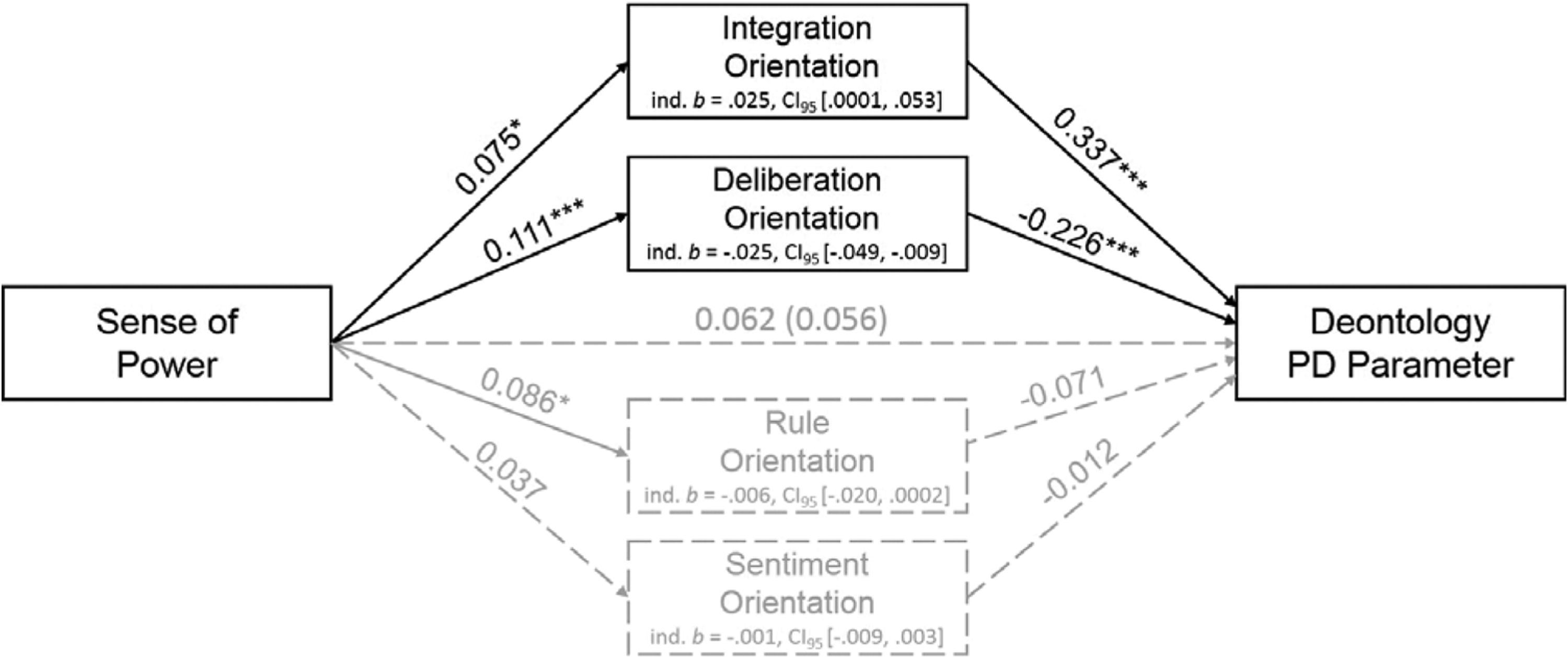
Mediation model for deontological process dissociation parameter in Study 2. Sense of power is associated with increased deontological response inclinations through integration orientation but with decreased deontological response inclinations through deliberation orientation. The effect of rule orientation approached significance, but there was clearly no indirect effect through sentiment orientation. Bold lines indicate significant effects and dotted lines indicate nonsignificant effects. Significant indirect effects in black, nonsignificant in gray.
General Discussion
Powerful people typically make the most impactful decisions in our society, so it is crucial to clarify how power affects moral decision-making. Yet, prior work provides inconsistent answers: Although Lammers et al. (2009) found that power increased deontological decisions at the expense of utilitarian decisions, Lucas and Galinsky (2015) theorized that power increases utilitarian decisions at the expense of deontological decisions. The current research suggests that both ideas are simultaneously correct.
Across two confirmatory studies (and two additional exploratory studies that produced near-identical results), and using both experimental and correlational approaches, we found power to be associated with increased integration orientation (the tendency to integrate cognition and emotion in moral decision-making), increased deliberation orientation (a tendency to pragmatically focus on outcomes), and increased rule orientation (a tendency to recognize the importance of following moral rules). These tendencies, in turn, statistically mediated the effect of power on moral dilemma decision-making: Increased integration orientation mediated the positive effect of power on the utilitarian and deontological parameters, increased deliberation orientation mediated the positive effect of power on the utilitarian and negative effect on the deontological parameters, and increased rule orientation mediated the negative effect of power on the utilitarian and deontology parameters (the latter approaching significance). Power did not affect sentiment orientation nor did sentiment orientation mediate the effects of power on either parameter. All in all, by assessing the combination of these factors simultaneously, we demonstrated how power simultaneously increases and decreases utilitarian inclinations via different processes and also simultaneously increases and decreases deontological inclinations. Thus, the relations between power and moral decision-making are complex and multifaceted.
Our results also replicate the relations between moral orientations and process dissociation parameters obtained previously (Conway et al., 2017). They also replicate previous findings linking power to increased flexibility (Guinote, 2007a, 2010b; Smith et al., 2008), increased abstraction (Smith & Trope, 2006), and increased focus on available cues, such as moral rules (Brinol et al., 2007; Guinote, Weick, & Cai, 2012; Slabu & Guinote, 2010). Interestingly, the finding that power increases integration orientation may be seen as a boundary condition to previous research on power and emotions. While these findings indicated that powerful people react with less emotions to others (van Kleef et al., 2008), it appears that if the emotional reactions concern moral violations, powerful people instead react with increased emotions. This is in line with the social distance theory of power that predicts lower socially engaging but higher socially disengaging emotions such as anger (Magee & Smith, 2013).
Future Research
Our findings demonstrate that it is theoretically and practically possible that power produces opposing effects on deontological and utilitarian decision-making. However, this exact pattern may not always arise. It is possible that situational factors may amplify some of the processes identified here while muting others, thereby producing a clear main effect of power on one form of moral decision-making. One factor might be the salience of rules, as powerful people are more likely to focus on available cues (Brinol et al., 2007; Guinote et al., 2012; Slabu & Guinote, 2010). This could explain why Lammers and colleagues (2009) found that power led to more deontological decisions: They explicitly mentioned the rules people should follow when asking participants about the dilemmas. In contrast, Côté, Piff, and Willer (2013) did not highlight rules when they found that high social class was associated with utilitarianism. Another factor may be the severity of the dilemma. While the dilemmas employed by Lammers and colleagues (2009) involved mundane actions, the dilemmas from Côté et al. (2013) included life-and-death decisions. As powerful people experience greater social distance from others (Lammers et al., 2012; Magee & Smith, 2013), their higher deliberation orientation—leading to more utilitarian decisions—may play a particularly strong role in life-and-death decisions. Furthermore, powerful people typically use mental resources efficiently, by relying on heuristics for less important decisions to preserve cognitive resources for more important decisions (DeWall, Baumeister, Mead, & Vohs, 2011; Fiske, 1993; Guinote, 2007a; Keltner et al., 2003). Thus, powerful people might make more deontological decisions for moral questions they perceive as unimportant (as in Lammers et al., 2009) but utilitarian decisions for moral questions they perceive as important (as in Côté et al., 2013). Future work should examine this possibility.
Conclusion
Power is one of the most fundamental aspects of social structure (Cartwright, 1959; Dahl, 1957; Weber, 1914/1978), and morality is one of the most important aspects of judgment and decision-making (G. P. Goodwin, Piazza, & Rozin, 2014; Hartley et al., 2016; Monin, 2007; Wojciszke, Bazinska, & Jaworski, 1998). If power would have simple, unqualified, and unidirectional effects, then society would be well organized and highly predictable. Instead, society is filled with paradoxes and contradictions. Our findings reflect this reality: Power is associated with both increased and decreased utilitarian and deontological inclinations, through separate mechanisms.
Supplemental Material
Supplemental Material, SPPS744022_suppl_mat - Paradoxical Effects of Power on Moral Thinking: Why Power Both Increases and Decreases Deontological and Utilitarian Moral Decisions
Supplemental Material, SPPS744022_suppl_mat for Paradoxical Effects of Power on Moral Thinking: Why Power Both Increases and Decreases Deontological and Utilitarian Moral Decisions by Alexandra Fleischmann, Joris Lammers, Paul Conway, and Adam D. Galinsky in Social Psychological and Personality Science
Footnotes
Declaration of Conflicting Interests
The author(s) declared no potential conflicts of interest with respect to the research, authorship, and/or publication of this article.
Funding
The author(s) disclosed receipt of the following financial support for the research, authorship, and/or publication of this article: This research was supported by a grant from the German Research Foundation (DFG) to Joris Lammers and Adam D. Galinsky (grant number LA 3566/1-1; part of the research unit FOR 2150/1-1).
Supplemental Material
The supplemental material is available in the online version of the article.
References
Supplementary Material
Please find the following supplemental material available below.
For Open Access articles published under a Creative Commons License, all supplemental material carries the same license as the article it is associated with.
For non-Open Access articles published, all supplemental material carries a non-exclusive license, and permission requests for re-use of supplemental material or any part of supplemental material shall be sent directly to the copyright owner as specified in the copyright notice associated with the article.
