



Abstract
In order to improve the lighting effect of the museum exhibition hall, clearly express the exhibition content of the museum exhibition hall, a lighting design method of museum exhibition hall based on Internet of Things and deep learning is proposed. According to the characteristics and functions of light sources and lamps, select appropriate light sources and lamps, and establish a convolutional neural network to evaluate the performance of lighting characteristic network model through computing accuracy, precision, recall and F1 score. Because the illumination of museum exhibition hall cannot be too high, the light projection method is designed to realize the lighting design of museum exhibition hall from two aspects: lighting mode and lighting characteristics, environmental lighting and light source form. The experimental results show that the lighting design method of the museum exhibition hall based on the Internet of Things and deep learning can achieve more than 70%, which has a good lighting effect and can clearly express the display content of the museum exhibition hall.
Introduction
After the reform and opening up, with the rapid development of China’s economy, the proportion of building lighting consumption for the total social consumption became more and more large, and the energy gap phenomenon appeared, but also affected the environmental problems. In the face of the current situation, all industries should pay attention to maintaining the balance between energy-saving environment and sustainable development, which will also become the key of the future work [1]. Therefore, it is necessary to make use of some design means and technical factors to minimize the consumption of building lighting, and realize the optimal allocation of resources, energy conservation and environmental protection. The rise of the Chinese museum industry stems from the cultural exchanges among foreign missionaries in China [2, 3, 4]. After the founding of the People’s Republic of China, new museums have sprung up all over the country, and the industrial systems of various museums are constantly developing and improving.
But at present, the research on the exhibition space lighting environment of Chinese museums is still in the stage of development. The museum has diverse functions, and the light environment design is more complex, putting forward higher requirements for the light environment. In this context, in order to better design the museum lighting environment, it is urgent to strengthen the in-depth analysis and research of the museum lighting design [5].
In World War II, there were many museums with mainly artificial lighting, mainly because it was easier to control than natural light, known as the “dark room” display lighting stage. Since 1983, the International Lighting Commission has held four international academic conferences on architectural lighting to show its emphasis on architectural lighting. In the 1990s, the EPA proposed the concept of green lighting. On the basis of health, energy saving and environmental protection, the corresponding energy saving standards for lighting and building lighting have been formulated. This is a low-carbon and environmental protection implementation plan, to promote the research and development and application of high-efficiency and energy-saving light sources and energy-saving lamps, and to establish a global awareness of energy conservation and environmental protection.
On the basis of environmental protection and energy conservation, improving the lighting effect has become an urgent problem to be solved in the lighting design of museum galleries.
Some studies at home and abroad provide a theoretical reference for the lighting design methods of museum galleries. To make the content clearer, the literature content is expressed in Table 1.
Summarize of document
Summarize of document
Based on the research results, this paper proposed lighting design methods for museum galleries based on the Internet of Things and deep learning. This paper makes a comprehensive evaluation on the lighting environment of the developing museums in China, and puts forward some suggestions for modification and improvement, so as to continuously improve our understanding of the lighting form and lighting design of museum buildings. This paper attempts to develop a safe, energy-saving, healthy and sustainable space design scheme, and make demonstration in the future open exhibition space design. First, the inexhaustible natural light can be used effectively again, and it can be regarded as an indispensable raw material in the construction, so as to give more play to its energy-saving role. Second, with the development of science and technology, more advanced technology will emerge, which will get rid of the backward conventional design of museum display lighting in the past, and reasonably arrange natural light and artificial light, so as to achieve the goal of energy conservation, environmental protection, health and efficiency of museum environment.
The exhibition area of the museum has a dual task, not only to arrange the exhibits, but also to guide the activities of the audience in the museum, so the exhibition space is one of the most important functional spaces of the museum. Generally speaking, the area of exhibition rooms is about half or even more than half of the total building area of the museum, and the number of exhibition rooms is also the largest [8]. Then, what kind of lighting mode to choose in the exhibition area has a crucial relationship with the form of the exhibits and the display position, height, size, etc. Therefore, it is necessary to carefully choose the light source type and lighting mode suitable for the museum exhibition area. At the same time, we should also consider the design of light illumination, light color and lighting control.
Choose light source and lamp
The selection of lighting sources is influenced by multiple factors, including light color, lighting application, and service life. Either factor may be related to the choice of the light source type. Table 2 lists several main light sources available for the museum.
Main light source types of the museum
Main light source types of the museum
Incandescent lamp: Also known as tungsten lamp, bulb, is the earliest bulb. In order to prevent the filament from oxidation, the gas in the bulb is pumped out, or the inert gas (such as argon) is refilled, so as to reduce the volatilization of tungsten filament during heating. It is a kind of lamp with relatively simple structure, low cost and good color rendering. It is suitable for the space or place requiring high color rendering, and it is easier to create a relaxed and warm atmosphere. Incandescent lamp can emit light instantaneously, which is suitable for places with frequent switching or emergency lighting, and its service life is not affected by switching, and its service life is relatively prolonged [9]. As artistic lighting or decorative lighting, this kind of light is suitable for all kinds of space environment, and it is easier to express the theme of an architectural space.
Fluorescent lamp: It is a light source that starts by triggering voltage and emits light through the phosphor coated on the inner wall of the tube excited by ultraviolet radiation. In addition, the fluorescent lamp must have a stable current to maintain after starting, so it needs to be equipped with ballast. Tubular fluorescent lamps and compact fluorescent lamps are used in museums. When they are used for display lighting, their ultraviolet radiation content must be controlled within the specified range. This kind of fluorescent lamp has soft light and linear luminescent body, so it is not suitable to use it as highlight area and three-dimensional display area.
LED lamp: Also known as light-emitting diode, can directly convert electric energy into visible light, a new type of semiconductor light source. This kind of lamp has long service life, low energy consumption, good applicability, short starting time, firm structure, and can withstand strong vibration [10]. In the museum, the lighting is mostly used for the display cabinet, and forms uniform diffuse light with the diffuse light-emitting panel. Due to the high price and the need to improve the light efficiency, this kind of light source cannot completely replace the traditional light source.
Optical fiber: Optical fiber, is a remote lighting device. Optical fiber has the advantages of low energy consumption, light weight, strong anti-interference ability and high fidelity. Generally, there are two kinds of light-emitting: end light-emitting and side light-emitting. In the lighting of the objects that need to be protected in the museum, the cross-section light-emitting optical fiber is often used. The optical fiber can reduce the heat generated around the light sensitive objects in the exhibition cabinet and reduce the damage to the exhibits [11]. The side lighting is more used to decorate the space and shape the outline of the exhibits. There are also shortcomings: high price, relatively fragile, easy to damage, should not be widely used in lighting design.
Product neural network is a feedforward neural network with a certain depth, which is an important algorithm in deep learning. Convolutional neural network has a similar structure, except the input layer and output layer, it is usually composed of three parts: convolution layer, pooling layer and full connection layer [12].
Convolution layer:
Due to the many indicators to pay attention to in lighting, the neural convolutional algorithm in the deep learning algorithm is applied to reduce the multi-dimensional lighting information, extract the lighting index characteristics and summarize and organize. Convolution layer is one of the hidden layers of convolution neural network, which is composed of multiple Feature Maps. It is a very important part of convolution neural network.
Improve computational accuracy, precision and recall through neural convolutional algorithms. The parameters of the lighting evaluation model depend on the location of the museum light source. Location map of the museum lighting light source is as follows.
Location map of the museum lighting light source.
According to Fig. 1, the lighting features of the convolutional operation museum are summarized as follows.
In the formula,
Pooling layer:
The function of pooling layer is to sample the convolution feature map from convolution layer downward, then compress the data and reduce the amount of parameters. Common pooling functions include average pooling function (average value of adjacent area), maximum pooling function (maximum value of adjacent area) and random pooling function (arbitrary value of adjacent area). Pooling layer can reduce over fitting, play the role of secondary feature extraction, and obtain features with spatial invariance [13]. The operation of the pooling layer is similar to that of the convolution layer, which is also composed of multiple feature planes. The difference is that the feature plane of the pooling layer only corresponds to the convolution feature plane of the upper layer, and the network only needs to take the maximum, average or random value of the corresponding position.
Fully connected layer:
In convolutional neural networks, after multi-layer convolution layer and pooling layer, there are often one or more fully connected neural networks. The role of fully connected layer is to integrate local information with category differentiation in convolution layer and pooling layer, and output deep semantics of feature graph [14]. The full join layer connects with all the neurons in the previous layer, which reduces the high-dimensional data to low dimensional data. The output of the full join layer is usually one-dimensional vector.
After the deep learning classification model is trained, in order to verify the performance of the model, it is necessary to use the validation data set to verify and evaluate the classification model. There are many evaluation methods according to different application scenarios. The following is a list of common classification model evaluation methods.
Confusion matrix, accuracy rate, precision rate, recall rate and F1 score.
Confusion matrix is also known as error matrix. Confusion matrix is equivalent to a visual tool in deep learning [15]. It displays the number of predicted value categories and the number of real value categories in the form of matrix, which can directly describe the coincidence degree between predicted value and real value.
According to the confusion matrix, accuracy rate, precision rate, recall rate and F1 score can be calculated. The calculation formula is as follows:
TP represents the number of correctly identified target samples, TN represents the number of correctly identified non-target samples, FP represents the number of target samples not identified, FN represents the number of non-target samples not identified. The accuracy is the ratio of the correct prediction to the total number, which can reflect the classification performance in most scenarios. However, when the gap between positive and negative samples is too large, the accuracy will be meaningless, because even the model with poor performance can get a good intuitive accuracy.
In the research of energy-saving light environment in museums, the way of light casting is quite particular, and different casting directions will create different effects for the objects receiving light.
The top light is the light shining down vertically from the top of the object, which can also be divided into flat top light and top side light. This kind of lighting is in line with people’s visual habits and psychology. It is easy to show the components and shapes on the top of the exhibits, especially the objects with relief ornaments, patterns and lines, and plays a role in creating an atmosphere [16]. But at the same time, its disadvantage is that the illumination cannot be too high, which leads to the widening of the gap between the light and shade between the upper and lower parts of the exhibits. One is the uneven illumination, and the other is the shadow at the lower part, which makes the visitors ignore the texture and decoration below. Therefore, when using top light or top side light, auxiliary light should be set at the bottom of the article, or some reflective materials and reflective plates should be used to shape the display part at the bottom, so as to create a relatively ideal lighting effect, as shown in Fig. 2.
Top lighting of museum exhibition hall.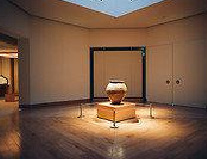
Side light is mainly used for the lighting of the side of the object, and the difference between the top light and the side light is that it does not conform to people’s observation habits and psychology, but it can fully display the left and right sides of the object’s shape, decoration, concave and convex light and shade (as shown in Fig. 3). In this way, the texture and decoration of the lower part of the object will not be affected by the light and shadow. Generally, it is the side light combination application, in order to avoid the left and right light and shade gap is too big.
Side lighting of museum exhibition hall.
Backlight, also known as backlight, is a form of light source shining from the back of the object, mainly to outline the outline lines of the exhibits, which mostly reflects the richness of the shape line changes and the three-dimensional sense of the object. For transparent objects, such as glass, and so on, backlight lighting can show the special texture of crystal clear. Therefore, this form of illumination is mostly used in the background of sculptures, figures, animals and the display of articles with great changes in external contour. However, when visiting Liaoning Provincial Museum of paleontology, the display boards in the first exhibition hall are backlit. As the display board is the carrier of displaying the text content, it not only does not achieve the desired effect, but also affects the viewing of the text on the display board. It is easy to produce visual fatigue when visiting, as shown in Fig. 4.
Museum of paleontology-exhibition board.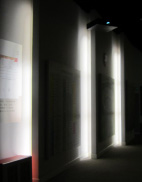
According to the requirements of the above light projection mode, the Internet of Things wireless sensing technology is used to sense the brightness and temperature of the museum in real time. If the brightness and temperature do not meet the requirements, the lamp source will be adjusted in time. The overall structure of the IoT wireless sensing technology is a topology, as shown in Fig. 5.
Topology of the intelligent monitoring data of the light environment in the museum.
In the topology of the museum IoT monitoring data shown in Fig. 5, multiple ZigBee nodes are constructed based on the ZigBee network control technology to collect the brightness and temperature information in the sensor and realize the information transmission and bus control.
In order to integrate the brightness and temperature information and comprehensively judge the indoor light environment, it is necessary to identify the fuzzy parameters of the collected information, establish a fuzzy parameter identification model, and calculate the adaptive parameter distribution. The resulting monitoring data has statistical features
In Eq. (6),
According to the analysis, the information collection and integration model of monitoring data is established, and all sensor interfaces are contacted according to the ZigBee network structure to provide a physical basis for information collection.
Program loading control and AD transformation design of indoor big data mining output model were performed according to the fusion of peak measurement and correlation features. Analysis of indoor network networking protocol, load the arithmetic program and sensor output information in the application; the hardware module for design sensor information acquisition is shown in Fig. 6.
Design of the museum light environment acquisition hardware based on the Internet of Things.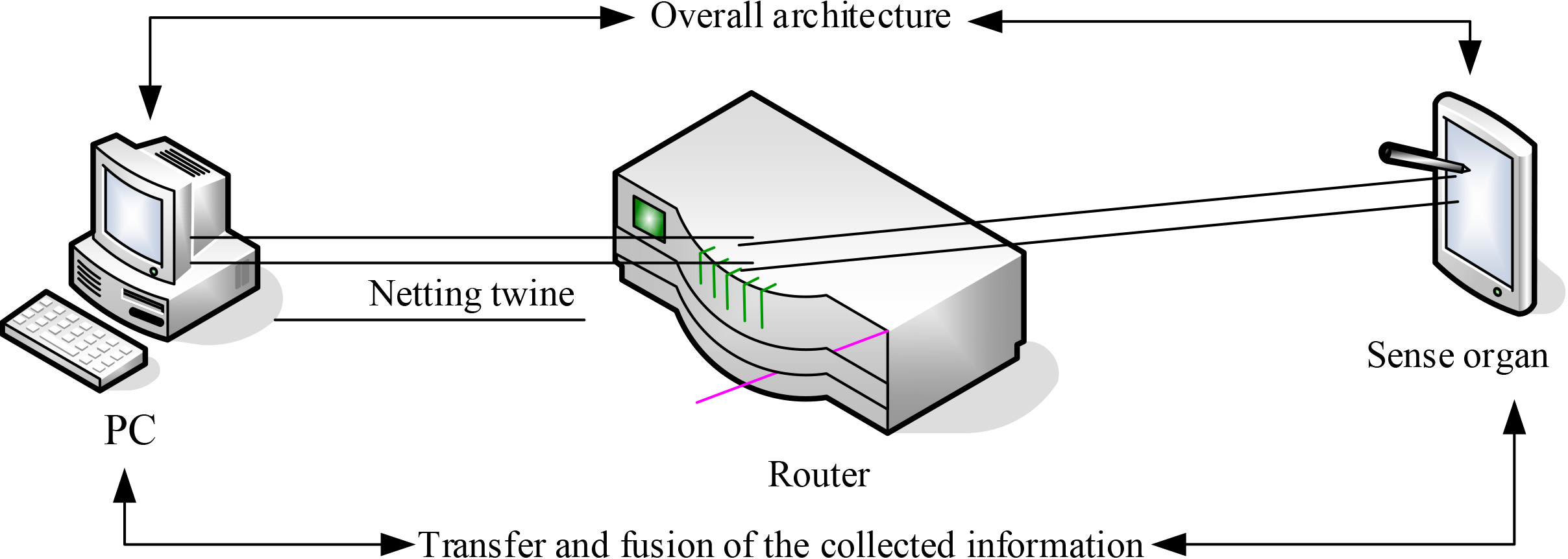
According to the hardware setting of Fig. 6, sensor collection and monitoring data are adopted to complete the real-time collection of museum light environment information, and to complete the integration of museum light environment information based on the Internet of Things. The administrator adjusts the lighting lamps in time according to the fusion results and the museum lighting requirements.
Lighting mode and characteristics
Ceiling lighting: The common ways of ceiling lighting are luminous ceiling lighting and grid ceiling lighting [17]. The lighting ceiling is usually created by artificial lighting (the exhibition hall on the local or top floor is a combination of natural lighting and artificial lighting). Fluorescent tubes or incandescent lamps with adjustable light are commonly used as internal lighting sources of luminous ceiling. Frosted glass and shading glass are used as diffusers to filter out part of the light. The light is soft and evenly projected onto the interior space and exhibits. This kind of top lighting is more suitable for museums with higher net height, which is effectively combined with local lighting of exhibits (such as LED track lights), which can also be combined with natural light to adapt to different exhibition modes.
Suspended lighting: Mostly used in rooms without ceiling or special design. This kind of lighting method makes the display space look lively and gorgeous through the clever arrangement of lamps and lanterns, showing the key points. This kind of lighting pays more attention to the artistic form of lamps and space, and can be designed with a more hierarchical sense. But it will cause insufficient light source, so we should pay attention to increase the light needed in the room to avoid glare.
Embedded lighting: This lighting mode is divided into wall washing lighting and key lighting. The embedded wall washing lamp can be flexibly arranged into a light band, and the reflector of LED lamps can be customized according to the actual characteristics. If the light is projected on the wall or exhibits, the illumination and uniformity will be increased, and the lamps and lanterns will be concealed, the “light eaves” will be formed. The light is soft, and it is not easy to produce glare. For embedded key lighting, the requirements for lamps and lanterns are relatively strict and flexible. For example, the light source can rotate in the lamps and lanterns, and can be accurately locked. Different light sources can be replaced according to the needs of exhibits.
Rail projection lighting: Ceiling top, or in the upper space lifting, erection of a movable rail, placed on the track of the light source. The position of this kind of track can not only be adjusted arbitrarily, but also the installation of lamps is convenient. This kind of lighting is usually used for local lighting, highlighting the key points, especially the booth lighting.
Reflective lighting: This lighting method usually uses incandescent lamps and fluorescent lamps as the light source, and generally hides the light source through special lamps or building components, so that the light is projected onto the reflecting surface, and then onto the exhibits in the exhibition space or exhibition area [18]. A Swiss museum uses a smart system to reduce the incident light and heat from lighting devices: The lighting devices are installed above the exhibition board and project light onto the active screen, reducing both illumination and glare. The light formed by this lighting method will not cause glare to the audience’s vision, and the light is also very soft, forming a comfortable visual environment. It should be noted that the reflector is made of diffuse material, and the area of the reflector should not be too small, otherwise it will become a potential glare source.
Display cabinet lighting: Most of them are equipped with lighting devices in the display cabinet, sometimes outside, and the light source is mainly spotlight. In the form of internal display cabinet for lighting, it is necessary to ensure the average internal illumination, and add anti ultraviolet measures, such as adding filters in front of the light source device, and using the light source with small luminous amount per unit illumination [19, 20, 21].
Environment lighting and light source form
The following are the various lighting forms that can achieve the light environment of the museum and the suitable lighting forms, and the corresponding use characteristics are listed according to the specific light sources, as shown in Table 3.
Environmental lighting and light source forms
Environmental lighting and light source forms
Simulation experiment environment.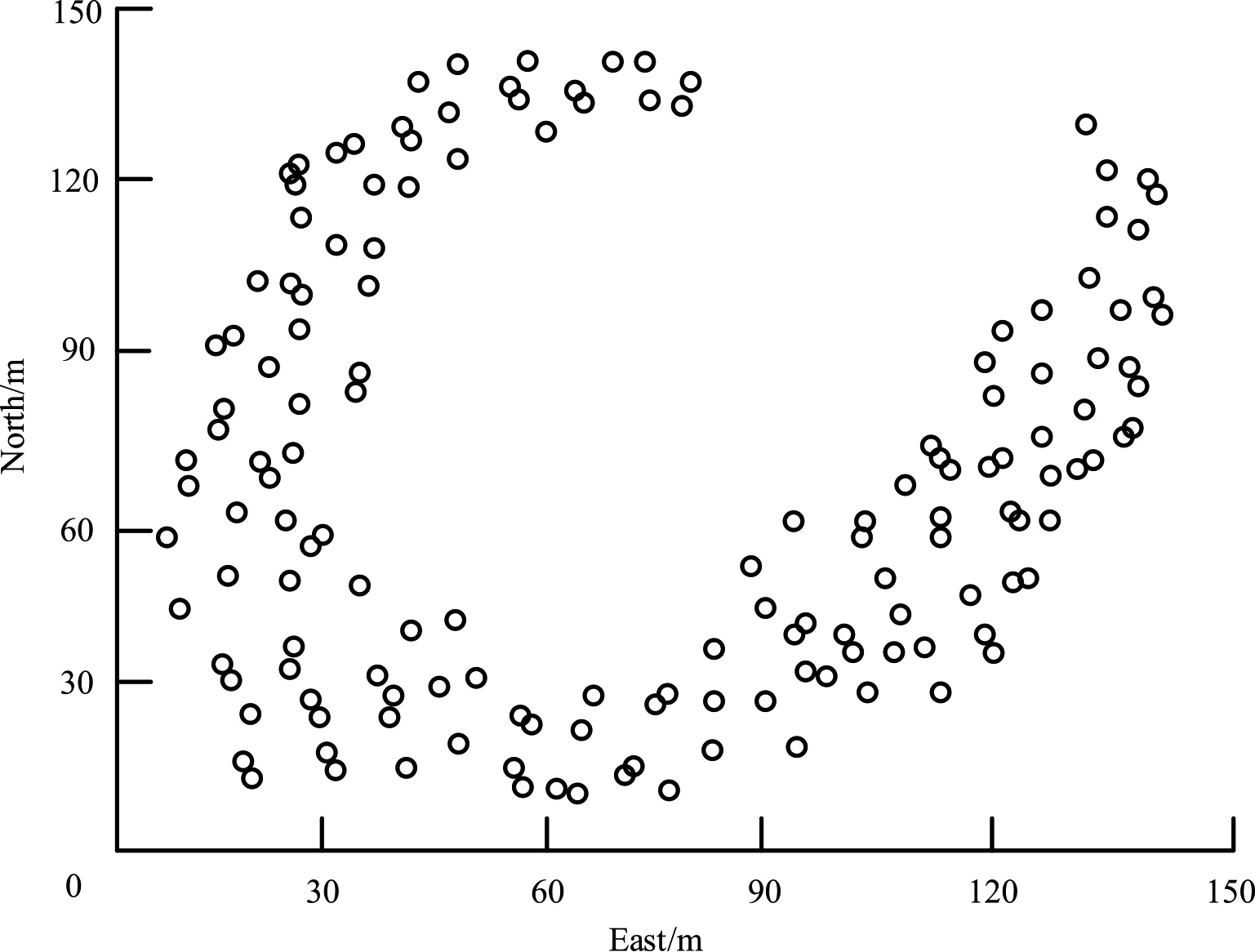
In addition to indoor flood lighting, some sculpture exhibits should also set direct light lighting according to the characteristics of sculpture to emphasize the key points, which is usually realized by using the point light source producing the beam, involving the beam size, shape (beam angle range, light boundary, light intensity distribution) and light intensity, etc.
The above features were replaced into the evaluation classification network model convolutional neural operation to calculate the optimal applicable scheme with different feature lights in museums. According to the scheme, the wireless sensor technology of the Internet of Things is used to perceive the luminosity and temperature of the museum in real time. If the luminosity and temperature do not meet the requirements, it will be adjusted in time to achieve the optimal performance of the museum exhibition hall lighting design method based on the Internet of Things and deep learning.
In order to verify the performance of the lighting design method of museum exhibition hall based on Internet of Things and deep learning, the simulation environment as shown in Fig. 7 is constructed.
The experiment adopts the intelligent control lighting system based on the Internet of Things. The installation environment is an art museum in Guangzhou with a total construction area of 79947 square meters and more than 7000 Tibetan paintings. It chose the Song Dynasty traditional Chinese painting museum as the installation environment. In order to avoid the actual lighting experiment may bring losses to the gallery, the museum uses DIALux software.
The parameters of the experimental lights are shown in Table 4.
Experimental light parameters
Experimental light parameters
Test results of lighting effect of museum exhibition hall.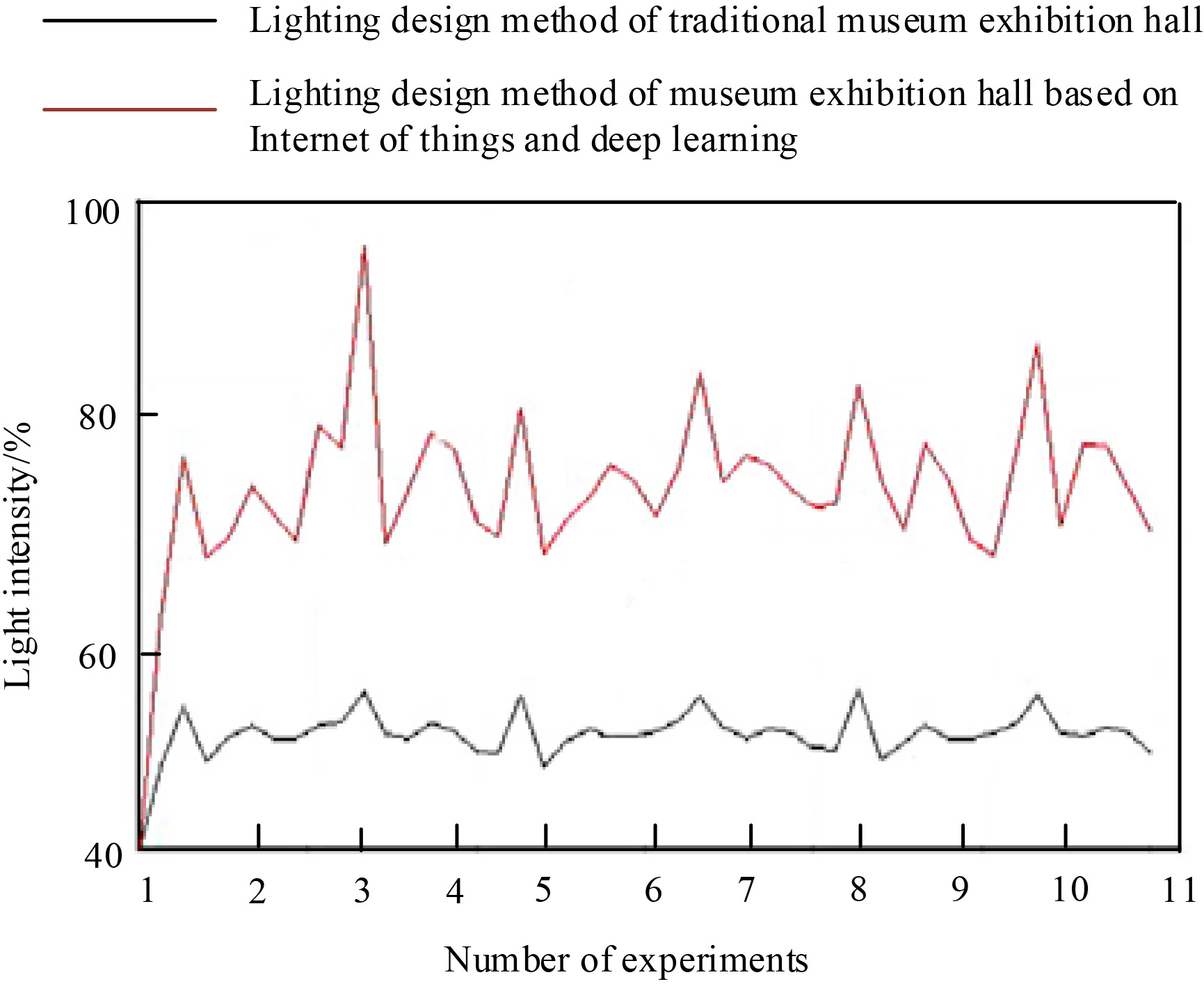
In the simulation environment of Fig. 5, the lighting design methods of traditional museum exhibition hall are simulated for 11 times, and the lighting effects of the two methods are tested. The results are shown in Fig. 8.
It can be seen from the results in Fig. 8 that the lighting effect of the museum exhibition hall obtained by using the traditional lighting design method of the museum exhibition hall is general, while the lighting effect of the museum exhibition hall obtained by using the lighting design method of the museum exhibition hall based on the Internet of Things and deep learning can reach more than 70%.
In order to improve the lighting effect of the museum, more clearly reflect the museum exhibition hall display content, a lighting design method of museum exhibition hall based on Internet of Things and deep learning is proposed. Starting from the functional division of the museum, the light source and lamps are selected, and the convolution neural network is established by combining Internet of Things and deep learning, the best application scheme for the different feature lamps in the museum is calculated. By designing the way of light projection, the lighting design of museum exhibition hall is realized from two aspects of lighting mode and characteristics, environmental lighting and light source form. Using the wireless sensor technology of the Internet of Things, the museum adjusts its luminosity and temperature in real time. The experimental results show that the lighting effect of this method can reach more than 70%, which can effectively improve the lighting effect, minimize the consumption of building lighting, and realize the optimal allocation of lighting resources.
However, due to the limitation of conditions, the type of lighting used for the museum lighting design is not comprehensive. The future research can study more lighting equipment and obtain more suitable lighting schemes for the museum lighting.
Footnotes
Acknowledgments
Fund: “Research on the diversified teaching methods of brand space innovation and design in digital age” Funder: Education and Science Planning Program in Guangdong Province Award Number: 2017GXJK087 Grant Recipient: Han Chen.