



Abstract
Food manufacturing industries have poor occupational safety and health (OSH) performance in many countries. The situation in Saudi Arabia is unknown due to absence of previous studies on the OSH performance of food industry. The current revised Labor Law is expected to dramatically increase workplace inspections by governmental inspectors. Therefore, both the industry and the OSH inspection authority needs to develop an effective decision making approach for improving the performance of companies. The objective of this study is to use quantitative and qualitative data for the assessment of OSH performance and develop a more reliable assessment approach. For the evaluation of OSH performance of food companies, a set of main and sub-criteria were determined. The quantitative assessments were carried out in accordance with national compliance requirements using a 5-point Likert scale approach. For the qualitative assessment, fuzzy linguistic terms were employed to measure the degree of satisfaction of main and sub-criteria. Two methods; the fuzzy decision tree approach and fuzzy technique for order performance by similarity to ideal solution (TOPSIS) were used for the evaluation and the competitiveness of companies. The fuzzy decision tree approach was used for criteria weight determination, however, the fuzzy TOPSIS approach revealed the best practices regarding OSH for benchmarking, and governmental authorities for managing the regulatory inspections conducted to follow up compliances. Hence, the presented approach was used to rank 21 food enterprises, and it was found that company (x7) is the best in all criteria. The key difference between this company and the other companies is that it showed consistent performance in all criteria, while in the others were found in performance fluctuations and deficiency in some sub-criteria. On the other hand, the quantitative assessment showed that most companies with good score are technically good which indicates that the technologies used are fairly up-to-date which generate less occupational hazards. This leads to the conclusion that the OSH problems in the Saudi food industries are mainly due to managerial deficiencies rather than being financial. The ranking can be used by the food industries for also benchmarking their performance within the context of the food industry sector. The overall aim is to identify the best industrial practices and identify the priorities to help the official bodies for a more effective inspection.
Keywords
Introduction
The manufacturing sector has made considerable improvements in OSH performance of firms over the past decades. However, occupational injury and illness rates still remain high in many sectors. The food processing industry has one of the poorest health and safety records among all types of industries [1]. The statistics of many countries depict high injuries among the workers of food industry [2–4]. The situation might be even worse in developing countries. In Saudi Arabia, the official OSH statistics of food industry is limited, the occupational injury/illness rates are often underestimated, mainly because the majority of the labour in the food industries is contingent workers [1], and usually they are not registered as food industry workers. Therefore, their injuries and illnesses are not included in the statistics of food industry. Although the food industries in Saudi Arabia want to apply quality tools [5], the overall OSH performance was found poor [6]. Therefore, assessment of the workplace for discovering the strengths and weaknesses of the OSH system is a crucial prerequisite for formulating improvement strategies.
The current assessment approach is based on a single OSH criterion and, therefore, does not produce effective outcomes. If an enterprise is a part of an industrial community with immature safety climate or poor OSH performance, a holistic approach could be used for more effective assessment. For these reasons, this study would be of great benefit for the food manufacturing industry to extend the assessment of OSH performance into benchmarking within the context of the same sector. A holistic approach is a combination of periodical assessment and benchmarking. Hence, it will assist in objectively comparing an enterprise OSH performance to the other companies within the same sector; providing an indicators on how to improve organizational performance; quantifying the use and value of good industrial practices; identifying industry norms and trends; and publicizing the strategies and procedures of industry leaders for the benefit of the whole industry [7]. The outcomes of benchmarking are of great benefit not only for the industries, but also for the OSH regulator and the work inspectors. If the OSH assessment criteria of food industry are known precisely, the work inspectors could have a clear overview of where they should start and how frequently they could carry out the auditing. However, the uncertainties rise during the assessment of criteria mainly due to their vague and imprecise characteristics. Moreover, the decision tree usually includes several criteria and many decision makers (DMs) have to involve in the assessment process. In this sense, OSH assessment is considered as a complex multi-criteria decision making (MCDM) problem with multiple and often conflicting quantitative and qualitative criteria [8]. However, there are still lack of systematic approaches providing an intuitive evaluation mechanism for heterogeneous criteria and dataset, in the case where a very large number of DMs and criteria involved for the assessment process. In this study, a thorough investigation was carried out to identify the key criteria for OSH performance assessment. Wu and Xu, [9] studied the concept of a possibility distribution, and proposed aggregation operators such as the hesitant fuzzy linguistic ordered weighted average operator to assess the heterogeneous criteria in decision processes. Hence, it was possible to convert the workplace subjective assessment criteria into more accurate and quantitative form so that it could be used as an effective decision making tool. On the other hand, Wu and Xu, [10] proposed new approaches to manage the consistency and consensus issues for MCDM with hesitant fuzzy linguistic preference relations to guide DMs to reach a higher consensus level in complex decision criteria. Zhang et al. [11] proposed a grey relational analysis and a maximizing deviation method to calculate the incomplete weight information of experts and attributes respectively to eliminate the conflicts in MGDM. Xu et al. [12] developed a new method called hesitant fuzzy linguistic Linear Programming Technique for Multidimensional Analysis of Preference (LINMAP) for MCDM, which combines the HFLTSs with LINMAP method. Xu et al. [13] studied group decision making (GDM) problems with incomplete fuzzy linguistic preference relations (FLPRs), and the linguistic information. Moreover, Cabrerizo et al. [14, 15] said that since the GDM evaluation was resulted from different evaluator’s view of linguistic terms, its evaluation must be conducted in an uncertain and fuzzy environment. However, the inspectors or auditors usually use either linguistic terms or a 4- or 5-point Likert scale. Because of ambiguity and vagueness of human judgment, fuzzy linguistic systems are more realistic approaches for the assessment [16, 17]. Similarly, fuzzy linguistic approximations can be used as an approach to suitably assess the OSH performance. The OSH performance evaluation process is considered as a MCDM problem, because a wide range of conditions must be evaluated to assess the performance of a firm. In this study, fuzzy decision tree approach and fuzzy TOPSIS methodologies were integrated to solve this problem. This is due to the fact that the majority of DMs prefer using linguistic tools for assessment due to either their ability to identify complex criteria and/or supporting the ways of conducting the necessary action for the large data.
A fuzzy decision tree is an approximation structure to compute the degree of membership of objects to a particular linguistic term, as a function of the attribute values of these terms [18]. This approach proposes a decision building procedure to construct fuzzy decision tree from fuzzy data. Fuzzy decision trees attempt to combine elements of symbolic and sub-symbolic approaches. Fuzzy decision tree induction has two major components: a procedure for fuzzy decision tree building and an inference procedure for decision making. As a hybrid method; integrated fuzzy linguistic approach of decision tree and fuzzy TOPSIS methods are promising method for the decision making problems which require handling complicated and highly interrelated heterogeneous data. However, classical MCDM techniques require precise ratings and weights of the criteria that are not always applicable in real-life problems when human judgment is utilized [19, 20]. The OSH criteria assessment is often performed in a subjective way based on the inspector’s judgement. In such approaches, we use fuzzy linguistic terms instead of direct numerical values, i.e., we assume the ratings and weights of the criteria by means of linguistic terms. Fuzzy set theory aids in measuring the ambiguity of linguistic terms that are associated with human’s subjective judgment [21]. In the field of OSH, the application of fuzzy assessment approaches exists for single occupational hazards [22–25]. Similarly, fuzzy MCDM approaches have applications in solving safety problems, such as fuzzy AHP for behavior-based safety management [26], ranking the fire hazard of chemical substances and installations [27], applying fuzzy TOPSIS for risk evaluation at workplaces [28, 29], fuzzy VIKOR for machine tool selection [30], and fuzzy group Electre for safety and health assessment in waste recycling facilities [8]. However, the fuzzy MCDM applications for OSH performance assessment of the food manufacturing industries do not exist yet in the literature.
Of the currently existing MCDM techniques; Fuzzy TOPSIS is a popular approach that has been widely used in the literature to evaluate competitiveness or rank the enterprises performance [31, 32] and other applications due to its logicality, rationality and computational simplicity [33]. Several extensions of TOPSIS method have been suggested in the literature, including fuzzy MCDM problems. In the integrated methodologies, the qualitative and quantitative data related to the criteria are collected initially and then used for the measurements. In this regard, the qualitative and quantitative data related to the OSH criteria can be collected and used for the assessment of overall performance of a company. The value of criteria can be decided by fuzzy linguistic terms, and then converted into corresponding fuzzy numbers.
The proven accuracy of fuzzy MCDM approaches applied in different fields indicates the potential for their use in the evaluation of OSH performance. Hence, the theoretical background of this study can be stated as the thorough assessment of the workplace to discover the strengths and weaknesses of the OSH system for formulating the strategies for business improvement and workers safeguarding. So far, enterprises are dealt with on the basis of a single OSH criterion during inspections, however, this approach might not be as effective as expected. If a food enterprise has immature safety climate as a result of poor OSH performance, new novel approaches should be used for a more effective assessment. The objective of this paper is the assessment of OSH performance of the food manufacturing industries using a more reliable approach combining workplace assessments and both fuzzy decision tree and TOPSIS methods to uncover performance deficiencies.
The remainder of the paper is organized as follows: the methods for industries selection and assessment, the safety performance criteria, and the proposed approach are presented in Section 2, whereas Section 3 provides the details of implementation of the methods and gives the results and findings of workplace qualitative assessment. After comparing the performance of the food companies, the paper culminates with the main conclusions in Section 4.
The methodology of proposed approach
The characteristics of food industries
All food and beverage manufacturing industries in Jeddah Industrial Zone (JIZ) were invited to involve in the current study. Out of 80 industries, only 21 agreed to participate in the assessment process proposed in the study (26.25% response rate). The participated industries consisted of 9 large and 12 medium-small sized companies with a total workforce of 5804 workers, comprising about 69% of the sector workforce in JIZ. The participating industries included bakeries, snacks and pasta manufacturing (7), fruit, vegetable and oilseed processing (4), beverage and dairy products (3), meat processing (2), bottled water production (2), seasoning and dressing manufacturing (2), and confectionary products manufacturing (1).
Workplace assessments
Workplace assessment approach was preferred over other methods (such as questionnaires) for many reasons. A weak link existed between self assessments and the ‘real’ conditions for safety in an organization due to failures of foresight [34], or because many plant owners or managers may be afraid that the results of OSH studies might be used against them [6]. As it is presented in Fig. 1, safety specialists including the authors were requested to conduct the workplace assessments using a checklist containing twelve OSH main performance criteria covering a total of 75 sub-criteria. These criteria were determined from several studies addressing OSH assessments [6]. To achieve harmony in judgments of the evaluators, workplace pictures and videos were reviewed in office meetings to reach common assessment scores as necessary. Assessments were made in accordance with national compliance requirements using a 5-point Likert scale comprising: 1 (no effort at all made regarding the sub-criteria); 2 (little effort made but still far from compliance); 3 (little effort is required to achieve minimum requirement of compliance); 4 (just in compliance to standards); 5 (following standards higher than the national ones).
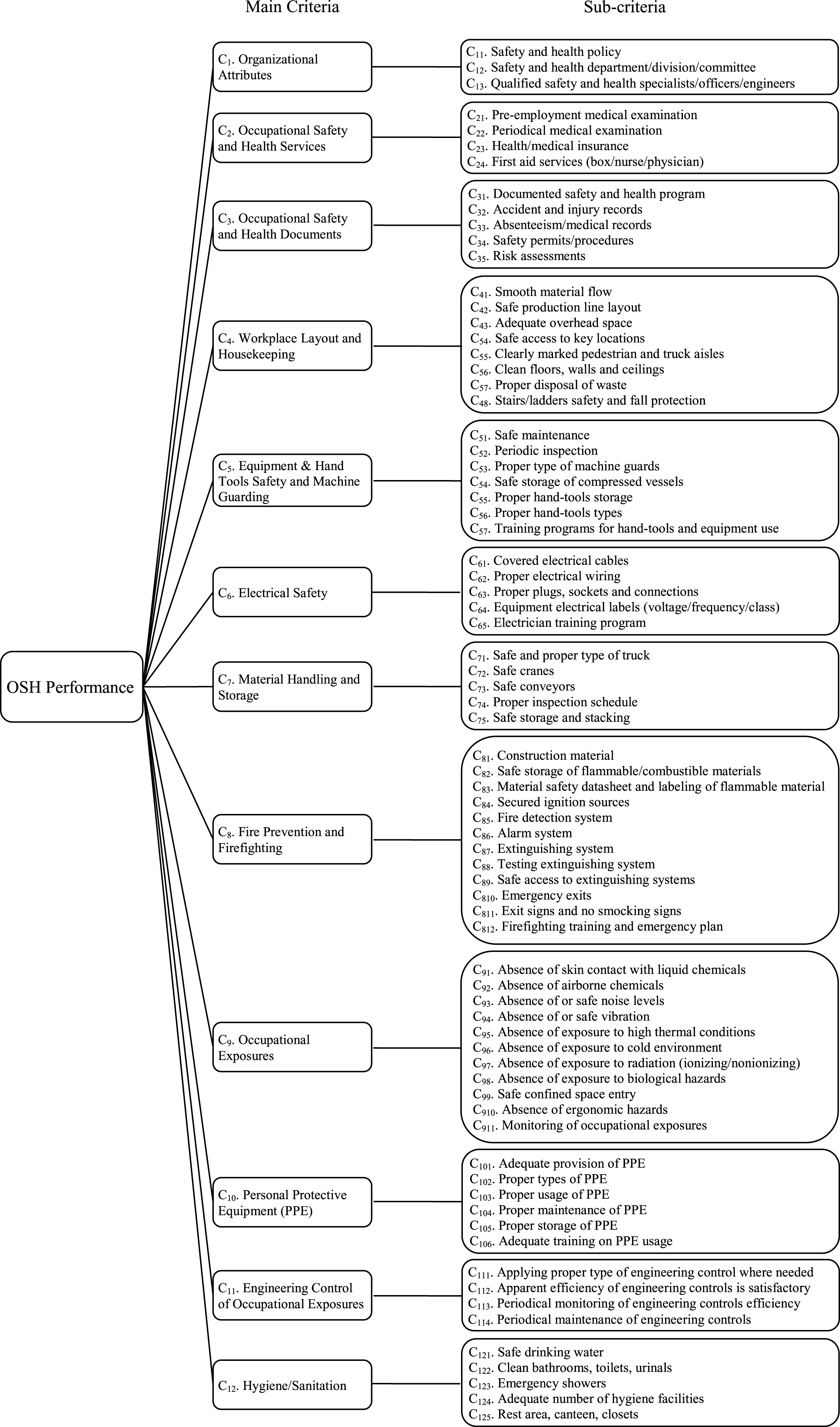
The decision tree for evaluating OSH performance of food industries.
The use of the two non-parametric methods namely; the fuzzy decision tree approach and fuzzy TOPSIS aims to evaluate the competitiveness of the food manufacturing industries and rank them according to their OSH performance, which is described in the following subsections.
Determination of safety performance elements by fuzzy sets
The fuzzy decision tree problem was formulated as the fulfillment of 12 main and 75 sub-criteria (Fig. 1). A set of criteria C n = {Cn1, …, C nm } was considered to determine the OSH performance. For instance, criterion 8 stands for “fire prevention and fire firefighting” including the 12 sub-criteria “construction material, safe storage of flammable materials,…, firefighting training and emergency plan,” i.e., C8 = {c81, …, c812}. As all criteria are important for the OSH performance assessment; they all must be satisfied simultaneously. In this study, the criteria containing the fuzzy linguistic terms were combined by conjunctive aggregation technique for modeling simultaneous satisfaction by using weighting operators (Ws). For measuring the degree of satisfaction of criteria, fuzzy membership functions were employed. Because fuzzy set approach uses operators from the fuzzy set theory for aggregating the decisions, more flexible aggregation behavior can be modeled [35]. In this study, the set of sub-criteria was assessed and normalized by fuzzy decision tree approach. A weight factor was determined for each criterion depending on the requirements of the decision problem. For instance, to determine the weight of main criterion “occupational safety and health services”, the weights of sub-criteria “pre-employment medical examination, periodical medical examination, health insurance, and first aid services” were considered, and so on.
The weight of a main criterion “fire prevention and fire firefighting” was calculated in detail and presented in this study. The weight factors are usually assumed to be elements of the unit interval, i.e., w
j
∈ [0, 1], j = 1, …, n. Equation 1 was employed for the aggregation of weights of criteria allocated by different DMs.
Sousa and Kaymak [35] stated that there are three different types of aggregation approaches. In the case that the DMs seek compensatory decision behavior, there are boundary conditions, rather than the personal preferences of the DM that determines the choice of the decision function. In a crisp decision tree, the cut-point test performs worse on examples with attribute values close to the cut point. Hence, two objects that are close to each other in the space of the attributes might be split on separate branches and therefore situated ‘faraway’ one of each other in the output space [18]. On the contrary, within a fuzzy decision tree, two examples close to each other in the space of the attributes are treated in a similar fashion. Therefore, fuzzy decision trees decrease bias near the region boundaries and thus the decision tree errors.In this study, all criteria and sub-criteria are considered equally important for decision making and determination of safety index. Hence, they all must be satisfied simultaneously, when the food companies are evaluated. In order to model different types of decision behavior, the DM decides to establish a hierarchy of decision functions. The criteria were combined by conjunctive aggregation technique for modeling the simultaneous satisfaction. The twelve decision criteria and 75 sub-criteria of safety index presented in Fig. 1 are evaluated by five DMs. The evaluation of sub-criteria weights were carried out by fuzzy linguistic terms. These fuzzy linguistic terms and their triangular fuzzy numbers are shown in Table 1.
Fuzzy linguistic terms determined for the weights of criteria
Fuzzy linguistic terms determined for the weights of criteria
The weights allocated to the sub-criteria were fuzzy weights, and the evaluation approach was carried out by fuzzy linguistic terms, and their membership functions. For instance, “fire prevention and fire firefighting” capability of a company was assessed by five DMs, and the results were presented in Table 2. The objective of this study is to determine the best company (x
i
) that has the highest OSH performance. For instance, C1 stands for “organizational attributes”, C2 stands for “occupational safety and health services”, C3 stands for “occupational safety and health documents”, and so on. The main and sub-criteria assessment by fuzzy linguistic terms is very important for OSH safety performance determination. As it appears in Table 2, fuzzy set approach uses operators from the fuzzy set theory to aggregate the decisions so that more flexible aggregation behavior can be modeled [35]. The weighting factors indicate the relative importance a decision criteria in relation to other decision criteria. The weight factors are usually fuzzy numbers in the unit interval of [0, 1]. The weights of the other main criteria were calculated in the same way by initially determining the weight of sub-criteria and finally calculating the main criteria. Equation 1 was employed to determine the weight of “fire prevention and fire firefighting”. The weight of ‘w8’ was found to be equal to (0.55, 0.71, 0.84). The details of calculations are presented below.
Decision matrix of “fire prevention and fire firefighting” by fuzzy linguistic terms and weights
The weight of the other criteria and sub-criteria were calculated in the same way and the outcomes are presented in Table 3. Considering and satisfying all the main and sub-criteria simultaneously is an important subject in decision making, which makes this study different from others. Partial fulfillment of criteria may simplify the problem, however, may cause omitting the effect of some criteria in the main question.
Fuzzy weights of safety performance criteria
Fuzzy TOPSIS is a technique to deal with MCDM problems. The technique considers both the shortest distance from the positive ideal solution (PIS) and the farthest distance from the negative ideal solution (NIS). The preference order of criteria is ranked according to their relative closeness [33]. In TOPSIS methodology, limited subjective inputs are needed. The DMs generally use the linguistic terms to evaluate the alternative food companies with respect to the criteria. The aggregation function of fuzzy decision making is usually called the decision function. The fuzzy TOPSIS procedure is applied by the following steps [36].
Step 1. The importance of the decision criteria and the ratings:
The calculations in this study cover the details of fuzzy decision criteria of “fire prevention and fire firefighting”. In order to combine the decisions and calculate the average decision for each sub-criterion, Equation 2 was employed.
Step 2. It is possible to obtain the normalized fuzzy decision matrix denoted by
The safety criteria were determined in terms of fuzzy numbers. The fuzzy sets transform the crisp information regarding the criteria to membership values which are then combined for further processing. In this sense, the importance of criteria becomes a well-defined concept in terms of the sensitivity of the aggregation to an individual membership value. The set of
Hence,
Step 3. The weighted normalized fuzzy decision matrix was constructed in this step:
The normalization method transformed the results in the range of triangular fuzzy numbers, in the interval of [0, 1]. Hence, the set of
Fuzzy TOPSIS is an attractive method which requires limited subjective input data from DMs [37]. Table 4 presents the importance of criteria in terms of fuzzy linguistic terms and their membership degrees. The application of fuzzy TOPSIS procedure was initiated as follows; let X = {x1, x2, …, x21} be the set of companies applied for safety performance measurement. The DMs have to use the fuzzy linguistic terms presented in Table 4 to evaluate the company’s OSH performance. The weight and degree of each criterion rating was incorporated into the formulation using fuzzy numbers for evaluation of alternative companies. The decisions about the criteria need to be combined in order to determine the overall safety performance of a company. This was carried out by aggregation of fuzzy linguistic terms that the DMs assign for the company performance. After the criteria weights were determined, the rating of safety performance was determined. Table 5 presents the grading of sub-criteria assessment of company #1 for “fire prevention and fire firefighting”. In this approach, the fuzzy linguistic terms and fuzzy numbers constituted the basic of grading system.
Fuzzy linguistic terms of criteria rating
Fuzzy linguistic terms of criteria rating
The decision matrix for the fire prevention and firefighting performance of company #1
Equation 2 was employed to aggregate the decisions made by the DMs and to calculate the aggregated decision for each of the sub-criteria. For instance, “testing extinguishing system” is the eighth sub-criteria of “fire prevention and firefighting”. The average of decision regarding the safety performance of this sub-criterion for company # 1 can be calculated as follows;
Then, the grand mean aggregation for “fire prevention and fire firefighting” is calculated and the findings are presented below which is (2.5, 3.1, 3.7). The aggregated decision of all other criteria was calculated in the same way.
Equation 8 was used to calculate
On the other hand, the set of
In this sense, the importance of criteria becomes a well-defined concept in terms of the sensitivity of the aggregation to an individual membership value. Different criteria were transformed into fuzzy membership scales. The
Workplace qualitative assessments
The results of the direct observations at workplace are shown in Fig. 2 where the assessment scale was reduced into 3 categories (for figure simplicity) by combining the lower two scores of the 5-point Likert scale into “poor”, the upper two scores into “good” and the middle score as “average”. Figure 2 shows clear variations in food industries performance regarding the OSH, where it was good in some main and sub-criteria while being poor or average in others. It is worth to note that the majority of criteria and sub-criteria with poor score are of managerial nature (e.g., organizational, documents and training attributes). On the other hand, most of those with good score are technical in nature (e.g., fire fighting and machines safety) which indicates that the technologies used by the majority of the participating industries are fairly up-to-date and generate less occupational hazards. This leads to the conclusion that the OSH problems in the Saudi food industries are due to management deficiency rather than being financial, which shows similar conclusions with Noweir et al. [6] found for the whole manufacturing sector in the same country. For instance, only few of the large industries have OSH policy and qualified specialists or department, as well as good documentation system. On the other hand, small and medium industries find it extremely difficult to manage occupational health and safety [38]. The assessment levels were converted into 3 categories (good, average, poor) in Fig. 2 for simplification. There are many factors that adversely affect the OSH performance of food industries. The majority of workers in this sector are temporary workers supplied by other agencies, depending on seasonal product demand and supply chain pressure [1]. For instance, in Saudi Arabia, the food and beverage manufacturing industries are always under supply chain pressure during pilgrimage seasons, where millions of pilgrims are added to the local customers.

Qualitative assessment of OSH performance criteria (see Fig. 1 for criteria sets) for food industries. Good performance (score 4 or 5);  Average performance (score 3);
  Poor performance (score 1 or 2).
This situation enforces the food industries to utilize a large number of untrained temporary migrant workers. The managers or plant owners, hence, find it useless or costly to offer safety training for those workers (poor performance in sub-criteria C5,7, C6,5, C8,12 and C10,6 in Fig. 2). For the same reason, the injuries of those workers are not included in the OSH records of the company resulting in poor OSH documentation system (the criteria C3 in Fig. 2). Furthermore, many of those workers are involved in material handling jobs imposing, in parallel to awkward postures and time pressure, increased risk of ergonomic hazards (notice the poor performance in sub-criteria C9,10 in Fig. 2).
The second important factor is that most of the food industries focus their efforts towards food safety rather than workers’ safety [4]. In these industries, the objective is customer satisfaction and certification; and the scope is limited to product quality or food hygiene. The fact that workers’ safety and wellbeing have both direct and indirect effect on quality and productivity is out of sight if safety awareness of the management or owners is inadequate. A third factor in the decreased OSH management performance in most of the food industries is the override of national OSH regulations by the food hygiene regulations. In Saudi Arabia, OSH is governed by the Labor Law; and the General Directorate of Labor Inspection (GDLI) is responsible for auditing industries regarding their compliance to the regulations. On the other hand, food hygiene regulations and inspections are governed by the Saudi Food and Drug Authority (SFDA). For some reasons, such as shortage of human resources and imperfect scope definition, the GDLI inspections are replaced by SFDA inspections in food and beverage industries, resulting in more investment in product quality on the expense of workers’ OSH. It should be mentioned that “Fire prevention and firefighting” is the only criterion inspected by one agency in all industries, which is the General Directorate of Civil Defence (GDCD). This is the reason for comparable performance among all manufacturing sectors in this criterion [6].
The results of weighted normalized fuzzy decision values of companies were calculated as described in section (2.3.4). For instance, v11 = (0.06, 0.29, 0.65) is the fuzzy triangular membership degree of the company x1 for the criteria “C1: Organizational attributes”. Similarly, v4,12 = (0.40, 0.59, 0.79) is a fuzzy triangular membership degree to the company x4 for safety performance criteria; “C12: Hygiene/Sanitation”. According to the weighted normalized fuzzy decision matrix, it is known that the
The distance of each company, x
i
(i = 1, 2, …, m) from A* and A- was calculated by Equations 9 and 10. In order that the fuzzy TOPSIS method can be used to deal with fuzzy MCDM problems, several extensions have been suggested. The simplest extension is to change a fuzzy MCDM problem into a crisp one via defuzzification method [39], however, it can cause some information lost and only give a crisp point estimate for the relative closeness of each alternative company. Another extension is to define the Euclidean distance between any two fuzzy numbers as a crisp value. For example, Chen [36] defined the Euclidean distance of two triangular fuzzy numbers as
where
It is obvious that, if an alternative company (say x i ) is closer to the FPIS (A*) and farther from FNIS (A-), CC i approaches to 1. According to the closeness coefficient (CC) (see Equation 12), the ranking orders of all companies were determined and the best one was selected among a set of alternatives. The ranking order of the twenty one food companies based on closeness coefficients was calculated and presented in Table 6. Hence, the company x7 got the highest overall safety performance and is the best in terms of criteria presented. On the other hand, company x18 is the worst in terms of overall safety performance.
Fuzzy decision matrix for ranking food companies
Figure 3 presents a framework for utilizing the results of the hybrid fuzzy TOPSIS approach by the food industries for benchmarking the best practices regarding OSH, and the governmental authorities for managing the regulatory inspections conducted to follow up the compliances. From an enterprise perspective, the food companies can use the resulting ranking in identifying their performance within the context of the participating food industries. Table 6 shows that the order of the companies related to OSH performance is as follows; x7, x1, x2, x21, x13, x14, x9, x3, x4, x16, x10, x8, x19, x6, x17, x12, x20, x5, x11, x15, x18.
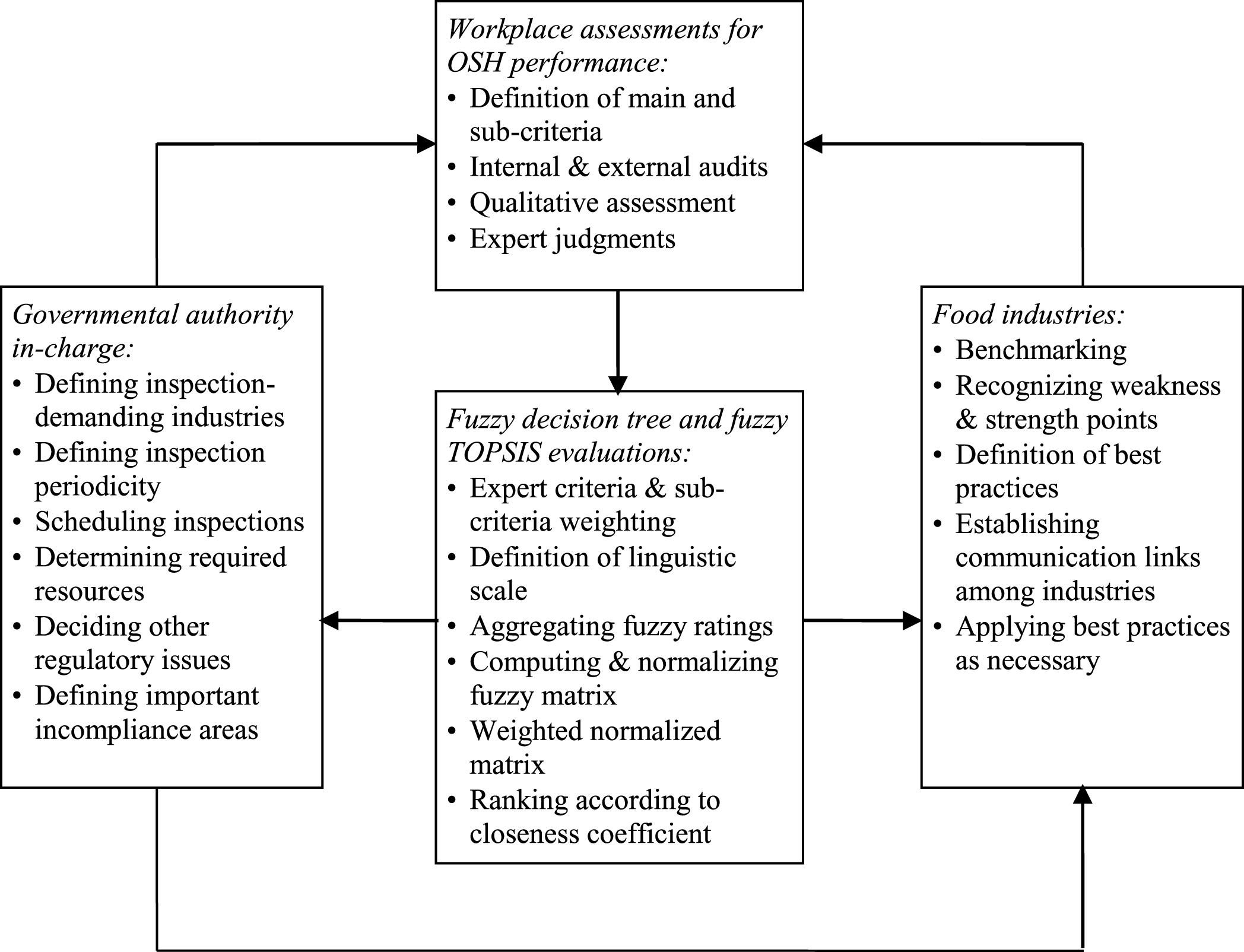
An integrated workplace assessment framework for OSH performance of food industries.
Comparing the ranking results of the fuzzy TOPSIS approach to the workplace assessment data, it was found that company x7 is not necessarily the best in all criteria, but rather, it was among the best ones, i.e., companies x1, x2, x21, x13, x14 as it is seen in Table 6. The key difference between this company and the other best ones is that it showed consistent performance in all criteria, while in the others there existed performance fluctuations in the form of deficiency in some sub-criteria and compliance in others. Based on the evaluation of company x7, it is believed that little effort toward the OSH management sub-criteria will further improve the overall performance.
During workplace visits, it was observed that most of the managers/owners of the surveyed industries believe that their company is the best in terms of OSH. However, the ranking process based on integrating workplace qualitative assessments and hybrid fuzzy quantitative analysis resulted in different scenario. In line with this, Mearns et al. [40] mentioned that absolute statements of quality are extremely difficult to make, and for this reason assessments made relative to other organizations within the same sector of industry present an alternative approach.
Reviewing the workplace assessments of the food industries ranked average or lowest, there were clear variations of performance from one OSH criteria to another. This discrepancy is a clear indication that the OSH programs in most of these industries are not properly designed. The reasons for this trend are discussed in section (3.1). The absence of a well-designed OSH programs that encompasses all the company activities results in sparse or nonintegrated efforts within the same organization that might fail to fully comply with the OSH regulations or standards. Nevertheless, this should not be upsetting to the participating food industries since the efforts and expenses needed for achieving substantial improvements in performance could be lower than expected. Mearns et al. [40] stated that OSH data collected with the same instrument can be shared by participants, and each organization would then be benchmarking itself with functionally similar organizations for mutual benefits and with minimal expenditure on project costs. In practice, there are some success stories in this regards. For instance, Wynn [41] mentioned that, as a result of the use of benchmarking data of eight companies, five of them could reduce the recordable incidence rate and lost workday case rates by up to 77% and 81%, respectively. This finding reinforces the belief that many benefits could be attained as a result of sharing OSH practices among the Saudi food industries. As mentioned earlier, the OSH regulations in Saudi Arabia have been revised allowing more stress on regulatory inspections of compliance. In this sense, the governmental authority in-charge of these inspections is in urgent need for powerful decision making tool to assist in prioritizing and scheduling the expected extensive inspection visits. Similar to OSHA [42], the inspection priorities are expected to be in the order: imminent danger, catastrophes and fatal accidents, complaints and referrals, programmed inspections, and follow-up inspections. The decision on the programmed and follow-up inspections should not be taken away from the existing situation of the OSH in food industries. For instance, if the decision on inspections is dependent mainly on factors other than the current performance levels, industries with poor OSH performance might not prioritized in formal inspections resulting in more occupational injuries and illnesses.
As shown in Fig. 4, the governmental DM can benefit from the application of the presented approach in defining OSH inspection plans by setting some criteria to define the inspection-demanding plants. For instance, the criteria may be the calculated closeness coefficient itself. Since the value 1.0 is the ideal solution (i.e., full compliance to OSH regulations/standards in this study), the DM might establish a further decision tool that correlates the priorities of programmed inspections, periodicity of follow-up inspections, and resources needed for inspection to the closeness coefficient generated by the presented approach.
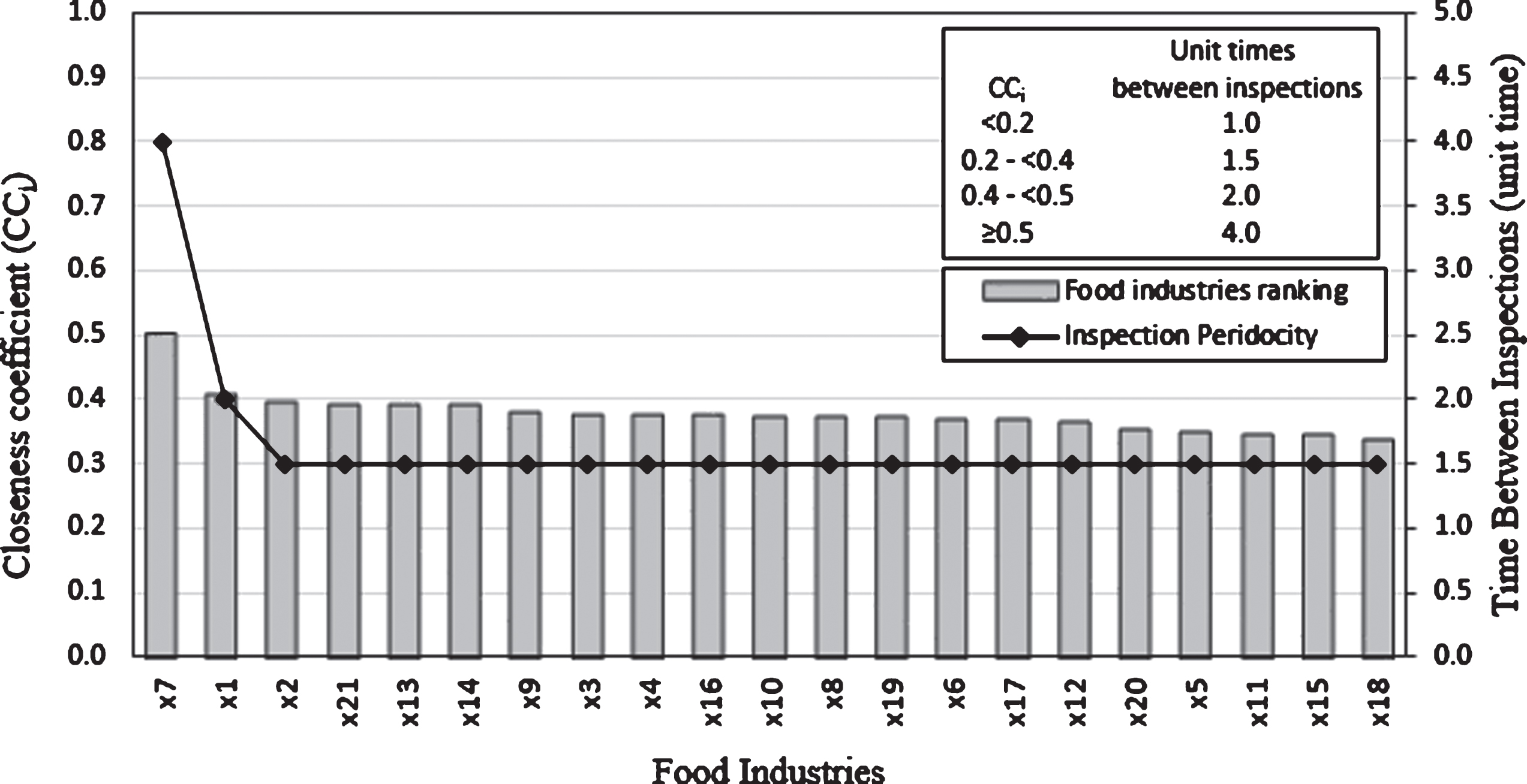
Linking the periodicity of inspections to the ranking of the food industries according to the closeness coefficient based on overall OSH performance.
There are many reasons for the urgent need to evaluate the OSH performance of the food manufacturing industry in Saudi Arabia, such as the absence of previous studies, the proven poor OSH record of this industry all over the world, and the revised labor regulations in the country.
In this study, twenty one food companies were evaluated according to their OSH performance though workplace inspections. This assessment process is a MCDM approach involving human judgments. DMs use often uncertain and vague data in assigning the criteria when treating such complex problems. Therefore, a multi-criteria decision-making model was designed to rank the food companies in terms of safety performance using fuzzy set theory.
After the evaluation of fuzzy TOPSIS method, the safety performance of companies was determined quantitatively; the weight of each safety criteria was calculated by fuzzy decision method and associated to triangular fuzzy numbers. The fuzzy TOPSIS method was employed to calculate the ordering of companies by employing triangular fuzzy numbers. The DMs used fuzzy linguistic terms to evaluate the company’s safety performance. The safety performance and the degree of each criterion were incorporated into the formulation by the fuzzy numbers for rating of alternative companies. The information about the companies was combined to determine the overall safety performance of a company. This is done by aggregation of fuzzy terms that the DMs assigned to the company performance.
Regarding workplace assessment of OSH, a sample of 21 food industries can be considered as a strength point of the current study. The results obtained from such a sample size, which constitutes 25% of food industries in JIZ, can be considered representative of the whole industry type and national actions can be taken based on it. On the other hand it can be a limitation the preparation of fully-fledged inspection plan by the governmental inspector. However, its results may be used for a preliminary plan for inspection based on the most and least hazardous categories of food industries found in this study. For instance, meat processing and bakeries were the most hazardous, whereas dairy products and confectioneries industries were least in hazards. As workplace assessments are conducted, as a continuous activity, their results are embedded into the quantitative hybrid fuzzy technique presented in this study. Thus, the calculation system should be designed to by a dynamic one capable of handling the newly added workplace assessments, generating new ranking results, and finally producing a priority plan for programmed and follow-up inspections for a given period in the near future.
Another limitation of the small sample size is that the number of each type of food manufacturing (and beverage) industries was small. Therefore, all the industries were treated altogether as food industries. If a dynamic hybrid fuzzy system is properly implemented and new inspection results continuously added to it, the number of involved food industries will be sufficient to divide them into subcategories for deeper management of the OSH performance. This will allow the OSH policy maker to set a country-wide policy for enhancing the OSH performance of this industry.
Despite the scope of the current study is food and beverage manufacturing industries, the proposed approach can be applied to all types of industries as an assisting tool for improving the safety performance of the Saudi manufacturing sector. Additionally, we think that we should study such decision model in dynamic [43] and heterogenous decision contexts [44, 45].
Footnotes
Acknowledgments
This project was funded by the Deanship of Scientific Research (DSR) at King Abdulaziz University, Jeddah, under grant no. (7-135-36-RG). The authors, therefore, acknowledge with thanks DSR technical and financial support. We would also like to acknowledge the FEDER funds under grants TIN2013-40658-P and TIN2016-75850-R.