



Abstract
The problems in the production systems often involve complexity and imprecision. The traditional techniques can be insufficient to handle such problems. This uncertainty and vagueness can be treated with the fuzzy sets. The fuzzy sets are frequently utilized to optimize production system problems under imprecise, complex and subjective information. It is important to gain academic knowledge on how fuzzy sets and the new developments in the fuzzy set theory are utilized in production systems. In this study, we develop a state-of-the-art literature review for the usage of fuzzy sets in production system problems. The literature review is based on 3147 publications composed of 1832 articles, 1277 conference papers and 38 book chapters indexed by Scopus. We present the tabular and graphical results of the literature review. The literature review indicates that although both production literature and fuzzy literature have an increasing attention, at some areas of production systems fuzzy sets have limited usage.
Keywords
Introduction
A comprehensive planning and execution process is crucial for designing and producing a successful production system. Production research involves collection and analysis of information for developing and manufacturing a product. Production planning, production scheduling, sequencing, assembly line balancing, lot-sizing, routing, allocation, cell formation, process planning and cutting stock problems are some of the production system problems. These problems can be optimized by using the tools and techniques of production research. These complex optimization problems may involve objectives such as improving quality, decreasing expenditures and time spent. Dealing with these problems is hard due to not only their complexity but also the impression and vagueness inherent in the nature of the production systems.
Fuzzy sets are excellent tools for dealing with ambiguity and imprecision. In the recent years, to better represent uncertainty and vagueness, various extensions of fuzzy sets such as intuitionistic, hesitant, Type-n and Pythagorean fuzzy sets have been developed. Both the fuzzy sets and their extensions are commonly used for solving the production system problems. Yet, there currently exists little academic knowledge on how fuzzy sets and the new developments in the fuzzy set theory are utilized in production systems and how the fuzzy set usage differs from production problems. According to Karwowski and Evans [31] fuzzy sets can be used for new product development, facilities location and layout, production scheduling and control, inventory management, quality and cost-benefit analysis. Guiffrida and Nagi [26] conduct a literature review on the usage of fuzzy set theory applications in production management research. Although these literature review studies are instrumental, they are not up to date. This paper aims to fill that gap, by presenting a state-of-the-art framework for the usage of fuzzy sets in production system problems. González-Neira et al. [23] review the flow-shop scheduling papers in the literature. The results indicate that there is an increasing trend towards flow-shop scheduling papers under uncertainties. The authors claim that the increasing capacity of computers allow complex problems to be solved and therefore there is an ongoing trend towards fuzzy models.
The remaining of the paper is organized as follows: In Section 2, the preliminaries of fuzzy sets and their extensions are given. In section 3, the main production system problems and the usage of fuzzy set theory in these problems are provided. Section 4 presents the literature review results by tabular and graphical illustrations. At the final section, we conclude and give future directions.
Ordinary fuzzy sets and their extensions
The fuzzy sets have been introduced by Zadeh [66]. An ordinary fuzzy set
Figure 1 shows the developments in the fuzzy set theory.
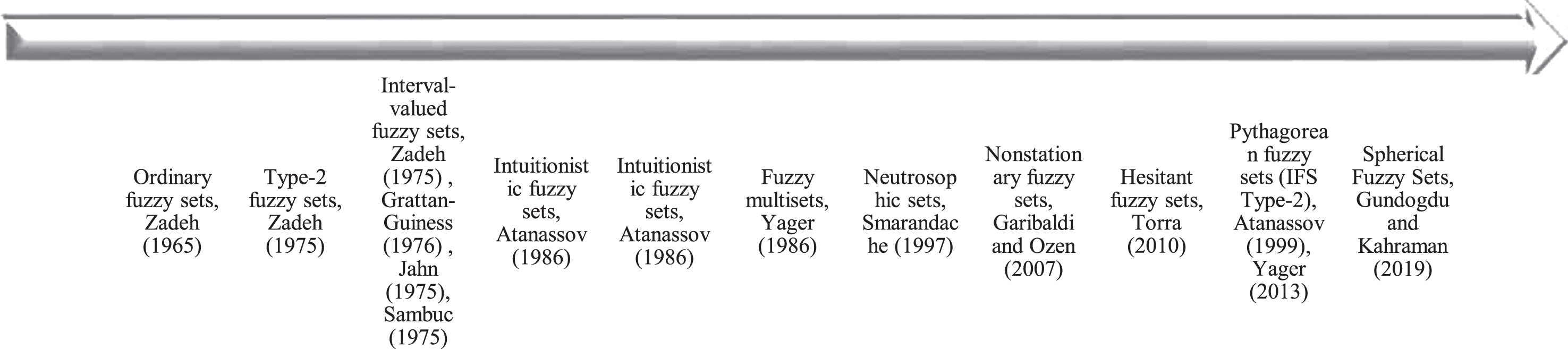
Developments in the fuzzy set theory.
An interval-valued fuzzy set (IVFS) have been introduced by several researchers in 1975 [25, 67]. An IVFS are formed with canonically extending fuzzy interval operations. IVFS are considered as the special version of Type-n fuzzy sets where more than one membership value is possible for an element.
Type-n fuzzy sets
Zadeh [67] develops type-2 fuzzy sets, which enable representing the uncertainty in the definition of the membership function. Type-n fuzzy sets are the generalized form of Type-2 fuzzy sets. Let
Atanassov’s [2] intuitionistic fuzzy sets (IFSs) consider both the membership, non-membership and hesitancy values. The sum of membership and non-membership values cannot exceed 1.
An intuitionistic fuzzy set
Where
The sum of membership and non-membership functions should satisfy Equation (5).
Yager [62] develops fuzzy multisets often recalled as fuzzy bags. Let
A nonstationary fuzzy set
Hesitant Fuzzy Sets (HFSs) are one of the other extensions of fuzzy sets where a set of values for the membership of a single element can be assigned. Let
Neutrosophic sets defined by Smarandache (1999) considers the membership, non-membership and indeterminacy values. Indeterminacy characterizes the neutrality of an element.
Unlike intuitionistic fuzzy sets, in the neutrosophic sets, the value of truth, indeterminacy, and falsehood can exceed 1.
IFS Type-2 fuzzy sets are first introduced by Atanassov (1999). The same concept is used by Yager [63] and named as Pythagorean fuzzy sets.
An IFS Type-2 (Pythagorean) fuzzy set is defined as follows:
Spherical fuzzy sets introduced by Gundogdu and Kahraman [27] are one of the extensions of ordinary fuzzy sets with three dimensional membership functions. These three dimensions namely, membership, non-membership and hesitancy enable better expressing uncertainty. Pythagorean fuzzy sets define hesitancy as a function of membership and non-membership values. Neutrosophic fuzzy sets enable defining membership, non-membership and hesitancy values independently, yet there is no relation among these values. In the spherical fuzzy sets, the hesitancy can be defined independently yet the sum of square of membership, non-membership values cannot exceed 1.
The production systems and production problems can be classified as production planning, production scheduling, sequencing, assembly line balancing, lot-sizing, distribution planning, routing, allocation, cell formation, process planning, quality control and cutting stock problem (Cevik Onar et al., 2016). The advance of new technologies such as industry 4.0 bring flexibility. This flexibility increased the complexity and uncertainty of the problems in the production systems. Fuzzy sets are excellent tools for modeling uncertainty; therefore, they have been extensively used in production system problems under uncertainty. In order to reveal the usage of fuzzy sets in production system problems, we review all the Scopus database until June 2019. Along with the articles, we also review book chapters and conference papers.
Production planning
Production planning is the process of planning necessary resources for producing a sound with a minimum cost and maximum revenue. These required resources involve not only the raw materials but also the human resources. In this study, we review all the Scopus database by searching both “production planning” and “fuzzy” at the “title” of the papers. 144 studies utilized fuzzy set theory in the production planning problems. For instance, Wang and Liang [59] use fuzzy linear programming approach for developing aggregate products plans. Djordjevic et al. [15] develop a fuzzy linear programming model for aggregated production planning.
Out of 144 studies, only seven studies use intuitionistic fuzzy sets in the production planning. As an example, Garai et al. [19] propose a production-distribution planning system using intuitionistic fuzzy sets. Similar to the intuitionistic fuzzy sets only six studies utilize Type-n fuzzy sets. Figueroa-García [18] develop a Type-2 fuzzy set approach to the mixed production planning problems. Five studies use the interval-valued fuzzy sets in production planning problems. Turksen and Zuhong [57] develop an interval-valued fuzzy model for the aggregate production plans. Similarly, Shih et al. [48] applied an interval-valued fuzzy production demand forecasting approach. The only neutrosophic fuzzy production planning study belongs to Ye [65]. Hossain and Hossain (2018) issue with fuzzy goal programming and Khemiri et al. (2018) use fuzzy TOPSIS and goal programming in production planning. Badhotiya et al. (2019) used fuzzy multi-objective optimization in production planning.
Figure 2 shows the production planning and fuzzy production planning studies in the literature. In literature, although the number of both the production planning studies and the fuzzy production planning studies increase, the percentage of the fuzzy studies over the all production planning studies also show an increasing trend.

Production planning and fuzzy production planning.
Production scheduling is the process of assigning resources to a manufacturing process by deciding when to produce, with which human resource, and on which equipment with a minimum cost and maximum revenue. It has an important impact on the success of a production system. Behnamian [5] classify fuzzy scheduling as a single machine, parallel machines, flow shop, job shop and open shop scheduling. In this study, we review all the Scopus database by searching both “scheduling” and “fuzzy” at the “title” of the papers. 1439 studies utilized fuzzy set theory in the scheduling problems. Sakawa and Kubota [44] propose a model for solving a shop scheduling problem with fuzzy processing time and due date. Out of 1439 studies, only five studies use intuitionistic fuzzy sets in the scheduling related problems. De and Sana [14] solve a multi-period production-inventory problem that minimizes overtime scheduling by using intuitionistic fuzzy sets. Similar to the intuitionistic fuzzy sets only five studies utilize or mention Type-n fuzzy sets in the production scheduling problems. Zarandi et al. (2013) develop a multi-agent based expert system for production scheduling by using Type-2 fuzzy sets and Knyazeva et al. (2018) use type-2 fuzzy numbers in project scheduling optimization. Other extensions of fuzzy sets have not yet been utilized in the production scheduling problems.
Figure 3 shows the scheduling and fuzzy scheduling studies in the literature. In literature, although the number of both the scheduling and fuzzy scheduling studies increase, the percentage of the fuzzy studies over the all production planning studies show a decreasing trend. The scheduling problems are gaining an ever increasing trend. Although fuzzy scheduling is also increasing the scale of the increase is limited when it is compared to the overall increase in the scheduling papers.

Scheduling and fuzzy scheduling.
Sequencing is the process of finding the optimal processing and assembly sequence by considering the manufacturing and supply chain constraints. It prevents the bottlenecks in the production process. Sequencing is an important research area. In Scopus database, 48,940 studies use “sequencing” at the “title”. In this study, we review all the Scopus database by searching both “sequencing” and “fuzzy” at the “title” of the papers. Only, 62 studies utilized fuzzy set theory in the sequencing problems. In these studies, the sequencing problem is mostly considered as a multi-objective fuzzy decision-making problem. Adamopoulos [1] develops a model for solving sequencing problems by using multi criteria fuzzy approach. Chutima and Tanontong [11] optimize a multi-objective car sequencing problem by using fuzzy adaptive extended coincidence algorithm. Javadi et al. [29] solve an assembly line sequencing problem by using fuzzy goal programming. Yang et al. (2009) use fuzzy processing time and fuzzy due date in job sequencing and hybrid fuzzy genetic algorithm for tackling the model. Intuitionistic fuzzy sets are utilized in four of these studies. In these intuitionistic fuzzy studies, the sequencing problem is formulized as a multi-criteria decision making problem. Although sequencing is an important research area, only few studies are available in literature. This limited usage can be related with the nature of the problem.
Assembly line balancing
Assembly line balancing is placing the appropriate manufacturing tasks at the workstations. The assembly line balancing aims at balancing the total time required at each workstation. It has a significant impact on decreasing bottlenecks and increasing productivity. In Scopus database, 1057 studies use “assembly line balancing” at the “title”. In this study, we review all the Scopus database by searching both “assembly line balancing” and “fuzzy” at the “title” of the papers. A total of 31 studies utilized fuzzy set theory in the assembly line balancing. Babazadeh et al. [3] modeled task processing times in the assembly line balancing problem using fuzzy numbers. Özcan and Toklu [39] used fuzzy goal programming approach for balancing a two-sided assembly line. The stations, cycle time and the number of tasks assigned per station are considered as the objectives of the optimization problem. Fuzzy goal programming and genetic algorithms (Zacharia & Nearchou, 2012; Cheshmehgaz et al., 2012; Adham and Tahar, 2012) are the most commonly used methods for solving assembly line balancing problems. The extensions of fuzzy sets are not utilized in assembly line balancing problems.
Lot-sizing
Lot sizing problem focuses on finding the optimal party size for supply chain or for manufacturing processes. Lot sizing problems involve defining inventory lot-sizing, inventory lot sizing, and production lot-sizing. In this study, we review all the Scopus database by searching both “lot sizing” and “fuzzy” at the “title” of the papers. A total of 24 studies utilized fuzzy set theory in the assembly line balancing. Petrovic et al. [43] utilized fuzzy multi-objective genetic algorithm approach for defining the production lot sizes. Choudhary and Shankar [10] develop a fuzzy multi-objective programming model for an inventory lot-sizing problem. Tayyab et al. (2018) issued optimal lot sizing for manufacturing process with Weighted Fuzzy Goal Programming approach. The extensions of fuzzy sets are not utilized in assembly line balancing problems.
Routing
Routing problem focuses on defining the optimal routes between numerous locations. The vehicle routing problems, where the primary objective is to optimize the routes of vehicles, are considered under routing problems. In this study, we review all the Scopus database by searching both “routing” and “fuzzy” at the “title” of the papers. 731 studies utilized fuzzy set theory in the routing problems. Grabot [24] develop a decision support system for the vehicle routing problems using fuzzy sets. Ghaffari-Nasab [21] develop a model for location routing problem where the demands are considered as fuzzy. The problem is solved by using both simulated annealing and stochastic simulation techniques. The extensions of fuzzy sets are rarely used in routing problems. Das and Tripati [12] utilize an intuitionistic fuzzy soft sets and multi-criteria decision making based approach in order to define intelligent energy-aware efficient routing for MANET.
Figure 4 shows the routing and fuzzy routing studies in the literature. In literature, although fuzzy routing is becoming more popular, the number of fuzzy routing studies on overall routing literature is very limited.
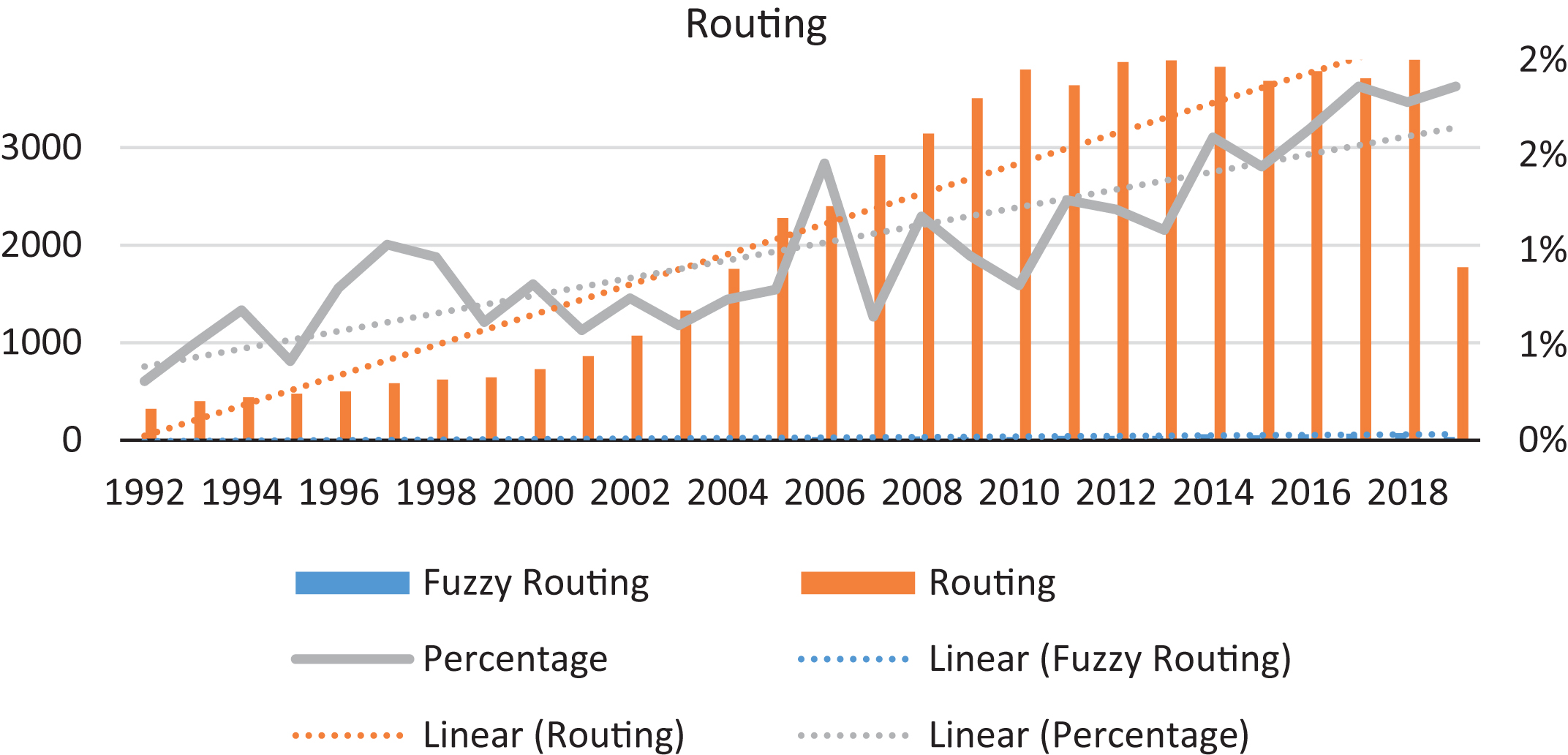
Routing and fuzzy routing.
The production allocation problem deals with allocating the customers’ order to one of the available plants. This process decreases time to customer and increases the efficiency. In this study, we review all the Scopus database by searching both “allocation” and “fuzzy” at the “title” of the papers. 673 studies utilized fuzzy set theory in the allocation problems. This number is very limited when the whole allocation literature is considered. Zhou et al. [70] solve a hybrid plant selection and production allocation bi-level optimization problem by using triangular type-2 fuzzy sets. Pal et al. [40] model the land allocation problems by using an interval valued goal programming approach. Genetic algorithms are employed for solving this model. Stanujkic [50] utilized interval-valued intuitionistic fuzzy sets for allocating a plant. Bozhenyuk et al. (2019) use intuitionistic fuzzy set in order to optimize complex resource allocation problems and for considering many factors that affects the final result. The other extensions of fuzzy sets are not used in allocation problems.
Cell formation
Cell formation is a process of defining the cells and the positions of the cells in a cell manufacturing system. Cell formation aims at minimizing the inter-cell movement and maximizing machine usage. Clustering algorithms are the most commonly used techniques in cell formation. In this study, we review all the Scopus database by searching both “cell formation” and “fuzzy” at the “title” of the papers. 49 studies utilized fuzzy set theory in the cell formation problems. Suresh and Kaparthi [51] grouped parts and machines by using fuzzy neural network approach. Susanto et al. [52] develop a fuzzy approach that increases clustering efficiency. Güngör and Arikan (2000) use fuzzy set theory i order to organize the cell layout. Moghaddam et al. (2008) model cell formation problem with fuzzy parameters suh as fuzzy demand and fuzzy parameter under undefined environment. The extensions of fuzzy sets are not utilized in cell formation problems.
Figure 5 shows the cell formation and fuzzy cell formation studies in the literature. The cell formation studies are gaining popularity whereas the fuzzy cell formation studies does not show an increasing trend. In literature, the number of fuzzy cell formation studies on overall cell formation literature is decreasing.
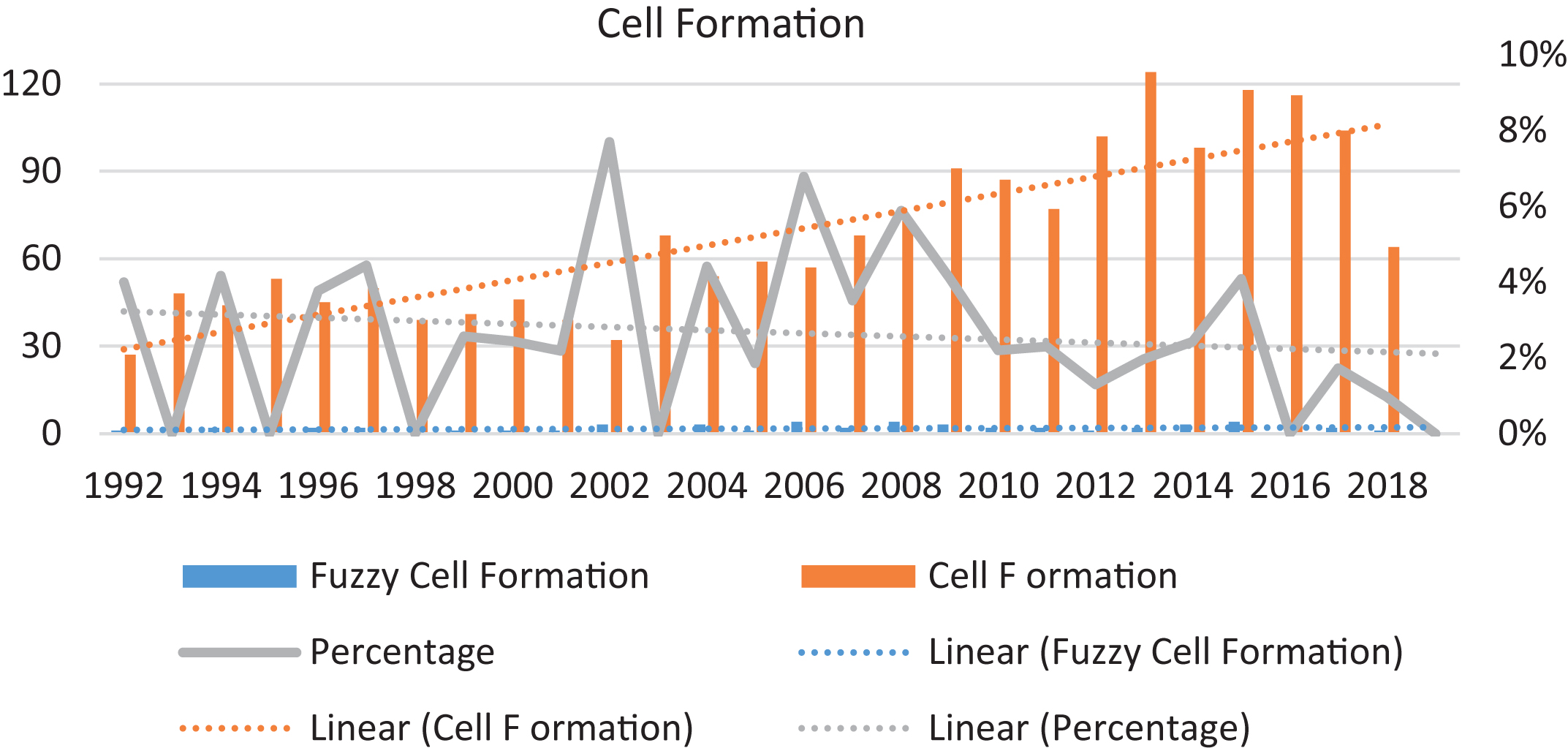
Cell formation and fuzzy cell formation.
Process planning is the creation and definition of operation processes and their sequences necessary for manufacturing a product. Defining the resources is also a part of process planning. In this study, we review all the Scopus database by searching both “process planning” and “fuzzy” at the “title” of the papers. In Scopus database, there are 32 fuzzy process planning studies. Out of 2311 “process planning” studies that puts process planning to the title, this number is very limited. For example, Shehab and Abdalla [47] develop an initial process planning system where fuzzy sets are utilized in the cost estimation. Xin et al. [60] employed interval-valued fuzzy sets for the machine tool selection in process planning. Bi et al. [6] used intuitionistic fuzzy sets for matching the degree of customer demands. Jadram and Boongsood (2018) used fuzzy set theory in order to machine layout organizing with genetic algorithm. The other extensions of fuzzy sets have not been used in process planning problems.
Cutting stock problem
The cutting stock problem (CSP) aims at defining the optimal way of cutting objects from stock rolls by minimizing the trim loss. In Scopus database, 502 studies use “cutting stock” at the title of the paper. Only 4 studies utilized fuzzy set theory in the cutting stock problems. Vasko et al. [58] used fuzzy sets in the cutting stock problems. Ghodsi and Sassani [22] develop an adaptive fuzzy and recursive algorithm for minimizing the waste in a cutting process of high-volume solid wood furniture. Ghodsi and Sassani [22] use adaptive fuzzy ranking method for solve the real time one-dimensional multiple-grade cutting stock problem when orders are prioritized. The extensions of fuzzy sets are not employed in cutting stock problems.
Others
Energy generation systems are essential components of production systems, but this area involves many different characteristics that need to be evaluated separately. Therefore, in this study, we did not focus on energy generation systems. Yet, in literature, both the extensions and ordinary fuzzy sets have been utilized to solve the energy generation problems [4, 64]. Similar to the energy generation system, Supply chain management, and distribution planning is also a broad area that needs special attention. Several studies evaluate the performance of suppliers by using interval-valued fuzzy sets [13, 45]. Also supplier selection problem is handled in many times with extensions of fuzzy set (Ayvaz et al., 2015, Bolturk, 2018) with different multi criteria decision making methods.
Production strategy and production method selection (design) is another field that needs to be analyzed. Zhang et al. [68] proposed a multi criteria production strategy approach using hesitant fuzzy sets. Xu [61] mechanical developed a model for measuring the product design quality by using hesitant fuzzy information. Ervural et al. [16] evaluate the performance of flexible manufacturing systems by using a hesitant group decision-making approach. Khishtandar et al. [32] evaluate the bioenergy production technologies by using a hesitant multi-criteria decision-making approach. Matawara et al. [35] assess the lean management degree by using interval-valued intuitionistic fuzzy sets.
Production systems and fuzzy sets in literature
In this Section, we summarize the literature review results by using graphical and tabular analysis. The keywords given in Section 3 are used to analyze the trends in fuzzy production literature. A total of 3147 studies are analyzed. The frequencies of fuzzy production systems are given in Fig. 6. Especially after 2000’s with the developments in the computational technologies the fuzzy production research papers have significantly increased.
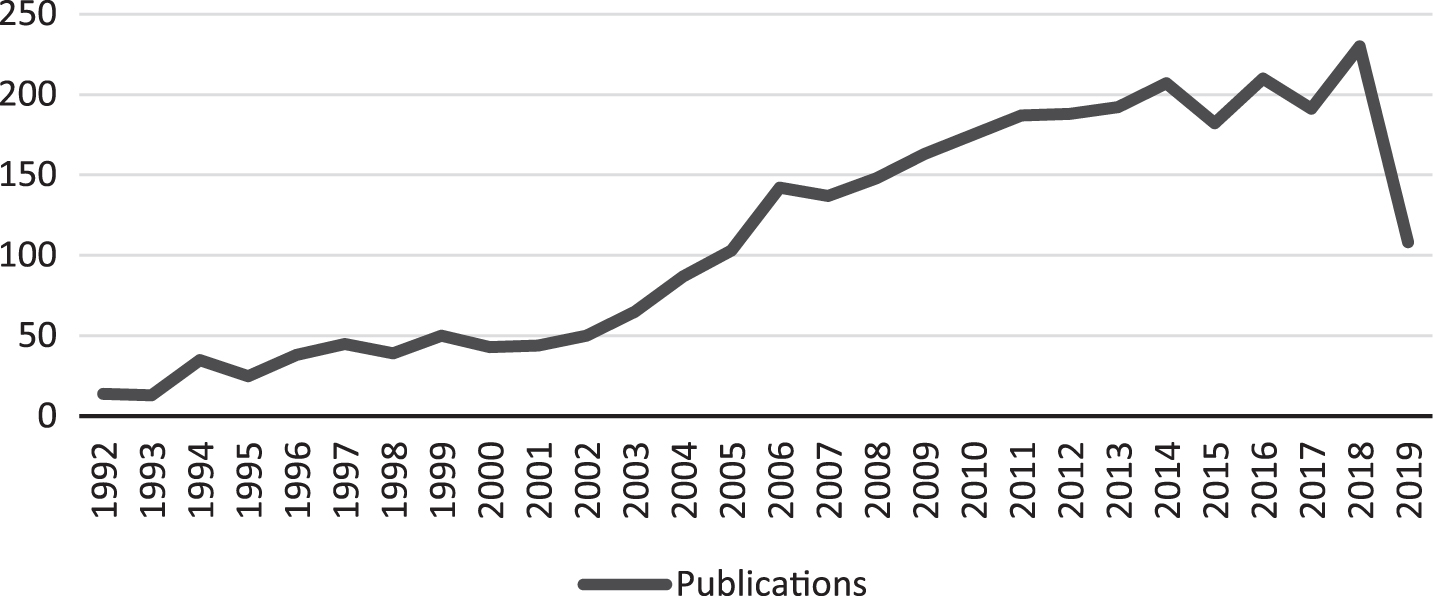
Frequencies of fuzzy production system studies.
Lecture Notes In Computer Science Including Subseries Lecture Notes In Artificial Intelligence And Lecture Notes In Bioinformatics (78 papers), IEEE International Conference On Fuzzy Systems (65 papers), International Journal Of Advanced Manufacturing Technology (55 papers), Applied Soft Computing Journal (46 papers), International Journal of Production Research (44 papers), Fuzzy Sets and Systems (41 papers), Expert Systems with Applications (38 papers), Journal of Intelligent and Fuzzy Systems (36), Computers and Industrial Engineering (32 articles) are the leading journals publishing fuzzy production system papers. Although fuzzy sets are commonly utilized in solving production system problems, the use of extensions of fuzzy sets is limited. Figure 7 illustrates the usage of extensions of fuzzy sets in production systems.
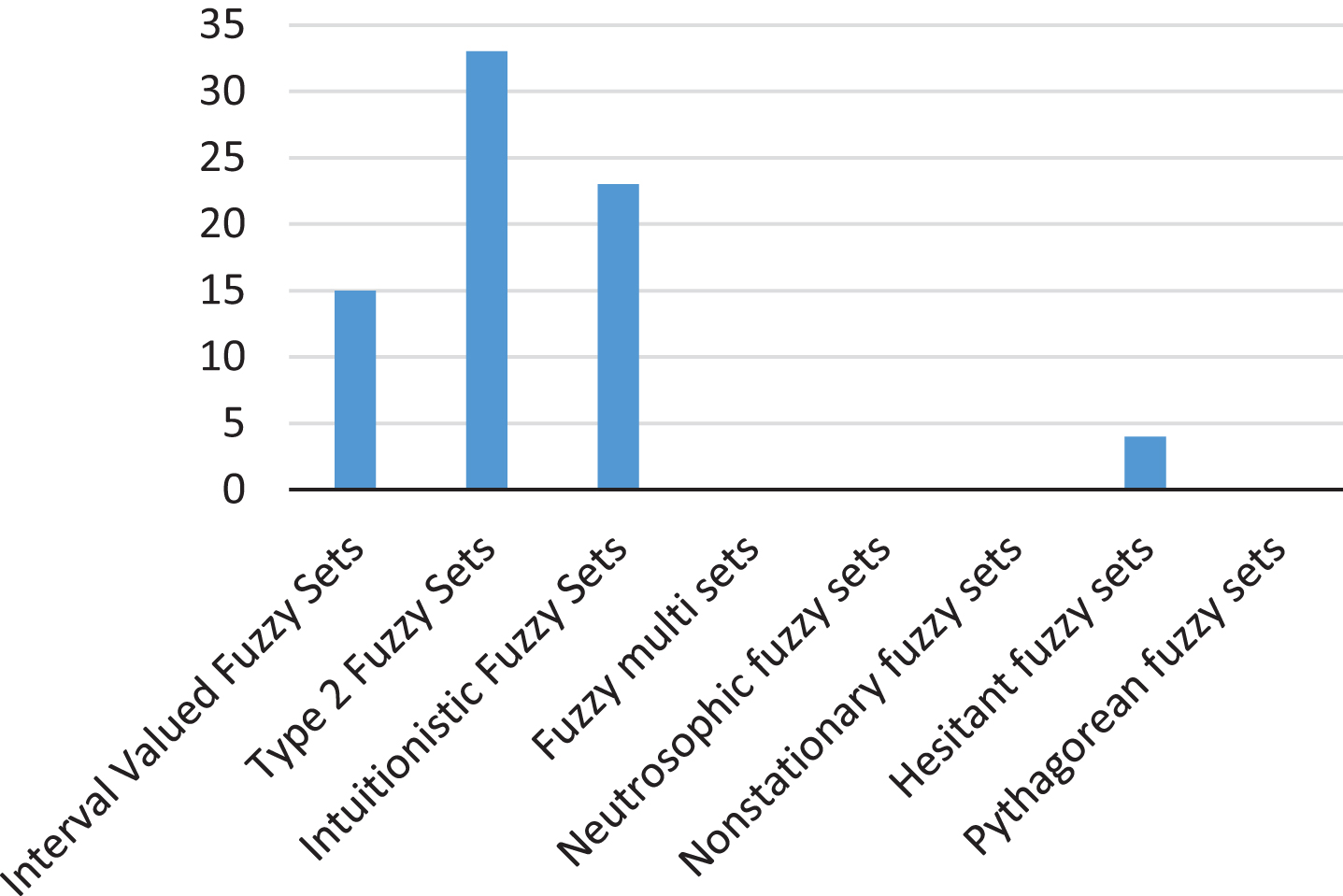
Extensions of fuzzy sets and production system.
Fuzzy multisets, neutrosophic fuzzy sets, non-stationary fuzzy sets and Pythagorean fuzzy sets are not used in production system problems. Type-2 fuzzy set is the leading extension followed by IFS and interval-valued fuzzy sets. Only a few hesitant fuzzy production system papers exist in the literature. Figure 8 shows the usage of fuzzy sets in the production system problems.
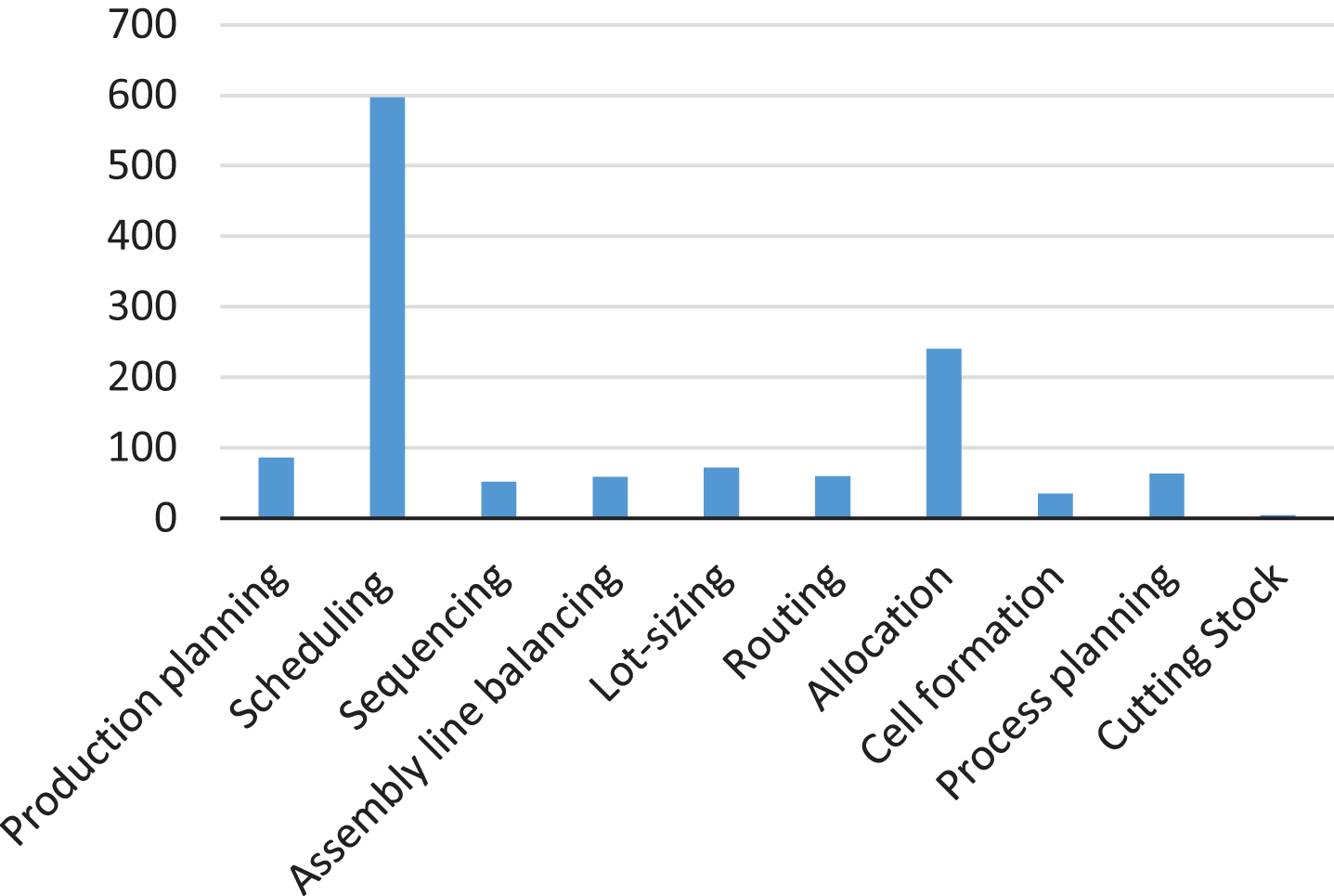
Fuzzy production system problems.
In scheduling and allocation problems, fuzzy sets are commonly used. In Fig. 9, the usage of extensions of fuzzy sets in the production system problems is given.
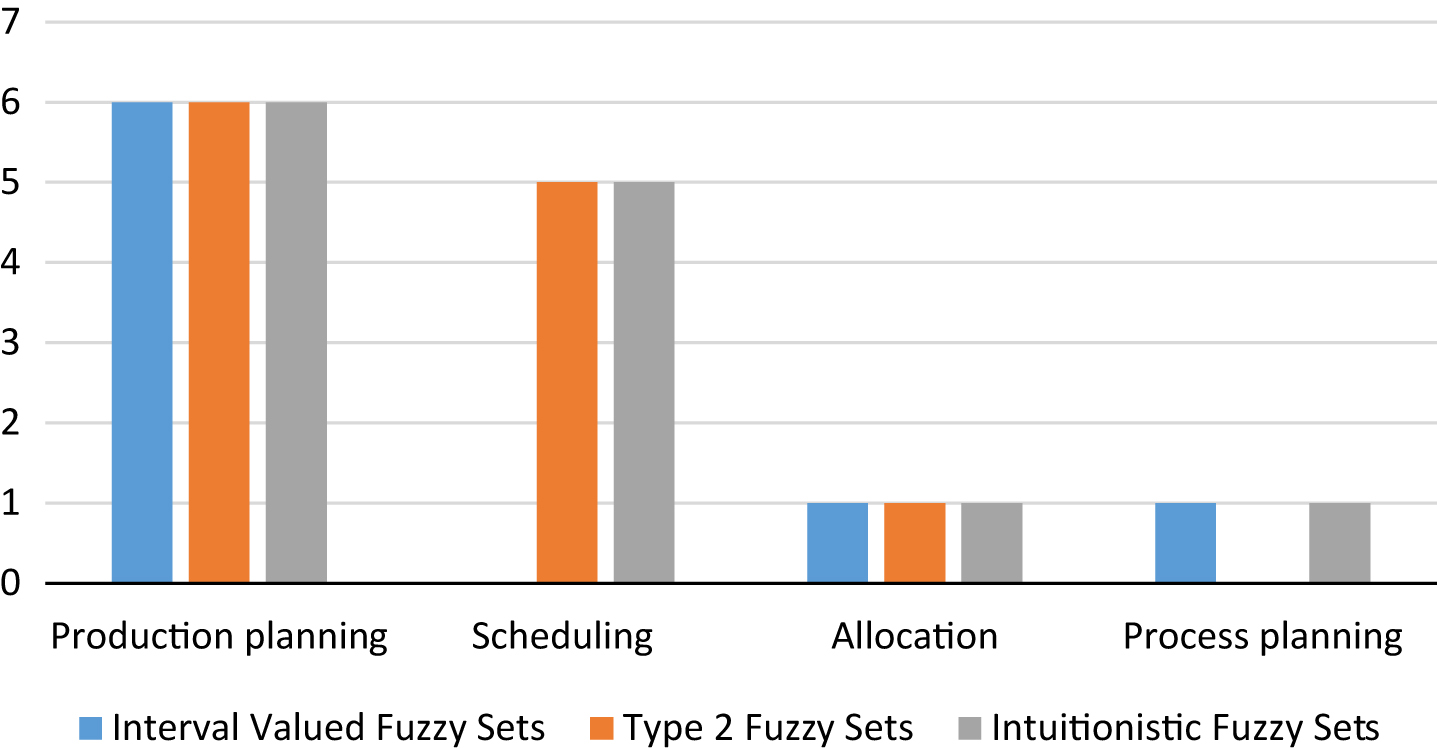
Extensions of fuzzy sets in the production system problems.
In sequencing, assembly line balancing, lot-sizing, cutting-stock, cell formation and routing problems the extensions of fuzzy sets are not utilized.
Production research focuses on the manufacture of a product, in other words, how it is made. Optimizing production systems are essecial for having an efficient and effective manufacturing system. As it has been in other areas, production research area has also taken a significant interest in employing fuzzy sets. Although both production problems and fuzzy application on these problems are gaining popularity at some of the areas the usage of fuzzy sets are very limited. For instance, the usage trend of fuzzy sets for the cell formation problems is not increasing. The fuzzy production scheduling studies are increasing but the position of these studies in the overall production scheduling literature is getting weaker. The obstacles of using fuzzy sets such as definition and computational problems are the reasons behind these decreasing trend. On the other hand, the usage of fuzzy sets on production planning problems show an increasing trend.
The usage of extensions of the fuzzy sets on the production system problems are very limited. Only Type 2 fuzzy sets have a significant application area. The complexity of defining the uncertainties and conducting calculations are the major reasons behind this limited usage. In the future, with the development of the operations on the fuzzy extensions these problems can be solved. This will cause an increasing trend in solving production systems by using fuzzy extensions.