



Abstract
With the vigorous promotion of the construction of smart campus by the ministry of education, the development concept of smart campus will have broad application prospects. However, colleges and universities are still at the stage of digital campus and there are many problems left. It is difficult to complete the transition from digital campus to smart campus. The main problem is that the campus data has only been digitized but not informational. The purpose of this article is to study a smart campus management system based on the Internet of Things technology. This research uses the unified data collection source of face recognition terminal hardware products based on the Internet of Things technology, unified management in the background of the system, and calculates and analyzes the data to obtain valuable campus big data. This study designed and implemented a complete smart campus management system by analyzing the system design principles and design goals. This system is mainly divided into the face recognition terminal hardware and smart campus software system based on the Internet of Things. By analyzing the data generated by students and faculty and staff, it can provide a reference for campus managers to improve management quality, and help teachers and students to formulate more efficient learning and teaching and research plans. This article tests the practicability of the system and obtains the user’s satisfaction as 8.0.
Introduction
Digital campus is an information-based environment that collects, integrates, and efficiently uses information such as teaching, scientific research, management, technical services, and living services based on digital information and networks. In recent years, relying on the development of cloud computing technology, Internet of Things technology and mobile communication technology, the combination of digital campus and students has become closer. The communication between people and things, things and things has become increasingly important, and smart campuses have emerged at the historic moment. “Smart campus” refers to an intelligent campus work, study and living environment based on the Internet of Things. It uses various application service systems as carriers to fully integrate teaching, research, management and campus life. With the continuous advancement of the application of information technology, many universities have proposed the development strategy of building a smart campus. In 2008, IBM proposed the concept of smart earth. In 2010, Zhejiang University publicly proposed the concept of smart campus for the first time in the Twelfth Five-Year Plan for information technology. The plan gives a description of a smart campus: ubiquitous online learning, innovative online research, transparent and efficient school affairs management, a colorful campus culture, and convenient and thoughtful campus life. In short, a safe, a stable, environmentally friendly and energy-efficient campus.
At present, due to the lack of practice in the construction of smart campuses, it is more confused about how to transition from digital campuses. Based on the intelligent Internet of Things, this article explores the construction methods of smart campuses through service design concepts. First, we analyze the current status of smart campus construction, and then look for Theoretical support, user behavior analysis of face recognition terminal hardware products, and finally completed the background design of the campus big data system. From the collection of data sources to the analysis and application of data, the ecological closed loop of campus data is formed. It has important reference value. Based on the actual situation, as the construction of the school’s smart campus mainly relies on major manufacturers for the school to not fully participate in it, and the manufacturers pay more attention to the construction of the top-level campus service and management system, which essentially forms paper data into electronic data, and no deeper mining and analysis of these data has been conducted, so the school is still in the digital campus stage. This topic is mainly reflected in two aspects. On the one hand, it is of material value: exploring the smart campus service model, providing construction concepts and method reference; on the other hand, non-material value: create a smart campus service blueprint to provide a more scientific campus management method for campus managers. In the future, the school and enterprise reform the way of student evaluation, from the traditional reliance on achievements, awards and honors to the comprehensive dimension evaluation of students’ campus behavior portraits, and promote the comprehensive and comprehensive development of students.
MA Razzaque and his team believe that the Internet of Things (IoT) envisions a future where digital and physical things or objects (such as smartphone, TV, car) can be connected through appropriate information and communication technologies to enable a range of applications and service. The characteristics of the Internet of Things, including the ultra-large-scale Internet of Things, heterogeneity at the device and network level, and the large number of events spontaneously generated by these things, will make the development of diverse applications and services a difficult task. In general, middleware can simplify the development process by integrating heterogeneous computing and communication devices and supporting interoperability in various applications and services. Recently, there have been many suggestions for IoT middleware. These proposals are primarily targeted at the key components of the Internet of Things, Wireless Sensor Networks (WSN), but do not consider the other three core radio frequency identification (RFID), machine-to-machine (M2M) communications, and supervisory control and data acquisition (SCADA). Elements in the IoT vision. Taken as a whole, they outlined a set of requirements for IoT middleware and conducted a comprehensive review of existing middleware solutions for these requirements. In addition, it highlights open research issues, challenges, and future research directions [1]. Hashem and his team believe that the expansion of big data and the evolution of Internet of Things (IoT) technologies have played a significant role in the feasibility of smart city initiatives. Big data provides cities with the potential to gain valuable insights from the vast amounts of data collected from various sources, while the Internet of Things allows highly integrated services to integrate sensors, RFID and Bluetooth in real-world environments. The combination of the Internet of Things and big data is an unexplored research area that brings new and interesting challenges to achieving the goals of future smart cities. These new challenges are focused on business and technology-related issues that enable cities to realize the vision, principles and requirements of smart city applications by implementing key smart environment characteristics. They describe the latest communication technologies and smart-based applications used in smart city environments. By focusing on how big data can fundamentally change the urban population at different levels, the vision of big data analysis to support smart cities is discussed. In addition, a future business model for smart city big data is proposed, and business and technology research challenges are identified. This research can provide a benchmark for researchers and industry in the future development and development of smart cities in the context of big data [2]. Liusong W and his team described the intelligent electronic device (IED) modeling method in the IEC 61850 protocol. Then, the IED modeling method is applied to the smart terminal device instance, and the IED modeling method and process are introduced from the aspects of function definition, function decomposition, and device object model, and the modeling results are given. The IED modeling method they proposed can achieve good interoperability between intelligent electronic devices of different manufacturers, achieve seamless system integration, avoid repeated investment, and reduce system maintenance costs [3].
In this paper, the unified data collection method of face recognition terminal hardware and the big data service platform will be used to analyze and process the collected data to change the original smart campus construction method. This article, from a system perspective, uses the concept of service design to design a complete set of service systems based on the Internet of Things, combines the construction of a smart campus with the Internet of Things, explores a system construction service system, quantifies the quality of the construction of a smart campus, and quantifies the quality of school management. Provide more scientific management methods and provide more convenient campus services for teachers and students.
Internet of things technology and smart campus
Internet of things
(1) The concept of the Internet of Things
Zhu Hongren, chief engineer of the Ministry of Industry and Information Technology, said at the China Industrial Operation Summer Report [4, 5]. The Internet of Things is based on the computer Internet, using RFID, wireless data communication and other technologies to construct an Internet of Things that covers everything in the world. In this network, objects can use the automatic screen recognition technology to achieve communication with each other without human intervention. The Internet of Things has three main characteristics: First, comprehensive perception, perception is the core of the Internet of Things, and things are connected; second, reliable delivery, real-time and accurate data transmission through agreed unified communication protocols; third, intelligent processing, the purpose of the Internet Realize intelligent identification, positioning, monitoring and management of various items through emerging technologies such as cloud computing and artificial intelligence [6, 7].
(2) Product architecture of the Internet of Things
The Internet of Things can be divided into three layers from the bottom up: the perception layer, the network layer, and the application layer. The three layers of systems complement each other, and various technology sets are divided into separate labors [8].
1) Perception layer
There are four main technical methods for identifying and collecting external information:
Sensing: is the most widely used information acquisition tool, such as acoustic sensors, optical sensors, thermal sensors and many other types. They are neurons of the Internet of Things;
Bar code: a bar code or two-dimensional code containing identity information of people and things;
The full name of RFID is Radio Frequency Identification, which is radio frequency identification, also known as electronic tag;
Embedded system: By embedding the inside of the controlled machine to make the machine work according to the manufacturer’s wishes, embedded is similar to a central nervous system for information exchange.
2) Network layer
The network layer is used to transmit the information collected by the perception layer. It is an intermediate media layer. It mainly uses two methods:
Wired transmission: such as usb, Ethernet (wire), but the limitations of inconvenience are being replaced by wireless communication due to its high cost and small transmission volume;
Wireless network: The wireless network is divided into wireless distance communication technology, low power wide area network and mobile communication network.
3) Application layer
The application layer analyzes and processes the data transmitted by the sensing layer.
(3) Internet of things service model
The service model of the intelligent Internet of Things in the information age is mainly divided into horizontal design services and vertical design services.
1) Vertical design services: for specific traditional industries, with specific industry standards, specific perception methods, transmission methods, and application methods, supporting specific industry and product models, information perception mainly focuses on technology and integrates different disciplines the purpose of technical support is to achieve better product performance feedback to improve perception processing capabilities [9, 10].
2) Horizontal design services: different information exchange and processing methods for different service scenarios, with personalization, not just to improve product awareness, the core is not in technical aspects, but in the business model, where product development, operation, and maintenance Key links [11, 12]. The Internet of Things researched in this article is a horizontal service model. It focuses on the information exchange, processing, and information collaboration collected at the perceptual level to maximize the value of data and integrate it efficiently.
Smart campus
The construction of a smart campus must first have a unified infrastructure platform and a network environment covered by both wired and wireless networks; second, it must have a unified data sharing platform and comprehensive information service platform [13, 14]. The construction and development of a smart campus will completely change the original mode of education and teaching management, which will help improve the level of school running and optimize school management.
Smart campuses have the following characteristics: omnipresent wired or wireless networks are seamlessly connected; a fully perceived campus environment and widely perceived information terminals; a broad and open learning environment; intelligent data processing and fast integrated business processing; teachers and students provide role-based personalized customization services [15, 16]. The smart campus undertakes the tasks of intelligent data processing and fast integrated business processing, and its ultimate purpose is to provide role-based personalized customization services for teachers and students. The current construction of smart campuses is mainly focused on rigid requirements such as teaching management, dormitory access control, and student consumption. Through the Internet of Things technology, students’ recycling information is counted, and this information is processed, mined, and used in combination with cloud computing and big data technologies. Campus application facilities will gradually become an integral part of a smart campus. These application facilities can be combined with today’s hot mobile Internet with great user stickiness to better provide students with life services and make campus application systems truly smart.
Analysis of smart campus service design system based on internet of things
(1) Components of Smart Campus Service System
1) Smart campus identification hardware
The existing campus identification hardware is classified as follows:
Campus All-in-One Card System: The campus digitalization is an important component of basic equipment. Based on the existing local area network or TCP / IP-based Internet network, multiple devices are integrated into a large software management platform [17]. Application subsystems include campus charging systems and access control systems.
RFID campus security intelligent management department: When students carry customized electronic tags (electronic student ID) to enter and leave the school, student ID will activate low-frequency exciters deployed inside and outside the school. The data is transmitted to the server via a reader. Application subsystems include: campus access control management system (campus card combined with long-distance card and contactless card), dormitory access management system.
The face recognition forbidden management system, face recognition server+face recognition terminal screen+access control / barrier+face recognition system, the face recognition terminal is installed on the traditional access control, and it is compatible with the traditional card entry method. The system records detailed entry and exit data.
2) Smart campus big data service platform
The smart campus big data platform is the backstage and data visualization display front desk that exchanges and collects the data collected by the intelligent identification hardware system [18, 19]. The platform uses a unified data format to achieve data sharing between systems. The significance of the smart campus big data service platform: collect and store various types of data to form school-based data, while ensuring the smooth horizontal and vertical circulation of data in each system; provide real-time campus data for teachers and campus managers, and improve the quality of teaching and campus management; Facilitate the development of later application systems, separate applications from data, reduce the difficulty of application system expansion and development, and lay a solid foundation for the comprehensive integration of university application systems [20, 21].
(2) Research on face recognition technology
1) The concept and advantages of face recognition
Face recognition technology, which is based on facial features in biometric features [22]. The accuracy of the algorithm has reached 99.15%. Therefore, face recognition technology is a very core information security authentication technology and has been widely used in various industries. Advantages of face recognition technology: non-mandatory, face recognition technology uses visible light to obtain face image information without disturbing the user; the detection method is non-contact, and does not require users to directly contact the device, and the user experience is better, easier [23, 24].
2) Process of face recognition technology
The core of face recognition technology is its algorithm, with the sharing of algorithms; application-level face recognition systems already have a high recognition rate [25, 26]. Generally, the face recognition process mainly includes four steps: image acquisition, face preprocessing, feature extraction, and recognition.
(3) Service process
The service process of building the system is from the campus data collection of face recognition terminals to the campus big data service platform data analysis and display.
1) Data collection
Data collection is divided into two ways. The first is collected by the campus’s unified face recognition terminal hardware products. When teachers and students enter and exit libraries, teaching buildings, dormitories and other places on campus, the face recognition terminal will record the teachers and students’ behavior data is stored in real time; the second type is provided by the school’s third-party system. The third-party system includes the existing teaching and research systems of the school.
2) Background data analysis
The backend adopts the Hadoop open source framework. Firstly, the collected massive data is stored through HDFS, MapReduce, and HDFS. The data is calculated and analyzed through MapReduce to dig out the campus teacher and student behavior behind scattered data.
3) Campus big data service platform display
The analysis results are displayed at the front desk. School administrators and teachers can view the corresponding data display modules according to their own system permissions to comprehensively understand the student’s learning, life dynamics, teacher research, and teaching conditions.
(4) Blueprint for smart campus services
The smart campus big data service blueprint is a user centric panoramic system service map based on the system service process. Blueprint drawing of smart campus big data service system:
1) Clear service process:
The blueprint is drawn to analyze the user’s experience in using the face recognition hardware and big data platform. Therefore, the service process established in the blueprint is from the face recognition of teachers and students on campus to the collection of data by campus managers and teachers. Big data platforms view the entire service range of data.
2) Describe the face recognition process and big data viewing process from the user’s perspective
In the design of the human-computer interaction service system, the user’s complete recognition experience is considered, and it is divided into the recognition area entry, camera shooting, recognition result display (whether the gateway is open), recognition result prompts (normal, incorrect guidance), and exit from the gate. Five steps to identify and take pictures again; check the campus big data display data on the PC.
3) Visibility division of service behavior
In the smart campus service system, the carrier of service visibility is on the interactive hardware, the gateway and the human-computer interaction display screen, and when the customer enters the waiting area, the human-computer interaction display screen will perform face recognition operation guidance prompts; the camera obtains the human face After the face recognition is completed, the display screen will provide corresponding prompts; after the normal recognition, the gate will be opened for release; after the user leaves the camera, the camera will take a photo to open the gate again. During the whole process, the user can’t see the background technical algorithm process, only showing that the user has to wait.
4) Internal support of services
The service system includes internal technical support such as face recognition technology, Internet of Things technology, cloud technology, and big data algorithms. Service evidence support at each stage: The service evidence includes the tangible substances that the user sees and contacts in each step of the smart campus big data system, including: the human-machine service interface and service prompts at each stage, service notifications.
(5) System construction goals
The author hopes to establish a smart campus service system based on the Internet of Things to complete the construction of a true smart campus. The construction of a smart campus service system is divided into hardware part face recognition terminal products and software part campus big data service platform. Library, dormitory, and teaching buildings collect teacher and student behavior data, and then transmit the data to the campus big data platform in real time, analyze and mine massive scattered data to form campus big data and teacher and student behavior portraits. Campus big data guides campus managers to make more scientific campus management decisions, guides teachers to better conduct teaching and scientific research, and improves the quality of student training.
(6) System construction principles
The design of a smart campus big data service system based on the Internet of Things needs to meet the following basic principles: Ergonomics compliance: Hardware and software systems need to be designed with the user at the core to ensure a good interaction experience within the system and ergonomics. Standardization: The design of hardware and software systems needs to have unified design standards and design specifications, to achieve standardized unified specifications, and to be open in practical structure. Modularity: The hardware system design needs to meet the modular design requirements to facilitate the early installation and later maintenance work. Compatibility: The design of hardware and software systems needs to meet the requirements of compatibility with existing and other systems. Modifiability: Design hardware and software systems in a scientific way, with good structure and complete system documentation, and system performance is easy to adjust. Security: Security requires the system to maintain user information, operations, and other security requirements, and the system itself must be able to repair and handle various security vulnerabilities in a timely manner to improve security.
Experimental simulation analysis
Data collection
A university has more than 15,000 students and more than 1,500 faculty members. During the study period, students need to enter multiple sets of PC-side software and websites, and they must keep in mind the functional operation of each software system, which is extremely inconvenient. The national open university’s educational administration management system is not open to students of the school. Students cannot query data such as course information, course selection information, and test notices, so a unified query platform for information release is urgently needed to provide one-stop services and guide students to complete their studies task. Aiming at the characteristics of adult students’ curriculum decentralization and difficult class management, it is also urgently needed for the platform to provide unified management functions and check-in management functions. The same question, many students asked the class teacher, the class teacher had to answer one by one, resulting in high communication costs; the class teacher urgently needed a software system to integrate class management functions to improve work efficiency and reduce repeated labor. So it is extremely urgent to design and implement a management system that can meet the above requirements.
System design
The overall architecture of the smart campus is shown in Fig. 1:

Overall architecture of smart campus.
(1) Face recognition terminal hardware products based on the Internet of Things: Collects daily behavior data of teachers and students, and is the data source of the campus data analysis service platform. Distributed in libraries, dormitories, and teaching buildings.It is divided into library face recognition terminal hardware, dormitory face recognition terminal hardware, and teaching building face recognition terminal hardware.Through TCP / IP and face recognition terminal background real-time data collaboration, it is completed. Unified collection of daily behavior data of teachers and students.
(2) Smart campus big data service platform: analyze and process the data collected by face recognition terminals to form campus big data.
1) Big data display (front desk): real-time data analysis chart visualization.
2) Data analysis and processing (backstage): Perform background analysis and processing on the collected data. There are two types of data sources: teacher and student behavior data collected by face recognition hardware terminal hardware and platform data of third-party systems (other campus software platforms).
Usability testing at this stage is a formative evaluation method: that is, testing is performed during the product development process, and it is continuously found during testing, and new problems are raised for optimization and improvement to meet the requirements of product usability.
Usability has five evaluation methods: easy to learn, easy to interact, easy to remember, fault-tolerant and user satisfaction. The system is available when the user’s satisfaction with each indicator is high.
Easy to learn: users can easily understand how the product is used; easy to interact: users can quickly use the product to achieve the purpose of use; easy to remember: the way the product is used is easy for the user to remember (that is, the user has not used for a long time); fault tolerance: the product for the user. The mistakes made are inclusive and will give users the correct guidance; satisfaction: users subjectively agree with the product.
Function module
(1) Campus overview
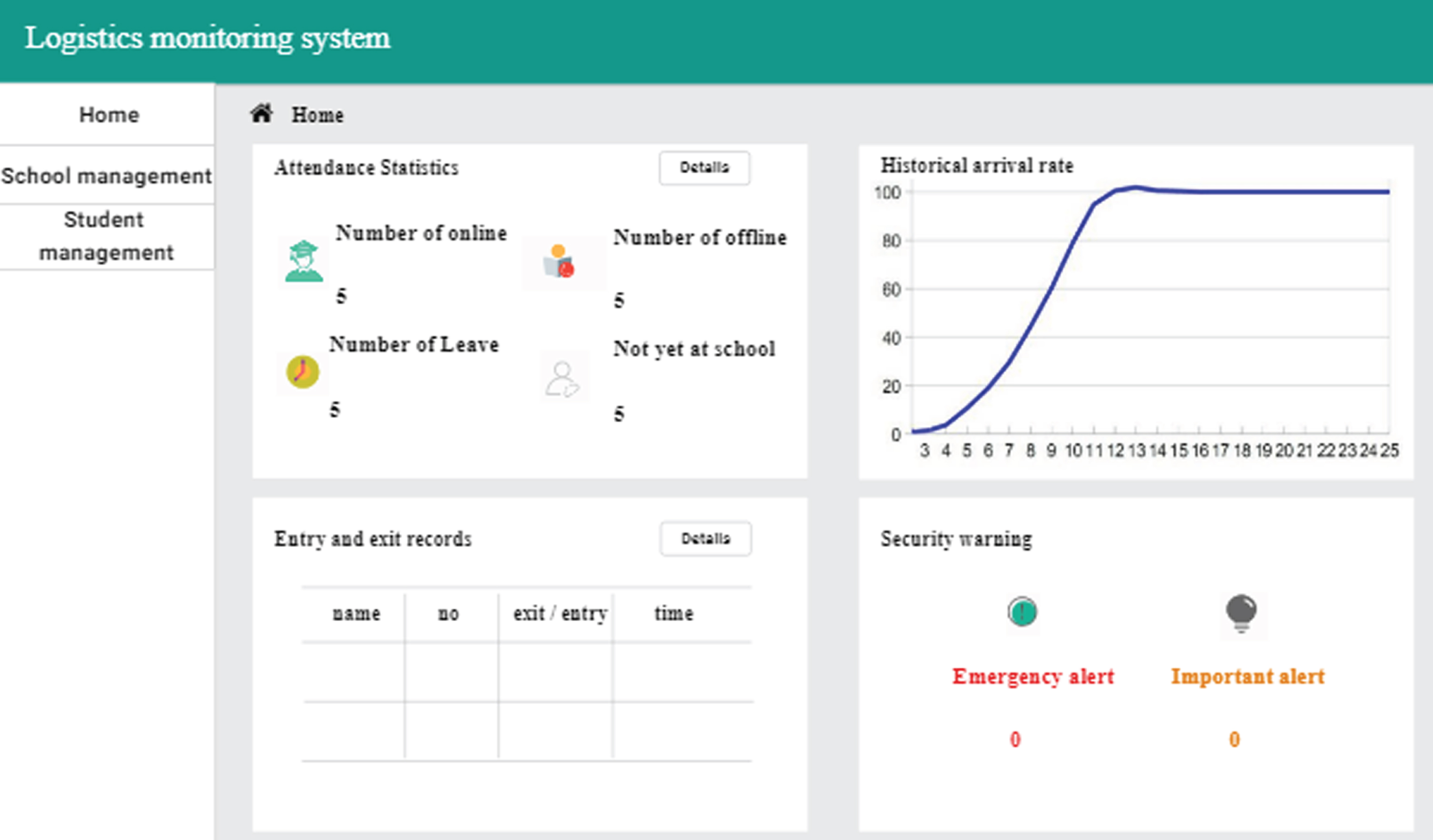
School administrators can open a browser and enter their own school-specific account and password to log in to the smart campus Internet of Things web management terminal. The home page of the web management terminal is the campus overview page. This page shows the overall situation of the entire campus. Divided into school management, student management and other sections. Each section has a detail button to browse specific statistics details. The campus overview interface is shown in Fig. 2.
Campus overview interface.
As can be seen from Fig. 2, clicking the attendance statistics details button of the campus overview, the page will jump to the attendance statistics details module. This page has tags for students at school, students leaving school, students on leave, not yet at school. Managers can click on the corresponding tags to view specific student information. Click on the entrance and exit situation in the campus overview, the page will jump to the entry and exit statistics details module. This page has two tags: school status and school leave status. The administrator can click the corresponding tags to browse the specific student information, click the security alert details button in the campus overview, and the page will jump to the floor plan of the crowded area. Campus managers can see if there is a crowded area on the campus and the situation of the crowded area,
(2) Student information management module
ApachePOI is a free and open source cross-platform Java API written in Java. ApachePOI provides APIs for Java programs to read and write Microsoft Office format files. ApachePOI is a Java API that creates and maintains operations that conform to the Office OpenXML (OOXML) standard and Microsoft’s OLE2 Compound Document Format (OLE2). Use it to read, create, and modify MSExcel files using Java. Moreover, you can also use Java to read and create MSWord and MS PowerPoint files. This article chooses HSSF (providing reading and writing of Microsoft Excel XLS format files) and XSSF (providing reading and writing of Microsoft Excel OOXML XLSX format files) to analyze the basic information data and student attendance information in the database. Data analysis of students’ basic information is shown in Fig. 3.

Data analysis of students’ basic information.
According to the above two report graphs, it can be obtained that, according to the age group of every 5 years old, the current open education students are the most aged 20 years old, the second is 25 years old, the number of students over 45 years old has decreased significantly, and only 60 students are 60. At the age of 20, the number of girls significantly exceeds that of boys. The number of boys increased at the age of 25, but decreased at the age of 30. From the analysis of the source of students and the conditions for social recruitment, students are mainly young (the proportion of young women is higher than that of men). With the increase of age, the stability of jobs, and the stability of life, the willingness to continue to improve their education gradually declines. It disappears completely by the age of 60. Therefore, in the setting of open education enrollment majors, it is necessary to adapt to local conditions, and to increase the promotion of popular majors (such as preschool education, administrative management and other majors) among young audiences to reflect their own advantages and ensure the survival line of enrollment. And in the follow-up teaching management, do everything possible to improve the teaching quality and establish a brand.
(1) System performance test
In this paper, the performance of the system login and page load time is tested through a virtual user access system. The number of virtual users is five different orders of magnitude, such as 10, 100, 1000, 2000, and 5000. Performance tests show that when the number reaches 5,000 people, the access time of the system is still very stable, and the results can be returned to the user within the prescribed time. The system performance test results are shown in Fig. 4.

System performance test results.
As can be seen from Fig. 4, for the application scenario of the login system, the time for users of the order of 10, 100, 1000, 2000, and 5000 to log in at the same time is stable in the interval of 2 to 5 seconds, and the average response time is 3.4 seconds. For the list page loading time, the time is stable at 4 seconds to 9 seconds, and the average time is 7 seconds.
(2) Usability test
Three testers can find the problem of system usability test. A typical usability test requires 6–12 participants. This test has a total of 36 testers. The test is divided into groups. The tester uses the demo to conduct user interviews and complete test metrics. The score is from 1 to 10 points. The usability test results are shown in Table 1 and Fig. 5.
Usability test results

Usability test results.
From the experimental results, it can be seen that among the five indicators, the highest score is 8.0, the lowest is 6.4, and 40% of the indicators are between 7.7–8.0. Satisfaction is based on positive evaluation. The user’s experience index for the UI interface of the big data analysis platform system is divided into 7.2, and the range of 7.0–7.9 is combined, and three indicators (60%) have obtained the first-rate evaluation of test users. The data display comprehensive index of the big data platform is 6.4, and the chart readability index of the big data platform is 6.9, which belongs to the middle and low-level evaluation. Through interviews, the main reason for the poor readability of the chart is because the test data is Due to the virtual data, the virtual data is difficult to reflect the real situation of data analysis. It is expected that this evaluation will improve after the data is realized. The largest dispersion in the test is that the big data platform displays the comprehensiveness of the data. Big, the author’s analysis is because of the differences between the interviewed user schools, different schools have different actual needs, and the existing big data analysis dimension of the platform is basic, and the lowest dispersion is whether the face recognition hardware system can meet all scenarios Most users think that they can cover all the scenes, indicating that there is no big difference between the schools for the scenes covered by identity recognition. Therefore, the design of the face recognition hardware system is universal.
This article applies the IoT technology theory to the research and design of smart campus service systems, integrates the design of campus data collection and processing methods, and clarifies that the face recognition terminal hardware is the best identity and data collection product, and is based on face recognition The terminal designed a campus big data analysis service platform. It provides a reference for the construction of smart campuses advocated by the state.
This paper has studied a complete set of smart campus construction solutions, and designed a smart campus management system composed of face recognition terminals and campus big data analysis service platforms. In theory, it provides design and Research reference.
This article analyzes the design of the smart campus management system. From the perspective of system goals and design principles, it analyzes the functional design, architecture design, hardware design, and software design of the service system to complete the overall design of the smart campus service system. Finally, after completing the basic design, this article conducted a system usability test evaluation and obtained the system usability test results to provide directions for future improvements.