



Abstract
Wireless sensor network is a wide network that works as a cutting edge model in industrial applications. The sensor application is mostly used for high security systems that provide safety support to the environment. The sensor system senses the physical phenomenon, processes the input signal and communicates with the base station through its neighbors. Energy is the most important criterion to support a live network for long hours. In the proposed system, the EUCOR (Efficient Unequal Clustering and Optimized Routing) protocol uses the objective function to identify the efficient cluster head with variable cluster size. The computation of the objective function deals with the ant colony approach for minimum energy consumption and the varying size of the cluster in each cycle is calculated based on the competition radius. The system prolongs the lifespan of the nodes by minimizing the utilization of energy in the transmission of packets in the networks when compared with the existing system.
Introduction
The progress in wireless communication has been developed by the application of sensor nodes. Monitoring the physical occurrences such as heat, smoke, vibration, and tsunami plays a major role in the improvement of sensor applications. Sensors are used in hazardous areas where humans cannot operate. The nodes accumulate statistics from the physical means and forward the data to the centralized unit for further processing. Many protocols have been introduced in sharing the data with the neighbors and reach the base station [1–4]. In the flat based routing protocol the sensed data are flooded throughout the network with the help of the neighbors. The nodes communicate with their neighbors by means of this; the nodes have the data of every node in the network, hence a huge number of transactions occur in data communication. The efficiency of the node will get degraded since the node drains within a short span due to the dissipation of the individual nodes’ energy in transmission. We have a few more models in transmitting the data that help to minimize the dissipation, but the nodes are not efficiently utilized. A few protocols multicast the data instead of flooding the data in the network region; in that case the energy utilization gets lower. We introduced another technique called clustering. Gathering the nodes together as a single bunch and placing the centralized node to receive and convey the data to the base station (BS) increases the vitality of the network. One of the possible method to reduce the transmission energy is aggregating the packets before forwarding it to the BS. Several protocols have been introduced to maximize the lifespan by minimizing the energy consumption. The novelty of the proposed system lies in employing the objective function for the selection of an efficient clustering head and effective routing. The centroid and priority queue of the centroid is identified based on the Euclidean vector. The objective function is compared with the nodes in the priority queue for the efficient way of appointing the cluster head (CH) by employing meta heuristic optimization technique and the energy of the nodes. Thus, conserves the energy of the nodes, perhaps raises the system’s vitality and prolongs the lifetime of the network.
Related work
In this segment, algorithms of few hierarchical routing protocols are briefly discussed and three being used for comparative purposes with the proposed system.
Low Energy Adaptive Clustering Hierarchy (LEACH) is a group dependent routing approach for efficient networking [5, 6]. The LEACH protocol uses the hierarchical networking approach in which the energy is distributed randomly to stabilize the load of the nodes. LEACH uses the stochastic mechanism for the selection of CH. It is a probabilistic approach that each and every node in the system will have a chance to be the CH at least once. The CH communicates with its neighbor nodes about their selection and after the joint request received from the members of the cluster, the CH share TDMA scheduling for the nodes to convey the data. The CHs accumulate the incoming statistics from the members and forward the packets to the BS directly. The DSSS (direct sequence spread spectrum) is used to avoid interference when the communication takes place from CH to the BS. Since the nodes are deployed randomly an assumption has been made to represent uniform distribution of the nodes in the network in the sensor sector and optimal number of clusters in the network. When compared with flat based routing protocols, LEACH performs better by applying clustering techniques for communication. This protocol is applicable only for the short range due to which the scalability is low.
In Extending Lifetime of Cluster Head (ELCH) the CHs are appointed depending on the election of the neighbor nodes. The node which has the maximum votes will be considered as the current CH of the round [7–13]. The members of the CH are joined depending on their radio radius. The CHs send an acknowledgement message to their members about the selection. Depending on the acknowledgement signal received, the members vary the transmission signal for data transmission. Since the nodes within network are adaptive in nature the energy consumption is minimized in data transmission. The time slot is introduced to share the data to the respective CH. All the packets in the CH are fused together as a single unit for inter cluster communication to reach the sink. Each CH maintains a table indicating the energy value of the cluster members that are amend at the end of each selection round. The system employs a shortest path approach for data conveyance from the CH to the sink. This mechanism can result in lower energy utilization which claims a more lucid network. This system is not scalable for larger region.
The Energy-Efficient Unequal Clustering (EEUC) protocol for gathering data during the regular interval has been implemented [14]. The CH closer to the BS use more energy since the communication form the nodes in the transmission range to the base station need high energy and it leads to hot spot problems in the network. To solve these issues, the protocol assigns small sized clusters nearer to BS. The probable cluster heads in EEUC can transmit an advertisement message to all the nodes within the competition radius. The competition radius is a function of node distances from the base station. Within the competition radius, the node that holds the highest amount of residual energy is considered as cluster head. Only cluster head is permitted to carry out aggregation and forwarding of data to base station from each cluster. EEUC can conserve energy by unequal clustering during intra-and inter cluster data transmission. Sensor node’s location calculation is the major problem to be addressed in EEUC.
Energy Aware Distributed Unequal Clustering protocol (EADUC) has constructing unequal sized clusters in the network [15]. The node that holds a larger quantity of residual energy will be chosen as cluster head in each cluster and competition radius calculation depends on residual energy and nodes distances from base station. Relay cluster head selection is based on the highest residual energy. The energy dissipation is shared by unequal clustering and that reduces the energy consumption. To sustain the size of the cluster, some nodes with high residual energy are located at predefined locations on the network and this leads to the difficulty in running the protocol in real time application.
Distance Aware Intelligent Clustering (DAIC) is a hierarchical routing protocol by building unequal clusters in the network environment to minimize energy utilization and escalate network lifetime [16]. The network is divided into tiers and appoints the high energy cluster head at the nearest distance from the base station. The system employs vertical distance of nodes from base station to identify different tiers in the network and the cluster heads is quantified dynamically to abstain the selection of the large number of cluster heads in the network. The base station computes the route and shares the information to the CHs in the regions. A greedy approach is employed to address the data to the base station via the cluster heads. The system supports minimum energy consumption but the load balancing is less in the system.
EUCOR (Efficient Unequal Clustering and Optimized Routing) protocol
Network model
Presumptions have been made for the sensor region. The dedicated sensors are placed randomly for environmental observation. The total number of sensors N ={ n1, n2, …, n
n
}. The nodes are spread in the network environment and BS is placed out of the region Dedicated sensors and the BS are fixed The nodes are homogeneous; the initial energy is the same for all nodes RSSI (received signal strength indicator) value of the node is identified Nodes uses adaptive power control for data transmission
The Fig. 1 represents the network model of the proposed system.

Network representation of EUCOR Protocol.
The energy required for transmission deals with circuitry and the data packet being conveyed. Similarly, the energy utilized for receiving is dealing with the same factors. The energy required to convey a unit data is:
The energy utilized to receive a unit data is
Where, E ele (p) is the energy loss per bit of transceiver circuitry. Depending on the transmission range, free space (d2) or multipath (d4) propagation is used. E amp (p, d) is the amplification energy with distance, d.
The proposed EUCOR protocol achieves the minimum energy consumption by routing the packet effectively through an efficient clustering approach. In each communication round the nodes share the details of position and power to the BS [17–27]. The centralized selection of clustering using an objective function will balance the dissipation of energy in the cluster heads, increase the packet reception ratio and the reliability is high when compared with the existing system. The phases include Creating Objective function for Clustering Data Transmission and Forwarding
Input:
nodes –nodes in the sensor region
d higher –highest distance from BS
d lower –lowest distance from BS
γ –cost factor
ρ –evaporation factor
(Steps 1)
d
delta
← d
higher
–d
lower
For each node k
i
: R
C
[k
i
] ← 1–γ×(d
higher
–d(k
i
, BS)) / d
delta
(Steps 2) For each: Communication Round: Clusters ← form Cluster(R
C
) For each: cluster C in Clusters: For each: node k
i
in C: e
delta
← 0 For p = 1 to n: e
delta
← e
delta
+ e (p, k
i
) e
r
[k
i
] ← (1 –ρ)×e
r
[k
i
] –e
delta
) O
f
[k
i
] ← max(e
r
) × RC [k
i
] End For CH
C
← {f : max(O
f
)} End For removeDeadNodes(nodes, R
C
) End For
Creating objective function for clustering
The BS broadcast the cue signal to every nodes. The nodes respond their energy and distance to the BS using minimal transmission power since the RSSI value is known by the nodes. The base station computes the objective function depending on the energy of nodes, size of clusters in the network to determine the cluster head by employing a local search optimization technique. The objective function is calculated depends on the energy with respect to time and the competition radius of the nodes in the network. For every routine the system has a dynamic change in the selection of the CH based on the objective function. The O
f
leads to energy conservation in the network. The effective utilization of energy rises the system lifetime. The Objective function is given as,
where,
where e
r
is the pheromone energy and ρ is the evaporation factor.
The number of clusters in each cycle is computed as given above. The cluster head selection was computed using the competition radius of the nodes R
C
(k
i
) is given below,
Where, d = d
higher
- d
lower
. Here d
higher
and d
lower
are the higher and lower distance of the node from BS. d(k
i
,BS) gives the distance of the node k
i
from the BS. γ is a cost factor ranges from (0,1). The size of the cluster varies depending on the competition radius and is given as,
Here, min {R
c
(k
i
) denotes the prominent competition radius of the node k
i
and is identified using RSSI value and distance from the base station. N is the node count in M × M region. The selection of optimal clusters in the system is given using the equation,
The computation of the objective function gives set of selected CHs in the network,
The cluster is formed in the previous stage and the objective function is defined for every cluster head at this stage. The energy utilization of the CH is derived as follows. The energy cost is quantified depend on the energy of CH required for data reception, data fusion and data transmission from the same. The energy cost of CH with respect to time is given as,

Synoptic Overview of EUCOR.
The data communication takes place between the nodes to the CH and CH-to-CH till it reaches the base station. The node conveys the data to the respected CHs using the TDMA slot. After transmission the members go into the sleep mode for energy conservation. All the CHs in the network fuse the received packet and forward the packet through multiple jumps to reach the relay CH in the communication range. The relay CH in the communication range further correlates the received packets and addresses the packets to the BS. The system employs a minimum spanning tree approach to determine the near optimal path for packet forwarding. In multiple jumps, the transmission distance to CH from BS is minimum when compared with direct transmission. The selection of near optimal path is done using the equation,
O
path
–Optimal path in a network, E –set of all viable edges. Optimal route is identified through unconsumed power of the node. The node that made the function minimal will be selected as an intermediate node.
here, k j , the intermediate nodes between k i and BS. min (d (k j )) gives the smallest distance to intermediate nodes from the BS provided the node k j should be max {e r (k i )}. Till the value of the objective function exceeds the threshold energy the system employs the CH selection for data communication to reach the sink.
The computation of the O
f
is compared with the threshold, if the O
f
is low the node will communicate with the neighbor nodes to form a linear chain to transmit the packet to the sink using a greedy approach. The reliability is a measure of efficient data transmission in each cycle of the dynamic topology. The reliability is based on three objectives: they are, the energy cost, path width, and dynamic clustering. The reliability measures the consistency of the metric. The reliability of transmission i at time t, R
i
(t) is the proportion of total packets received to total packets forwarded at time t. The reliability of the node can be found out by using the given equation,
RP i (t), number of data packets received at time t
FP i (t), number of data packets forwarded at time t
τ (t), threshold of the ith transmission at time t
The simulation was done using the mat-lab simulator. The growth of the EUCOR is compared with the GSTEB, ELCH and LEACH protocols. In our simulation work, 500 sensors are spread in a 500 × 500 m2 region. 0.5J is the initial energy of the node, and the size of the data was 500 bytes long. The simulation results are plotted in the graph and shown in Figs. 3 10. The values of the simulation parameters for the scheme are given in Table 1 below,
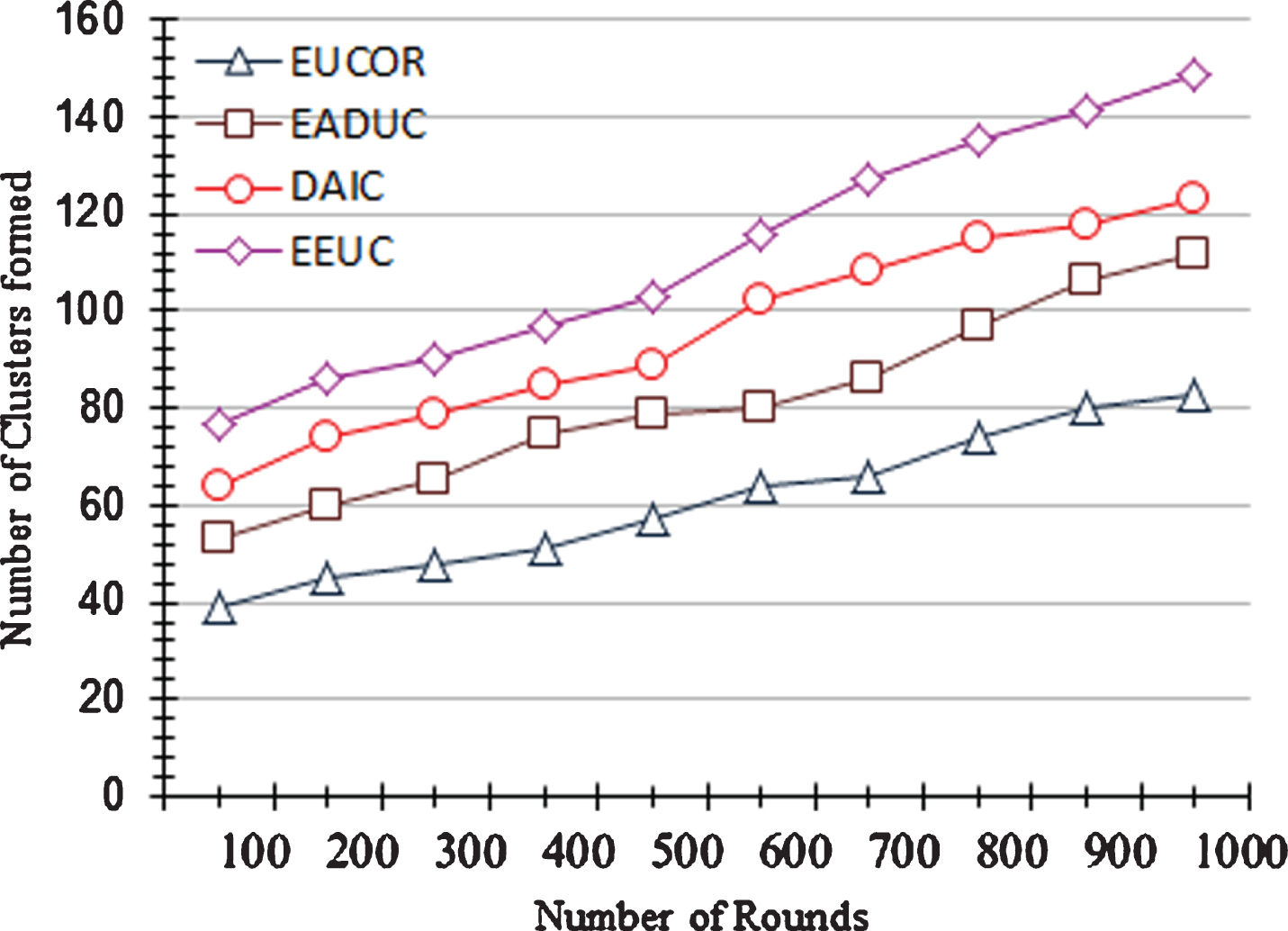
Clusters formed in each round.
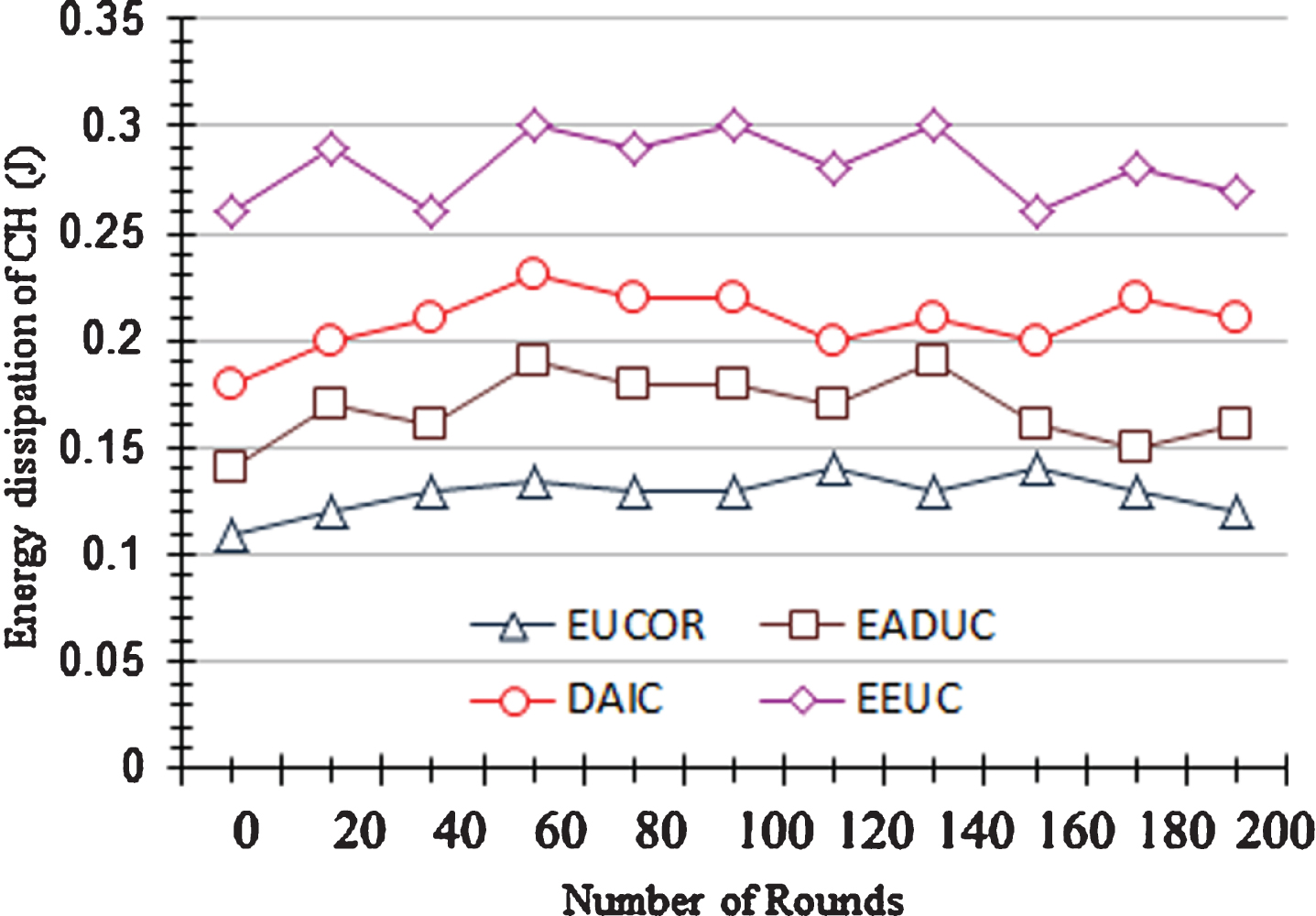
Energy dissipation of the CH in each round.
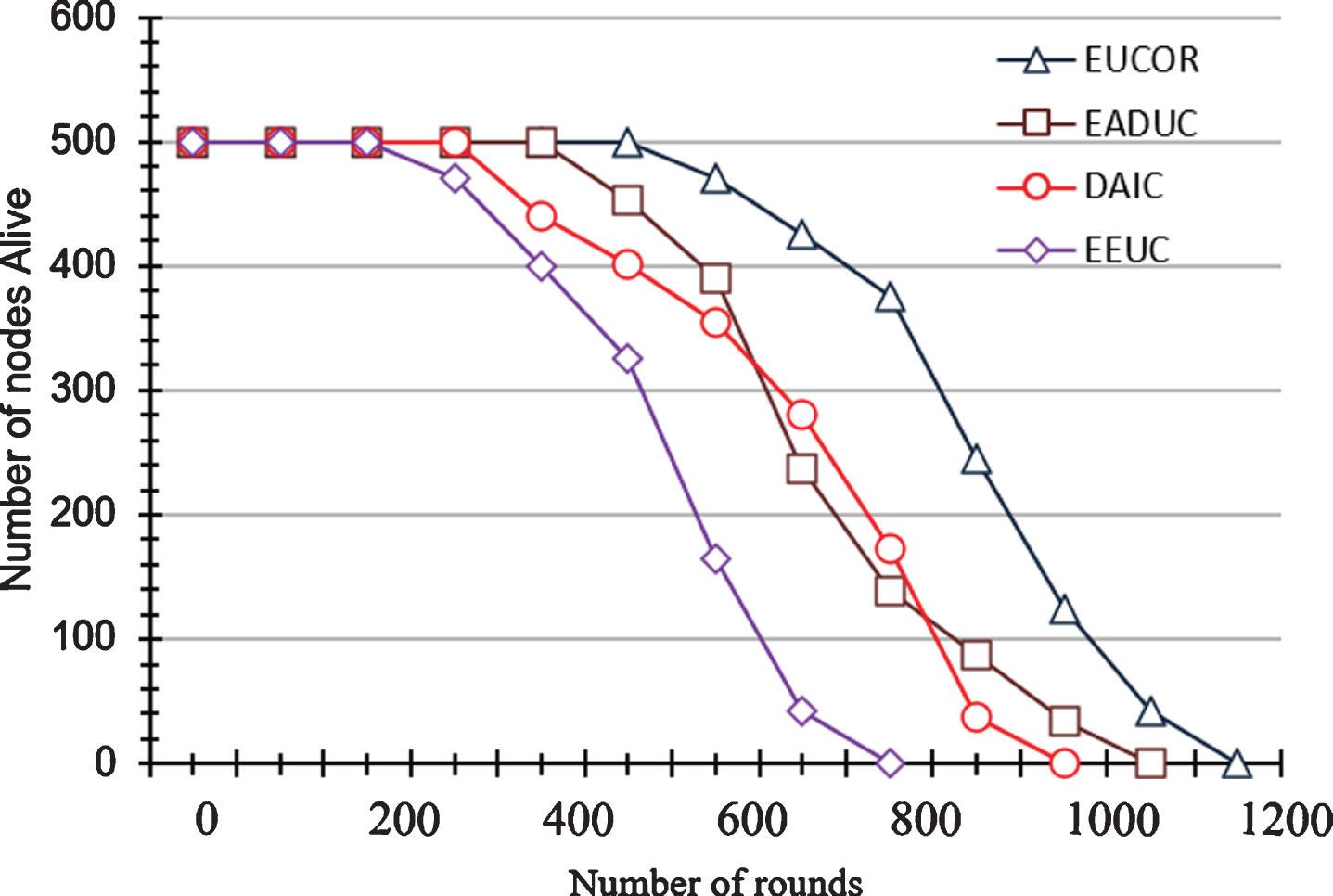
Existence of nodes under each round.

First node dies in the communication round.
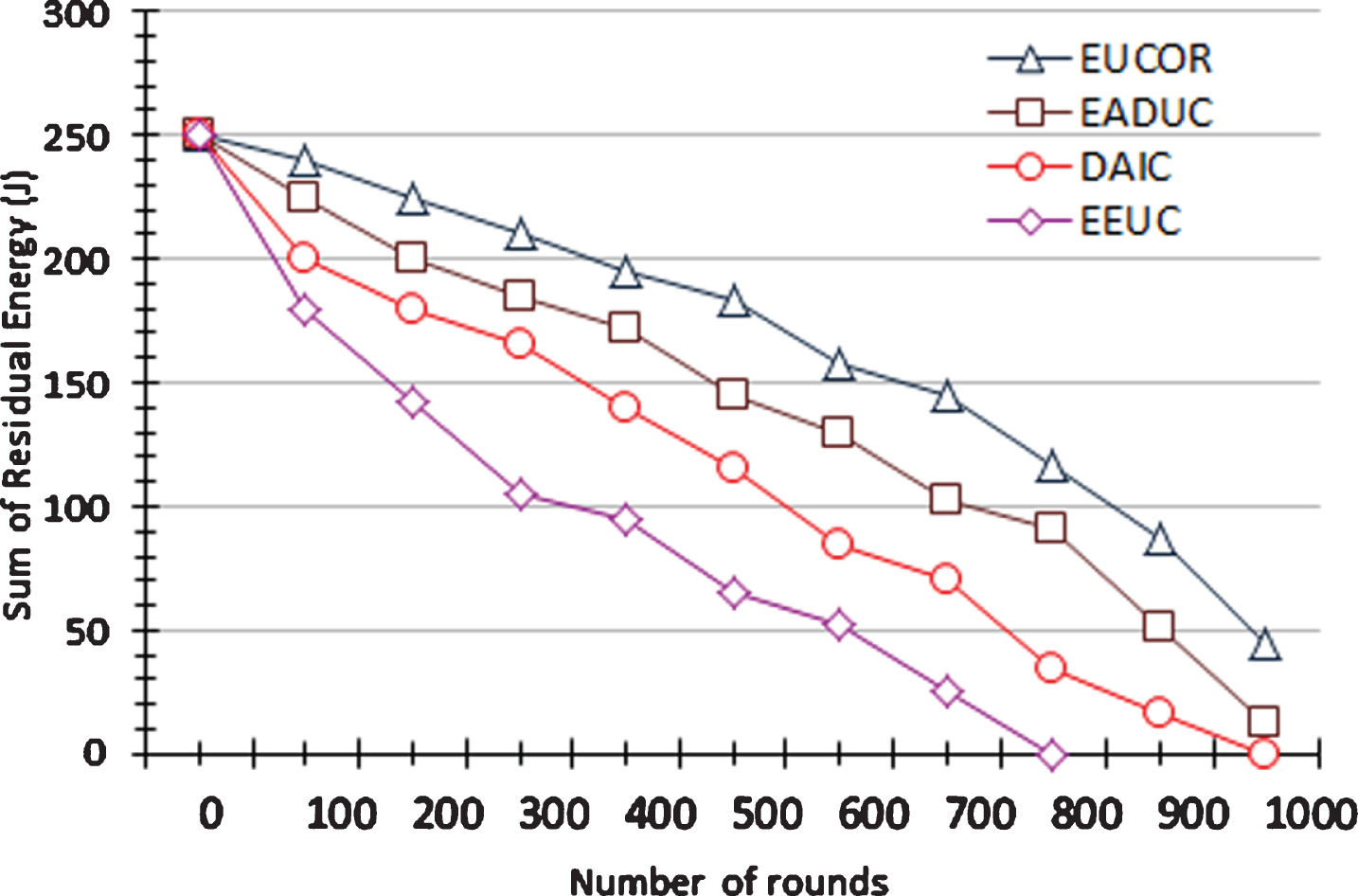
Sum of residual energy during each round.

Lifetime comparison of the protocol.

Packet delivery ratio.
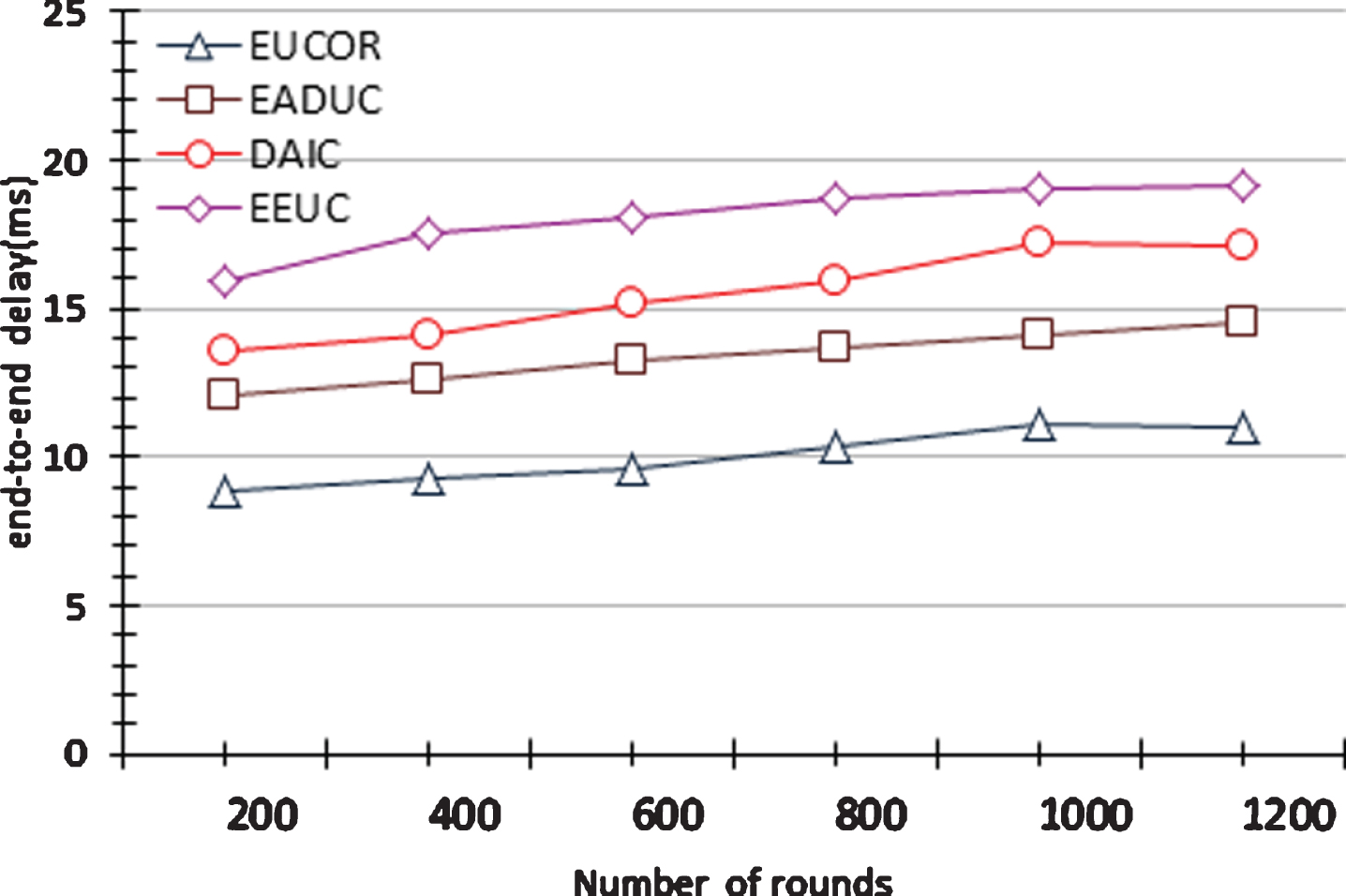
Comparison of end-to-end delay.
Simulation parameters
In this system, the cluster formation count is higher than the comparative protocols. The total number of clusters generated at the end of 1000 rounds is 82 which is less compare to EADUC, DAIC and EEUC give 105, 226, 249 the difference achieved is 21.9%, 34.1% and 44.5% respectively. Figure 3 index the number cluster formations in the network.
The energy dissipation of the CH in EUCOR is 0.11J for 200 rounds, which is less than those of the current systems like EADUC, DAIC and EEUC protocol which give 0.16J, 0.21J and 0.25J respectively. Figure 4 plots the energy utilization of the CH with the existing protocols.
The total count of live nodes in the network is greater in comparison among the existing system and is shown in Fig. 5. The communication ends at 1200, 1100, 1000 and 800 rounds for EUCOR, EADUC, DAIC and EEUC respectively. The round at which first node dies in each protocol is shown in Fig. 6.
The summation of the unconsumed energy of every node is analyzed and compared with the existing systems like EEUC, DAIC and the EADUC protocol. The growth shown in EUCOR over EADUC is 71.1%. In DAIC and EEUC the nodes dies at 800 and 1000 rounds respectively. Figure 7 shows the sum of residual energy during each round and the improvement achieved by EUCOR. The energy consumption of the CH present in transmission range is higher always since it communicates the data to the BS. By using the objective function for the selection of cluster size and the CH, the energy consumption of these nodes has been reduced in EUCOR.
In the proposed system, the growth of the lifetime constantly increased with the total count of nodes and total count of iterations when compared with the existing protocol. The growth achieved in EUCOR over EADUC, DAIC and EEUC is 8.70%, 23.22% and 54.53% respectively. Figure 8 plot the network lifetime comparison with EEUC, DAIC, and EADUC with the EUCOR protocol.
The packet delivery ratio indicates a proportion of the total numbers of packets collected by a BS to the total number of packets forwarded by sensor nodes. It is proven from Fig. 9 that the count of packets reached the sink in EUCOR is a bit higher than that of EADUC, DAIC, and EEUC protocols. The packet delivery ratio calculation in EUCOR is based on the following Equation (17) in which, overall number of packets received by sink is P accept and the entire number of packets sent by a sensor node is P transit and the total number of sensors in the network is represented by n i . PDR is given by
Figure 10 compares the protocols EUCOR, EADUC, DAIC and EEUC regarding the delay that has occurred during data transmission in the network. The delay occurred in EUCOR protocol is marginally lesser than that of EADUC, DAIC and EEUC protocols. The selected cluster heads can form unequal sized clusters in the network, i.e., size of the clusters will be small in size if the nodes are located nearer to base station and the size will gradually increase if the nodes distances increase from base station. Election of CH is done by ant colony approach and the parameters considered are nodes distances to base station and residual energy. Ant colony optimization based CH selection can sustain for more rounds of operation without any change.
In the given results we find that the proposed system has minimum energy dissipation in the CH, the growth of the CH is also high and the lifespan of the network is improved gradually in comparison with EEUC, DAIC and EADUC protocols. The life time evolution is based on the growth of the number of cycles. The count of the packets acquired by the BS is higher in the EUCOR protocol. It is noted that in the EUCOR protocol the nodes have remaining energy beyond the total number of iterations. Therefore, the EUCOR protocol performs better than EEUC, DAIC and EADUC. Table 2 shows the summary of the analysis derived based on the simulation results obtained. The observations exhibit the improvement of the proposed system on comparison with the existing systems.
Summary of the analysis
The task of the system is to raise the span of the network life. Clustering minimizes the exhaustion of the energy in the network. Since the objective function is employed in the selection of the CH, the energy dissipation and the overhead get reduced and thus improve the number of cycles. The objective function is created based on the local search optimization algorithm. The communication between the CH is shown for the shortest path approach. In the proposed system, MATLAB is used to simulate the outcome. The chart of the simulation results shows that the count of CH selection is higher, the dissipation of energy in each CH is reduced, and that improves the energy utilization of the nodes. The network lifetime and the packet reception ratio are also high in comparison. The results and outcomes have proved that EUCOR performs better and gives better energy conservation than the EEUC, DAIC and EADUC protocols.