Editorial
Select search scope: search across all journals or within the current journal

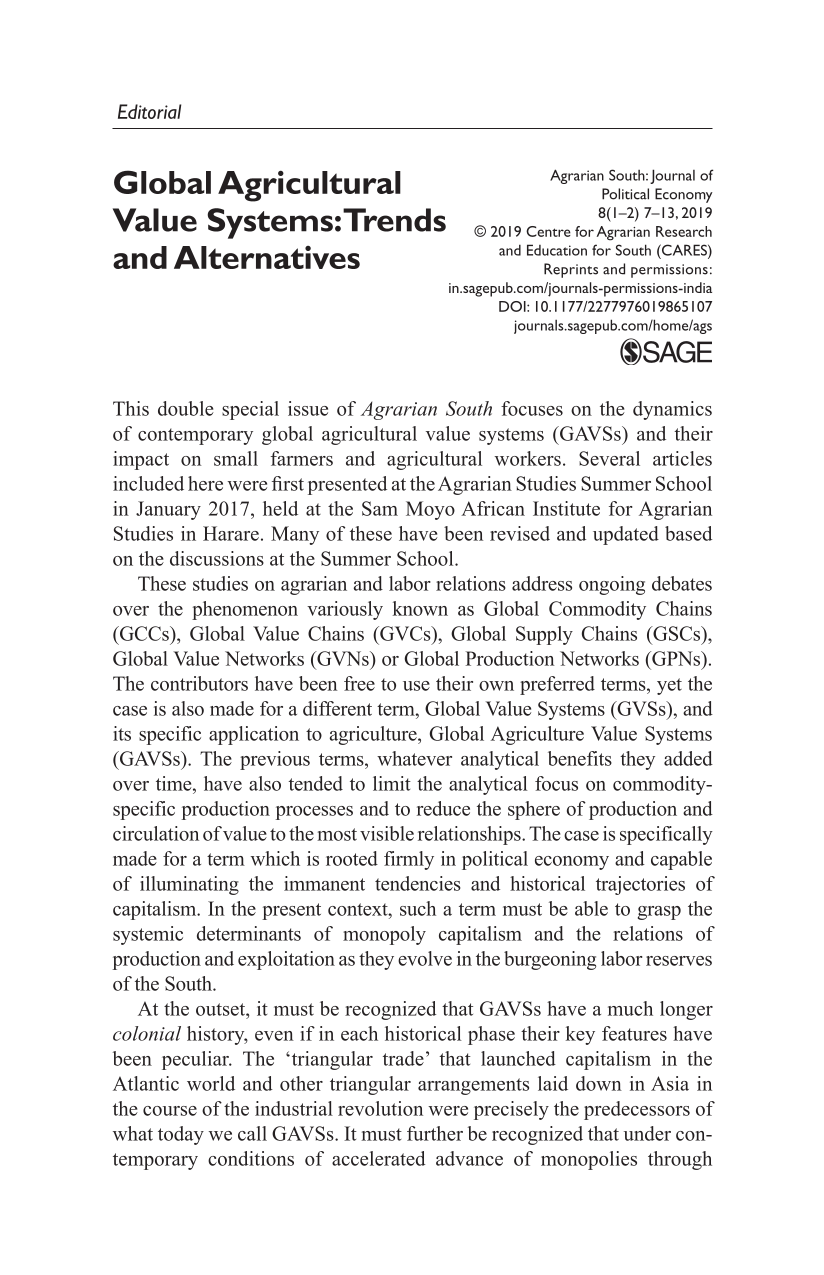
Contemporary capitalism has been in a process of restructuring driven by giant corporations for which the world as a whole has become the playing field, more than ever before. As such, components of a single end-use commodity/final output are conceived, designed, produced, procured, and processed in different parts of the globe, before being assembled at a specific destination for ultimate consumption, which again may have a global reach. This is the crux of what is termed Global Value Systems (GVSs) in this article, a notion which is introduced in its conceptual underpinnings and historical significance. This then applied to global agriculture, to argue that a key feature of contemporary capitalism is the expansion of Global Agricultural Value Systems (GAVSs), alongside the GVSs in industry and services. GAVSs have contributed to the strengthening of direct land acquisitions and contract farming or out-grower models in the peripheries across the South.
This article critically examines the concept of agrarian value chains in Africa, exploring the extent to which they reflect the expansion of agribusiness and its influence on agriculture. It traces the rise of agribusiness in the United States as a system based on extracting value through control over input marketing, processing and retailing in the post-war period. It examines the close relationship between US imperialism and the expansion of agribusiness and the facilitation of agribusiness interests by the rise of neoliberalism and the opening of global markets. Against the backdrop of monopolies, mergers and takeovers, it questions the extent to which conceptions of upgrading through smallholder integration into agribusiness chains accurately reflects the fortunes of smallholder farmers. It argues that far from constituting a dynamic system of entrepreneurship that facilitates acquisition of new skills by farmers, upgrading of production, and higher incomes, agribusiness constitutes a system of value capture in which transnational corporations extend their control over production and marketing through takeovers and contractual arrangements that control farmers’ production. This is largely absent from value chain frameworks, since they focus on the transformations of commodities rather than the existing relations of production, make assumptions about the relationship between upgrading and integration into global markets, and assume that failures to upgrade result from the peculiarities of national and regional settings rather than agribusiness practice. Three case studies are presented focusing on monopolies within the seed breeding, cocoa and pineapple and their impact on smallholders and national patterns of accumulation.
This article examines how global value chains alter the processes of value creation by reshaping the institutional systems that govern the livelihoods of poor rural workers in contemporary Africa. In connecting rural workers to distant markets, global value chains reconfigure local modes of organization and resource use, translating and redistributing value in unexpected ways. The capacity of global linkages to resolve problems of rural poverty and disaffection is explored in the context of informal workers in horticultural farms in South Africa and precarious women producers of exotic oil in the Argan forests of south-western Morocco. Particular attention is focused on the mechanisms through which global linkages reconfigure institutional systems in the creation of transnational value chains, realigning labor regimes, livelihoods, and local commercial systems, followed by a consideration of the social tensions created by the economic and organizational realignment needed to make global value chains work.
Apparel and agriculture are two sectors historically marked by extreme levels of exclusion and abuse of worker rights. Global trade regimes have protected developed market economies at the expense of developing countries, and lead firm consolidation in agriculture and apparel supply chains has created downward pressure on wages and working conditions. However, it is precisely in these more precarious sectors of the global economy that an innovative strategy of binding cost sharing accords is emerging. This dynamic of the sourcing squeeze and a binding, cost-sharing accord to address the problem of exclusion of worker’s rights is illustrated by the Accord on Fire and Building Safety in Bangladesh, which is the focus of this article. The Bangladesh case is then briefly compared to working conditions in agriculture and the Fair Food Program in the United States. This article argues that these efforts have been more successful than other state and non-state initiatives because they bind lead firms in supply chains to share in the cost of better conditions of labour.
This article highlights the importance of collective action and the role of the state in upgrading the social and economic conditions of farmworkers and smallholders. It is argued that economic upgrading does not automatically translate into social upgrading for workers and small producers and explores the conditions conducive to social upgrading. The asymmetric power relations among actors in the agricultural value chain erect barriers that hinder social upgrading of smallholders and farmworkers. Collective actions of those who are currently underprivileged in the agricultural value chains and the efforts of states can dismantle these barriers. Drawing on theories relating to power resources and the state, the article documents three successful examples from Pakistan and Brazil where collective action and state involvement have partially dismantled barriers against upgrading.
In a situation where the Indian farming community is already facing deficits and is unable to cover the cost of production, the recent export prices are an additional concern. Since an exporter of any country cannot alone change the world price, to make export profitable, even with a lower margin, the price squeeze is possible only in the backward linkages in general and from farmers in particular.
It is important to understand the implications of participation in global value chains (GVCs) in horticulture for farmer and worker upgrading/downgrading. This article examines the functioning and dynamics of supermarket driven GVCs in a high-value export crop, baby corn, to understand the significance of standards in farms and pack houses in India. It explores patterns of governance, smallholder inclusion, economic and social upgrading, or lack of it, and its determinants and changing nature of farmer and labor linkages. This article presents case studies of farmers and various types of labor on farms and in pack houses, based on interviews with the exporter and facilitator management staff, field visits to the operations and a personal interview survey of 76 farmers and workers across the entire value chain of baby corn in western India conducted during 2011–2012.
Integrating smallholders within global agricultural value chains through contract farming has regained momentum in the development agenda, particularly in Africa. Governments, corporate agri-business, and global development institutions have embraced sugarcane as a suitable commodity to promote the integration of smallholders within commercial agricultural circuits so as to improve the prospects of rural development and reduce rural poverty. Influenced by the new institutional economics paradigm, win-win scenarios in which agribusiness companies and smallholders reciprocally benefit—the former by getting regular and standardized quantities of produce; the latter through secure access to the market—are advocated. However, little evidence of success in contract farming has been provided. By exploring the socio-ecological implications of contract farming within two major agro-industrial complexes (in Uganda and Tanzania), we demonstrate that the incorporation of smallholders in these schemes is spearheading dispossession from below, selection of most competitive producers, ecological degradation, social differentiation, and conflict.
After the withdrawal of agrarian capital from financing agriculture in the context of a backlash following the implementation radical land redistribution and tenure reforms since 2000, the fiscally constrained Zimbabwean state assumed an enlarged role in funding production, especially of food grains. Various input subsidy programs were initiated by state and donor agencies to plug the challenges faced by farmers in accessing expensive agricultural inputs, such as seeds and fertilizer on the open markets. Notwithstanding these interventions, the country’s national production has been short of domestic demand for grains, among other key food items, and the recurrent deficits have been increasingly met with a ballooning food import bill. Against this background, in 2016, the Zimbabwe government initiated the Special Maize Import Substitution Programme to enhance domestic production and reduce food imports. Commonly referred to as the Targeted Command Agriculture Programme (TCAP), it is akin to a contract-farming scheme enlisting both the peasantries and the new small-scale capitalist farms, with funding support from domestic capital. Contract farming in Zimbabwe has largely been driven by domestic and international agribusiness and focused on export commodities such as cotton, tobacco and horticulture. In this respect, the TCAP represents a relatively novel, if not innovative, approach by the state to finance food production through contract farming geared to serve the home market. This article examines the effectiveness of this state-driven model of financing agriculture, drawing from research conducted in Zvimba district, in Mashonaland West Province.
This article accesses the effects of the North American Free Trade Agreement (NAFTA), now the US, Mexico and Canada Agreement (USMCA), on the Mexican food system, specifically on the country’s food consumption patterns. The double burden of malnutrition, that is, the coexistence of undernutrition with obesity, is identified as one of the most significant global health challenges. The article explores the main explanations for this malnutrition crisis and the links between the free-market policies pursued under NAFTA and the perverse change in food consumption patterns that affect Mexico, and mainly developing countries. The Mexican experience is presented in terms of the change in food consumption patterns and the food-system transformation over the past decades. It is argued that free-market policies do not merely change the origin of the food consumed but also affect its quality and the general consumption and production patterns. Under the NAFTA, the Mexican food system suffered a restructuring process that struck at its heart, by subsuming maize under capitalist logic.
This second Sam Moyo Lecture was delivered in Harare, Zimbabwe, on 22 January 2019, during the Annual Agrarian Summer School organized by The Sam Moyo African Institute for Agrarian Studies and the Agrarian South Network. The lecture celebrates the life and legacy of two great Pan-Africanists and world intellectuals, Samir Amin and Sam Moyo, who were close friends with mutual respect and admiration for each other, and who passed away in quick succession in the last 3 years. The lecture addresses three areas that were close to both Amin and Moyo: first, trajectories of accumulation on a world scale; second, the contestations over the agrarian question and third, the contradictions of the national question. Sam’s and Samir’s works were mutually complementary. Sam’s empirical research was thorough and conscientious; his research site was Zimbabwe, but he trained his sight on the continent. Samir painted in broad strokes on the world canvas; his theory was global, his vision was epochal. In Sam and Samir, we had a fine ‘glocal’ pair. They have left us a wealth of writings from which we will continue to draw for many years to come.
The most significant feature of contemporary capitalism in relation to the world of work is its inability to provide work to a substantial proportion of persons looking for it. This has diverse implications, ranging from hunger and crime to socio-psychological distress and to the boost it provides to the upsurge of fascism. This lecture discusses the structural dynamics in capitalism that produces unemployment and the expansion of the ranks of the reserve army of labor. Moreover, it argues that a theory of imperialism is essential to explaining the perpetuation of the reserve army of labor and the reproduction of contemporary capitalism itself.

