



Abstract
Sustainability research has coalesced around the notion that many environmental problems can be framed as social dilemmas in which conflicts often arise between consumers’ pursuit of individual, short-term and self-directed goals and their support for collective, long-term and socially-oriented interests. The need to address this challenge is simultaneously becoming more important and challenging for macromarketers and policy makers as the incidence of individualistic consumer traits (e.g., narcissism and self-esteem), already high in general population, continues to grow throughout Western societies. This article examines why and how such individualistic tendencies (here, narcissistic exhibitionism) may impact consumers’ pro-environmental behavior. This research identifies an underlying mechanism (i.e., altruism) for the proposed effect. The potential effects of manageable boundary conditions for this relationship are also proposed and tested across four studies.
Narcissistic behaviors are widely viewed as undesirable. By contrast, behaviors that support more sustainable environmental outcomes are generally seen as highly desirable. Most informed policy makers, businesspeople or academics would agree with each introductory statement. Indeed, most would also agree that the pursuit of “sustainability requires informed action sooner rather than later” (McDonagh and Prothero 2012, p. 332). Yet an even higher proportion of thought leaders would similarly agree that sustainability advocates inevitably run head-long into the reality of conducting business and functioning as consumers in a world that usually falls well short of anyone’s idealistic visions. The real developed world unfolds as an utterly un-idealistic place in which high percentages of consumers routinely behave narcissistically (Twenge 2006) and relatively few routinely make choices that support sustainable outcomes (Bonini and Oppenheim 2008; Scarborough Research 2010).
In an effort to conceptually and empirically link the two conventional wisdoms that initiated this discussion, this study investigates whether an undesirable consumer trait, narcissism, can be leveraged through marketing efforts to create more of a desirable environmental good, namely, green consumer decisions and behaviors that enhance sustainability. This study was not initiated as an oxymoronic or glib sleight-of-hand. Instead, it was designed to address a core challenge that governmental and corporate actors routinely encounter: that the indispensable first step toward successfully promoting the idea of making more sustainable choices to consumers is to overcome an intrinsic human unwillingness to suffer excessive short-term costs in exchange for the prospect of conferring long-run benefits to others.
Current facts bear out the existence, scale, nature, and to a partial degree, the causes of this challenge. Since 1982, Narcissistic Personality Inventory (NPI) scores have consistently increased among American college students. Almost two-thirds of recent college students “live-out” above the mean 1979-1985 narcissism score, a 30% increase (Twenge, Konrath, Foster, Campbell and Bushman 2008). These data are consistent with theories positing an increase in individualism in American society and with studies finding generational increases in other individualistic traits such as self-esteem and agency (e.g., Twenge 1997; Twenge and Campbell 2001). Although still growing, the initial figure implies a substantial proportion of the U.S. population is already inherently wired to engage in highly self-centered consumption practices (Twenge 2006). One relevant analog and likely consequence of this trend: as little as 5% (estimates vary) of U.S. consumers regularly engage in activities that support environmentally sustainable outcomes. All the while, of course, materially higher proportions of consumers profess their support for “green” (Bonini and Oppenheim 2008). This low actual-conversion-rate nags, frustrates, and disappoints, for many reasons – and then there is the resultant environmental degradation to consider. Yet once the proliferation of nominally undesirable narcissistic consumer traits throughout the U.S. populace is acknowledged, this same consumer bloc’s lack of engagement with the ostensibly desirable notion of sustainability may become more understandable. For example, this precept may explain why nominally green younger generations concentrate more on aesthetics while ignoring sustainability factors when purchasing apparel.
This research investigates whether narcissistically oriented – and thus intrinsically more highly self-centered or self-absorbed – consumer decisions can be leveraged in ways that yield pro-sustainability outcomes benefitting others as part of an environmental whole. This research specifically addresses the prospect that manageable differences exist in the propensity of normally narcissistic and non-narcissistic consumers to purchase green, as opposed to traditional, products. The role that various manageable factors might play in prompting normally narcissistic consumers to support environmentally sustainable outcomes is also investigated.
Narcissism, rather than interrelated traits such as materialism or individualism, was chosen as the focal variable in this research for two primary reasons. First, Western societies (and even China) are currently enduring epidemics of narcissism. This spate of narcissism has spread throughout developed or developing socio-cultural constructions (Twenge and Campbell 2009; also see, e.g. The Culture of Narcissism, Lasch 1978). Indeed, then, “not only are there more narcissists than ever” but situations are arising where “even non-narcissists are increasingly seduced by the increasing emphasis on material wealth, physical appearance, celebrity worship, and attention seeking” (Twenge and Campbell 2009, p. 1-2). Narcissism is subsequently affecting narcissistic and less self-centered people alike as the disparate cohorts co-jointly live out their collective lives within such cultures. Second, the narcissism construct captures a wider range of characteristics that would potentially generate negative environmental consequences, and at levels likely to prove more impactful than those that materialistic or individualistic behaviors might generate. Such characteristics include antisocial behaviors and an abiding dearth of empathy and concern for others (and the environment). As a result, the need to more thoroughly understand the narcissism epidemic is pressing because its potential long-term consequences may prove so damaging to societal and by extension environmental interests.
The literature offers cues about why and how normal consumer narcissism might be leveraged through ethically acceptable positioning and promotional approaches to generate net gains in sustainability. Socially excluded consumers, conceivably narcissists, often subvert personal tastes and desires and/or overspend when doing so is perceived as socially lucrative by the socially challenged (Mead, Baumeister, Stillman, Rawn, and Vohs 2011). Additionally, Griskevicius, Tybur, and Van den Bergh (2010) found that activating status motives increased desire for green products over more luxurious non-green products. Yet the potential macromarketing implications associated with these findings have never been unpacked. Thus no one knows whether or how marketers/policy makers might address already high and growing levels of normal narcissism through approaches that promote more sustainability-supporting consumer decisions (Zinn and Graefe 2007). Might normal narcissism, which proliferates throughout the U.S. society, be leveraged through positioning and promotional practices that ultimately benefit non-narcissistic consumers and society at large?
The possibility that narcissistic consumer behaviors might favorably impact sustainability outcomes as an unintended and counterintuitive consequence of consumer’s narcissism merits investigation. The need to address the issue of whether narcissists will sacrifice their short-run economic welfare to, unknowingly, benefit even unborn others in the long-run is pressing, for more than academic reasons. Understanding whether manageable factors exist that could be leveraged to mollify narcissism’s me-first drag on consumers’ willingness to buy into more sustainable green alternatives is a practically significant issue. This study does not suggest narcissism itself offers a direct path through which greater numbers of pro-sustainability consumer choices – such as the decision to engage in individually more expensive but societally more beneficial green purchases – can be leveraged. Nor is this study blind to the fact that other factors besides narcissistic tendencies surely influence consumers’ support for, apathy toward, or rejection of sustainability initiatives. But given the intersection of an increasingly narcissistic society and an increasing need to promote sustainable consumer behaviors, the possibility that macromarketing strategies could be developed that align collectivistic “sustainability” goals with highly individualistic “narcissistic” goals should be evaluated.
Normal versus Clinical Narcissists: A Distinction that Matters
Narcissus was a mythical Greek character. He symbolized self-absorption, alienation of others and self-destructive behaviors. Narcissus’s modern psychic progeny, narcissism, is defined as a persistent manifested pattern of grandiosity, self-focus, and self-importance (American Psychiatric Association 1994). The Diagnostic and Statistical Manual of Mental Disorders (DSM-IV) reports narcissists are preoccupied by dreams of their own success, power, beauty, or brilliance. Narcissists often react with feelings of defiance, rage, shame or humiliation when they perceive threats to their self-esteem. Narcissists also lean readily into exhibitionist behaviors, seeking out attention and admiration. Narcissism has historically been considered a dysfunctional personal trait. The relative presence of narcissism within their psyches materially influences how consumers feel, think, behave, decide and, ultimately, consume (Boyd and Helms 2005; Sedikides, Gregg, Cisek, and Hart 2007).
Two categories of narcissism exist. One entails an unhealthy, pathological or so-called clinical version. Clinical narcissism is frequently treated as a psychological ailment. The second is designated as sub-clinical, healthy or so-called normal narcissism. Normal narcissism (hereafter, simply narcissism) is a relatively conventional, far more prevalent, consumer trait. Research suggests that narcissism is already prevalent and probably expanding in Western societies (Lasch 1978; Twenge and Campbell 2009; Twenge et al. 2008; Twenge and Foster 2010). And recent studies reveal that level of narcissism has likely expanded as individuals obsessively engage in Internet-mediated communiqués where trite information about self is the primary object of exchange (Buffardi and Campbell 2008; Toma and Hancock 2013).
Normal narcissism is the subject of this study. To be certain, even normal narcissists often manifest a self-centered, self-aggrandizing, dominant and manipulative interpersonal orientation. But their possession of the trait can actually benefit narcissistic consumers – or managers and other professionals, for that matter – in the short run. This is because narcissism’s negative consequences typically emerge slowly (Sedikides, Rudich, Gregg, Kumashiro, and Rusbult 2004). Narcissism also can deliver net positive emotional consequences for consumers (Sedikides et al. 2004). Indeed, “the benefits and costs of narcissism depend on social context and the specific outcome variables being measured” (Campbell and Foster 2007, p. 125).
Narcissistic Characteristics and Behaviors
Three dimensions characterize narcissism as a behavioral trait. The first entails a strong sense of positive self. Narcissistic, as compared to non-narcissistic, personalities tend to be inflated, agentic, selfish, and success oriented (Campbell, Rudich, and Sedikides 2002; Gabriel, Critelli, and Fe 1994; John and Robbins 1994).
The second dimension entails an absence of interest in warm and caring interpersonal relationships. Narcissists come up short on empathy, concern for others, acceptance of responsibility, desire for affiliation, agreeableness, gratitude, and need for intimacy. Concurrently, they are imbued with excessive exploitativeness, anger, hostility, and/or cynical mistrust of others (Campbell, Reeder, Sedikides, and Elliot 2000; Morf and Rhodewalt 2001; Raskin and Terry 1988).
The third dimension that characterizes narcissists follows from their pronounced tendency to self-regulate. As compared to non-narcissists, they expend excessive energy making their selves look and feel positive, special, successful, and/or important (Campbell and Foster 2007). These self-regulatory tactics include vigorous efforts to surpass others, present oneself as noble or idealistic, defend oneself vigorously against perceived threats, and draw attention to oneself. Standard narcissistic strategies include attention seeking, showing off, or bragging about their accomplishments or qualifications. Narcissists are highly motivated to make good impressions on others because they seek admiration (Morf and Rhodewalt 2001).
At net: theory suggests narcissists demonstrate strong negative correlations with feelings of responsibility, empathy, or concern for the needs of others while they have a strong need for admiration from others. As narcissists “yearn and reach for self-affirmation, they destroy the very relationships on which they are dependent” (Morf and Rhodewalt 2001, p. 179). This cocktail of inherently contradictory cognitions and behaviors often results in narcissists experiencing a cognitive dilemma that has been labeled the narcissistic paradox (Emmons 1984). Organizational or governmental calls for the support of pro-sustainability behaviors may typify decision-making contexts in which this paradox could manifest and play out in ways that materially influence narcissistic consumers’ decisions.
Sustainability and Consumer Narcissism
The progressive inclusion of consumers as supportive stakeholders and/or customers is likely crucial to most marketers whose goals relate to sustainability. This is surely true for green marketers and, by extension, green products (Connolly and Prothero 2008; Varey 2010). Yet despite their friendliness to current and future societal/environmental welfare, green products are usually accompanied by higher consumer costs and lower effectiveness (D’Souza, Taghian, Lamb, and Peretiatkos 2006; Shrum, McCarty, and Lowrey 1995). Logic consequently prescribes that their innate love of self and lowered regard for others should lead narcissistic consumers to choose non-green products. After all, as compared to green products, non-green alternatives typically offer narcissists the chance to secure additional comfort, better performance, or lower costs for themselves.
Much of the research on green consumption has sought to profile green consumers and identify factors that influence their behavior (Peattie 2010). Three primary theories may explain why consumers choose to engage in, or refrain from, pro-environmental behaviors. The environmental concern perspective suggests consumers are motivated to engage in such behaviors because they inherently care about the environment and its current or future occupants (e.g., Bamberg 2003; Schwepker and Cornwell 1991; Thøgersen 2010; Van Liere and Dunlap 1980). Unfortunately, the persuasive value of this motive is largely invalidated by narcissists’ general absence of genuine concern for others. The theory thus falls short as a plausible explanation for why narcissists might engage in sustainable (here, green purchasing) behaviors.
The economic rationality perspective suggests consumers might support sustainability, or purchase green products, based on an economic rationale that reflects self-interest and perceived costs and benefits (Peattie 2010; Schaefer and Crane 2005; Stern 1999). Narcissists’ persistent pursuit of self-interested behaviors initially appears compatible with this theory. But this motive’s explanatory power is constrained to green products – or pro-sustainability choices – that deliver direct, albeit long-term, benefits to focal decision makers, e.g. hybrid cars or high-efficiency light bulbs. Meanwhile, a substantial percentage of green products deliver only social benefits such as recyclability or less pollution, and are usually accompanied by higher initial costs. These conditions degrade the explanatory power of the rational economic perspective.
Finally, recent research demonstrates how socially oriented motives can function as powerful encouragers of pro-environmental behaviors (e.g., Goldstein, Cialdini, and Griskevicius 2008; Hopper and Nielsen 1991; Jackson 2005; Peattie 2010). For instance, their desire for greater social influence and an enhanced self-image significantly influences support for sustainability among young consumers (Lee 2008). Given that, ceteris paribus, green products are generally associated with higher costs, greater inconvenience, and diminished performance than non-green alternatives, a decision to go-green often demands consumer sacrifice (Ottman, Stafford, and Hartman 2006). Theory suggests that ostensibly altruistic acts (i.e., pro-environmental behaviors) could directly or indirectly benefit socially conscious actors who purportedly are acting solely on altruistic motives (Smith and Bird 2000). For instance, pro-environmental behaviors may signal that “one has sufficient time, energy, money, or other valuable resources to be able to afford to give away resources without a negative impact on fitness” (Griskevicius, Tybur, and Van den Bergh 2010, p. 394). This rationale imposes a decidedly non-altruistic twist into any marketing context that might be structured to promote sustainable consumer behaviors. This study is grounded in the premise that similar motives may prompt narcissistic consumers to engage in sustainable purchasing behaviors that benefit others absent any concern or thought about their decisions’ ultimately munificent consequences for society or the environment.
Theoretical Foundation: Green as a Costly Signal
Costly signaling theory provides a plausible explanation for how and why narcissists’ abnormally high exhibitionist behaviors might be managed in ways that oxymoronically contribute to more sustainable behavioral outcomes – particularly when the purchasing context is also managed. This theory suggests that socially visible acts of self-sacrifice, when pursued in exchange for a group’s benefit, can function to communicate one’s willingness and ability to incur costs and thus enhance the status and reputation of the sacrificing actor (Miller 2000). The rationale embedded in costly signaling behavior implies that marketers could position green products as status symbols and prestigious products. Alternatively, marketers might position green consumption acts as high-status consumption behaviors (Ottman et al. 2006). Naturally, decisions or acts that support or enhance sustainable outcomes could be similarly positioned. Indeed, “it is not required that status and sustainability be at odds” (Burroughs 2010, p. 131).
With no small fanfare, narcissists often engage intensely in self-enhancing behaviors, status-seeking activities, or intentional displays of high-status goods (Back, Schmukle and Egloof 2010). Narcissistic consumers clearly might regard pro-sustainability behaviors that have been well positioned by marketers as opportunities to exhibit – and perhaps flaunt – their financial wherewithal and signal their ability to bear the higher costs associated with going green. From this perspective, green consumption can function as communicative acts (i.e., means of signaling) between consumers initiating the behaviors and others in their social network. The presence and influence of these signaling behaviors and communication processes might be influenced at macro- and micro-marketing levels.
Yet these initiating behaviors must demonstrate four main characteristics to qualify as costly signals (Smith and Bird 2000). First, behavioral signals must convey reliable information about the underlying quality being communicated. In other words, signals must reliably indicate – in effect, underscore – the signaler’s competitive ability, such as strength, skill, leadership, or access to resources (e.g., financial means).
The second characteristic is that signaling behaviors must impose a related cost to the signaler. Such signals must underscore either higher marginal costs that signalers must bear (e.g., higher resource or energy expenditures) or lower marginal benefits they reap (Smith and Bird 2000). As noted, green products are associated with higher cost or lower performance (Mainieri, Barnett, Valdero, Unipan, and Oskamp 1997). Therefore, compared to non-narcissists, normal narcissists may be more motivated to choose green products as green prices rise. Under such conditions, typically higher green product prices may confer higher-status to the green product and also demonstrate the narcissists’ ability to acquire such costly items.
Third, the behavior must provide an effective means to broadcast signals, while attracting a large audience. In other words, the signaling agent’s (here, narcissistic consumers) behavioral information must be easily observable. What is the point of acting in an exhibitionistic fashion, if no one observes or understands the meaning of the behavior being signaled?
Narcissists typically manifest higher public self-awareness and other-directed self-monitoring styles (Ames, Rose, and Anderson 2006; Emmons 1984) and subtly adjust their behaviors with great diplomacy in response to even small changes in the relevant social environment. Their strong predilection for self-preservation and self-enhancement likely drives narcissists toward self-presentational tactics and behaviors that make some of their socially undesirable traits (e.g., selfishness or lack of empathy) less overt. Consequently, as narcissists’ status-seeking and self-presentational motives manifest in their consumption behaviors, narcissists may “green-wash” their behaviors, regardless of whether such behaviors actually align with their environmental beliefs and attitudes – particularly if marketing strategies were positioned to deliver “properly-desirable” motivational cues.
As noted, narcissists are generally highly mindful of themselves and their surroundings. This is why a behavior’s visibility may play a remarkably crucial role in motivating narcissists’ support for – or rejection of – sustainable alternatives. When specific actions are pursued to secure status or relative position, by definition those actions must be socially/publically visible to be effective (Chao and Schor 1998). Green consumption, executed to satisfy narcissists’ heightened desire for status and attention, appears more likely to arise in consumption situations if observable cue differences are available. The right incentives (i.e., delivered through the right social cues), which are properly positioned, may prompt narcissists to demonstrate insincere green behaviors.
The fourth characteristic is that behaviors must provide benefits to signalers as well as recipients (audience). Consumers typically purchase products to communicate intended meanings (i.e., costly signals) to target audiences only if their audience shares a similar perception of a product’s symbolic value and reacts in ways that the signaler desires. Such behavioral reactions might entail positive feedback or signs of admiration, any or all of which flows back toward signalers; here, green narcissists. Narcissists may more readily engage in pro-sustainability consumer behaviors when self-promotional meanings that they hoped would implicitly accompany their purchase are positively perceived by relevant others. When consumers go green, properly detected signals often produce favorable social feedback; a compensatory and thus enticing value for narcissists.
The Present Research
This study focuses on exhibitionistic behaviors of normal narcissists in a sustainability context. Exhibitionist narcissists generally have an inflated, grandiose self-perception and seek perfect admiration all the time from others (Masterson 1993). The behaviors of exhibitionist narcissists aim to compel others to support their excessive claims of superiority and perfection (Manfield 1992). Exhibitionism is treated as a fundamental aspect of normal narcissism and is highly correlated with show-off and social presence (Raskin and Terry 1988).
The method, results, and macromarketing implications associated with four related studies are reported below. In Study 1 relationships between the primary constructs driving this research; i.e. consumers’ propensity to exhibit narcissistic behaviors and their pro-sustainability behavior, was investigated. In three succeeding experiments, the influence of green product visibility (Study 2), green purchase setting’s visibility (Study 3), and relative price of green versus non-green alternatives (Study 4) on consumers’ propensity to engage in pro-sustainability behaviors are then tested. Experimental scenarios were designed to manipulate these three purchase conditions.
Study 1: Narcissistic Exhibitionism and Sustainable Behaviors
Study 1 examines the relationship between exhibitionism tendencies in narcissists and their orientation toward sustainability-supporting behaviors. The general hypothesis that narcissistic exhibitionists would be less concerned with sustainability is investigated. Support for this hypothesis would suggest that such individuals are inherently less motivated to engage in pro-sustainability – or, here, green consumption – behaviors. The findings would also validate the theoretical premise in which each succeeding experiment is grounded.
Method
Data for this study were collected from a sample of 278 students (145 males and 133 females) enrolled at a large public university in the Southwestern United States. Participants ranged from 18 to 48 in age (M = 24.39, SD = 5.73). Narcissistic exhibitionism was measured on a six-item scale (α = .829) adapted from the exhibitionism dimension of the NPI scale (Raskin and Terry 1988). The original NPI measures individual differences in narcissism as a personality trait in the general population (Raskin and Hall 1979). Although the scale initially included 40 dyadic pairs featuring narcissistic and complementary non-narcissistic statements, items in this research were scaled from 1 (strongly disagree) to 7 (strongly agree), consistent with Samuel and Widiger’s (2008) study.
Two measures of pro-environmental behavior were used in this study to capture a wide range of pro-environmental behaviors such as energy saving, recycling, and willingness to pay premium prices. The first scale was adapted from the Ecologically Conscious Consumer Behavior (ECCB; Roberts 1996) scale ranging from 1 (never true) to 7 (always true) and demonstrated high internal consistency (α = .913). The other scale was willingness-to-pay (WTP) to protect the environment (α = .894). Adopted from the willingness-to-sacrifice dimension of the environmentalism scale (Stern, Dietz, Abel, Guagnano, and Kalof 1999), it was measured by three items ranging from 1 (strongly disagree) to 7 (strongly agree). Finally, altruism (α = .861) was measured on a semantic differential scale adapted from the Self-report Altruism Scale (Rushton, Chrisjohn, & Fekken, 1981). The items ranged from 1 (never) to 7 (very often).
Analysis and Results
Item scores within each construct were averaged to create composite scores. Bivariate correlation analysis was used to examine relationships between the constructs. The correlation between narcissistic exhibitionism and pro-environmental behavior is negative and significant (r = –.331, p < .001), confirming expectations. Narcissistic exhibitionism is also negatively correlated with willingness-to-pay to protect the environment and the correlation is significant (r = –.253, p < .001). Findings also demonstrate that altruism and exhibitionism are negatively correlated (r = – .461, p < .001). In contrast, altruism is positively correlated with both pro-environmental behavior (r = .332, p < .001) and willingness-to-pay (r = .255, p < .001) scales. Finally, as expected, pro-environmental behavior and willingness-to-pay are highly correlated (r = .713, p < .001).
Following the procedure recommended by Baron and Kenny (1986), the mediating role of altruism was also examined for both measures of green behavior. The results show that altruism partially mediates the effect of narcissistic exhibitionism on both pro-environmental behavior (Sobel’s Z = – 3.363, p < .001) and willingness to pay (Sobel’s Z = – 2.589, p < .01). More precisely, negative effect of exhibitionism on pro-environmental behavior (b = – .363, t(276) = – 5.821, p < .001) is stronger than this effect when altruism is also included as a predictor (b = – .248, t(275) = – 3.606, p < .001). Similarly, negative effect of narcissistic exhibitionism on WTP is stronger (b = – .351, t(276) = – 4.341, p < .001) than this effect in presence of altruism as a predictor (b = – .238, t(275) = – 2.628, p < .01).
Discussion
Study 1 results empirically support the thesis that narcissistic exhibitionists are not inherently motivated to support sustainability. Moreover, this lack of motivation to demonstrate pro-environmental behavior is partially attributable to lack of altruism. These findings lend credence to the hypothesis that normal narcissists with higher exhibitionistic tendencies show lower levels of altruism and thus do not intrinsically value green behavior or its potential societal benefits. Under specific conditions, however, their constant need for attention and self-monitoring propensities may lead narcissists to demonstrate behaviors that conflict with their internal beliefs. Product visibility may represent one such condition, a prospect investigated below.
Study 2: Product Visibility and Sustainable Behaviors
The possibility is investigated that low- and high-exhibitionist narcissists may differ in their preferences for green (rather than non-green) products when product visibility is high. Costly signaling theory suggests that status motives lead people to be especially sensitive to what their behaviors might signal to others when such behavior is observable (e.g., Harbaugh 1998). Thus, the prediction is tested that narcissistic exhibitionists would prefer green rather than non-green products when product visibility is high. This hypothesis is premised on the proposition that narcissistic exhibitionists may perceive green consumption choices as opportunities to signal self-sacrifice to others and consequently earn the societal admiration of those others. In contrast, no change in pro-environmental behavior is predicted for low-exhibitionists.
Method
One hundred and nine students (53 males and 56 females) from the same university participated in an experiment with a 2 (narcissistic exhibitionism: low vs. high) × 2 (product visibility: low vs. high) between-subjects, full factorial design. Participants ranged in age from 20 to 45 years (M = 25.25, SD = 4.90). A cover story was used to reduce potential suspicion and participants were told that they would be participating in two unrelated tasks: decision making task and personality test.
Product visibility was manipulated in this experiment. Laptop (high-visibility) and desktop (low-visibility) computers were chosen because each product is manufactured and marketed by same industry and is highly relevant to the subject population. Additionally, the environmental attributes of each product are routinely evaluated through the Green Electronic Council’s Electronic Product Environmental Assessment Tool (EPEAT). Consequently, firms are required to satisfy several environmental-focused prerequisites; i.e. product lifetimes, toxic materials, packaging, and recyclability. These standards are used to differentiate green and non-green computers (desktop and laptop) in this experiment. Participants were randomly assigned to one of the following scenarios:
Imagine you have wanted to purchase a new laptop (desktop) computer. Your plan is to use this only at school for coursework and group projects with your teammates (at home for personal and regular use). Now that you can afford it, you are shopping for one and find two product options from your favorite brand. Each product has the same price.
After completing the first task, which ostensibly investigated consumer decision making, participants completed a battery of personality items in which the six-item exhibitionism dimension of the NPI scale was embedded (α = .840). Demographic information was also collected. Finally, a hypothesis-guessing check revealed no suspicion regarding a connection between the studies.
Analysis and Results
Ratings for the dependent measures as well as the manipulation questions were transformed such that higher scores were assigned to green options. One-sample t-tests with test values of 4 (i.e., no difference) show that the green product is perceived higher in environmental friendliness (M = 6.57; t(108) = 27.770, p < .001), whereas the non-green product is perceived higher in performance (M = 2.77; t(108) = – 6.761, p < .001). A one-way ANOVA was used to examine product visibility manipulation. The analysis reveals that, compared to the desktop (M = 3.54), the laptop is significantly more socially visible (M = 5.88; F(1, 107) = 67.132, p < .001). Therefore, all manipulations are successful.
As in Study 1, item scores within each scale were averaged to form composite scores for the constructs. Following the procedure recommended by Aiken and West (1991), data were analyzed using a multiple regression model with the continuous measure of narcissistic exhibitionism (mean-centered to reduce multicollinearity), product visibility (contrast-coded), and their two-way interaction on green product preference as the dependent variable. The analysis shows that exhibitionism (b = – .776, t(105) = – 7.795, p < .001), product visibility (b = .724, t(105) = 3.373, p = .001), and their two-way interaction (b = .575, t(105) = 2.888, p < .01) are all significant predictors of green product preference. Also as recommended by Aiken and West (1991), this analysis was followed by slope analysis after re-centering exhibitionism at one standard deviation above and below the mean. The analysis reveals that the effect of product visibility is positive and significant for exhibitionists (b = 1.352, t(105) = 4.389, p < .001). That is, attractiveness of green alternative is higher for such individuals when product visibility is high (M = 3.887) rather than low (M = 2.525). This effect, in contrast, is not significant for low-exhibitionist individuals (b = .095, t(105) = .314, p > .10) and green product attractiveness does not differ when product visibility is low (M = 4.849) or high (M = 4.944). These findings are demonstrated in Figure 1.

Effects of product visibility and narcissistic exhibitionism on green products preference.
Discussion
The findings of Study 2 further support the robustness of what was observed in the prior study. Specifically, narcissistic exhibitionists prefer green products when product is highly visible. The implication: such consumers are more likely to purchase green products when the chance of being seen and admired by their audience is relatively high, as is the case with highly visible products. In other words, these narcissists drastically alter their behavior when the positive change is visible to other people and may be used to judge the narcissists’ behaviors as being decidedly non-narcissistic in nature. Low-exhibitionists, in contrast, demonstrate more consistency in their green product preference under low- and high-visible conditions.
Study 3: Purchase Visibility and Sustainable Behaviors
Exhibitionist narcissists crave attention. They also fervently seek admiration (Masterson 1993). Consequently, narcissistic exhibitionists are more likely to regulate their behaviors in ways intended to secure positive reactions from others. These interactive behavioral processes never unfold in vacuums. Any prospect that sustainable consumption might function as a tool through which actors communicate with each other is rendered irrelevant when consumption choices are not visible to others (Mead et al. 2011). In addition to degree of visibility associated with green product use or consumption, visibility of the purchasing act may influence the sustainability choices (i.e., yea or nay) made by narcissists. Motives to communicate messages regarding self through consumption choices are stronger in public as opposed to private settings (Berger and Heath 2008). In fact, the effect of shopping channel (traditional versus online retailers) on conspicuous consumption has been previously supported (e.g., Griskevicius et al. 2010).
Social interactions with immediate audience (e.g., salespeople, cashiers or other customers), unfolding within traditional store settings, may motivate signaling behavior in narcissists as their interpersonal success may primarily depend on the cues they signal to proximate audiences (Back et al. 2010). Narcissistic exhibitionists appear more likely to exploit such settings to solve their narcissistic paradox by “relying on positive feedback from unacquainted others” (Back et al. 2010, p. 143). Consequently, public settings may provide these individuals with perceived opportunities to deliver self-elevating messages by purchasing green products more frequently. In contrast, when purchasing occurs in more isolated settings (e.g., online shopping), self-interests are more likely to govern – and diminish – the pro-sustainability behaviors of exhibitionists.
Method
Participants in this experiment were 210 students (120 males and 90 females) from the same institution. Sample ages ranged from 19 to 39 years (M = 23.52, SD = 4.33). Initial examination revealed no difference in responses of males and females. Consequently, the study analysis was collapsed across genders. The procedure followed in this experiment was similar to the one used in Study 2 and a cover story was used to minimize potential suspicions and demand effects.
In a 2 (narcissistic exhibitionism: low vs. high) × 2 (purchase visibility: low vs. high) between-subjects, full factorial experiment, participants were randomly assigned to one of the two scenarios manipulating purchase visibility. The product used in this experiment was a desk lamp because it is frequently sold through both online and offline channels and characterized by relatively low public visibility. Participants assigned to the low purchase visibility condition (online shopping) read:
Imagine you have wanted to purchase a desk lamp for the past few weeks. Now that you have money, you decided to buy one online. After visiting an online website while you were home alone, you found the following two product options. Each product has the same price. Imagine you have wanted to purchase a desk lamp for the past few weeks. Now that you have money, you are shopping for one. While visiting a local store, in which there are a lot of people, you must decide between the following two product options. Each option was recommended by the salesperson, and each features the same final price.
After finishing the first task, participants were instructed to complete the second task, ostensibly a personality test. The genuine purpose of this part, however, was to measure narcissistic exhibitionism (α = .803), which was embedded in a battery of personality items. The experiment concluded by demographic questions. Participants were then probed for suspicion. No one correctly guessed the overall purpose of the experiment.
Analysis and Results
Ratings were transformed such that higher scores corresponded with the green product. One-sample t-tests with test values of 4 show that participants perceive the green option higher in environmental benefits (M = 6.71; t(209) = 50.094, p < .001) and lower in performance (M = 2.51; t(209) = – 12.280, p < .001). One-way ANOVA reveals that purchasing actions is perceived more visible in in-store settings (M = 4.89) than in online settings (M = 3.11; F(1, 208) = 89.136, p < .001). Therefore, the manipulation of purchase visibility is also successful.
The scores on the six items measuring narcissistic exhibitionism were averaged to form the composite score. A multiple regression analysis, in which narcissistic exhibitionism (mean-centered), purchase visibility (contrast-coded), and their two-way interaction were included as the predictors of green product attractiveness, was run (Aiken and West 1991). Analysis reveals that the effects of both exhibitionism (b = – .485, t(206) = – 4.176, p < .001) and purchase visibility (b = .743, t(206) = 2.881, p < .01) on green product attractiveness are significant, qualified by a significant interaction effect (b = .624, t(206) = 2.685, p < .01). This analysis was then followed by slope analysis which reveals that the effect of purchase visibility on green product attractiveness is significant for individuals with high narcissistic exhibitionism (b = 1.443, t(206) = 3.927, p < .001). More specifically, narcissistic exhibitionists perceive green products more attractive in public (M = 4.513) as opposed to private settings (M = 3.070). This effect, however, is not significant for low-exhibitionists (b = .044, t(206) = .119, p > .10) and such individuals evaluate the green option similarly in public (M = 4.902) and private (M = 4.858) settings. These findings support the hypothesized expectations (see Figure 2).
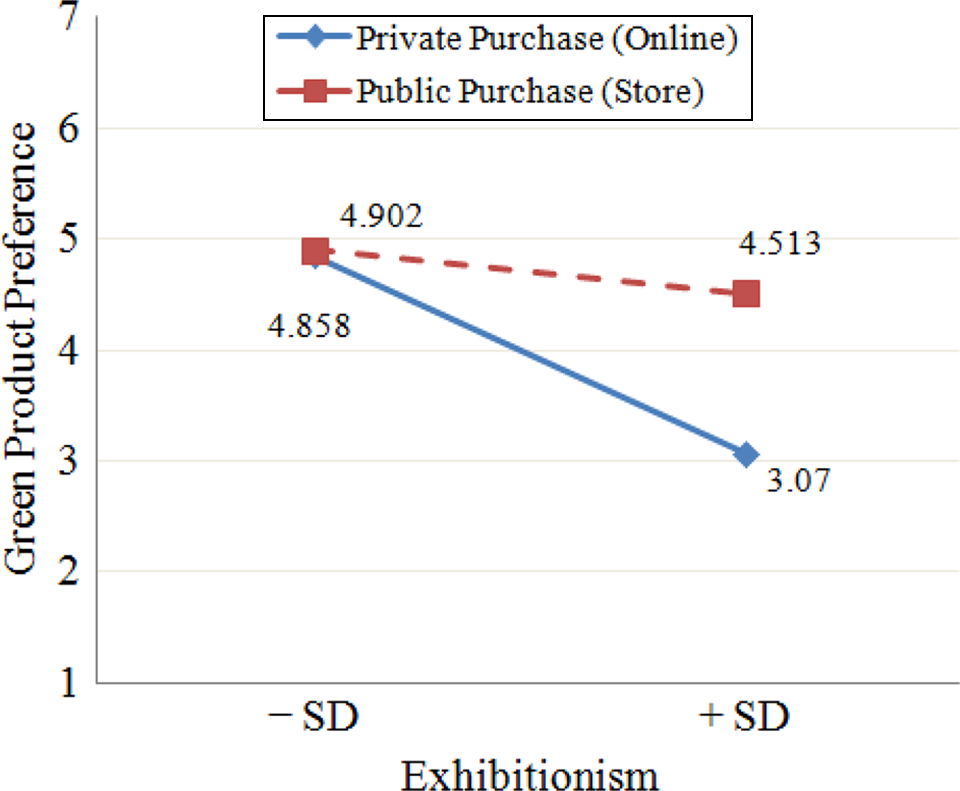
Effects of purchase visibility and narcissistic exhibitionism on green products preference.
Discussion
The findings of this study show that narcissistic exhibitionism negatively affects green behavior, supporting the robustness of the findings in Study 1 and Study 2. Study 3 also suggests that purchase settings influence such individuals’ preference for green products. More precisely, these results demonstrate that while low-exhibitionist individuals are likely to display behavioral consistency across purchase settings, exhibitionists are more motivated by the opportunity to impress proximate audiences by acting out socially desirable behaviors. Exhibitionist individuals tend to prefer green products more in public purchase contexts (physical stores) than in private settings (online stores). Notably, these results suggest that even when products themselves are not publically used or consumed, more visible channels could facilitate signaling behaviors through pro-environmental purchases amongst narcissistic exhibitionists.
Study 4: Green as Expensive Luxury
The effect of relative price of green product alternatives is examined in this experiment. Three research streams suggest that narcissistic exhibitionists may view green products more favorably when their price is higher than comparable non-green alternatives. Costly signaling theory suggests that signaling behaviors must impose related costs on the signaler. Otherwise, signaling behaviors are unlikely to function as effective communication devices (Smith and Bird 2000). Indeed, research shows that pro-environmental behaviors such as taking public transportation are associated with lower status because such actions signal that the person does not have enough resources to behave otherwise (Sadalla and Krull 1995). This premise parallels the presumed effects elicited by quality and quantity of the message (i.e., signal) as depicted in the realistic accuracy model (Funder 1995). Finally, the desire for enhanced status that routinely drives narcissistic exhibitionists also might be satisfied by purchasing higher priced products, given that the very ability to pay higher prices is frequently associated with greater prestige and enhanced status (Chao and Schor 1998). Therefore, exhibitionist narcissists’ preference for green products should be more pronounced when green products are more expensive. Meanwhile, economic rationality perspective suggests that low-exhibitionists should behave differently. They should prefer green products when they are less expensive.
Method
Participants in this experiment were 122 students (58 males and 64 females). They ranged in age from 19 to 42 years (M = 22.80, SD = 3.50). A 2 (narcissistic exhibitionism: low vs. high) × 2 (green price: less vs. more) between-subjects, full factorial design was used. The same procedure was followed to minimize potential suspicion and demand effects.
Backpacks were used as the product category in this study due to their relevance to the sampled population. The products and their focal attributes were adapted from Griskevicius et al.’s (2010) study and modified for this study. Price of green and non-green options were manipulated in two scenarios and participants were randomly assigned to one of these conditions. The price difference of the two alternative products was about 20%. In one condition, the green backpack was priced at $60 whereas its non-green alternative was priced at $50. In the other, the green backpack was less expensive ($50) than the non-green choice ($60).
Similar to the previous experiments, green product and its non-green alternative were randomly labeled (Product A and Product B) for counterbalancing purposes. In addition, each was presented alternatively on the left or right side of the screen and scales. Green product attractiveness was then measured as the dependent variable on a scale from 1 (definitely Product A) to 7 (definitely Product B). Perceived environmental friendliness and performance of the products were also measured for manipulation check. Participants were then asked to specify the more expensive option based on the scenario to examine whether the price premium was recognizable. Attitude toward the product (α = .933) and brand (α = .918; Spears and Singh 2004) as well as price consciousness (α = .713; Darden and Perreault 1976) were measured to control for potential confounding effects.
After finishing the first task (consumer decision making), participants completed a personality questionnaire in which the six-item scale measuring narcissistic exhibitionism was embedded (α = .820). Demographics were collected, followed by a hypothesis-guessing question. No suspicion was found among participants. Participants were then thanked and dismissed.
Analysis and Results
Before analysis, ratings were transformed such that higher scores were associated with the green option. One-sample t-tests (test values of 4) reveal that, compared to its non-green alternative, the green backpack was perceived as more environmentally friendly (M = 6.70; t(121) = 40.399, p < .001), yielding lower performance (M = 2.25; t(121) = –13.304, p < .001). Score items within the scales were then averaged to form composite scores for the constructs. Three one-way ANOVAs were used to examine differences across the groups assigned to each scenario. The results show no significant difference across groups on attitude toward the product (M = 5.97 vs. 5.74; p > .10), attitude toward the brand (M = 5.72 vs. 5.50; p > .10), and price consciousness (M = 5.62 vs. 5.70; p > .10). Further, bivariate correlation analyses reveal that green product attractiveness is not significantly correlated with product attitude (r = .035, p > .10), brand attitude (r = .000, p > .10), or price consciousness (r = .104, p > .10). These constructs, therefore, were excluded from the analysis.
A regression analysis including narcissistic exhibitionism (mean-centered), relative price (contrast-coded), and their two-way interaction was conducted with green product attractiveness as the dependent variable. The analysis indicates that the effect of narcissistic exhibitionism on green product attractiveness is negative and significant (b = – .313, t(118) = –2.062, p < .05) while the interaction effect is positive and significant (b = 1.067, t(118) = 3.510, p = .001). Slope analysis was then conducted after re-centering exhibitionism at one standard deviation above and below the mean (Aiken and West 1991). This analysis reveals that the effect of relative green product price is positive and significant for narcissistic exhibitionists (b = .975, t(118) = 2.131, p < .05). That is, narcissistic exhibitionists perceive the green option more attractive when it is more expensive than the other option (M = 3.689 vs. M = 2.714). This effect, in contrast, is negative and significant for low-exhibitionist individuals (b = – 1.340, t(118) = –2.857, p < .01). Green product attractiveness for low-exhibitionists is higher when it is less (M = 4.552) rather than more expensive (M = 3.212) in comparison with the non-green alternative (Figure 3).
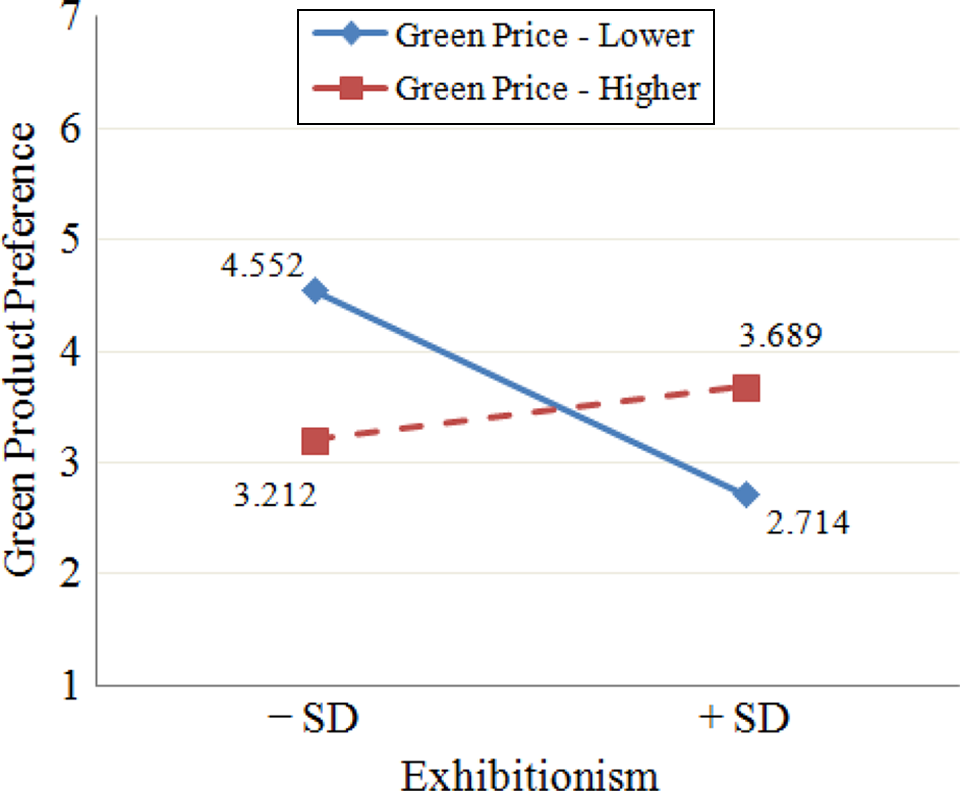
Effects of relative price and narcissistic exhibitionism on green products preference.
Discussion
This experiment provides empirical support for the proposed hypotheses. The results show that narcissistic exhibitionists are inclined to purchase more expensive green products, presumably because higher prestige and luxury image is associated with expensive products. Although the green option was perceived to yield higher performance and comfort, the findings show that narcissistic exhibitionists tend to sacrifice their comfort in order to enhance their status by purchasing and consequently using expensive green products. In contrast, when the green alternative is less expensive than the non-green product, exhibitionist narcissists are not willing to sacrifice their immediate self-benefits without gaining price-related status. An inverted relationship was observed for low-exhibitionists. That is, price-related image is not as important for such individuals. As a result, their preference for the green product is lower when it is more expensive. These findings infer exhibitionist narcissists will go green if they see a self-benefit (in this case, enhanced status) in it.
Discussion and Implications: Can Green Narcissists Be Cultivated?
The findings associated with Study 1 underscored the outcomes that the relevant literature suggests should have been observed about narcissistic consumers. These findings also provide a logical underpinning for three, initially counterintuitive but ultimately revealing, experiments that follow. As expected, their characterization as exhibitionist narcissists was negatively associated with consumers’ support of pro-environmental purchases and behaviors. This effect, as shown, is partly attributable to low levels of altruism in such individuals. Narcissists displayed a consistent and an intrinsic lack of regard for “green” consumption and for others. Study 1 validates what was strongly suspected: Narcissists, as a consumer segment, are deeply and inherently indifferent about any potential benefits that their green behaviors might confer to others. In its first major implication, this research may partially explain why so many consumers from developed economies profess strong support for sustainability yet fail to back up their words through their consumption behaviors. Is it hypocrisy, or normal narcissism, that prevails?
Within human sciences, there is widespread conflict between individual and group interests (Varey 2010). And under condition of scarcity “individuals pursuing their self-interest must necessarily hurt others” (Kilbourne, McDonagh, and Prothero 1997, p. 6). An extensive literature suggests that narcissists often engage in decisions that injure others’ welfare, primarily because of their self-absorbed and self-interested tendencies. But the results of Study 2, 3, and 4 generated counterintuitive insights that call into question the universality of this conventional wisdom. Each study generated marketing insights that contextually nullify the uniformly negative consequences assumed to be associated with this generalization about narcissistic behaviors in certain manageable green marketing contexts. During an era when two still-emerging trends (i.e., increases in narcissism and a push for more sustainable consumer behaviors) are clearly intersecting, marketing context apparently matters greatly. In its second major implication, this research underscores why organizational or governmental proponents of sustainability should not always attempt to understand or leverage by character traits (i.e., consumer narcissism) and behaviors (i.e., the choice of green) that are at times better understood and leveraged on a context-by-context basis.
The insights developed in Studies 2, 3 and 4 progressively suggest that macromarketers seeking to promote more sustainable consumer behaviors should avoid such mistakes. At net, macromarketers should not reflexively assume that narcissistic consumers’ highly self-absorbed behaviors are irredeemably destined to negatively impact others (i.e., the collective, or the environment). This research suggests the negative environmental consequences that are assumed to be associated with “me-first” consumption behaviors may be partially ameliorated. But this salutary outcome is possible only to the degree that the green decision-making contexts that narcissists encounter are purposefully leveraged by marketing agents in ways that concurrently generate self-absorbed values (appealing outcomes) for narcissists and green benefits (sustainable outcomes) for others.
Still, the descriptive conjunction “green-narcissists” may strike many as “an-oxymoron-too-far.” Yet this research’s third major implication derives from its revelation that within properly managed contexts, “green narcissists” actually could exist. Or rather, green narcissists are subject to cultivation through strategically focused positioning efforts. Apparently, as the ranks of normal narcissists, already high, increase throughout developed markets, the expansion need not inevitably dampen prospects for a more sustainable environment. This research explains how and why normal narcissists’ demonstrated propensity to engage in self-directed consumption behaviors might be leveraged to benefit the entire society.
These three implications are interesting and useful. But they beg the question of how “green” decision-making contexts might best be managed to enhance the prospect that higher proportions of normally narcissistic consumers make more sustainable consumption decisions. This issue is addressed below. This study’s overarching purpose was to investigate whether – within manageable contexts – the intensive self-monitoring propensities that characterize narcissists and are reflected in their behaviors might be redirected in ways that motivate these individuals to engage in ostensibly “green” consumption choices.
This prospect was investigated despite the fact that all forms of pro-environmental (i.e., other-oriented) behavior investigated in Study 1 proved demonstrably incompatible with exhibitionist narcissists’ personal beliefs. Yet remarkably, in Study 2 exhibitionist consumers were significantly more likely than low-exhibitionists to purchase green alternatives when the product and its usage setting was publically visible and the probability of being seen and admired was elevated. Three general implications follow. First, sustainability advocates should initiate measures as necessary to promote consumer behaviors that in turn facilitate pro-environmental outcomes. Specifically, the choice of green should be positioned as “admirable” or “worthy of respect.” Second, when communicating the need for pro-environmental behaviors, sustainability proponents should affiliate their promotional efforts with products that are already highly visible or consumed in highly visible contexts. And third, policy makers may allocate more subsidies to low visible green products in order to achieve an optimal mix of conservation effort.
Study 3 revealed that “visibility of purchase setting” also significantly influenced preference for green alternatives amongst narcissistic exhibitionists. This group still was significantly more likely to choose green products that were distributed through public, as compared to private, purchase contexts. A fourth implication is obvious: marketing actors seeking to promote consumption of green products as a pathway to environmental sustainability should more intensely employ public rather than private retail distribution and communication channels. Another fifth implication: signaling behaviors arise routinely as determinant influences on the purchasing decisions of exhibitionist narcissists in green consumption contexts.
Study 4 revealed that exhibitionist narcissists also attempt to impress others by demonstrating socially responsible consumption behaviors (going green) when their behaviors were associated with higher costs (prices) to the self. This finding suggests that even though affordable green products are supposedly more efficient at sustaining the environment, buying inexpensive green products might explicitly undermine a person’s ability to signal wealth (Griskevicius et al. 2010). A sixth implication: as they promote green alternatives to narcissistic segments, the sustainability cause will be advanced once organizational or governmental agents understand that, for exhibitionist narcissists, price is becoming less of an object at the same time that reflective pride of ownership is becoming more an objective. Consequently, macromarketers should position pro-sustainability behaviors as prestigious and desirable activities and decision sets in which narcissists rightfully can take pride.
One might argue that much of this discussion is just an interesting academic exercise. That is until and unless one also recalls the fact that an already substantial and steadily growing portion of the U.S. population currently demonstrates normally narcissistic tendencies. From there, one could logically conclude that a majority of consumers simply will not engage in pro-sustainability behaviors unless their choice redounds directly to their self-interests, or in the case of green consumption, unless the green anything they are “asked to choose” “reflects fabulously” on them. As compared to others, narcissists have a materially different take on what represents their best self-interests. Given that one sure means of partially ameliorating environmental problems entails increasing the consumption of alternative green products, these findings – which specify where narcissists’ self-interests lie and potentially could be managed – are useful.
These oxymoronic results bush up against one final macro-managerial implication. Successful green marketing initiatives must simultaneously satisfy two main objectives: improved environmental quality and customer satisfaction (Ottman et al 2006). Conventional wisdom in sustainability research suggests that these two objectives are incompatible because individual self-motivated behavior, which maximizes short-term gain, often causes long-range damage to the environment (van Dam and Apeldoora 1996). What was proposed and tested in this research, however, demonstrates a vulnerability of this view. Society (and business or governmental entities within it) typically attempt to solve problems using perspectives and solutions known to work in the past, even if they no longer are the optimum solutions (a.k.a. the Einstellung effect). Narcissism, in the past, was deemed both problem and threat. But as contexts evolve over time, opportunities to manage the new contexts in new and valuable ways also emerge. This research suggests macromarketers advocating sustainability should approach the interminable struggle to inform, persuade, remind, cajole or otherwise emotionally or logically seduce often apathetic – or, in this case, inherently and deeply self-absorbed – consumers into responding in ways that create a greater societal good through a more expansive macromarketing lens.
Concluding Remarks
This research does more than simply suggest that narcissists routinely choose green products as a means of showing-off or demonstrating their pro-societal bona fides. The final contribution of this research is that it provides insights on how to convert an already widespread and rising threat within our society (culture of narcissism) and its potential undesirable consequences (short-term, self-directed, unsustainable behavior) into opportunities with net positive outcomes for the society (pro-environmental behavior). Acknowledging that the narcissism epidemic exists as a societal and cultural trend may prove crucial to macromarketers. Otherwise, the inexorable nature of this trend’s long-term consequences may degrade the effectiveness of their pro-environmental efforts. Clearly, two approaches traditionally pursued by green marketers (i.e., environmental concern approach and rational economic approach) may no longer function as effectively in a marketplace where self-admiration, self-expression, and lack of empathy drive behaviors amongst a substantial portion of consumers. Macromarketers thus may benefit by considering a third approach; one where sustainable outcomes are more readily achieved among a substantial portion of the populace by developing socially-oriented motives and programs that successfully promote sustainability as a megatrend.
Footnotes
Declaration of Conflicting Interests
The author(s) declared no potential conflicts of interest with respect to the research, authorship, and/or publication of this article.
Funding
The author(s) received no financial support for the research, authorship, and/or publication of this article.