



Abstract
This study examined which dynamic risk factors for recidivism play an important role during adolescence. The sample consisted of 13,613 American juveniles who had committed a criminal offense. The results showed that the importance of almost all dynamic risk factors, both in the social environment domain (school, family, relationships) and in the individual domain (attitude, skills, aggressiveness), decreased as juveniles grew older. Therefore, the potential effect of an intervention aimed at these factors will also decrease as juveniles grow older. The relative importance of the risk factors also changed: In early adolescence, risk factors in the family domain showed the strongest association with recidivism, whereas in late adolescence risk factors in the attitude, relationships, and school domain were more strongly related to recidivism. These results suggest that the focus of an intervention needs to be attuned to the age of the juvenile to achieve the maximum potential effect on recidivism.
Introduction
The most important goal of the juvenile justice system is to reduce recidivism. For this reason, the effectiveness of interventions is measured by the extent to which these interventions contribute to a reduction of recidivism. Various meta-analyses have shown that interventions are most effective when the Risk-Need-Responsivity (RNR) model is used (Andrews & Bonta, 2010). The RNR model describes three basic principles that interventions must comply with to be effective: (a) the risk principle: the level of an intervention must be matched to the offender’s risk of recidivism; (b) the needs principle: the intervention must be geared to the criminogenic needs; and (c) the responsivity principle: the intervention must be tailored to fit the learning style, strengths, ability, and motivation of the offender (Andrews, 1995; Andrews, Bonta, & Hoge, 1990; Andrews & Dowden, 1999; Lowenkamp & Latessa, 2005). The risk principle indicates who should be treated (juveniles with a medium and high risk); the needs principle indicates what should be treated; and the responsivity principle indicates how treatment should take place (Andrews & Bonta, 2010).
The needs principle focuses on the criminogenic needs. Criminogenic needs are dynamic (variable) risk factors that increase the likelihood of delinquent behavior. Examples are delinquent friends and poor school performance. Criminogenic needs can be distinguished according to the different domains and contexts in which they operate. In general, scholars distinguish risk factors in the following domains: individual, family, peers, school, and neighborhood (Howell, 2003; Loeber, Slot, & Stouthamer-Loeber, 2008). Delinquent behavior can be considered as the result of complex interactions between these risk factors (Deković & Prinzie, 2008; Prinzie, Hoeve, & Stams, 2008). Youth’s exposure to an accumulation of risk factors in multiple domains rather than in a single domain increases the probability of delinquent behavior (Loeber, Slot, & Stouthamer-Loeber, 2008; Rutter, Tizard, & Whitmore, 1970).
Exposure to risk factors is dependent on the age of the juvenile. Loeber, Slot, & Stouthamer-Loeber (2008) show with their developmental model of onset, accumulation, and continuity of risk factors that the extent to which children are exposed to risk factors increases as they grow older, peaks during adolescence, and then decreases in early adulthood. Exposure in early childhood is restricted to individual and family factors. Friend and school factors are added in middle childhood, and community and work-related factors in adolescence. It is not only the extent to which juveniles are exposed to risk factors that changes as they grow older; we also see a change in the impact of the risk factors.
The impact of some risk factors decreases with age, whereas the impact of other factors increases. For example, the influence of peers on juveniles’ behavior increases with age and the effect of parenting skills decreases as juveniles grow older (Holmbeck, Greenley, & Franks, 2003; Loeber, Slot, & Stouthamer-Loeber, 2008 ; Sampson & Laub, 1997; Stouthamer-Loeber et al., 1993; Van der Laan & Blom, 2006; Weijters, Vinke, Van der Logt, & Gerris, 2004).
The above-mentioned studies focus on risk factors for the onset of delinquent behavior in various developmental phases. Thus far, very little research has been carried out on the extent to which these findings also hold for the continuation of delinquent behavior (recidivism). It is important to differentiate between risk factors for the onset of delinquency, which are possible targets for preventive interventions, and risk factors for recidivism, which are targets for rehabilitative or curative interventions. To be able to comply with the needs principle, it is important that for each age phase interventions be aimed at those risk factors that are most strongly associated with recidivism.
As far as we know, only one study examined risk factors for recidivism at different ages. This study showed that the importance of dynamic risk factors decreases as juveniles grow older (Van der Put et al., 2010). In this study, a comparison was made between early adolescence (12- to 13-year-olds), middle adolescence (14- to 15-year-olds), and late adolescence (16- to 17-year-olds). It was found that in early adolescence, by far the most dynamic risk factors were significantly linked to recidivism and that these links were considerably stronger than in late adolescence. In late adolescence, relatively few dynamic risk factors proved to be associated with recidivism, whereas the links between these risk factors and recidivism was found to be relatively weak. These results not only indicate that there are fewer targets for efficacious intervention in late adolescence but also that the potential effects of an intervention on recidivism are smaller.
The goal of the current study was to provide more insight into the relative importance of dynamic risk factors for recidivism at different ages during adolescence. This study is built on the previously mentioned study by Van der Put et al. (2010) in that the same risk factors were being examined but now in a different sample (American instead of Dutch juveniles). This study also added to the previous study, because it examined additional risk factors within the following domains: school, relationships, family, use of free time, alcohol, and drugs. Moreover, besides risk factors in the social environment, this study also focused on risk factors in the individual domain, including the domains of attitude, skills, and aggression. These risk factors in the individual domain may become increasingly important at the expense of the risk factors in the social environment because the personal domain, referring to adolescents’ decision-making autonomy, becomes more important with age at the expense of the social domain, where social conventions structure adolescents’ decision-making processes (Hasebe, Nucci, & Nucci, 2004; Laupa & Turiel, 1993; Wray-Lake, Crouter, & McHale, 2010). Adolescents’ newly acquired decision-making autonomy could make them increasingly less sensitive to stimuli from the environment, including friends and family.
It is also examined whether the impact of dynamic risk factors in late adolescence increases when a differentiation is made between early and late starters. Early starters have started with delinquent behavior in childhood (before the 10th year), whereas late starters started their delinquent behavior during adolescence (between 12 and 18 years). Research has shown that the behavior of early starters is more strongly determined by individual and/or social risk factors than the behavior of late starters, whose behavior is more often determined by situational factors (Moffitt, 1993). The group of juveniles in late adolescence contains proportionally more late starters than the group of juveniles in early adolescence. This may provide an explanation for the decreasing importance of some risk factors with advancing age. The differentiation between early and late starters may make it possible to more effectively predict the behavior of early starters and to better anticipate the risk and needs principles for this group.
In this study, 12- and 13-year-olds were considered separately, because of the many changes that occur during this period, such as the transition from primary to secondary school. The study by Van der Put et al. (2010) showed a strong decrease in the importance of risk factors in the social domain for this age group. Therefore, the 12- and 13-year-olds were examined separately in order to gain better insight into the potential influence of risk factors at these ages. To summarise, this study focused on the following research questions:
To what extent does the prevalence of dynamic risk factors change during adolescence?
To what extent does the impact of dynamic risk factors on recidivism change during adolescence?
Are there any differences in the impact of dynamic risk factors between early and late starters?
Which combinations of dynamic risk factors are most prevalent?
Method
Sample and Procedure
For this study, secondary analyses were done on the data that were used for the validation of the Washington State Juvenile Court Assessment (WSJCA; Barnoski, 2004).
The WSJCA is a screening and risk assessment instrument that was developed in Washington State. The WSJCA maps out the most important risk and protection factors for a large number of domains. The selection of domains and items took place on the basis of a review of the juvenile delinquency research literature and then was modified based on feedback from an international team of experts. The assessment was revised again following reviews by Washington State juvenile court professionals (Barnoski, 2004).
The WSJCA comprises two parts: a prescreen and a full assessment. The prescreen assessment is administered to all youth on probation and is a shortened version of the full assessment that quickly indicates whether a youth is of low, moderate, or high risk to reoffend. The full assessment is required only for youth assessed as moderate or high risk on the prescreen. The full assessment identifies a youth’s risk and protective factor profile to guide rehabilitative efforts. The courts have refocused their resources on moderate- and high-risk youth by assigning low-risk youth to minimum-supervision caseloads. These caseloads have a large number of youth report to a single probation officer where supervision is primarily by telephone. As a result of these savings in resources, more effort is directed toward the higher risk youth.
The sample of this study consisted of 13,613 American juveniles aged 12 to 18 years, who in the period January 1999 to January 2000 appeared in juvenile court charged with a criminal offense and who scored medium to high on the prescreen. Although the data are a decade old, there is no reason to doubt the current relevance of the data, because there is no indication in literature of any substantial changes in the operation of dynamic risk factors for recidivism in the past 10 years. The sample consisted of 3,502 girls (26%) and 10,111 boys (74%). The distribution of cultural background was as follows: 69% European Americans, 11% African Americans, 12% Hispanic Americans, and 8% other.
Instruments
Washington State Juvenile Court Assessment (full assessment)
The full assessment contains dynamic risk factors in the following domains: school, employment, use of free time, relationships, family, alcohol and drugs, attitude, aggression, and skills. Per domain, the following dynamic risk factors were measured: (a) School: severe behavior problems (fighting or threatening students or staff members; lying; cheating; dishonesty; crimes, e.g., theft, vandalism; overly disruptive behavior), truancy (some full-day unexcused absences or truancy petition/equivalent or withdrawn), poor academic performance (some Ds and mostly Fs), poor relationship with teachers (not close to any adult at school), recent expulsions (two or more recent expel/suspend), not interested or involved in school activities, estimation of school progress (not likely to graduate), youth does not believe school is encouraging, and youth does not believe education of value. (b) Employment: no understanding of what is required to maintain a job (lacks knowledge to maintain a job) and not interested in employment. (c) Use of free time: no daily activities (youth does not attend school or work), not involved/interested in structured recreational activities (clubs, groups, church), and not involved/interested in unstructured recreational activities (hobby). (d) Relationships: no positive adult nonfamily relationships, no prosocial community ties (no people in his or her community who discourage the youth from getting into trouble or are willing to help the youth), antisocial friends or gang membership, romantically involved with an antisocial person, admires or emulates antisocial peers, and rarely resists antisocial peer influence. (e) Family: low family income (annual income under $15,000), jail/imprisonment of persons who are currently involved with the household (siblings, mother, and/or father), problems of parents who are currently involved with the household (current alcohol problem, current drugs problem, current mental health problem, current employment problem), poor relationship with parents (not close to father and mother), serious conflicts in the family (family verbal intimidation, threats of physical abuse and domestic violence), inadequate parental supervision (parents do not or hardly know whom youth is with, when youth will return, where youth is going, and what youth is doing), poor parental authority and control (youth consistently disobeys family), poor parental punishment (inconsistently or consistently insufficient), poor parental reward (consistently appropriate/inconsistently or consistently insufficient), no family support network, and run away from home. (f) Alcohol and drugs: alcohol and/or drug abuse (alcohol and/or drugs causing family conflict, disrupting education, causing health problems, and/or interfering with keeping prosocial friends), alcohol and/or drugs contribute to criminal behavior. (g) Attitude: optimism (low aspirations: little sense of purpose or plans for better life), impulsiveness (usually acts before thinking), no control over antisocial behavior (believes cannot stop antisocial behavior), no empathy (does not have remorse, sympathy, or feelings for victims of criminal behavior), no respect for others’ property, no respect for authority figures, no respect for rules/social conventions, does not accept responsibility for behavior, does not think he or she can comply with measures. (h) Aggression: low frustration tolerance (often gets upset over small things or has temper tantrums), hostile interpretation of others’ behavior/intentions, believes verbal aggression is often appropriate to solve a conflict, believes physical aggression is sometimes or often appropriate to solve a conflict, reports/evidence of violence, reports of problem with sexual aggression (aggressive sex, young sex partners, sex for power, voyeurism, exposure). (i) Skills: poor consequential thinking (does not understand about consequences of actions), poor goal setting (does not set any goals or sets unrealistic goals), poor problem-solving behavior (cannot identify problem behaviors), poor situational perception (cannot analyze the situation for use of a prosocial skill), problems in dealing with others (lacks basic social skills), lacks skills in dealing with difficult situations, lacks skills in dealing with feelings/emotions, problems in controlling internal triggers (cannot recognise and monitor internal triggers [thoughts, needs, emotions] that lead the youth into trouble), problems in controlling external triggers (cannot recognise and monitor external triggers [people, situations, events] that lead the youth into trouble), lacks techniques to control impulsive behavior, lacks alternatives to aggression.
The scoring of the items is done by the assessor (probation officer) based on information obtained through a semistructured interview with the adolescent and the parents. Some risk factors are scored on a 2-point scale (0 if the risk is not present, 1 if it is present), some on a 3-point scale (0 if the risk is not present, 1 if it is somewhat or sometimes present, and 2 if the risk is very present or often present, during the past 6 months) and some on 4-point scale, if the protective side is also measured.
Definition of recidivism
Recidivism was defined as the occurrence of one or multiple new judicial contact(s) within 18 months.
Analyses and Procedure
To measure the prevalence of the risk factors of the various domains, the risk factors were recoded into dichotomous variables (1 if there is an increased risk and 0 if there is no increased risk). A total score is calculated for each domain using a binary logistic regression analysis. Chi-square tests were used to identify differences in the prevalence of the risk factors in the various age groups. Pearson correlation coefficients were calculated to determine the strength of the relation between the risk factors and recidivism in the various age groups. Fisher’s z tests were calculated to assess the significance of the differences between the correlations of the youngest group and those of the oldest group. As the correlation coefficient varies with the base rate of examined predictors and outcome variables in the population of interest, we computed the area under the receiver-operating-characteristic curve (AUC) statistic, which is not sensitive to base rate differences, in order to examine the strength of the associations between the total scores of the risk domains and recidivism.
Results
To What Extent Does the Prevalence of Dynamic Risk Factors Change During Adolescence?
Table 1 shows the prevalence of the dynamic risk factors in the different age groups. The extent to which problems occurred in the different domains was dependent on the age of the juveniles. The differences between age groups in the prevalence of risk factors were significant in almost all domains. Figure 1 shows the changes of the total scores of the different domains, with the total score recoded into a dichotomous variable.
Percentage of the Prevalence of Risk Factors for Each Age Group

p <.05. **p < .01.
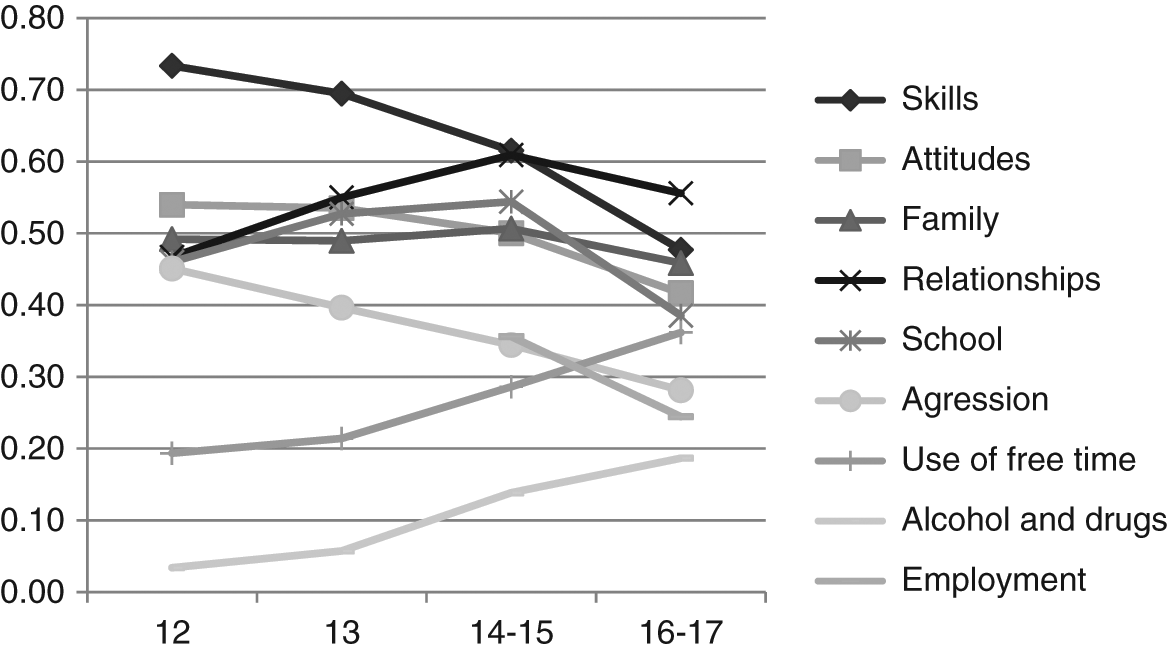
Change in prevalence of risk factors with increasing age
It can be seen in Table 1 and Figure 1 that the prevalence of some risk factors increased as juveniles grew older, whereas the prevalence of other risk factors decreased. There was a strong increase in the domains of alcohol/drugs and use of free time. Both the school and the relationships domains showed an initial increase in prevalence followed by a decrease in prevalence after age 15. The prevalence of problems in the family remained relatively stable with increasing age. The domains that relate to individual risk factors (attitude, skills, and aggression) showed a decrease in the number of juveniles with problems with increasing age. The total number of problems remained the same until age 15, with a slight decrease after this age. We have examined whether there were gender differences and found similar patterns of findings for boys and girls. The only difference was that in girls, the prevalence of problems in the family domain did not remain stable with increasing age, but there was an initial increase in prevalence followed by a decrease in prevalence after age 15. 1 Therefore the prevalence of problems in the family domain was significantly higher in girls aged 13 to 15 than in boys of that same age.
To What Extent Does the Impact of Dynamic Risk Factors on Recidivism Change During Adolescence?
Table 2 shows the correlations between the dynamic risk factors and recidivism for each age group. A total score was calculated for each domain using a logistic regression analysis. The correlations of these total scores and recidivism are also included in the table, together with the AUC values of these total scores.
Correlations Between Risk Factors and Recidivism and the AUC Values for the Total Score per Domain for Each Age Group

p < .05. **p < .01.
It can be derived from Table 2 that the impact of risk factors decreased sharply as juveniles grew older. This pattern is shown for almost all risk factors in most domains. Only the domains of employment and use of free time showed a slight increase in impact as adolescence did progress, but this increase was not significant. Figure 2 depicts the correlations between the total scores and recidivism in a graph.
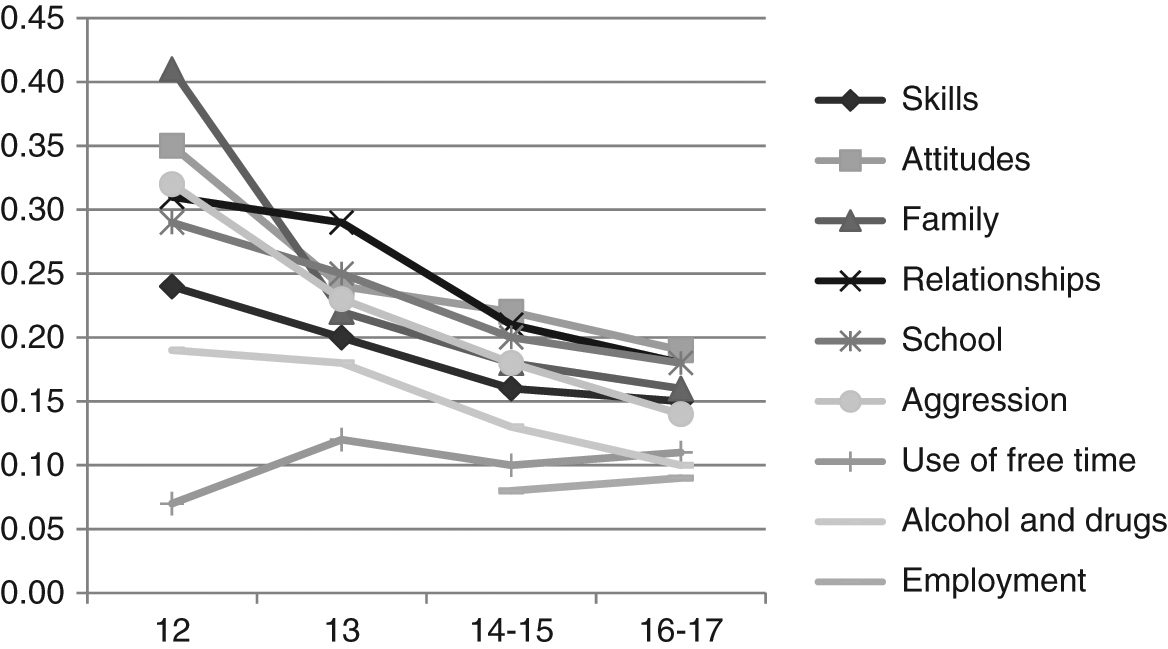
Change in the strength of correlations between the risk factors and recidivism
This figure shows that the strength of the correlations decreased strongly with age for most domains. The average decrease during the entire period of adolescence was 40% and the average decrease between 12 and 13 years was 25%. Thus, immediately after age 12, a sharp decrease in the importance of the dynamic risk factors (with the exception of the domains of employment and free time) was found. Especially the importance of the family decreased rapidly: The strength of the correlations decreased by 46% between age 12 and 13 years.
The figure also shows which domains did have the strongest correlation with recidivism at different ages. For example, for 12-year-olds, the family had the strongest link to recidivism, followed by attitude and aggression. For 14- to 15-year-olds and 16- to 17-year-olds, the domains showing the strongest correlation with recidivism were attitude, relationships, and school. Again, we examined whether there were gender differences and found similar results for boys and girls. Only two differences were found. The decline of the importance of the family domain was much larger for girls than for boys, particularly between age 12 and 13. For girls the importance of the alcohol and drugs domain showed an initial increase in impact, followed by a decrease in impact after age 13, while for boys the importance of this domain decreased gradually as boys became older.
Are There Any Differences in the Impact of Dynamic Risk Factors Between Early and Late Starters?
To study the extent to which the relatively low correlations among 16- to 17-year-olds can be explained by a relatively large proportion of late starters (age of first offence 16 years and older), we examined whether there were differences in the impact of risk factors between early starters (age of first offense <13 years) and late starters. Table 3 shows the correlations of the total scores of the domains with recidivism separately for these two groups. The table shows that the correlations were significantly higher in the group of early starters for alcohol/drugs use and aggression. In the other domains, there were no significant differences between early and late starters.
Correlations Between the Total Scores of the Domains and Recidivism, Separately for Early Starters and Late Starters
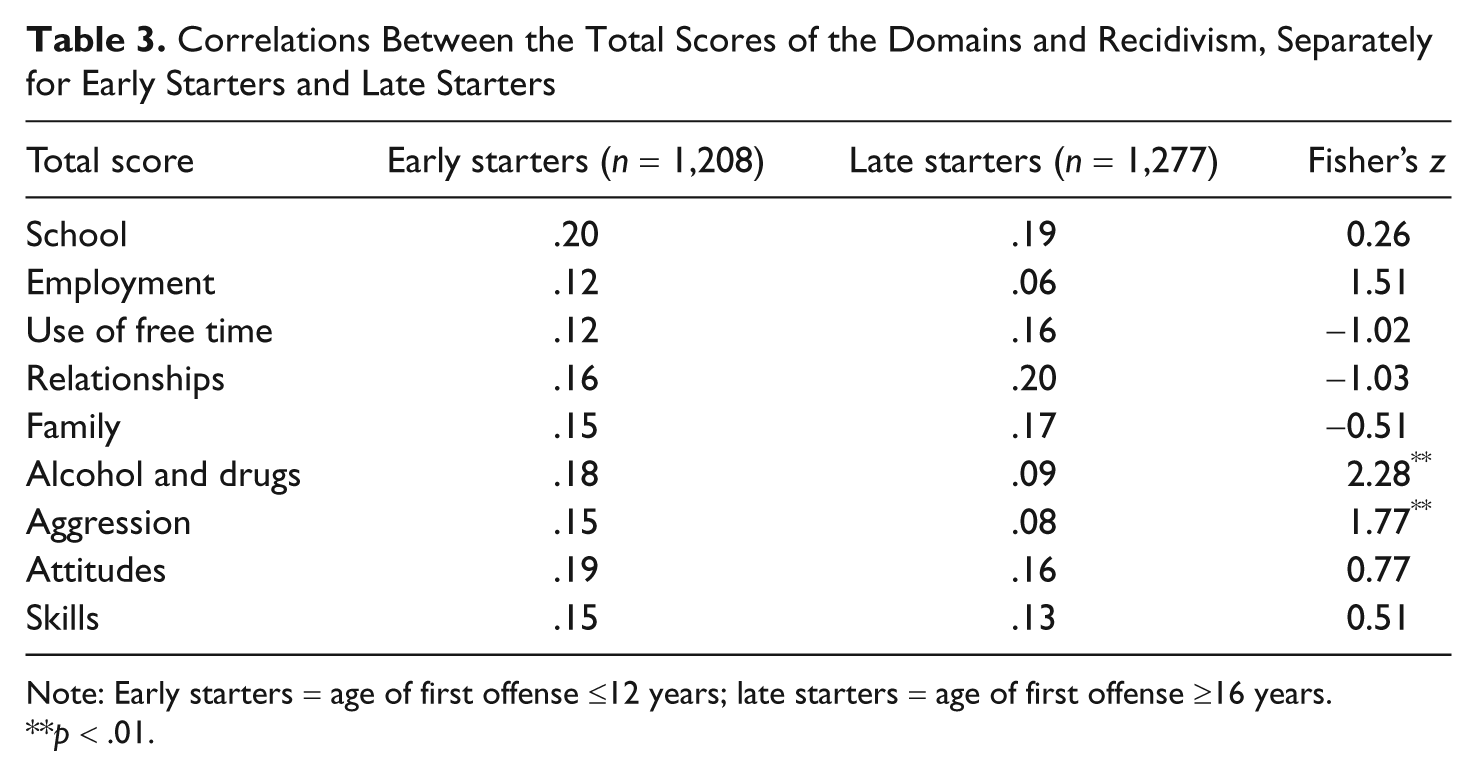
Note: Early starters = age of first offense ≤12 years; late starters = age of first offense ≥16 years.
p < .01.
Which Combinations of Dynamic Risk Factors Are Most Prevalent?
To examine which combinations of risk factors occur frequently, we calculated the correlations between the total scores of the different domains (Table 4).
Correlations Between the Total Scores of the Different Domains
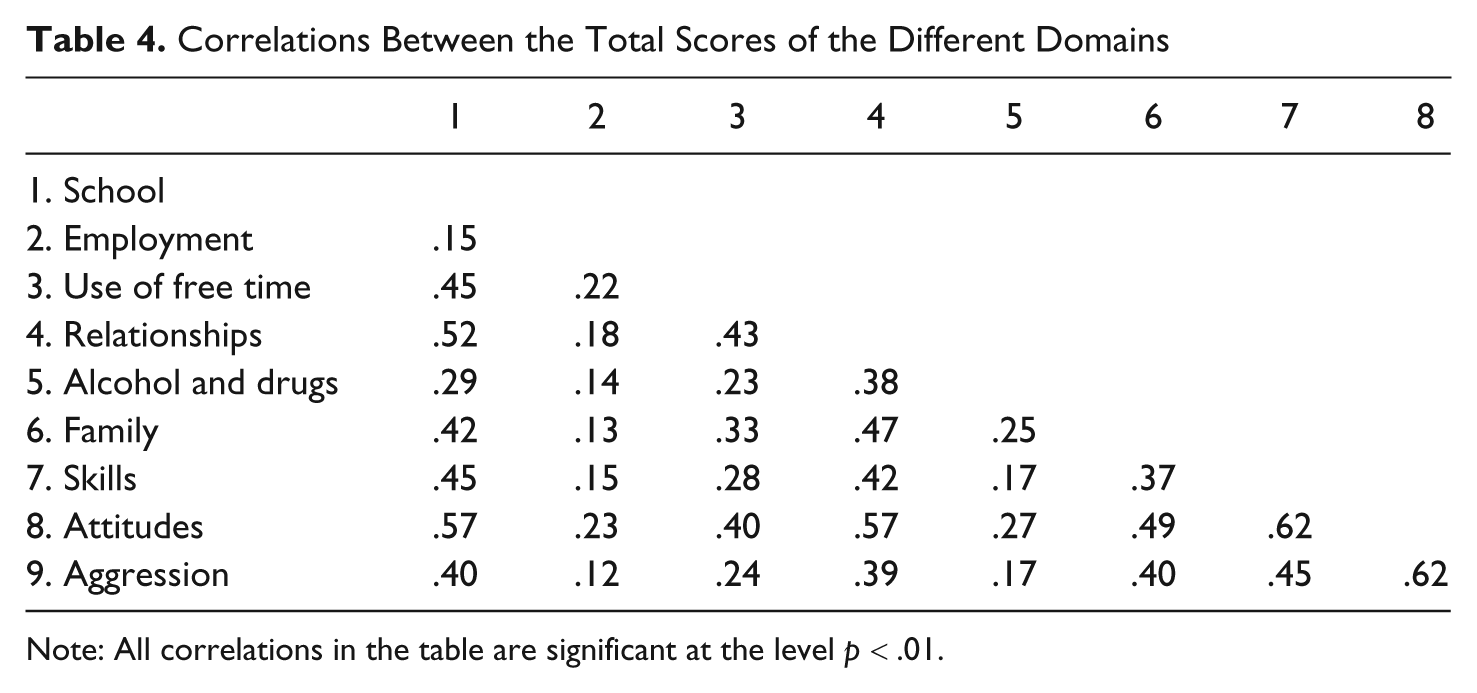
Note: All correlations in the table are significant at the level p < .01.
Table 4 shows relatively strong correlations between the different domains. All correlations in the table were significant (p < .01). Almost every domain was most strongly linked to the domain of attitude, and the domains of skills and aggression in particular showed a high correlation with attitude (both r = .62).
Discussion
The purpose of this study was to gain more insight into the importance of dynamic risk factors for recidivism during adolescence. A recent study showed that the importance of most dynamic risk factors decreases as the age of the juveniles increases (Van der Put et al., 2010), indicating that the chances of reducing recidivism according to the risk and needs principles are limited. For this reason, the main aim of the present study was to identify dynamic risk factors that are important in late adolescence and therefore should be the focus of intervention for this age group. To achieve this, the most important risk factors in a large number of domains were examined for various age groups.
We first investigated to what extent the prevalence of risk factors changed during adolescence. In most domains (employment, free time, drug/alcohol use, relationships, and school), an increase in the number of juveniles with problems was found as age increased (problems in school and relationship domains both showed an initial increase, followed by a reduction from age 15). However, in the domains relating to individual risk factors (attitudes, skills, and aggression), the number of juveniles with problems decreased as age increased.
The second research question concerned the extent to which the impact of risk factors on recidivism changed during adolescence. The impact of almost all dynamic risk factors from almost every domain on recidivism was found to become weaker with increasing age. Only the domains of work and free time showed a slight increase during adolescence, but this increase was not significant. This concurs with previous findings that show a decrease in the importance of dynamic risk factors in the social environment of juveniles (Van der Put et al., 2010). The present study revealed that this decrease also holds for dynamic risk factors from the individual domain (skills, attitude, and aggression). The age–risk paradox, that is, the phenomenon that problems occur more often as juveniles grow older but yet are less important for recidivism (Van der Put et al., 2010), was only found for risk factors in the domains of school, employment, free time, and alcohol/drug abuse.
The third research question was whether there are differences in the prevalence and impact of risk factors between early and late starters. We found that the lower impact of risk factors in late adolescence could only partly be explained by the relatively high number of late starters in this group: A comparison of early and late starters showed that the correlations were significantly higher in the group of early starters for the domains alcohol/drugs use and aggression. In the other domains, no differences between early and late starters were found.
The decreased importance of the social environment in comparison with the individual domain (attitude, skills, and aggression) was in accordance with our expectations and may be explained by the increased decision-making autonomy, at the expense of the social domain (see Wray-Lake et al., 2010). The decreased importance of the risk factors in the individual domain (attitude, skills, and aggression), however, was not in accordance with our expectation. A possible explanation for this might be that the period of adolescence is characterised as a period of increased cognitive abilities, emotional self-regulation skills, and moral growth (Cole, Cole, & Lightfoot, 2005). Although this development may be considerably slower with juvenile delinquents, it still may explain the decreasing prevalence and impact of risk factors in the individual domain.
The relative importance of the domains also changed as juveniles grew older. At age 12, the family domain showed the strongest association with recidivism; at age 13, the relationships domain showed the strongest association with recidivism; and from age 14, attitude was most strongly associated with recidivism. Thus, criminogenic needs change during adolescence, indicating that the interpretation of the needs principle should be matched to the juvenile’s age to achieve the maximum potential effect.
Finally, we found strong relations among the dynamic risk factors from all domains. Problems in the attitude domain showed the strongest associations with deficiencies in other domains, suggesting that problems in the different domains frequently occur in combination with each other, and most frequently in combination with problematic attitudes that can be designated as antisocial, such as lack of empathy and having no respect for other’s property, authority, and social conventions. Also, from age 14 problems in the attitude domain had the strongest link with recidivism, indicating that problematic or antisocial attitude plays a central role. These findings suggest that the attitude domain should be taken into account during any intervention. If a change can be brought about in the attitude domain, this may work its way through into other domains. Various review studies have shown that cognitive–behavioral therapy is an effective intervention targeting criminogenic attitudes and subsequent delinquent behavior (Andrews & Bonta, 2010; Lipton, Pearson, Cleland, & Yee, 2002). On the other hand, it is also possible that positive changes in other domains (e.g., family functioning) not only have a direct impact on delinquency but also affect attitudes and accordingly delinquent behavior. Given the strong associations among risk factors and especially the detrimental effect of cumulative risk (Loeber, Farrington, Stouthamer-Loeber, & White, 2008), it is probable that changes are required in both attitudes and in other risk factors that might be associated with these attitudes. Therefore, it is advisable to monitor the progress in all of these domains during the intervention.
Some limitations of this study need to be mentioned. First, the sample predominately consisted of moderate- and high-risk youth. Therefore, the results cannot be generalised to juvenile delinquents with a low risk of criminal offense recidivism. Second, we did not distinguish between different types of recidivism, different ethnic groups, or difference in socioeconomic status because we already have numerous figures and tables presented. Further research should reveal whether the results also apply to different types of recidivism, different ethnic groups, and socioeconomic groups. Third, this study focused on risk factors only and did not examine the impact of protective factors. Future analyses need to examine, in a multivariate manner, how protective factors affect recidivism at different ages and how protective factors interact with risk factors. Finally, recidivism is defined in terms of judicial contacts. The use of official records involves the risk of underestimating the actual number of criminal acts, as there is more criminality than is registered in the official systems. On the other hand, self-reported data have their limitations too. For instance, Breuk, Clauser, Stams, Slot, & Doreleijers (2007) showed that juvenile delinquents tend to underreport delinquent behavior, in particular on severe offenses.
Our findings have a number of implications for clinical practice. In the first place, they illustrate once again the importance of early intervention within the criminal justice system. Because the importance of most dynamic risk factors decreases as juveniles grow older, the potential effect of an intervention aimed at these factors will also decrease as juveniles grow older. The average decrease in the importance of the risk factors was 40% over the entire period of adolescence, and 25% between the ages of 12 and 13. Thus, the influence of dynamic risk factors strongly decreased (with the exception of the domains of employment and free time) immediately after age 12. These findings imply that at age 12 a fair amount of progress may be made regarding all domains, whereas much more effort would be required to achieve similar results at age 13 years or older.
The results also show that in general the focus of an intervention needs to be attuned to the age of the juvenile to achieve the maximum effect on recidivism. The first step in determining what issues need to be dealt with comprises a screening to investigate which problems are present in which domains. The high correlations among the different domains mean that there will often be problems in several domains in the higher risk groups. Given that delinquency and recidivism are the results of complex interactions between risk factors (Deković & Prinzie, 2008; Prinzie et al., 2008) and the detrimental effect of cumulative risk (Loeber, Farrington, Stouthamer-Loeber, & White, 2008), it is probable that changes in multiple risk factors are required to reduce recidivism. When determining treatment goal priorities, it should be kept in mind that the potential effect of an intervention aimed at reducing recidivism at age 12 will be probably the greatest when attention is paid to the family domain; at age 13 attention should be especially paid to risk factors in the relationships domain and from age 14 risk factors in the attitude domain deserve special attention.
Finally, it should be emphasised that the noncriminogenic needs of juveniles should not be forgotten. These needs encompass problems that are not, or only to a lesser extent are, related to recidivism, such as low self-esteem, sexual abuse, and internalising problems, but which nevertheless play a significant role in the well-being of juveniles. For this reason, interventions should focus on these noncriminogenic needs too.
Footnotes
The author(s) declared no conflicts of interests with respect to the authorship and/or publication of this article.
The author(s) received no financial support for the research and/or authorship of this article.