



Abstract
Improvements in energy efficiency, cost savings, and environmental advantages are possible effects of adopting and using renewable energy in agriculture. However, whether renewable energy consumption (REC) has any impact on agricultural productivity is a research question that this analysis tries to answer. Previous research neglected to consider the influence of REC on agriculture. The primary objective of the analysis is to analyze the role of REC in sustainable agriculture in Asia, America, Africa, and Europe with the help latest econometric technique of the CS-ARDL model. The findings show that REC and technological capital (TC) improve long-run agriculturalization in the full sample, Asia, Africa, America, and Europe. The results infer that a 1% increase in REC causes agriculturalization to boost by 1.512% in the full sample, 1.254% in Asia, 1.654% in Africa, 0.897% in America, and 1.325% in Europe. In addition, financial development favorably influences long-run agricultural productivity in the full sample, Africa, America, and Europe, and population growth only impacts agricultural productivity in the long run. In contrast, the long-run agricultural productivity is negatively impacted by environmental pollution globally and in Asia. On the other hand, in the short run, TC positively impacts agricultural productivity in all samples, while other short-run estimates are insignificant in most samples. These findings suggest that renewable energy utilization may lead to more effective and resilient agricultural systems by supplying clean and dependable electricity, lowering greenhouse gas emissions, and supporting sustainable resource management.
Introduction
In recent years, the world has witnessed a growing realization of the urgent need to transition toward a more sustainable and environmentally friendly future. With the daunting challenges posed by climate change and the increasing energy demand, the integration of renewable energy sources has emerged as a pivotal solution. Renewable energy, generated from natural sources like solar, wind, hydro, and biomass, is increasingly recognized for its ability to cut greenhouse gas emissions, decrease reliance on fossil fuels, and spur economic growth.1,2 One area where the impact of renewable energy is increasingly being recognized is agriculture, a vital sector that sustains global food production and ensures food security. 3 Agriculture relies heavily on traditional energy sources, predominantly fossil fuels, for activities ranging from irrigation and machinery operation to processing and transportation. 4 However, this dependence on non-renewable energy sources not only contributes to environmental degradation but also exposes farmers to the volatility of fossil fuel prices. The integration of renewable energy technologies in agriculture holds great promise for addressing these challenges while fostering sustainable agricultural growth. 5
Renewable energy technologies offer the potential to increase agricultural productivity through improved access to reliable power sources. Off-grid renewable energy systems, such as solar-powered irrigation pumps and wind-powered water desalination units, can alleviate the dependence on erratic electricity supply in rural areas, enabling farmers to irrigate their fields, process crops, and store perishable goods efficiently. Enhanced productivity leads to increased crop yields, higher incomes, and improved livelihoods for farmers. 6 By adopting renewable energy systems, farmers can reduce their operational costs in the long run. Solar panels and wind turbines, once installed, have minimal operating expenses compared to the continuous expense of purchasing fossil fuels.7,8 This cost-effectiveness can lead to improved profitability and economic viability, especially for small-scale farmers who often face financial constraints.9,10 Renewable energy in agriculture offers a notable environmental advantage by producing minimal greenhouse gas emissions. 11 By transitioning to renewable energy, farmers contribute to mitigating climate change, preserving natural resources, and protecting the overall ecosystem. 12 Moreover, renewable energy systems can facilitate the implementation of sustainable farming practices, such as precision agriculture, agroforestry, and organic farming, further enhancing environmental sustainability. 13 The integration of renewable energy in agriculture can spur rural development by creating new employment opportunities and fostering inclusive growth. Local manufacturing and installation of renewable energy technologies can generate jobs in rural areas, leading to skill development and income generation for the local population. 14 Furthermore, the availability of reliable energy sources can attract agro-industries, food processing units, and other value-added enterprises to rural areas, promoting economic diversification and reducing urban-rural migration. 15
Literature reports that renewable energy technologies can improve agricultural productivity in several ways, leading to increased crop yields, enhanced operational efficiency, and overall economic benefits. 16 Chel & Kaushik 17 reported that renewable energy sources provide a reliable and affordable power supply for agricultural activities. Traditional energy sources, like fossil fuels, often face issues of price volatility and limited accessibility in rural areas. By contrast, renewable energy systems, once installed, have minimal operational costs. Aroonsrimorakot et al. 18 described that renewable energy technologies can improve irrigation efficiency, which directly impacts crop productivity. A study by Rathore et al. 19 investigated the economic feasibility of solar-powered water pumps for irrigation in India and found that farmers who switched to solar pumps experienced substantial cost savings on fuel and maintenance, leading to improved economic viability and higher agricultural productivity. Rahman et al. 20 explored the economic implications of solar-powered post-harvest technologies in Bangladesh and highlighted the potential for value addition and income generation. Acosta-Silva et al. 21 in India revealed that the adoption of solar-powered drip irrigation systems led to higher water-use efficiency and increased crop yield, thereby improving the economic returns for farmers.
While existing studies have shed light on the impact of renewable energy on agricultural productivity, there are still some literature gaps that warrant further investigation. Firstly, previous literature does not examine the impact of renewable energy on agricultural productivity. Prior studies focus on long-term outcomes. Secondly, conducting more comparative studies across different regions and countries would be valuable for understanding the variations in the impact of renewable energy on agricultural productivity. Comparative studies can identify the factors that influence the effectiveness of renewable energy systems in different agricultural contexts. Thirdly, while some studies have examined the economic viability of renewable energy in agriculture, there is a need for more comprehensive economic assessments. Lastly, existing studies provide the ambiguous impact of renewable energy on agricultural productivity. However, more research is needed to understand the comparative advantage of different renewable energy technologies in specific agricultural practices. The study aims to fill these gaps, offering a more thorough comprehension of how renewable energy affects agricultural productivity.
This study represents a pioneering and innovative contribution to the field by comprehensively examining the impact of renewable energy on agriculturalization on an international scale. As the first of its kind, the research exceeds regional boundaries, offering a unique perspective on the intersection of renewable energy and agriculture. By considering various countries and regions, the study provides a comprehensive understanding of how renewable energy affects agriculturalization in Asia, Africa, America, and Europe. The study utilizes advanced econometric techniques for analysis such as the CS-ARDL method by controlling cross-sectional dependence (CSD), endogeneity, and serial correlation. For robustness, this study used PMG-ARDL to assess the nexus between renewable energy and agriculture. The study offers both long-run and short-run impacts of renewable energy on agricultural productivity presenting a more comprehensive analysis. The study's findings hold immense importance for policymakers and researchers in the agricultural and renewable energy sectors. By offering evidence-based novel insights, this research serves as a valuable resource for shaping policies of renewable energy in smart agriculture.
Theoretical framework and model
The agriculture sector can take advantage of various environmental and financial benefits that can be gained through renewable energy sources. Renewable energy in the agriculture sector is not a new dimension. Several studies reported that renewable energy technologies involve such materials that make them cheaper and more efficient, and particularly made for agriculture value added. 17 Renewable energy is pivotal in driving the modernization of agriculture value added. 22 By connecting the sun rays, solar energy enables farmers to produce electricity for irrigation systems, machinery, and other operations, reducing reliance on non-renewable sources. 23 Wind turbines, strategically placed on agricultural land, contribute to the generation of clean energy that can improve agriculture value added. 24 Moreover, biomass, derived from organic waste and crop residues, can be converted into bioenergy for heating, electricity, and fuel. 25 The emerging literature also reports that the adoption of renewable energy in irrigation ensures a sustainable and energy-efficient water supply, particularly in areas with limited access to grid electricity. Beyond operational benefits, the transition to renewable energy enhances energy independence and promotes the integration of precision agriculture technologies. Khan et al. 26 simulated that solar and wind energy are used to produce fresh water without the use of fossil fuel energy sources. Majeed et al. 27 described that renewable energy sources have a vast potential for the agriculture sector.
The theoretical underpinning of this study is based on the renewable energy-agriculture value-added nexus, recognizing the interactions of these aspects. Renewable energy sources in the agriculture sector are crucial determinants for reducing environmental degradation.
28
The transition towards renewable energy sources could positively affect agricultural productivity by developing eco-friendly and sustainable approaches. Considering the sustainable development goals of the United Nations, this study uses renewable energy consumption (REC) as a means to attain manifold objectives, including “affordable and clean energy (SDG 7) and zero hunger (SDG 2).” The theoretical underpinning is based on the premise that increased REC has the potential to create a more sustainable and resilient agricultural sector. Within the study's framework, sustainability theory advocates for the fundamental role of adopting renewable energy in agriculture to safeguard long-term economic, social, and environmental well-being.
29
The EKC theory suggests that the usage of renewable energy increases agriculture activities by mitigating environmental pollution (EP).
30
Building upon the empirical and theoretical arguments presented above, this study posits that REC significantly influences agricultural productivity. Consequently, the study has formulated the subsequent foundational econometric model:

Econometric techniques
The study analysis relies on panel data settings. In this examination, the no of time “t” is greater than country “i.” The study employs the second-generation panel data method. Traditional techniques such as fixed and random effect, 2SLS, and GMM models are not suitable when “t” is greater than “i”. 31 The second-generation panel data analysis involves several crucial steps. These steps encompass addressing CSD (Pesaran test), conducting unit root tests (CIPS and CADF), performing cointegration tests (Westerlund test), and employing the CS-ARDL method. The steps of second-generation panel data are reported as follows.
Cross-sectional dependence
Since the economies are interconnected and dependent on each other due to financial integration between them, inspecting CSD has become the inaugural and mandatory phase of panel analysis. To that end, we perform a renowned test for checking CSD developed by Pesaran.
32
This test is based on the following specification (2):

Unit root tests
Once the existence of the CSD is confirmed, our next motive is to see what are the stationary characteristics of the variables. As second-generation unit root tests can control the CSD, these tests suit well in the situation where CSD exists in the model Usman et al. 32 CIPS and CADF are the two tests that are widely used and recognized as the second-generation unit root tests. These tests perform well even under the conditions of CSD and heterogeneity Zafar et al. 33 In addition to these tests, we have also performed a first-generation test.
Cointegration test
Even though the long-run relationship between the selected variables is crucial, its reliability is questionable unless we prove cointegration between them. For this purpose, our selection is Westerlund, 34 which has the ability to deal with the issues of CSD and heterogeneous slope. Four statistics are crucial in deciding the cointegration between the variables. Out of these four statistics, two are known as panel statistics, represented by Pt and Pa, and two are known as group statistics, represented by Gt and Ga. The null hypothesis for both panel and group statistics are quite different, where the null of the panel assumes “cointegration in at least one cross-section” while the null of the group assumes “cointegration across all cross-sections.”
CS-ARDL
Following the preliminary tests, we now shift our focus to our main estimation technique, i.e. CS-ARDL of Chudik and Pesaran.
35
When compared to other panel estimation techniques, it is considered much superior due to the following strengths. First, this approach helps provide correct estimates while dealing with the issues of heterogeneity and endogeneity.
36
Second, tackling CSD without affecting the estimates. Third, the ability to deal with the mixed order of integration, i.e. I(0) and I(1). Fourth, the quality of estimating short and long-run results at once. Due to these characteristics, this technique qualifies to be the best suited while dealing with panel data.
37
For controlling the CSD, this test utilizes the cross-sectional averages. Thus, the baseline equation representing this approach can be written in the following way:

Data and descriptive analysis
This study aims to assess the impact of REC on agriculturalization at the international level. This study gathered data from the top 46 polluted economies spanning the years 1995 to 2021. Detailed information about variables and sources of collection are outlined in Table 1. The study has dependent variable is agriculturalization (Agr). As Ullah et al. 39 used agricultural value added as a proxy for agriculturalization, this study employs the same definition in analysis. Agriculturalization is determined by the value added from agriculture, forestry, and fishing as a percentage of GDP. The World Bank provided the data on agriculture value added. The primary focus variable is REC, which includes the total energy consumption from renewable, nuclear, and other sources. REC data is obtained from the Energy Information Administration (EIA). In addition to REC, the model incorporates four control variables to examine the relationship between REC and sustainable agriculture. These control variables are TC, EP, FD, and population (POP). The justification for choosing these control variables is based on both theoretical ideas and previous literature. TC plays a significant role in sustainable agriculture. Including TC as a control variable that helps in agricultural productivity and sustainability. 40 The inclusion of EP as a control variable is based on the study done by Lin & Xu, 41 who reported that CO2 emissions can reduce agriculture value added. They also reveal that CO2 emissions create negative externalities and the potential negative externalities associated affect sustainable agricultural practices. FD can influence agricultural practices and sustainability. 42 FD affects investment in renewable energy technologies that ultimately influence agricultural infrastructure. Following the study of Schneider et al., 43 this study has included the population as the control variable. The possible justification is that a growing population may increase the demand for both renewable energy and agricultural productivity. TC is assessed based on nonresident patent applications, while EP is quantified by the total greenhouse gas emissions equivalent in kilotons of CO2 emissions. FD is gauged using an index developed by the International Monetary Fund (IMF). The data series for TC, EP, and total population are sourced from the World Development Indicators (WDI). Table 2 outlines the summary statistics for Agr, REC, EP, TC, POP, and FD. The mean scores are reported positive as 7.110 for Agr, 1.305 for REC, 12.44 for EP, 6.741 for TC, 17.48 for POP, and 0.481 for FD. The S.D scores are observed as 6.422 for Agr, 3.012 for REC, 1.242 for EP, 1.757 for TC, 1.317 for POP, and 0.236 for FD. In terms of skewness, all the data series in the model exhibit positive skewness based on the results of the skewness test.
Variable definitions and data sources.
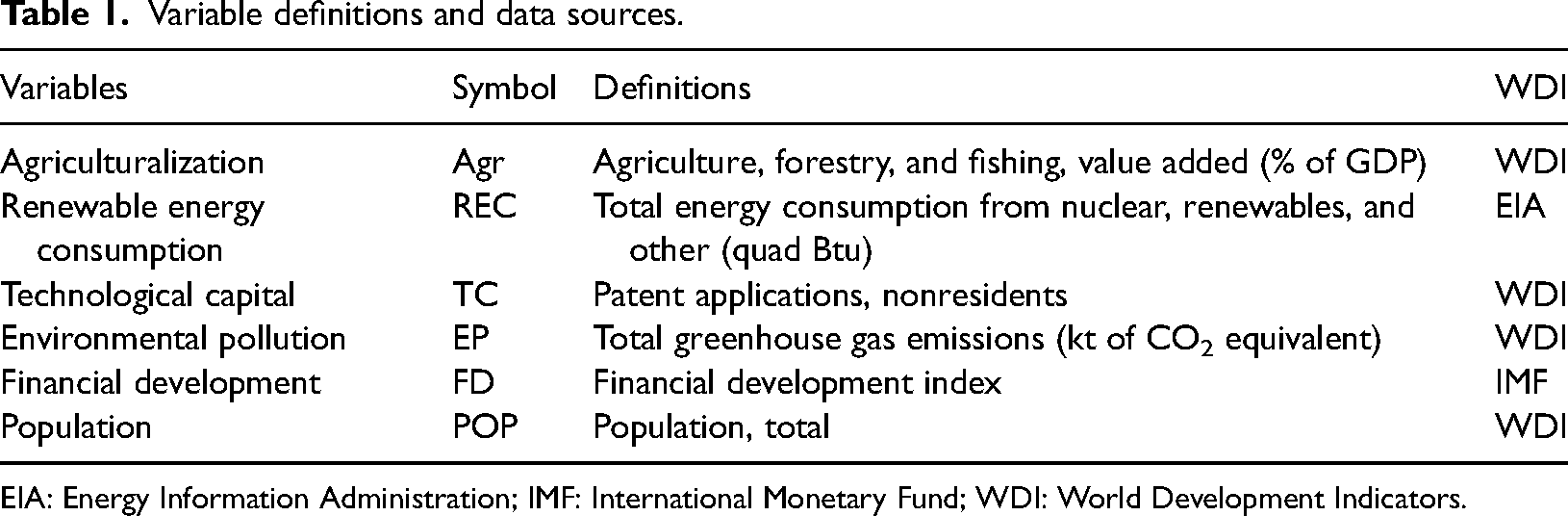
EIA: Energy Information Administration; IMF: International Monetary Fund; WDI: World Development Indicators.
Summary statistics.
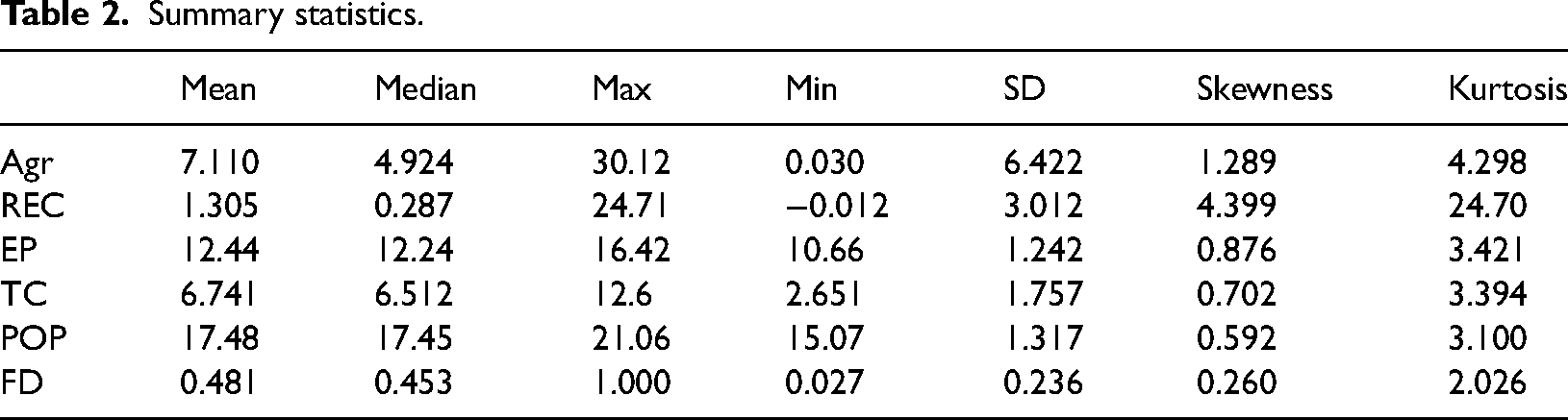
Empirical results and discussion
Cross-sectional dependency is the connection or correlation between data collected from various cross-sectional units, such as people, businesses, or geographic areas. In other words, it shows how many common factors that affect many units at once impact the observations within a panel dataset. Table 3 shows the results of Pesaran CD. 32 According to the Pesaran 32 CD test findings, the statistics attached to Agr, REC, EP, TC, FD, and POP have significant cross-sectional dependencies within the dataset, implying that the model suffers from CSD.
Cross-sectional dependence results.
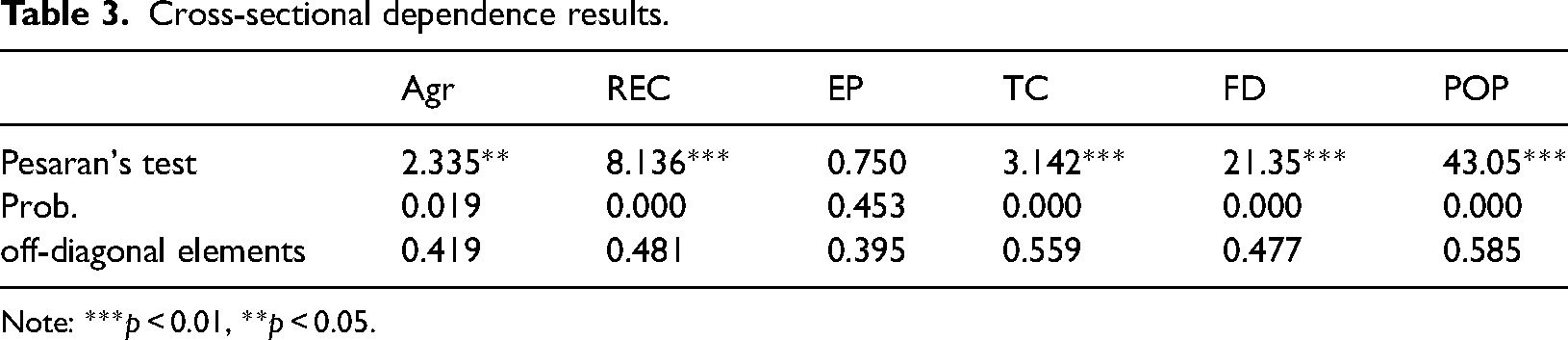
Note: ***p < 0.01, **p < 0.05.
The results of the panel unit root tests performed for the variables Agr, REC, EP, TC, FD, and POP are shown in Table 4. This study uses well-known panel unit root tests, including “Im, Pesaran, and Shin (IPS), Augmented Dickey-Fuller (ADF), and Levin, Lin, and Chu (LLC).” These tests are crucial to detect whether the series are I(0) or I(1). Table 4 lists the outcomes of the panel unit root testing. According to the results, the series Agr, TC, and POP are I(0), whereas the series REC and EP are I(1) in all three tests. On the other side, the series FD is I(0) in LLC and I(1) in the other two tests, i.e. IPS and ADF. These results suggest that both I(0) and I(1) series are included in the analysis.
Unit root tests results.

Note: ***p < 0.01, **p < 0.05.
A long-term link between the variables (Agr, REC, EP, TC, FD, and POP), revealing their dependency and the occurrence of equilibrium in the long run, is assessed using cointegration tests. This study has chosen the Westerlund 34 test, a popular cointegration test that provides trustworthy results if there is the presence of CSD. In this examination, there are two panels (Pa & Pt) and two sets of statistics for groups (Ga & Gt). The results of the Westerlund 34 cointegration test performed on the variables included in the investigation are shown in Table 5. In conclusion, the findings of the cointegration test show considerable evidence of cointegration among the variables based on the significant Gt and Pt statistics.
Cointegration test results.
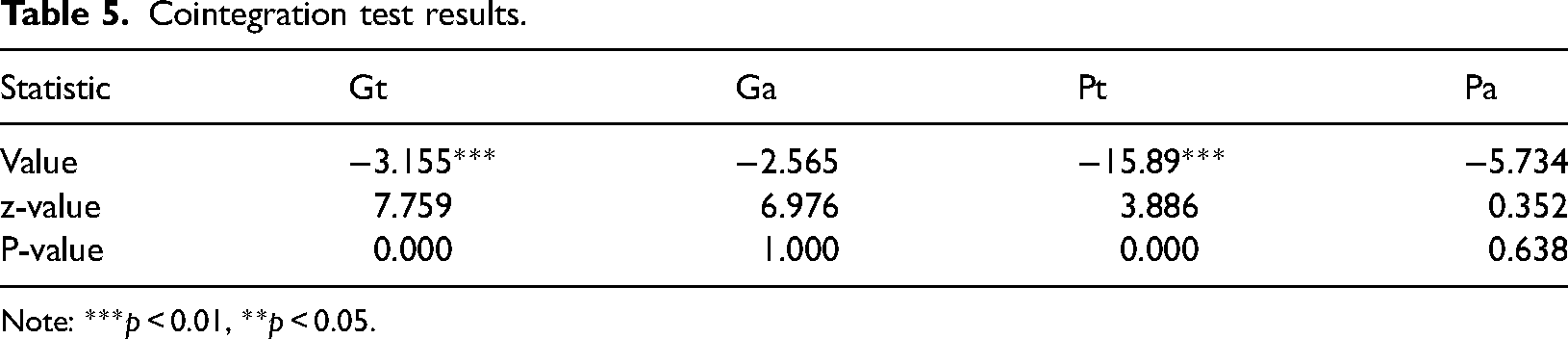
Note: ***p < 0.01, **p < 0.05.
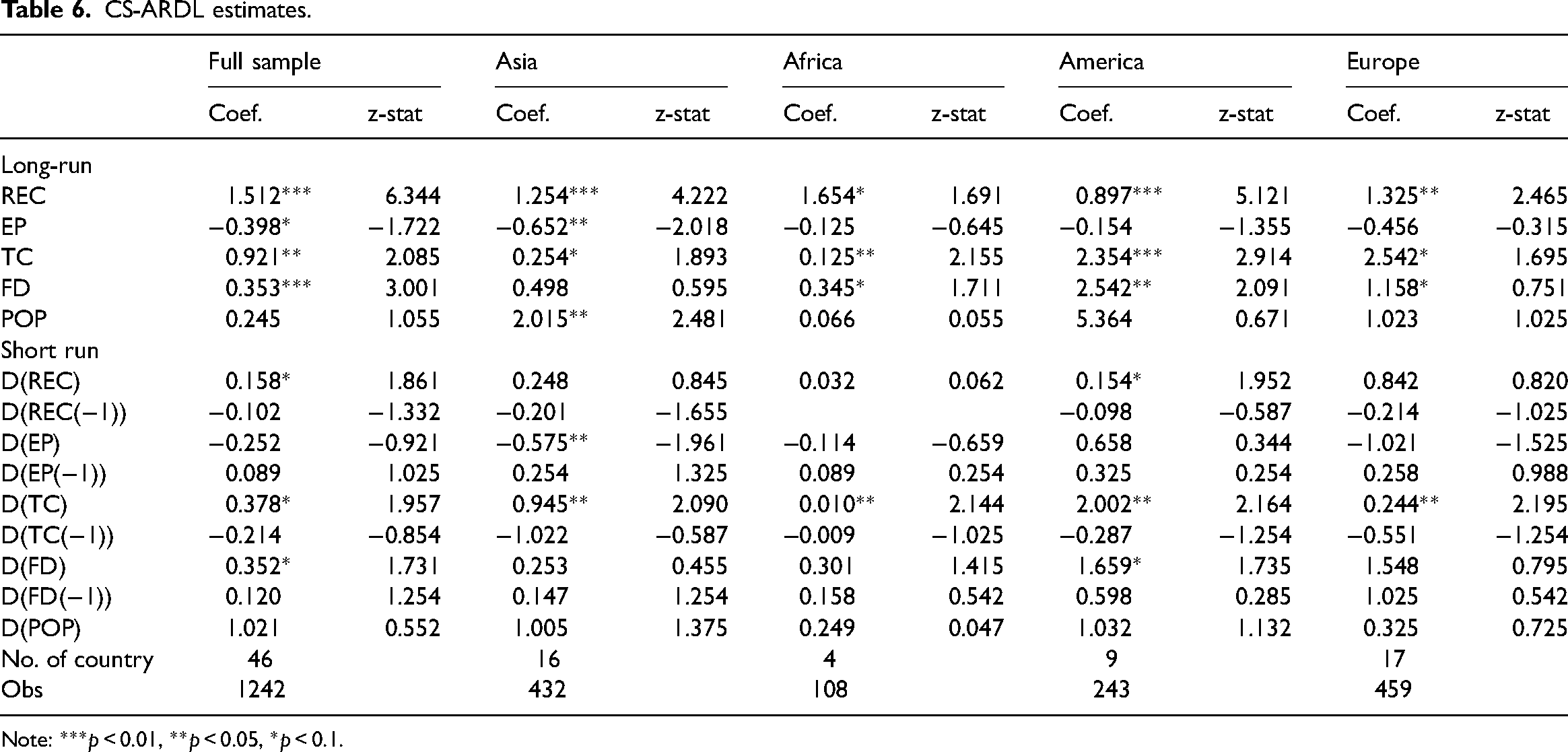
In this analysis, the empirical evaluation depends on the CS-ARDL methodology to accomplish the research goals Five models are examined for the following samples: Full, Asia, Africa, America, and Europe. The outcomes of the CS-ARDL approach are shown in Table 6. The long-run estimates for REC, TC, FD, and POP are positively significant in most areas and samples. In particular, a 1% increase in REC causes Agr to improve by 1.512% in the full sample, 1.254% in Asia, 1.654% in Africa, 0.879% in America, and 1.325% in Europe. Similarly, a 1% upsurge in TC causes Agr to rise by 0.921% in the full sample, 0.254% in Asia, 0.125% in Africa, 2.345% in America, and 2.542% in Europe. Additionally, a 1% increase in FD helps increase Agr by 0.353% in the full sample, 0.345% in Africa, 2.542% in America, and 1.158% in Europe; a 1% POP growth helps intensify Agr by 2.015% in Asia only. Conversely, a 1% increase in EP causes Agr to decline by 0.398% in the full sample and 0.652% in Asia. This finding is consistent with Chel & Kaushik, 17 who described that renewable energy sources provide cost savings for farmers. Reduced energy costs allow farmers to allocate more resources towards improving agricultural practices, investing in advanced technologies, or expanding their operations, all of which tend to enhance agricultural productivity. This means that renewable energy technologies power irrigation systems, improving their efficiency, and reducing reliance on non-renewable energy sources. This enables farmers to better control irrigation schedules, optimize water usage, and enhance crop yields. Consistent and reliable access to water through renewable energy-powered systems contributes to sustainable agricultural practices.
CS-ARDL estimates.
Note: ***p < 0.01, **p < 0.05, *p < 0.1.
These empirical findings are also in line with Bayrakcı & Koçar, 44 who noted that increased renewable energy facilitates the adoption of advanced agricultural technologies and machinery. Renewable energy sources power farm equipment, such as tractors, harvesters, and processing machinery. This leads to improved efficiency, reduced labor requirements, and increased production capacity. With renewable energy, farmers afford to invest in modern equipment and technologies, enabling them to accomplish tasks faster, manage larger areas of land, and achieve higher productivity levels. Similar findings are reported by Majeed et al., 27 who have explored the positive impact of renewable energy on energy efficiency, emphasizing that increased energy efficiency can enhance agricultural productivity. The energy efficiency also reduces operational costs for farmers. This also suggests that the adoption of renewable energy sources positively contributes to the energy efficiency of agricultural practices, leading to increased productivity. The study finding also supports the EKC theory, 30 they suggest a positive impact of REC on agriculture value added by reducing EP. The study supports the ideas of sustainable development theory that REC not only positively influences sustainable agricultural practices, but it also increases environmental sustainability. The finding also infers that renewable energy sources have minimal environmental impact compared to fossil fuels, as they produce lower carbon emissions. By transitioning to renewable energy, farmers contribute to environmental sustainability and protect natural resources. This exerts indirect positive effects on agricultural productivity.
The outcomes correspond with the findings of Udomkun et al., 45 who reported that TC directly contributes to agricultural productivity. The positive impact of TC infers that TC significantly affects agricultural productivity by improving efficiency, precision, crop and livestock management, and access to information. The results align with previous research, including the study conducted by Arora. 46 The study revealed that pollution emissions degrade soil quality, leading to reduced nutrient availability, impaired microbial activity, and decreased soil fertility. As a result, crops suffer from nutrient deficiencies, decreased growth, and lower yields, ultimately reducing agricultural productivity. Climate neutrality targets exert a valuable effect on the dynamic relationship between REC and agriculturalization. 47 In the pursuit of climate neutrality targets, renewable energy sources emerge as a key factor in agricultural practices. By adopting low-carbon energy solutions, agricultural practices contribute significantly to emission reductions and sustainable development. These empirical findings support the sustainable development theory. 29 The intersection of renewable energy and agriculturalization becomes a pivotal strategy in achieving both climate-related and productivity objectives.
The positive impact of FD is consistent with Zakaria et al., 48 who reported that FD plays a vital role in agricultural productivity by providing farmers with access to capital, facilitating market integration, and promoting the adoption of modern technologies. With access to loans or financial services, farmers purchase high-quality seeds, fertilizers, machinery, and equipment, which significantly improve productivity. Capital infusion enables farmers to adopt modern agricultural practices, expand their operations, and make investments that enhance efficiency and agricultural productivity. This means that the increase in population creates a higher demand for agricultural products. This increased demand incentivizes farmers to expand agricultural productivity.
In contrast, except for TC, which is positively significant in most areas, the coefficient estimates in the short term are generally insignificant in most locations. For instance, with every 1% escalation in TC, Agr improved by 0.378% in the full sample, 0.945% in Asia, 0.010% in Africa, 2.002% in America, and 0.244% in Europe. Similarly, REC and FD caused the Agr to improve by 0.158% and 0.352% in the full sample and 0.154% and 1.659% in America. On the other side, the EP causes the Agr to fall by 0.575% in Asia only.
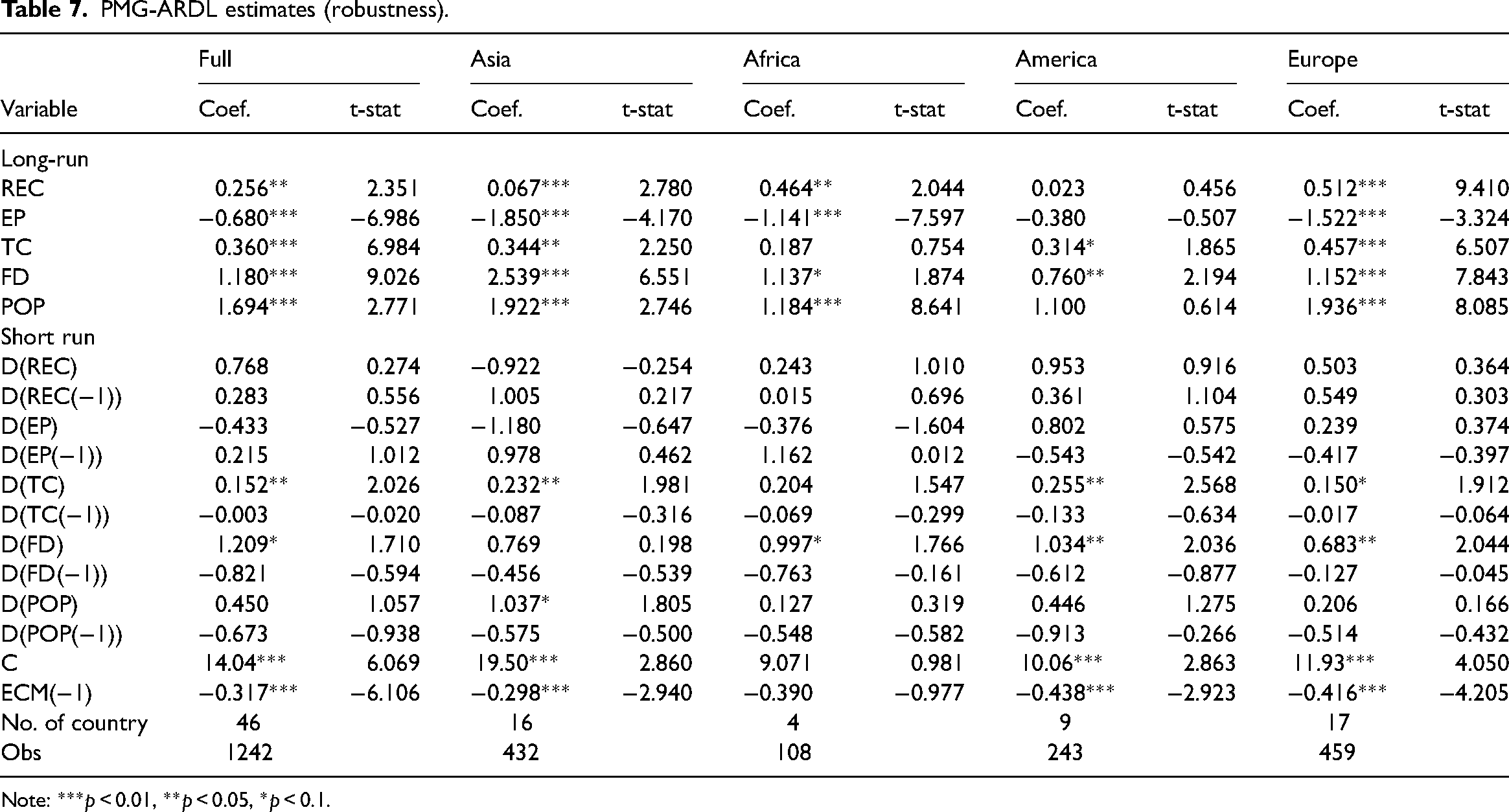
In econometric analysis, it has become customary to use an alternate approach to confirm the estimates’ robustness. Therefore, the study used a different technique called PMG-ARDL to test the reliability of estimations. The outcomes of the PMG-ARDL framework are shown in Table 7. In the majority of areas, the projected long-run coefficients for REC, TC, FD, and POP are all strongly positive. Quantitatively, a 1% rise in REC improves Agr by 0.256%, 0.067%, 0.464%, and 0.512% in the full sample, Asia, Africa, and Europe. Likewise, a 1% proliferation of TC improves Agr by 0.360%, 0.344%, 0.314%, and 0.457% in the full sample, Asia, America, and Europe. In addition, a 1% surge in FD increases Agr by 1.180%, 2.539%, 1.137%, 0.760%, and 1.152% in the full sample, Asia, America, Africa, and Europe, and a 1% expansion in POP results in the growth of Agr by 1.694% in the full sample, and 1.922% in Asia, 1.184% in Africa, and 1.936% in Europe. Conversely, a 1% growth in EP decreases Agr by 0.680% in the full sample, 1.850% in Asia, 1.141% in Africa, and 1.522% in Europe. In the short run, most estimates do not significantly influence Agr in most regions.
PMG-ARDL estimates (robustness).
Note: ***p < 0.01, **p < 0.05, *p < 0.1.
Conclusion
The impact of REC on agriculturalization has emerged as a significant area of study in recent years. As the world faces the dual challenges of sustainable development and climate change, understanding the relationship between REC and agriculturalization becomes crucial for ensuring food security and environmental sustainability on a global scale. Therefore, this study aims to evaluate the impact of REC on agriculturalization at the international level. This study also contributes significantly to examining the nexus between REC and agriculturalization in a comparative setting for Asia, Africa, America, and Europe. This study, focusing on 46 top polluting economies, employs the CS-ARDL technique, and the robustness of the findings is permitted through the PMG-ARDL technique. The study results hold considerable implications for policymakers by offering valuable insights into renewable energy adoption and sustainable agricultural practices. This study reports the following results. The findings show that REC and TC improve long-run agricultural value added in the full sample, Asia, Africa, America, and Europe. In addition, FD favorably influences long-run agricultural value added in the full sample, Africa, America, and Europe, and population growth only impacts agricultural value added in the long run. In contrast, the long-run agricultural value added is negatively impacted by EP globally and in Asia. On the other hand, in the short run, TC positively impacts agricultural value added in samples, while REC and FD improve agricultural value added only in the full sample and America. However, EP only hurts agricultural value added in the full sample and Asia.
Policy implications
Based on research findings, policymakers are advised to initiate specific changes in agricultural policies. Governments should offer financial incentives to encourage the adoption of renewable energy technologies by farmers and agricultural businesses. These incentives aim to offset initial investment costs and promote widespread adoption. Targeted funding programs should be established to support research and development for agricultural applications. Investments in rural renewable energy infrastructure, focusing on high agricultural activity regions, are recommended. This involves expanding access to solar panels, wind turbines, and small-scale hydropower systems to enable farmers to generate clean energy, reduce reliance on fossil fuels, and enhance agricultural sustainability. The government should prioritize knowledge and capacity-building programs for farmers through training sessions, workshops, and information campaigns is crucial. This will empower farmers to make informed decisions about renewable energy in their practices. Encouraging collaboration between the renewable energy and agricultural sectors through partnerships and joint initiatives. Governments should also align renewable energy targets with agricultural policy objectives for policy coherence. Additionally, facilitating international knowledge exchange and cooperation and emphasizing sustainable land-use practices in agriculture are essential. This comprehensive approach aims to accelerate the adoption of renewable energy, create environmentally friendly practices, and enhance agricultural productivity.
In order to achieve both climate neutrality and promoting sustainable agricultural practices governments should offer financial incentives and subsidies for farmers to adopt renewable energy technologies. Investment in research and development is vital for innovative technologies in smart agricultural practice. Climate-smart agriculture programs should raise renewable energy by reducing non-renewable energy. Incentives for carbon farming practices, such as agroforestry, should be implemented, along with policies ensuring coherence between climate, energy, and agricultural strategies. Transition support mechanisms are needed to assist farmers in adopting sustainable practices. Initial financial barriers to Climate-smart agriculture impede sustainable agricultural practices. Government incentives and subsidies contribute to overcoming economic challenges by increasing agriculturalization.
Limitations and future recommendations
This study possesses certain limitations that could be addressed through subsequent research. Firstly, the study's scope is limited to 46 global countries. As a result, the findings may not be applicable to other regions or countries, and generalizability could be constrained. This study does not capture the diversity of global agricultural systems. Secondly, this study does not consider the government policies, socio-economic factors, or regional variations that may promote agriculturalization in China. Thirdly, this study overlooked the dynamic nonlinear impact of REC, technology, policy, and economic conditions on agriculturalization. The theoretical model is also missing in the study. Lastly, one notable limitation of the study is the absence of a detailed cost-benefit analysis for the proposed interventions. In light of these limitations, future research could expand the scope of the study. The sample size should be enriched by analyzing the diversity of global agricultural systems in future studies. In addition, future research could also investigate the role of government policies, socio-economic factors, or regional variations in agriculturalization. Upcoming studies should also examine the nonlinear impact of REC, technology, policy, and economic conditions on agriculturalization in a global context by constructing a theoretical model. Finally, new research should conduct an in-depth cost-benefit analysis. This analysis should delve into the economic implications, feasibility, and potential returns associated with the recommended policies.
Footnotes
Declaration of conflicting interests
The authors declared no potential conflicts of interest with respect to the research, authorship, and/or publication of this article.
Funding
Ministry of Education, Industry-University Co-operation and Collaborative Education 2023 Batch Project: Research on Optimisation of Civic and Political Teaching and Teacher Team Building of College English Course (No. 230805862210906); Guangxi Educational Science “14th Five-Year Plan” 2023 Special Project: Design and Application of Online and Offline Integration Application Scenario of Civic Teaching of College English Course Based on Value Shaping (No. 2023ZJY585); “Three Inputs” Research on the Cultivation of College Students' Ability to Tell Chinese Stories in Foreign Languages in the Context of “Three-in-one” - Taking College English as an Example (No. 2023ZJY2399) The National Social Foundation of China (Grant No. 20BGL247) 2023 Guangxi 14th Five-Year Education Science Planning Key Special Project: Research on Innovation and Entrepreneurship Education in Local Applied Colleges and Universities to Serve the Development of Local and Regional Economies (No. 2023ZJY1456) China Postdoctoral Science Foundation:A study on the mechanism of physician engagement behaviour in online medical communities from the perspective of network effects (No. 2022M710038). 2022 Guangxi Social Science Think Tank Project: Research on the Innovation of Guangxi Rural Revitalization Path from the Perspective of High-Quality Integration of Agriculture, Culture and Tourism (No. Zkzxkt202325) 2022 Postdoctoral research project in Hainan Province: research on tourist engagement mechanisms in social media communication for destination brands. 2022 Guangxi Philosophy and Social Science Planning Research Project: Path and Policy Optimization of High-Quality Integration of Rural Agriculture, Culture and Tourism for Rural Revitalization (No. 22FGL024). 2022 Guangxi 14th Five-Year Education Science Planning Key Special Project: Research on the Design of Informatization Classroom Teaching Evaluation Index System in General Higher Undergraduate Institutions (No. 2022ZJY354); && Research on the Model Mechanism of High-Quality Development of Study Tours for Rural Revitalization (No. 2022ZJY1699). 2022 Innovation Project of Guangxi Graduate Education: Research on Cultivating Innovation and Practical Ability of Postgraduates in Local Universities in Guangxi (No. JGY2022122). Guangxi undergraduate teaching reform project in 2022: research on the construction of thinking and government in marketing courses under the online and offline mixed teaching mode. (No. 2022JGB180). Teaching reform project of Guilin University of Electronic Science and Technology: research on the construction of the ideology and politics of the course of Brand Management (No. JGB202114 ). Research and practice on the cultivation of innovation and entrepreneurship of university students based on the trinity of “curriculum + base + platform” (No. JGB202114). Doctoral research initiation project of Guilin University of Electronic Science and Technology: “Research on the incentive mechanism of knowledge sharing in online medical communities” (No. US20001Y).
