



Abstract
Background
Current therapies for cognitive impairment, including Alzheimer's disease (AD) and mild cognitive impairment, are limited by a lack of universal treatment and adverse effects associated with polypharmacy. Investigating genetic and molecular mechanisms underlying cognitive decline is critical for the development of targeted therapeutics.
Objective
To identify causal genes and potential therapeutic targets for cognitive impairment through integrative genomic analyses.
Methods
Genome-wide association study data on cognitive impairment were combined with the expression quantitative trait loci (eQTL) data from the eQTLGen consortium. Mendelian randomization (MR) and colocalization analyses were employed to infer causal relationships. Gene Set Enrichment Analysis and Gene Set Variation Analysis evaluated the pathway and functional differences. Immune cell infiltration patterns and the immunometabolic pathways were assessed, followed by drug target prediction.
Results
MR analysis identified seven gene-eQTL pairs significantly associated with cognitive impairment. SMR colocalization prioritized three key genes: HNMT (histamine metabolism), TNFSF8 (inflammatory signaling), and S1PR5 (sphingolipid signaling). HNMT, TNFSF8, and S1PR5 had 39, 24, and 30 predicted targeted drugs, respectively, including arsenic trioxide, aspirin, and immunomodulators.
Conclusions
This study implicates HNMT, TNFSF8, and S1PR5 as potential therapeutic targets for cognitive impairment. Further validation is required to confirm their clinical relevance.
Keywords
Introduction
Alzheimer's disease (AD), a neurodegenerative disorder characterized by progressive cognitive decline, represents the most prevalent form of dementia globally.1,2 It manifests through insidious onset, progressive memory deterioration (>6 months duration), and diagnostic complexity in preclinical stages. 3 Mild cognitive impairment (MCI), particularly AD-derived MCI, is the clinical prodromal stage of AD, representing a transitional state where biomarker profiles (e.g., amyloid-β [Aβ] plaques, hyperphosphorylated tau) align with AD pathology. Searching for biomarkers and intervening in the MCI stage may be the most effective way to delay the onset of AD.4,5 While early MCI intervention holds therapeutic promise for delaying AD conversion, its clinically silent progression—characterized by absent neurological focal signs and nonspecific symptomatology—hampers timely detection.6,7 Notably, AD constitutes 60–80% of cognitive impairment cases, sharing overlapping pathomechanisms (neuroinflammation, synaptic dysfunction) and therapeutic targets with MCI and broader cognitive impairment syndromes. 2 This nosological continuum motivates our investigation of conserved biomarkers across these interrelated entities. Therefore, this paper aims to create a database of cognitive impairment (data sources include AD and MCI) to find possible common biomarkers among the three.
Cognitive impairment constitutes a multifactorial syndrome marked by acquired deficits in memory, executive function, visuospatial processing, and social-occupational adaptability. 8 Global prevalence rates exhibit significant variability, correlating with modifiable determinants including educational attainment, lifestyle patterns, and healthcare accessibility. 9 Current therapeutic paradigms encompass pharmacological interventions,10–12 psychosocial support 13 and rehabilitation therapy. 14 While acetylcholinesterase inhibitors and NMDA antagonists provide symptomatic relief, their long-term efficacy is constrained by adverse effects such as cardiovascular risks and iatrogenic cognitive decline. Moreover, polypharmacy strategies targeting isolated etiological factors lack specificity for heterogeneous patient populations.15,16 The study mentions the results of clinical trials of anti-amyloid immunotherapies, such as lecanemab and donanemab, demonstrating that drug development is a focus, but there are safety concerns.17–19 Concurrently, an official update on revised biomarker frameworks (ATN classification) emphasizes multitarget intervention strategies.4,5 These developments necessitate systematic identification of molecular hubs bridging AD, MCI, and cognitive impairment through multi-omics integration. Therefore, the focus of this paper is to better understand the biochemical, molecular mechanisms, key biomarkers and patent medicine genes behind cognitive impairment through comprehensive analysis of cognitive impairment databases, so as to lay a better foundation for the creation of new drugs and determine universal therapeutic targets.
Pathophysiological mechanisms involve synergistic interactions among neurodegeneration, neurotransmitter dysregulation, and neuroimmune activation.20–22 Neuroinflammatory cascades induce synaptic dysfunction and neuronal apoptosis, particularly in hippocampal and cortical regions governing memory consolidation. 23 Neuronal damage and death affect cognitive functions controlled by specific regions of the brain. 24 Concurrently, disrupted cholinergic and glutamatergic transmission exacerbates cognitive deficits.25,26 Immune-mediated processes further compromise blood-brain barrier integrity, facilitating cytokine-mediated neural damage.27,28 Elucidating these molecular pathways is paramount for developing targeted protective therapies.
Advances in high-throughput technologies enable systematic exploration of disease mechanisms. Microarray-based transcriptomics employs in situ-synthesized oligonucleotide probes for genome-wide expression quantification via fluorescence hybridization, 29 facilitating cross-disease biomarker discovery when coupled with machine learning classifiers. 30 Mendelian randomization (MR) leverages single-nucleotide polymorphisms (SNPs) as instrumental variables to infer causal exposure-outcome relationships, circumventing confounding biases through genetic randomization during gametogenesis. 31 Reverse causation is lessened in multiple regression compared to traditional confounding concerns because of the random distribution of genes at conception. So a person's genetics cannot be influenced by cognitive impairment.32,33 Several genetic variants strongly associated with specific traits have been identified, and hundreds of thousands of summarized data on the relationship between exposure and disease and genetic variants have been released from many large-sample genome-wide association studies (GWAS). 34 These pooled data permit researchers to estimate genetic associations of cognitive impairment in large sample data. 35 Leveraging GWAS datasets from large cohorts like the UK Biobank, MR enables robust identification of therapeutic targets through colocalization analysis of exposure-outcome associations.
This study conducted a systematic exploration of the cognitive impairment cohort data (including AD and MCI) from the UK Biobank by integrating transcriptomic analysis and MR analysis, with the aim of achieving three objectives: (1) identifying the key genes related to cognitive impairment; (2) excavating potential drug treatment targets; (3) revealing the key molecular markers and signaling pathways associated with disease progression. This research strategy will contribute to narrowing the gap between the basic mechanisms and clinical applications, providing a theoretical basis for the development of biomarker-based precise treatment paradigms.
Methods
An outline of the study design is shown in Figure 1.
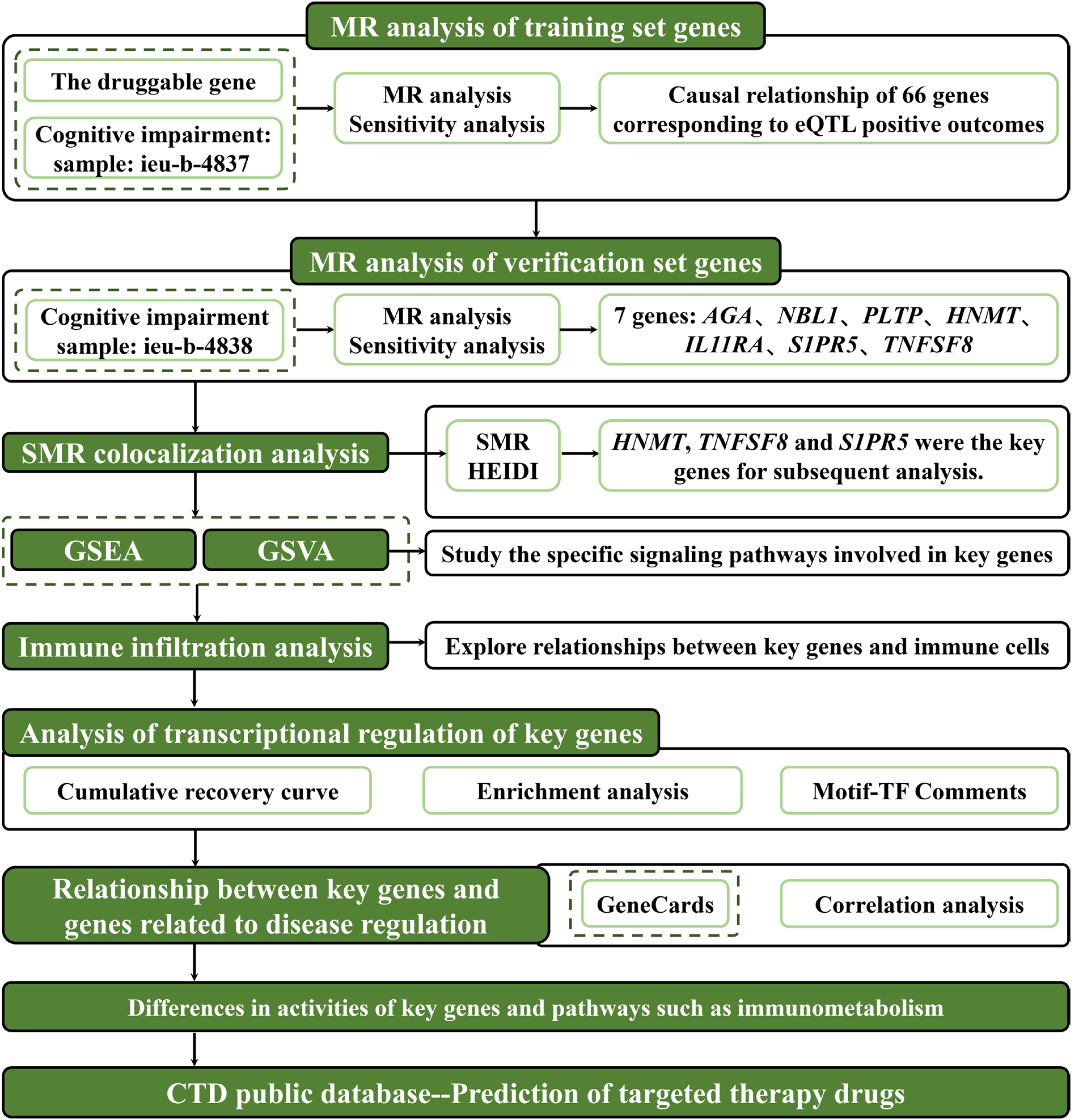
Outline of the study design.
Data source
The National Center for Biotechnology Information (NCBI) produces and maintains the GEO database (https://www.ncbi.nlm.nih.gov/geo/info/datasets.html). We retrieved GSE239282 from the GEO database. 36 The annotation-containing file was GPL24676. A total of thirty patients’ expression profiles were included, which comprised 14 samples in the control group and 16 in the illness group.
Exposed data: The database of the eQTLGen collaboration (https://www.eqtlgen.org) was the source of eQTL data. To understand the genetic foundation of complex phenotypes, the eQTLGen program is dedicated to focusing on the genetic makeup of blood gene expression.
Outcome data: Most participants selected for the study's training set were of European descent. The Integrative Epidemiology Unit (IEU) database (ieu-b-4837) was the source of all outcome summary data. Papers, leading relationships, and comprehensive summary statistics are now available in the GWAS catalog. At the moment, its data are mapped to dbSNP Build and Genome Assembly. 37 A total of 9997 samples of cognitive impairment were identified from the catalog. Participants in the GWAS connected to outcomes study who were selected for the validation set were also of European descent. Outcome aggregated data were sourced from the IEU database (ieu-b-4838) which contained 22,593 samples with cognitive impairment.
MR analysis
The result IDs filtered via the IEU database were taken from the GWAS summary data, which may be found at https://gwas.mrcieu.ac.uk. If related SNPs met the significance criteria of every gene in the entire locus (p < 1 × 10⁻⁵), they were deemed to be possible IVs. 38 Furthermore, inverse variance weighted (IVW, utilizing the Wald estimate for every SNP along with the meta-analysis technique), MR Egger (dependent on the concept that direct effects have little bearing on the instrument's strength), weighted median (In 50% of cases where IVs are invalid, the weighted median technique enables an accurate calculation of causality.), and weighted mode (Compared to MR-Egger regression, weighted model estimation has a lower type I error rate, less bias, and a better capacity to identify causal effects.) methods were employed. 39 We evaluated the causal relationship using two statistical techniques. The aggregate impact of all cis-specific and trans-regional gene expression on cognitive impairment in whole blood may then be estimated (the Wald ratio was used if there was only one statistical method for the SNP in the causal relationship). Ultimately, the screened causal links were analyzed and verified using the leave-one-out approach.
Summary-data-based Mendelian randomization (SMR) colocalization analysis
We originally intended to use pooled-level data from GWAS and eQTL research with the SMR software tool. It was meant to utilize SMR and heterogeneity in dependent instruments (HEIDI) to evaluate pleiotropic relationships between complex features of interest and gene expression levels. 40 The SMR and HEIDI approaches are intended to determine if gene expression mediates the effect size of an SNP on a phenotype. Consequently, GWAS hit target genes can be ranked using this technique in order of importance for later functional research. This method is currently applied to various molecular eQTL data.
GSEA analysis
We utilized Gene Set Enrichment Analysis (GSEA) to examine the variations in signaling pathways between the two groups after classifying patients based on the expression of important genes. An annotated version 7.0 of the background gene set was acquired from the MsigDB database. For the purpose of analyzing the differential expression of pathways between various groups, we gathered annotated genes of subtype pathways. Gene sets that were considerably (p < 0.05) enriched were sequenced. GSEA analysis is frequently used in studies where biological significance and disease classification are tightly related. 41
GSVA analysis
Gene Set Variation Analysis (GSVA), an unsupervised method, is used to measure transcriptome gene set enrichment. By allocating a score to the set of genes of attraction, GSVA can ascertain the biological functions of a sample. Concurrently, GSVA has the ability to convert gene-level modifications into pathway-level changes. In order to assess potential biological functional changes in the sample, we scored the gene sets using the GSVA method after obtaining the gene sets from a molecular signature database. To give a thorough grasp of their roles in disease mechanisms, the way that differentially expressed genes impacted Biological Process, Molecular Function, Cellular Component, and pathways utilizing R was examined.
Immune infiltration analysis
The CIBERSORT methodology is frequently employed for identifying the different types of immune cells that are present in the microenvironment. Based on the support vector regression theory, this method applies deconvolution analysis to the immune cell subtype expression matrix. 42 22 Immune cells, including T cells, B cells, plasma cells, and subsets of myeloid cells, are identified by a total of 547 biomarkers. This study evaluated patient data using the CIBERSORT tool to ascertain the relative quantities of 22 invading cell population and to perform a correlation analysis between immune cell content and gene expression.
Transcription factor regulatory network
The “RcisTarget” package was utilized to forecast the transcription factors (TFs). 43 We scored each gene motif pair using several factors after obtaining the database. The cisTarget function enables motif enrichment analysis on the gene list at data read time. After that, cisTarget performs the following steps in order: motif enrichment analysis, MotiF-TF annotates and selects significant genes. The area under the curve for the motif-gene set is then used to estimate the overrepresentation of each motif on the gene set. Ultimately, the standardized enrichment score (NES) was used to identify significant themes. 44
Noncoding RNA network related to key genes
miRNAs (targetscan) are short noncoding RNAs that control gene expression by either encouraging mRNA degradation or preventing its translation. Consequently, the presence of miRNAs targeting key genes that regulate the transcription or degradation of certain harmful genes was examined. Using the Cytoscape software, the miRNA network of the genes was visualized and important gene-related miRNAs were retrieved from the miRcode database. 45
Targeted drug prediction
The Comparative Toxicogenomics Database (CTD) is a valuable public resource designed to raise awareness about how environmental exposure affects human health. 46 This database delivers information on curated gene-disease and chemical-gene/protein linkages as well as chemical-disease correlations. The NCBI provides the gene database from which the CTD cross-species gene vocabulary is derived. Views include curated interacting chemical collections, curated and inferred illness correlations, and linked pathways and functional annotations among other gene-related data. Genes can be viewed by browsing, advanced query creation options, or keyword searches.
Statistical analysis
Three assumptions underpin reliable MR analysis: (1) correlation assumption (Although instrumental variables are not directly related to outcomes, they are closely related to exposure.), (2) independence assumption (Confounding factors have no relationship with instrumental variables.), (3) exclusivity hypothesis (Gene pleiotropy occurs when IVs influence outcomes through pathways other than exposure.). Sensitivity tests were carried out to confirm the strength of the causal linkages between the discovered potential biomarkers and to support the MR hypothesis. Testing for horizontal pleiotropy and heterogeneity was part of these investigations. To assess the heterogeneity between the causative estimates of each SNP, the Cochran's Q test was employed. To be more precise, a p-value of less than 0.05 for the Cochran's Q test indicated considerable heterogeneity. Even in the presence of heterogeneity, the random-effects IVW test yielded precise causal estimates when horizontal pleiotropy was absent. 47 To find out if the MR results would be biased by a single SNP, a leave-one-out study was performed. The MR-Egger intercept test was used to find horizontal pleiotropy among SNPs. 48 The correlation was regarded as statistically significant when the Bonferroni-adjusted p-value threshold was <0.017 (corrected for three exposures and one outcome), whereas a nominally significant indication of a potential causal relationship was defined as a p-value of less than 0.05. (Horvath). In this study, the R programming language (version 4.3.0) was utilized. A two-sided design was used for all statistical tests, with p < 0.05 denoting statistical significance.
Results
MR analysis of genes in the training set
The druggable gene was obtained from the literature, 8 and the outcome ID was obtained from the summary statistics of 9997 samples related to cognitive impairment: ieu-b-4837. The exposure factors and result data were read using the extract_instruments and extract_outcome_data commands in order. Using MR analysis, the causal linkages of 66 gene pairs associated with eQTL positive outcomes were further investigated (Supplemental File 1, IVW pval < 0.05). Of these, the genes PIK3CD, PTH2R, PCOLCE2, IL16, SCD, COCH, SEMA3A, STAT5B, GSTT1, GRIK4, STK38, SDC2, FDFT1, MAPK13, LYG1, ABCB4, SSTR3, HDAC4, S100A9, DRAXIN, NBL1, AGA, SEMG1, COMT, MAP3K20, EMR3, PLTP, RELT, APOBEC3A, MKNK1, CYTL1, TNFSF12, ITGA4, BTN3A2, and GSTM1 are linked to a decreased incidence of cognitive impairment; the genes ITGB5, NRG1, PI16, LIPA, MGST2, TNFRSF10B, APAF1, TRPV5, RAMP3, LILRA1, BACE1, KCNK6, IL11RA, CPA5, PF4, PRTN3, HNMT, CD1E, CD68, LGALS3BP, S1PR5, CD1B, TNFSF8, IARS, SMN2, CD1C, IL2RA, RYR1, PTGIR, IL12RB1, and CHST12 were related to a high risk of cognitive impairment (Supplemental Figure 1). We performed sensitivity analysis to determine the reliability of the causal relationships involving 66 genes. The results showed that removing any SNP did not exert a significant impact on the overall error line, which confirmed the robustness of the selected causal relationships (Supplemental File 2).
MR analysis of validation set genes
The result ID was acquired using the summary statistics of 22,593 samples of cognitive impairment to further identify the important genes influencing cognitive impairment: ieu-b-4838. To read the exposure factors and outcome data, extract_instruments and extract_outcome_data were used in the same order. The causal relationship of seven pairs of genes corresponding to eQTL positive outcomes was further screened using MR analysis (Figure 2, IVW pval < 0.05). The matching genes were AGA, NBL1, PLTP, HNMT, IL11RA, S1PR5, and TNFSF8. Of these, the genes AGA (0.967; 0.938–0.997; p = 0.029), NBL1 (0.941; 0.902–0.982; p = 0.006), and PLTP (0.953; 0.921–0.987; p = 0.008) were linked to a low risk of cognitive impairment. The genes HNMT (1.062; 1.011–1.115; p = 0.016), IL11ra (1.049; 1.005–1.095; p = 0.028), S1PR5 (1.124; 1.048–1.207; p = 0.001), and TNFSF8 (1.075; 1.027–1. 127; p = 0.002) had some ties with a high risk of cognitive impairment. Sensitivity analysis was done to assess the validity of the seven genes’ causal relationships. The results indicated the resilience of the seven pairs of causal linkages chosen because it was not clear how the removal of any one SNP affected the overall error (Figure 3).

Scatter plots of the results of MR methods.

“Leave-one-out” sensitivity analysis results of 7 pairs of genes.
SMR colocalization analysis
To explore the colocalization between phenotypes on the genome and enhance the strength of causality, SMR colocalization analysis was used to determine the degree of colocalization of variables in space and time. Colocalization analysis of positive pQTL-Outcome (BRCA) causal relationship pairs was performed using the tool SMR. Of these, four genes, S1PR5, TNFSF8, HNMT, and IL11RA, corresponded to PSMR < 0.05, whereas six genes, HNMT, S1PR5, AGA, TNFSF8, NBL1, and PLTP, corresponded to PHEIDI > 0.05. Of these, only three genes, HNMT, TNFSF8, and S1PR5, met both SMR and HEIDI tests (Supplemental File 3). Therefore, these genes were employed as important genes in a later study.
GSEA analysis
Subsequently, the unique signaling pathways linked to significant genes were scrutinized, and potential molecular pathways by which significant genes impacted the onset of disease were explored. The findings demonstrated that HNMT was abundant in signaling pathways like the citrate cycle, tryptophan metabolism, and proteasome (Figure 4(A)). TNFSF8 was enriched in B cell receptor signaling pathway, RIG-I-like receptor signaling pathway, Fc epsilon RI signaling pathway, and other signaling pathways (Figure 4(B)). S1PR5 was enriched in glucagon signaling pathway, B cell receptor signaling pathway, VEGF signaling pathway, and other signaling pathways (Figure 4(C)).

The results of Gene Set Enrichment Analysis.
GSVA analysis
GSVA analysis revealed that HNMT is enriched in pathways such as OXIDATIVE_PHOSPHORYLATION, PROTEIN_SECRETION, and FATTY_ACID_METABOLISM (Figure 5(A)). TNFSF8 is enriched in UNFOLDED_PROTEIN_RESPONSE, PROTEIN_SECRETION, MTORC1_SIGNALING, and other signaling pathways (Figure 5(B)). S1PR5 is enriched in GLYCOLYSIS, MITOTIC_SPINDLE, HEDGEHOG_SIGNALING, and other signaling pathways (Figure 5(C)). This observation suggests that important genes can influence the course of disease through these channels.
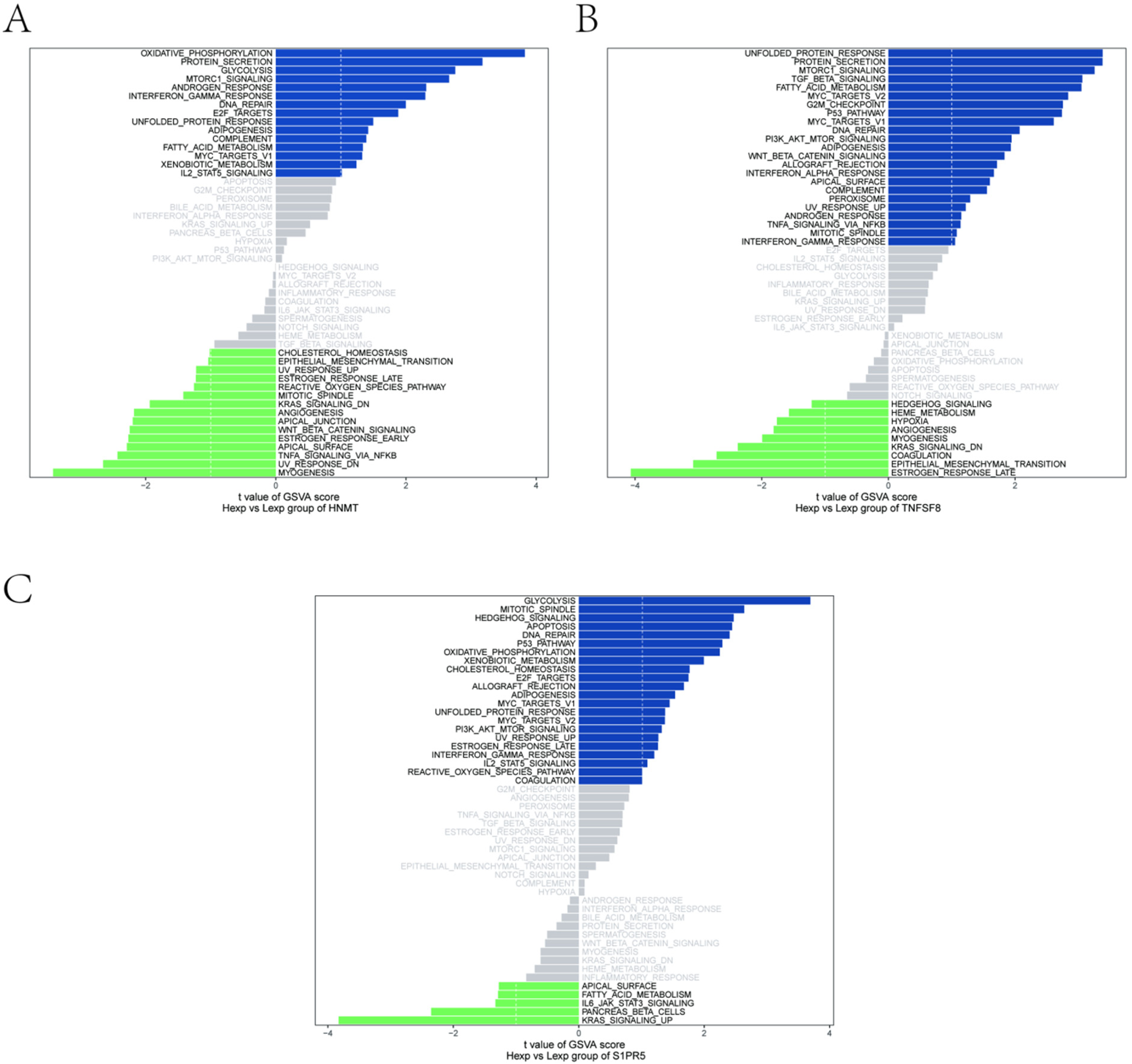
The results of Gene Set Variation Analysis.
Immune infiltration analysis
The above results of enrichment analysis suggest that the key genes were related to immunity and microenvironment. The microenvironment primarily composed of fibroblasts, immunological cells, extracellular matrix, various growth hormones, inflammatory agents, and unique physical and chemical characteristics. The diagnosis, prognosis, and response to disease therapy are substantially influenced by the microenvironment. Subsequently, immune infiltration analysis was performed to examine the differences between the disease group and the control group. The distribution of the immune infiltration level and immune cell correlation were illustrated in different formats (Figure 6(A) and (B)). In contrast to the control group, the natural killer (NK) cell resting levels of the disease group samples were significantly higher. Moreover, the levels of naive B cells, activated NK cells, naive CD4 T cells, and regulatory T cells (Tregs) were significantly lower (Figure 6(C)). After investigating the connection between important genes and immune cells in more detail, HNMT was found to exhibit a strong negative correlation with plasma cells. TNFSF8 showed a substantial negative link with resting NK cells and a significant positive correlation with naive B cells and Tregs. S1PR5 showed a strong negative correlation with naive CD4 T cells, activated dendritic cells, and a strong positive correlation with resting NK cells, CD8 T cells, etc. (Figure 6(D)).

A distribution of immune infiltration levels.
Furthermore, the association between key genes and other immunological elements, including receptors, chemokines, immunostimulatory agents, and immunosuppressive agents, was examined. The results revealed that key genes were strongly correlated with the degree of immune cell infiltration and had a substantial effect on the immunological milieu (Figure 7).
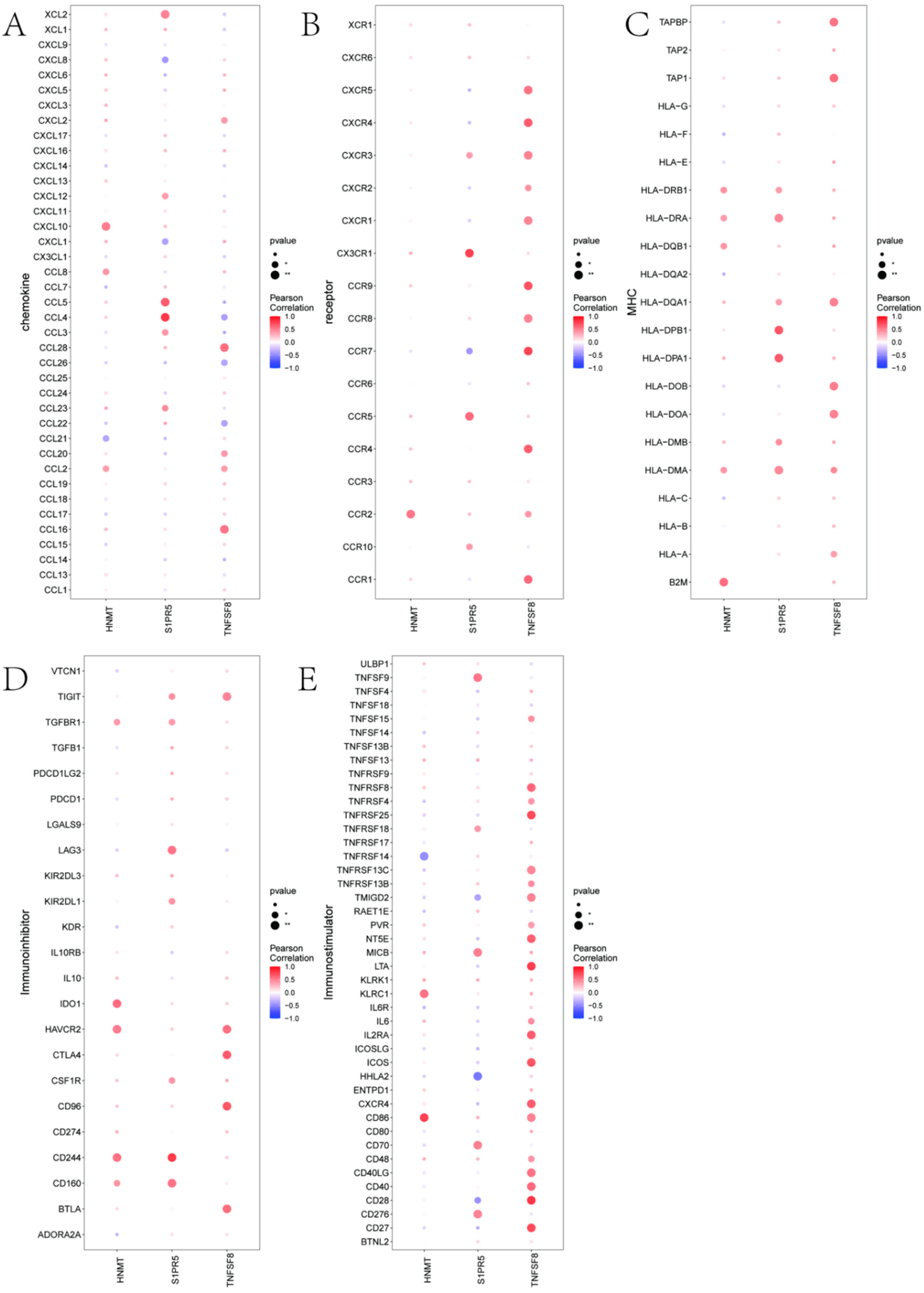
The correlation between key genes and different immune factors.
Analysis of transcriptional regulation of key genes
To further investigate the expression patterns and regulatory mechanisms of key genes, transcriptional regulatory network analysis was performed to explore the manner in which TFs modulate the expressions of the construction genes. Using the important genes as the gene set for this study, multiple TFs, among other common mechanisms, were found to control these genes. These TFs were subjected to enrichment analysis using cumulative recovery curves. A motif-TF annotation study and significant gene selection showed that cisbp__M2025 had the highest normalized enrichment score of 9.52. For significant genes, all the enriched motifs and related TFs were identified (Figure 8(A) and (B)). Next, the miRcode database was utilized to perform reverse prediction for the key genes. This step resulted in the identification of 58 miRNAs or 81 pairs of mRNA–miRNA interactions, which were displayed using Cytoscape (Figure 8(C)).
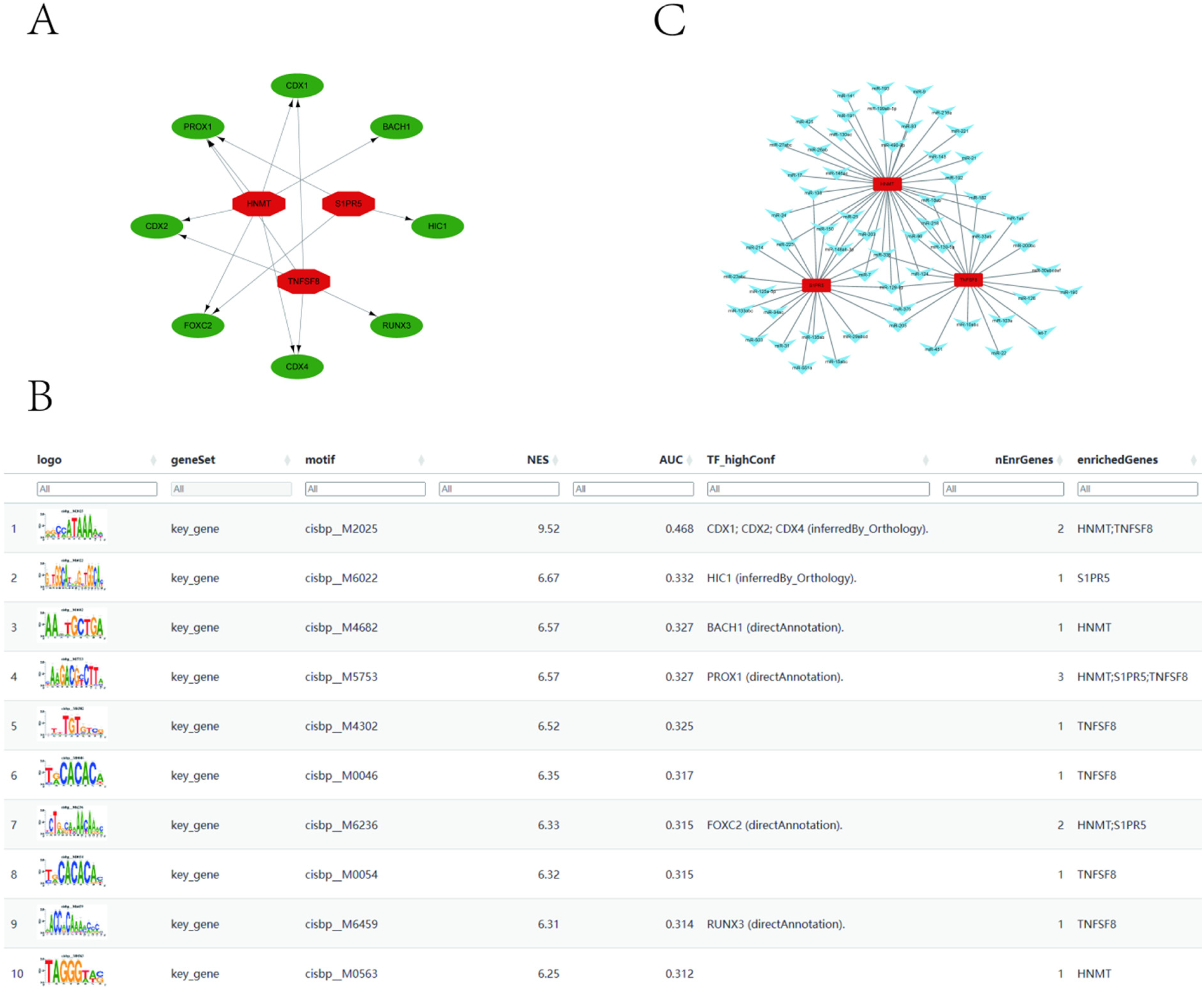
Analysis of transcriptional regulation of key genes.
The relationship between key genes and genes related to disease regulation
Disease regulation-related genes were obtained from the GeneCards database (https://www.genecards.org/). The expression levels of 20 genes that ranked high in the relevance score and were expressed in the transcriptome were analyzed. The expressions of GNB5, PSEN1, FMR1, APP, and BACE1 differed significantly between the control and disease groups of patients. Additionally, a correlation study was carried out on disease-regulated genes and the important genes. There were notable associations observed between the expression levels of the critical genes and those of the disease-regulated genes. Among these, there was a substantial negative correlation (cor = −0.487) between HNMT and APOE, and a strong positive correlation (cor = 0.855) between S1PR5 and NPC1 (Figure 9(A)).

(A) Disease gene expression level; and (B) immune metabolism pathways.
Differences in activities of key genes and pathways such as immunometabolism
Subsequently, the immunometabolism-related pathway genes were quantitatively scored, and bubble charts were used to display the activity differences of key genes in immunometabolism-related pathways. The results showed that TNFSF8 had higher activity in heme_metabolism, epithelial_mesenchymal_transition, and other pathways. S1PR5 had higher activity in heme_metabolism, androgen_response, and other pathways. HNMT had higher activity in myogenesis, notch_signaling, and other pathways (Figure 9(B)).
Prediction of targeted therapy drugs
In this study, targeted drugs were predicted based on the CTD public database (https://ctdbase.org/). Research results showed that HNMT had 39 targeted drugs in cognitive impairment, including arsenic trioxide, aspirin, and atrazine. TNFSF8 had 24 targeted drugs in cognitive impairment, including aluminum, amphetamine, and arsenic. S1PR5 had 30 targeted drugs in cognitive disorders, including the arsenic, arsenic trioxide, and benzo(a)pyrene (Figure 10).
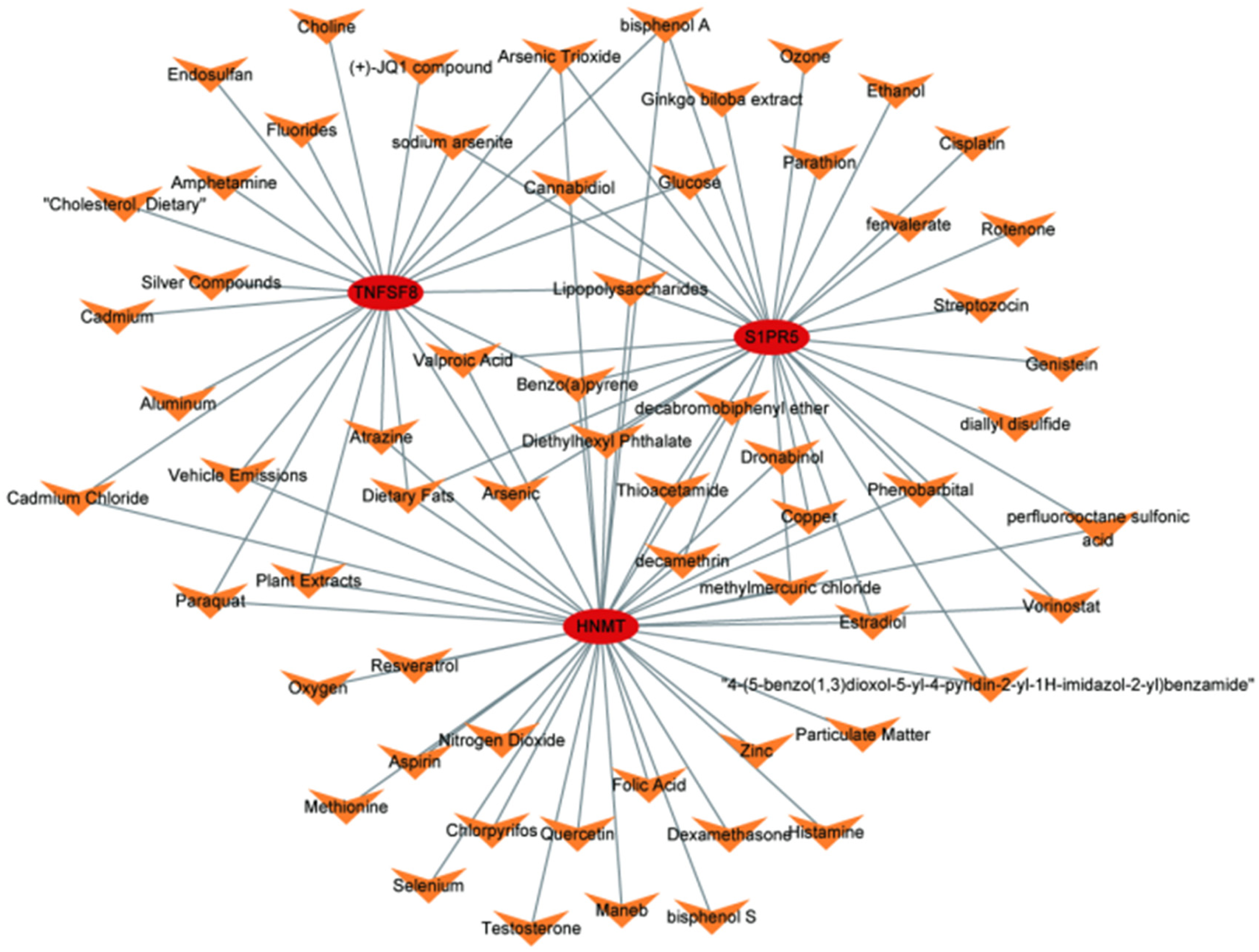
Targeted drugs of HNMT, TNFSF8, and S1PR5.
Discussion
The impending demographic transition poses unprecedented challenges to cognitive health management. By 2060, China is projected to harbor over 300 million individuals aged ≥70 years, necessitating urgent strategies to mitigate age-associated cognitive decline. 49 Epidemiological data reveal that 15.5% of Chinese seniors (>60 years) exhibit MCI, corresponding to 38.77 million cases.50–52 Cognitive function, a multidimensional construct integrating memory consolidation, executive processing, and perceptual integration which serves as the neurobiological substrate for daily functioning. Its deterioration not only precipitates neurodegenerative disorders (e.g., AD) 53 but also exacerbates psychiatric comorbidities (depression, 54 schizophrenia 55 ) and somatic conditions (long COVID, 56 malignancies), collectively increasing all-cause mortality. 57 Current therapeutic paradigms remain palliative, with pharmacotherapies often paradoxically accelerating cognitive deterioration. 58 This therapeutic impasse underscores the imperative to identify modifiable risk factors and molecular targets for primary prevention.
Advancements in predictive genomics offer preventive potential. Polygenic risk scores (PRS) derived from genome-wide association studies enable individualized risk stratification for cognitive impairment, facilitating preemptive interventions under clinical supervision.59,60 The 2023 Alzheimer's Association International Conference consensus reinforced biomarker-driven diagnostics, prioritizing neuroinflammatory mediators within the ATN (Amyloid/Tau/Neurodegeneration) framework. 61 Moreover, single-core ATAC sequencing and single-core RNA sequencing have been employed by. 62 The researchers used these technologies to build the most comprehensive transcriptomic and epigenome maps so far. This work suggests that specific cell types, genes, biological markers, and molecular mechanisms are particularly important for the occurrence and development of cognitive disorders.62,63 Oxidative stress, mitochondrial dysfunction, excessive inflammatory responses, and abnormal protein processing have opened new windows for radical therapies for cognitive disorders. 64 Therefore, the aggregated statistical data of 9997 samples related to cognitive impairment were downloaded for MR analysis. The focus was on key genes related to cognitive impairment. The findings revealed that 66 gene pairs were robust in identifying the risk of cognitive impairment outcomes. Further screening showed that seven pairs of genes (AGA, NBL1, PLTP, HNMT, IL11RA, S1PR5, and TNFSF8) were correlated with eQTL positive outcome (Supplemental File 1, IVW pval < 0.05). Colocalization analysis of positive pQTL-Outcome (BRCA) causality was performed using SMR, and three key genes, NMT, TNFSF8, and S1PR5, were screened out.
N-Myristoyltransferase (NMT): N-myristyltransferase is an enzyme that plays a role in the post-translational modification of proteins and is responsible for adding myristyl groups to the amino terminus of proteins. The authors used RNA interference screening to identify molecular pathways that affect senescent cell survival, including coatomer complex I vesicle formation in membrane transport and protein N-myristoylation. Pharmacological NMT inhibition ameliorates senescence burden in hepatic and oncological models, suggesting therapeutic potential for age-related cognitive decline. 65
TNFSF8 (CD30L): A mouse model of simulated chronic cerebral hypoperfusion models was used to observe its effects on white matter injury and cognitive impairment. The experimental results demonstrate TNFSF8 upregulation in reactive astrocytes, concomitant with ROS-mediated white matter degradation and hippocampal synaptic loss. Thus, cognitive function was impaired. 66
Sphingosine-1-phosphate receptor 5 (S1PR5): Sphingosine-1-phosphate (S1P), a lysophospholipid signaling molecule derived from the metabolism of sphingolipids in cell membranes, binds to five distinct S1P receptors (S1PR1-S1PR5). This ubiquitous signaling molecule plays a critical role in regulating various biological processes, including cardiac function, lymphocyte trafficking, vascular development, and endothelial integrity. The selective agonist effects of S1P on S1PR5 enhance neuroprotection by mitigating lymphocyte infiltration into the central nervous system (CNS) and promoting myelin repair, which are mechanisms associated with vascular cognitive impairment. 56 Therefore, in this study, NMT, TNFSF8, and S1PR5 were selected as important genes for further examination.
The aging process is associated with alterations in the brain, such as shrinkage (especially in the hippocampus), abnormalities in the synthesis and breakdown of amyloid-beta, inflammation, and a decrease in neurons in areas of the brain connected to memory. 67 Observational studies in the general population have also reported correlations between inflammatory markers and poor general cognitive ability and specific cognitive domains. However, whether inflammation is linked to cognitive function in young people and whether these associations are causal remain unclear. 56 As inflammation is one of the main factors affecting cognitive function, finding the key to inhibiting the development of inflammation could delay aging and avoid cognitive decline. Increases in proinflammatory cytokines and chemokines produced by resident brain cells, such as astrocytes and microglia, as well as the influx of peripheral immune cells into the CNS are the hallmarks of neuroinflammation. Research has indicated increased concentrations of traditional inflammatory mediators, including interleukin (IL)-1β, IL-6, and C-reactive protein, 68 which leads to the degradation of tissue matrix and the infiltration of peripheral immune cells. It triggers an inflammatory reaction in the central nervous system, damaging the blood–brain barrier (BBB). Therefore, when the BBB is compromised, proinflammatory chemicals and autoantibodies from the peripheral circulation can enter the brain and activate microglia, causing central nervous system inflammation and cognitive impairment. 69 These observations signify that multiple immune cells in the brain, the immune microenvironment at the edge of the brain, the multipathway communication between the brain and the immune system, and the abnormal activation or dysfunction of immune cells are intricately linked to the development of cognition-related diseases in the brain caused by inflammatory responses. 70 In addition, NK cell is a type of innate cytotoxic lymphocyte, and its accumulation during aging can lead to neurogenic decline. These cells may be the reason for the reduced ability to recover from CNS injury in old age, which indicates that the infiltration of lymphocytes into the brain parenchyma can promote brain aging.
Our MR analysis extends these findings, demonstrating causal links between peripheral immune phenotypes and cognitive impairment. Notably, our results exhibited elevated resting NK cells (OR = 1.32, p = 3.1 × 10⁻⁴) alongside depleted Tregs (OR = 0.67, p = 0.002) and naive lymphocytes—a profile reminiscent of immunosenescence. Colocalization signals between immune-related SNPs and prioritized genes (TNFSF8: PP4 = 0.89; S1PR5: PP4 = 0.76) suggest lymphocyte-to-CNS signaling mediates neuroinflammation. This aligns with murine evidence in which choroid plexus CD4+ T cell dysfunction and parenchymal NK cell accumulation exacerbate age-related neurogenesis impairments.
Numerous studies have utilized AD-related GWAS data for bioinformatics analysis to identify biomarkers, explore pathological mechanisms, and conduct genetic analyses. However, this study uniquely integrates datasets encompassing age-related cognitive impairment, AD, and MCI. It focuses on broader cognitive impairment to investigate potential co-regulation among patent genes and their influence on inflammation, metabolism, and other biological functions, as well as drug targeting to identify possible common therapeutic agents for the three conditions. Research in this comprehensive direction remains scarce. Nevertheless, further fundamental experiments are necessary to examine the specific regulatory pathways of the final selected genes (NMT, TNFSF8, and S1PR5) within a cognitive impairment model to mitigate disease heterogeneity.
This study employed MR to determine exposure factors and statistically analyze the causes of cognitive impairment outcomes. The key advantage of MR is its ability to avoid confounding biases inherent in observational studies through the random assignment of genotypes. Additionally, genotypes, being fixed at birth help prevent reverse causality. However, limitations exist: instrumental variables may be influenced by sample heterogeneity and exhibit genetic structural differences across populations. To address these challenges, we leveraged GWAS data to enhance MR sample size and genetic representation.
GWAS can identify genetic loci significantly associated with complex traits or diseases via whole-genome scanning. Consequently, GWAS-identified correlation sites were used as instrumental variables in MR and combined with multi-omics integration techniques such as GSVA and GSEA to strengthen causal inference reliability. Nonetheless, the concurrent use of multiple statistical tools and analyses poses a risk of hypothesis overloading and amplified bias. Moreover, simultaneous examination of biological mechanisms, including genetic associations from GWAS, causal effects of MR, and GSVA results, complicates result interpretation. Follow-up animal and cell experiments, along with clinical patient data, are essential to validate biomarker changes both in vivo and in vitro.
Conclusion
In this study, seven pairs of genes corresponding to eQTL positive outcomes were screened using MR analysis, and HNMT, TNFSF8, and S1PR5 were targeted as the key genes for subsequent analysis via SMR colocalization analysis. In addition, for each of the three genes, the targeted therapeutic drugs had been predicted. The findings showed that HNMT had 39 targeted drugs in cognitive impairment, including arsenic trioxide, aspirin, and atrazine. TNFSF8 had 24 targeted drugs in cognitive impairment, including aluminum, amphetamine, and arsenic. S1PR5 had 30 targeted drugs in cognitive disorders, including arsenic, arsenic trioxide, and benzo(a)pyrene. However, further studies are needed to elucidate the specific mechanisms and potential therapeutic applications.
Supplemental Material
sj-xlsx-3-alz-10.1177_13872877251335891 - Supplemental material for Drug-targeted Mendelian randomization analysis combined with transcriptome sequencing to explore the molecular mechanisms associated with cognitive impairment
Supplemental material, sj-xlsx-3-alz-10.1177_13872877251335891 for Drug-targeted Mendelian randomization analysis combined with transcriptome sequencing to explore the molecular mechanisms associated with cognitive impairment by Xixi Wu, Qingyan Yang, Yudi Xie, Lingfeng Xia, Jiatao Li, Wenting An and Xiao Lu in Journal of Alzheimer's Disease
Supplemental Material
sj-pdf-4-alz-10.1177_13872877251335891 - Supplemental material for Drug-targeted Mendelian randomization analysis combined with transcriptome sequencing to explore the molecular mechanisms associated with cognitive impairment
Supplemental material, sj-pdf-4-alz-10.1177_13872877251335891 for Drug-targeted Mendelian randomization analysis combined with transcriptome sequencing to explore the molecular mechanisms associated with cognitive impairment by Xixi Wu, Qingyan Yang, Yudi Xie, Lingfeng Xia, Jiatao Li, Wenting An and Xiao Lu in Journal of Alzheimer's Disease
Supplemental Material
sj-pdf-5-alz-10.1177_13872877251335891 - Supplemental material for Drug-targeted Mendelian randomization analysis combined with transcriptome sequencing to explore the molecular mechanisms associated with cognitive impairment
Supplemental material, sj-pdf-5-alz-10.1177_13872877251335891 for Drug-targeted Mendelian randomization analysis combined with transcriptome sequencing to explore the molecular mechanisms associated with cognitive impairment by Xixi Wu, Qingyan Yang, Yudi Xie, Lingfeng Xia, Jiatao Li, Wenting An and Xiao Lu in Journal of Alzheimer's Disease
Supplemental Material
sj-pdf-6-alz-10.1177_13872877251335891 - Supplemental material for Drug-targeted Mendelian randomization analysis combined with transcriptome sequencing to explore the molecular mechanisms associated with cognitive impairment
Supplemental material, sj-pdf-6-alz-10.1177_13872877251335891 for Drug-targeted Mendelian randomization analysis combined with transcriptome sequencing to explore the molecular mechanisms associated with cognitive impairment by Xixi Wu, Qingyan Yang, Yudi Xie, Lingfeng Xia, Jiatao Li, Wenting An and Xiao Lu in Journal of Alzheimer's Disease
Footnotes

Ethical considerations
Author contributions
Xixi Wu (Funding acquisition; Project administration; Supervision; Writing—original draft; Writing—review & editing); Qingyan Yang (Data curation; Formal analysis; Supervision; Validation; Writing—original draft; Writing—review & editing); Yudi Xie (Supervision; Validation; Writing—review & editing); Lingfeng Xia (Data curation; Project administration); Jiatao Li (Investigation); Wenting An (Validation); Xiao Lu (Data curation; Supervision; Validation; Writing—review & editing).
Funding
The author(s) disclosed receipt of the following financial support for the research, authorship, and/or publication of this article: This work was funded by the National Key Research and Development Program of China (2022YFC2405605) and the Jiangsu Provincial Key Research and Development Program (BE2022160). The funding bodies had no role in the study design, data collection, analysis or interpretation.
Declaration of conflicting interests
The author(s) declared no potential conflicts of interest with respect to the research, authorship, and/or publication of this article.
Data availability
The datasets used and/or analyzed in the current study are available from the corresponding author on reasonable request.
Supplemental material
Supplemental material for this article is available online.
References
Supplementary Material
Please find the following supplemental material available below.
For Open Access articles published under a Creative Commons License, all supplemental material carries the same license as the article it is associated with.
For non-Open Access articles published, all supplemental material carries a non-exclusive license, and permission requests for re-use of supplemental material or any part of supplemental material shall be sent directly to the copyright owner as specified in the copyright notice associated with the article.
