



Abstract
With the advancement of cultural globalization, China has increased its support for the study of British and American literature. However, due to the great differences in the forms of expression and thinking logic between British and American literature and Chinese local literature, it is difficult for Chinese students to learn British and American literature. In order to solve the dilemma of Chinese students learning English and American literature, the team constructed a smart classroom model with flipped classroom as the core based on big data and Internet of Things technology. The smart classroom model is constructed according to the four-layer architecture of the Internet of Things, which is divided into perception layer, network layer, platform layer and application layer. The flipped classroom is in the application layer. The flipped classroom is designed according to the three processes before, during and after class, which has certain theoretical significance. In order to verify the effectiveness of this model, a university in H city was selected for research. Through the control experiment, it was concluded that within a certain error range, the flipped classroom teaching mode can significantly improve the teaching effect of British and American literature compared with the traditional teaching mode. Finally, based on the problems of English and American literature learning, we further deepen the model of flipped classroom. In the pre-course pre-study stage, teachers should play their organizational role and enhance students’ pre-study effect through interesting pre-study methods. Teachers should also pay attention to students’ pre-study status and make timely adjustments. In the classroom, teachers need to find students’ questions in time and answer common questions in a unified manner and answer individual questions in private, in an effort to improve classroom efficiency and promote the process of internalizing students’ knowledge. At the end of the flipped classroom, the classroom should also summarize the lesson, recognize the strengths and weaknesses of the lesson implementation based on the feedback from the students, and clarify the room for improvement of the lesson. At the same time, teachers should also reflect on the flipped classroom model and comprehensively assess its strengths and weaknesses to ensure that this model can be applied to its full value.
Introduction
With the globalization of economy and culture, the communication between different cultures is increasing. As a distinctive literary theme in the world literary system, British and American literature has been widely studied by scholars from all over the world [1]. In China, British and American literature classroom is an important course in China’s education system, which can promote Chinese students’ understanding and internalization of different cultures and broaden their horizons and opinions of British and American literature. British and American literature is an important branch of world literature. It has unique style and characteristics, and has distinct differences from other literature. Learning English and American literature is of great help to promote the diversified development of culture. British and American literature classroom provides a platform for us to learn British and American literature. Promoting the healthy development of British and American literature classroom can not only make British and American literature known to more people, but also promote the diversified development of Chinese culture [2].
With the birth of Internet of Things sensors, the amount of data in the information world has grown dramatically and Big Data has come into being. Big data technology mainly involves the collection, management, processing, and analysis of massive data. It is able to deal with the huge amount of data that is difficult to handle and solve by traditional methods. Nowadays, big data foundation has been widely used in various industries in China, such as medical big data, financial big data, etc. Similarly, big data technology is also used to analyze the content related to pedagogy, which can also promote better development of pedagogy by processing and analyzing that huge amount of data of teaching process and obtaining the conclusion hidden under these data. IoT and big data complement each other. IoT sensors are one of the important sources of big data, and big data can analyze the data generated by IoT. IoT mainly includes the sensing part and the internal processing part, which breaks the limitation of information exchange of objects and constitutes a network of connected characters. In the application process, Internet is often used in combination with big data and has important applications in communication, education and financial convenience.
The development of big data and the Internet of Things brings new opportunities to the development of classroom teaching. With the rapid development of information technology, people are increasingly interested in the development of information technology in all walks of life, and the education industry is no exception. At this stage, the national government and the people have higher and higher requirements for the level of classroom education, and the construction of a new education method represented by flipped classroom has become a major trend in the development of pedagogy. Big data and IoT technology are of great use in information collection, information processing and information display. Combining classroom teaching and information technology together can not only reduce the burden of learning for teachers and students, but also improve the overall level of the education industry. IOT technology has great advantages in the interconnection of everything and information communication, and the use of IOT technology can promote the development of smart classrooms, which can help build a wise model of efficient cooperation between teachers and students, and is of great help to improve the level of informationization in the education industry and enhance the level of classroom teaching.
The flipped classroom is a teaching model that changes the sequence of teaching and learning, and originally originated in a small village in the eastern United States. The main model of the flipped classroom is that students spontaneously pre-study before class to have a brief understanding of the book content, and then the teacher will explain this part of the book in class, which is a kind of learning before teaching model. The advantage of this model is that students have a brief understanding of the book content through independent pre-study, and later, under the guidance of the teacher, they can further deepen and summarize the book knowledge, which not only deepens their understanding of the knowledge, but also has a generalized knowledge system of the content explained in class [3].
For the classroom itself, flipped classroom reduces the burden of classroom lessons, improves the efficiency of the classroom, and ensures the quality of classroom content. Since its birth, the flipped classroom has been used extensively in Europe and the United States, and then spread to China, where the Chinese catechism is closely related to the flipped classroom.
There have been very mature research systems in this field, and they have summarized the origin, development, and emerged problems of flipped classroom, but this paper is innovative in studying the flipped classroom teaching model of English and American literature in the context of big data and Internet of Things from the technical perspective. At the same time, it also fills the technical gap in this field.
Construction of flipped classroom model based on IoT and big data
Analysis of the demand for flipped classroom
The flipped classroom teaching model is an emerging teaching method for reforming the drawbacks of the traditional teaching model, which can effectively avoid problems such as students’ lack of interest in class, students’ lack of thinking during learning, and students’ low learning efficiency. Students’ independent study before class can deepen their understanding of the course content and help them accumulate practical experience at the same time, and this way will be of great use, so it is of high value to apply the flipped classroom model to English and American literature education.
The flipped classroom system is shown in Fig. 1.
Flipped classroom system.
In the traditional teaching method, due to the short classroom time and heavy teaching tasks, teachers cannot take into account all students and can only develop the teaching content according to the level of most students. Such a teaching method cannot meet the precision teaching and often leads to ambiguity in the content taught and a lack of reflection by students in the learning process. As shown in Fig. 1, the emergence of the flipped classroom model makes it easy to solve these problems. The flipped classroom disperses a portion of the teacher’s classroom lecture to the classroom, where students gain a simple understanding of the knowledge through independent study. At the same time, in the course, the teacher only needs to summarize, conclude, and sublimate the core content, without repeating it. This model disperses and teacher pressure to teach, which allows the teacher to better focus on each student, develop individualized teaching plans for each student, and promote the overall development of the student. At the end of the class, students also have to reflect on and summarize what was taught in class [4].
The flipped classroom can promote students’ spontaneous learning. English and American literature is an abstract subject, and if the teacher alone explains it, students will not be able to understand the emotions incorporated in it, the consciousness the author wants to convey, and at the same time may lose interest in the subject, making students resistant to it. However, the flipped classroom is a classroom where the main learning task is placed in the classroom, and students are able to understand the literature in the classroom, and in the classroom, the teacher conveys the knowledge involved in English and American literature through interesting teaching methods, and at the same time, the teacher can combine modern technology and add activities in the form of videos and music in the classroom to stimulate students’ interest in learning English and American literature.
The flipped classroom facilitates students’ absorption of classroom knowledge. In the flipped classroom model, students preview the kind of classroom in class and ask the teacher their confusion based on the teaching content in class, and then the teacher gives answers. In class, students practice on their deficiencies. This mode of teaching solves the drawbacks of traditional duck-and-egg teaching and makes teaching more interesting while allowing students to learn more.
Flipped classroom enhances student-teacher interaction. In the flipped classroom model, the main content of the classroom changes from teacher lectures to teacher-student interactions. Instead of a systematic overview, the classroom addresses student problems. This process increases the interaction between teachers and students, cultivates the relationship between teachers and students, and is instrumental in improving classroom efficiency and enhancing students’ learning on significant significance [5, 6].
The construction of the flipped classroom model is divided into three stages: before, during, and after class. In terms of teaching environment, before and after class are the stages of self-learning, and during class is when teachers present classroom content and answer confusions through smart classrooms. The type of learning in all three stages is absorption type, from before to during and after class is a process of continuous accumulation of knowledge, while the cognitive level requires that there is a change from understanding to application. The specific teaching and learning process is shown in Table 1.
Teaching and learning process of flipped classroom
Teaching and learning process of flipped classroom
Based on big data and IoT technology as support, the flipped classroom teaching model is integrated into the design process of the platform to build a smart classroom with reversed classroom as the core content. This model is divided into four main layers. The first layer is perception layer. The perception layer mainly consists of IoT sensors and other smart devices, including smart devices, computers, etc. The second layer is the network layer. The network includes both wired sensing and wireless sensing. The third layer platform layer, mainly consists of Paas and Laas. The fourth layer application layer. The main core of the application is flipped classroom, but it also includes teaching management applications and so on. The platform is supported by big data technology as the underlying technology, and the data obtained from the perception layer is processed by big data analysis, so as to get data related to each student’s performance in the classroom. Using big data analysis to cluster and fuzzy analyze these data, the comprehensive performance of students in the classroom is summarized, and these data are fed back to teachers. Teachers get these data and design personalized teaching programs for students based on what the data reflects to promote students’ learning of English and American literature. The specific framework structure of the smart classroom model is shown in Fig. 2 [7, 8]. If there is a group of students in the smart classroom, the IoT sensors and other smart devices installed in the classroom will constantly sense the students’ expressions, words, and movements, and convert them into data transmitted to the platform layer through wireless or wired means, and the platform will feed the data back to the application layer after relevant processing, and the application layer will present the teacher with a complete flipped classroom teaching plan, which includes the comments on each student’s The application layer presents the teacher with a complete flipped classroom teaching plan, which includes the opinion of each student.
Framework model of the smart classroom.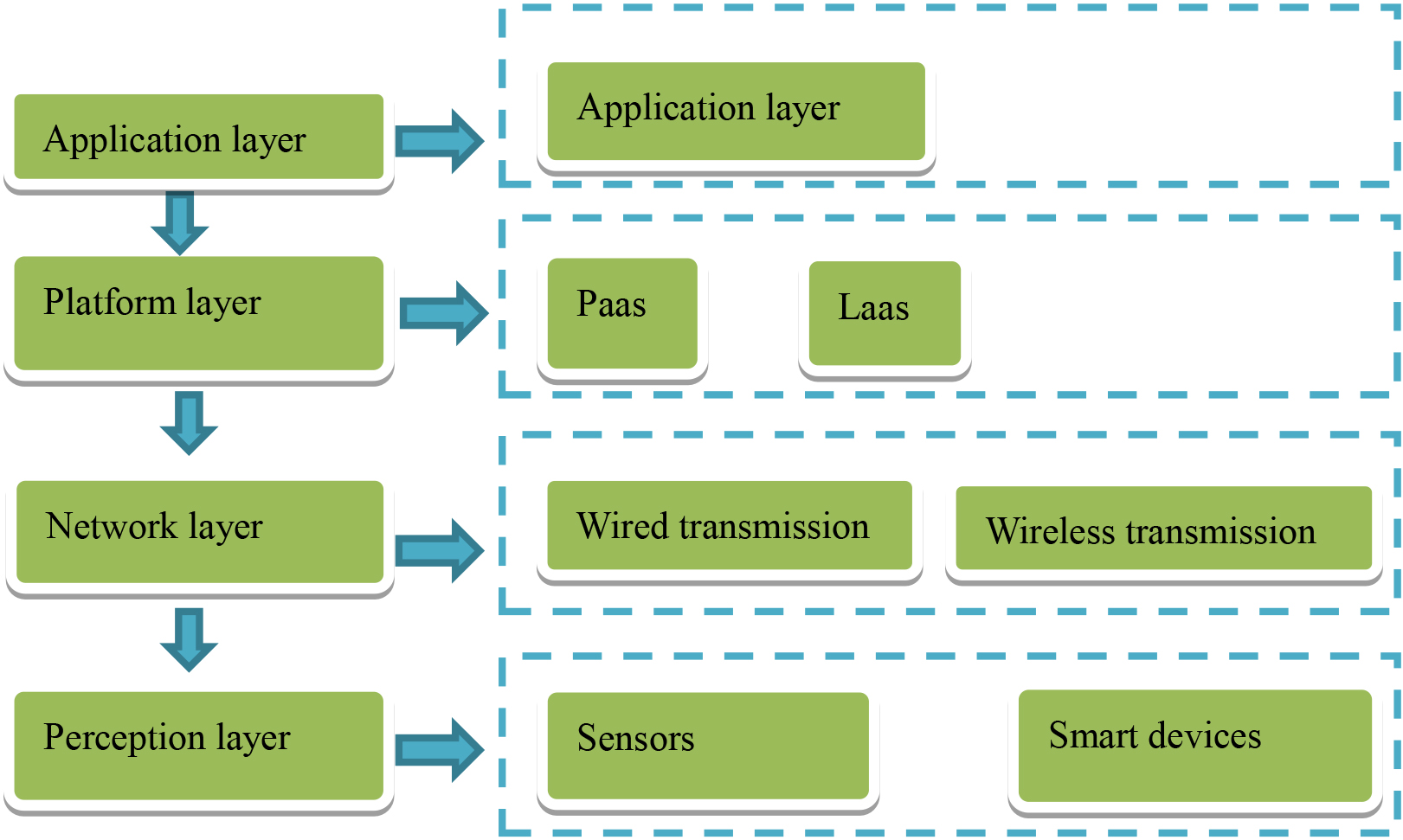
The framework structure of the smart classroom, with the realization of flipped classroom as the core, senses student behavior through IoT big data technology. The emergence of smart classrooms solves the problem that teachers do not pay enough attention to students under traditional teaching methods. Also, the flipped classroom application in the smart classroom framework allows for personalized assessment based on student performance. Traditional teaching assessments tend to focus only on grades, without personalized assessment of students. The Smart Classroom Framework structure provides personalized assessments that can uncover the strengths of each student and have the effect of improving classroom effectiveness.
According to previous studies, the flipped classroom has good results in practical applications; however, this study is based on the premise of technology and has significant differences from traditional studies in terms of experimental content. Therefore, the findings of the previous study could not be directly applied. In this study, we use the framework model of smart classroom to verify the effect of the smart classroom built using big data and IoT technology with flipped classroom as the core on improving the effectiveness of English and American literature lectures. If the results of the study are good, this each experiment has high theoretical and practical significance.
In order to fully explore the influence of flipped classroom teaching mode on English and American literature teaching, we explored the students’ performance under the teaching mode of flipped classroom smart classroom based on big data and Internet of things technology from a technical perspective.
This study focuses on building a flipped classroom teaching model based on big data and Internet of Things technology. Based on theoretical knowledge, our team has built a flipped classroom application under the framework of smart classrooms. In order to explore the role of this application, our team designed the following experiments.
Investigation process
The selection of survey subjects. A university in H city was selected as the research object for this study, and 160 people were randomly selected from the university’s English and American literature majors, both of whom were divided into two groups, the experimental group and the control group. The assessment of students’ abilities is divided into two parts. Firstly, students are tested in English to get the scores of students’ learning performance. Then let the students count the content of the classroom teaching, and let the 20 professional judges and teachers score the students’ learning situation, including learning ability and learning habits. The score of each student’s learning ability and learning habits is the average score of the 20 judges, which is fair to a certain extent. To ensure the validity of the experiment, a comprehensive assessment of study ability, study habits, and grades was conducted on these 160 English and American literature before the experiment. The specific results are shown in Table 2. According to the results displayed in Table 2, under the condition that
Analysis of study subjects
Analysis of study subjects
In this study, a controlled experiment was conducted to construct experimental and control groups, and the reliability of the experiment was ensured by randomly selecting survey subjects in English and American literature majors, and by calculating their scores in the three areas of study ability, study habits, and performance, so as to control the differences in scores within a certain range. During the experiment, the English and American literature lectures were conducted for the Dao masters according to the traditional teaching method and analyzed in the classroom. The experimental group was taught through the wisdom model constructed this time, and also analyzed the performance of English and American literature in the classroom.
On the premise of ensuring the consistency of the subjects, we made different learning arrangements for the control group and the experimental group. For the control group, we follow the conventional teaching methods, according to the traditional teacher teaching, student learning teaching methods. For the experimental group, we follow the teaching mode constructed by the article, and teach in the smart classroom constructed according to big data technology and logistics network technology. The teaching method is selected to be student-centered and give students more opportunities to participate.
Validity analysis of the data from the questionnaire is an important guarantee of the reliability of the questionnaire results. Table 3 shows that the KMO value of validity analysis is 0.736, and according to the criterion of validity analysis, when the coefficient of validity analysis is
Validity analysis
Validity analysis
Presentation of survey results
We collected the scores of the comprehensive performance of the experimental group and the control group collected by smart devices during the experiment. The comprehensive performance score is calculated according to the of students’ listening, speaking, reading and writing in 1: 1: 1: 1.
In this experiment, by testing the English and American literature of the experimental and control groups, the results obtained are shown in Table 4. By comparing the total scores of English and American literature of the control group and the experimental group, the total mean score of the experimental group was 8.6 and the mean score of the control group was 6.9, which can be seen that the experimental group was significantly higher than the control group. It can be concluded that the application of flipped classroom is better than traditional teaching within a certain margin of error.
The evaluation of students’ learning effect is divided into two parts. Firstly, the students are tested in English to get the scores of their knowledge. Then let the students retell the classroom teaching content, etc., and let the 20 professional judges and teachers score the students’ performance ability. Each student’s learning ability and learning habit score is the average score of the 20 judges, which is fair to a certain extent. Finally, an applied question is put forward to the students, and the students are asked to answer it. The judge teacher scores it and finally obtains the score of practical ability. In order to further investigate the effect of the flipped classroom model of teaching, on the effectiveness of teaching English and American literature, we refined the research indicators to assess the performance of English and American literature from three perspectives: practical ability, knowledge mastery, and presentation ability. The data obtained from the comparison experiment are shown in Fig. 3. As shown in Fig. 3, the experimental group’s practical ability, degree of knowledge mastery, and presentation ability of English and American literature were all better than the control group. Comparing these two groups of data through Fig. 3, it can be found that the experimental data of the experimental group and the control group have significant differences. It can be concluded that the smart classroom constructed by this experiment with the flipped classroom as the core can improve the learning effect of English and American literature English and American literature.
Comparison between experimental group and control group.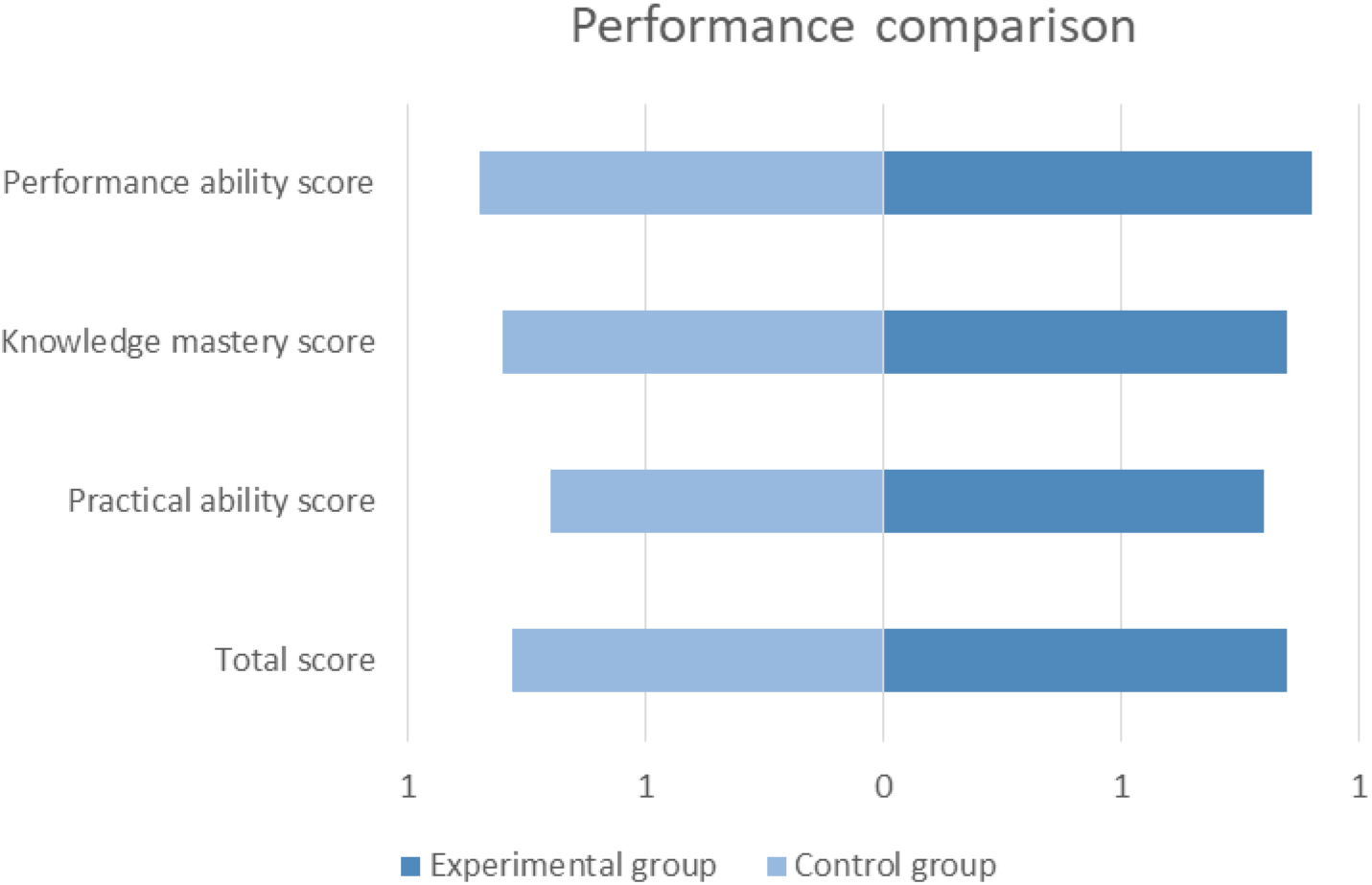
Learning English and American culture in traditional classrooms is often taught by teachers in class, but students are completely unable to understand and perceive the content of the class. Teachers do not explain knowledge from the students’ perspective, but impart content with their own understanding of knowledge, resulting in students’ inability to understand, and such a learning process will gradually sap students’ interest in English and American literature. In contrast, in the flipped classroom, English and American literature learning is divided into three stages, the pre-class stage, the in-class stage, and the post-class stage. Through the teaching mode of pre-learning before class, deepening during class and consolidating after class, students can understand English and American literature, perceive the philosophies taught in English and American literature, the current social situation, the differences between different civilizations, and understand the diversity of cultures, thus enhancing students’ interest in English and American literature and improving the efficiency of English and American literature classroom. The specific implementation steps of the flipped classroom are as follows.
Through the above research process, we can conclude that the experimental group of British and American literature practice ability, knowledge, performance ability are better than the control group. In the course of the experiment, we interviewed some students, asked them about the opinions of the flipped classroom, and our team put forward some suggestions before, during and after class through some imperfections in the experimental process.
Pre-class stage
The key to learning English and American literature lies in students’ understanding of the philosophies and social phenomena embedded in English and American literature, cultivating students’ sense of identification with different cultures and understanding the differences of different cultures, so pre-course pre-study is particularly important. However, due to the poor self-awareness of students, the pre-class implementation stage of the flipped classroom is not effective, and many students are only perfunctory to the teacher, which does not have the expected effect. Therefore, in order to better implement the flipped classroom, it is necessary to solve the problems of students in the pre-study stage. The traditional way of pre-study is limited to students’ independent reading and thinking about the textbook content. However, this approach is too boring for many students to accept. Although this provides a simple understanding of the book’s knowledge um, different students have different levels of understanding of the book. To solve this problem, teachers can organize some interesting ways of pre-study in the pre-class stage. For example, watching videos, group discussions, let students bring learning to get fun, so as to enhance students’ students’ interest in learning English and American literature, encourage communication among students, different students may have different opinions, let them communicate with each other, can deepen the depth of students’ understanding of knowledge, also make the learning much more interesting [10].
Classroom stage
The flipped classroom model puts students’ learning knowledge in the pre-class, while the classroom is mainly responsible for answering students’ questions and generalizing the knowledge. Since the task of learning knowledge is completed before class, which greatly reduces the teacher’s teaching burden, teachers should focus on individualized teaching for students during the class. Teachers should make full use of class time to answer students’ questions and solve their problems, discover the differences of different students, provide individualized teaching solutions, and improve the efficiency of the classroom. Teachers should organize a variety of classroom activities, such as group presentations, to deepen students’ understanding of knowledge and promote the process of knowledge formation to internalization. Learning English and American literature is more about students’ understanding and gradually internalizing their knowledge and understanding the differences between Eastern and Western cultures, so the focus in the classroom should be on allowing students’ self-presentation process, and teachers should actively ask questions in the classroom to give students the opportunity to show themselves and express their understanding of English and American literature. At the same time, the teacher should summarize the content of the lesson. If there are students who have not studied before the lesson, they may not be able to follow the teacher’s progress. Students who have not studied can do a quick pre-reading based on the teacher’s key points, while those who have studied can review again based on these contents to realize the consolidation of knowledge. In the classroom, teachers need to find students’ questions in time and answer common questions in a unified manner and answer individual questions in private, in an effort to improve classroom efficiency and facilitate the process of internalizing students’ knowledge. In the pre-course pre-study stage, teachers should play their organizing role to enhance the effect of students’ pre-study through interesting pre-study methods. At the same time, teachers should also pay attention to students’ pre-study status and make timely adjustments [11, 12].
Post-class phase
At the end of the flipped classroom, the classroom should also summarize the lesson, recognize the strengths and weaknesses of the lesson implementation based on the feedback from the students, and clarify the room for improvement of the lesson. At the same time, teachers should also reflect on the flipped classroom model, comprehensively assess its strengths and weaknesses, and ensure that this model can be applied to its full value. Teachers can assess students’ learning in a variety of ways, including paper exams, group presentations, and individual presentations, to comprehensively assess students’ practical skills, presentation skills, and knowledge mastery. Based on the results of the assessment, further adjustments are made to the teaching program and teaching methods to finally get a way that can maximize the learning effect of students. In order to further consolidate students’ learning results, teachers can recommend some movies, books and cartoons related to this course to students at the end of the course, so that students can cultivate their interest and achieve the purpose of consolidating their knowledge at the same time.
Conclusion
The flipped classroom was born in Europe and the United States, and has achieved great success since its introduction to China. The nature of the subject of English and American literature tends to make students understand it automatically. In China, due to the lack of systematic teaching programs, the flipped classroom is not effective in teaching English literature, and the development of big data and Internet of Things brings new opportunities to the development of the flipped classroom of English and American literature. Based on big data and IoT technology, a smart classroom model is constructed according to the four-layer architecture of IoT, which is divided into perception layer, network layer, platform layer and application layer, and the flipped classroom is in the application layer. The flipped classroom is designed according to three processes before, during and after the class, which has certain theoretical significance. In order to verify the validity of this model, a university in H city was selected for the study, and through a controlled experiment, it was concluded that within a certain error range, the flipped classroom teaching model can significantly improve the teaching effect of English and American literature compared with the traditional teaching model. The process is as follows: We first compared the total scores of the control group and the experimental group in English and American literature, and the total mean score of the experimental group was 8.6 and the mean score of the control group was 6.9, which can be seen that the experimental group was significantly higher than the control group. From this, it can be concluded that the application of flipped classroom is better than traditional teaching within a certain margin of error. Again, by comparing the specific items, it can be found that the experimental data of the experimental group and the control group have significant differences. From this, it can be concluded that the intelligent classroom constructed by this experiment with the flipped classroom as the core can improve the learning effect of English and American literature EFL.
Finally, based on the problems arising from the implementation of the flipped classroom, this paper puts forward suggestions to address them, starting from before, during and after the class, in which the teacher organizes students’ pre-study through various forms before the class. In the middle of the class, teachers lead students to answer questions and solve problems, discover students’ individual problems, and develop individual teaching plans. At the end of the lesson, review is conducted through a fun approach. To sum up, this paper is innovative and practical, and solves the teaching challenges of English and American literature. Moreover, this paper is innovative in terms of reforming the implementation model of flipped classroom from a technological perspective.
Footnotes
Funding
This research was supported by 2021 Shandong Provincial Undergraduate Teaching Reform Research Project (M2021316), Research on the Application of Exploration and Practice of the Cultivation of "Innovative Talents" in Foreign Languages under the Background of New Liberal Arts.